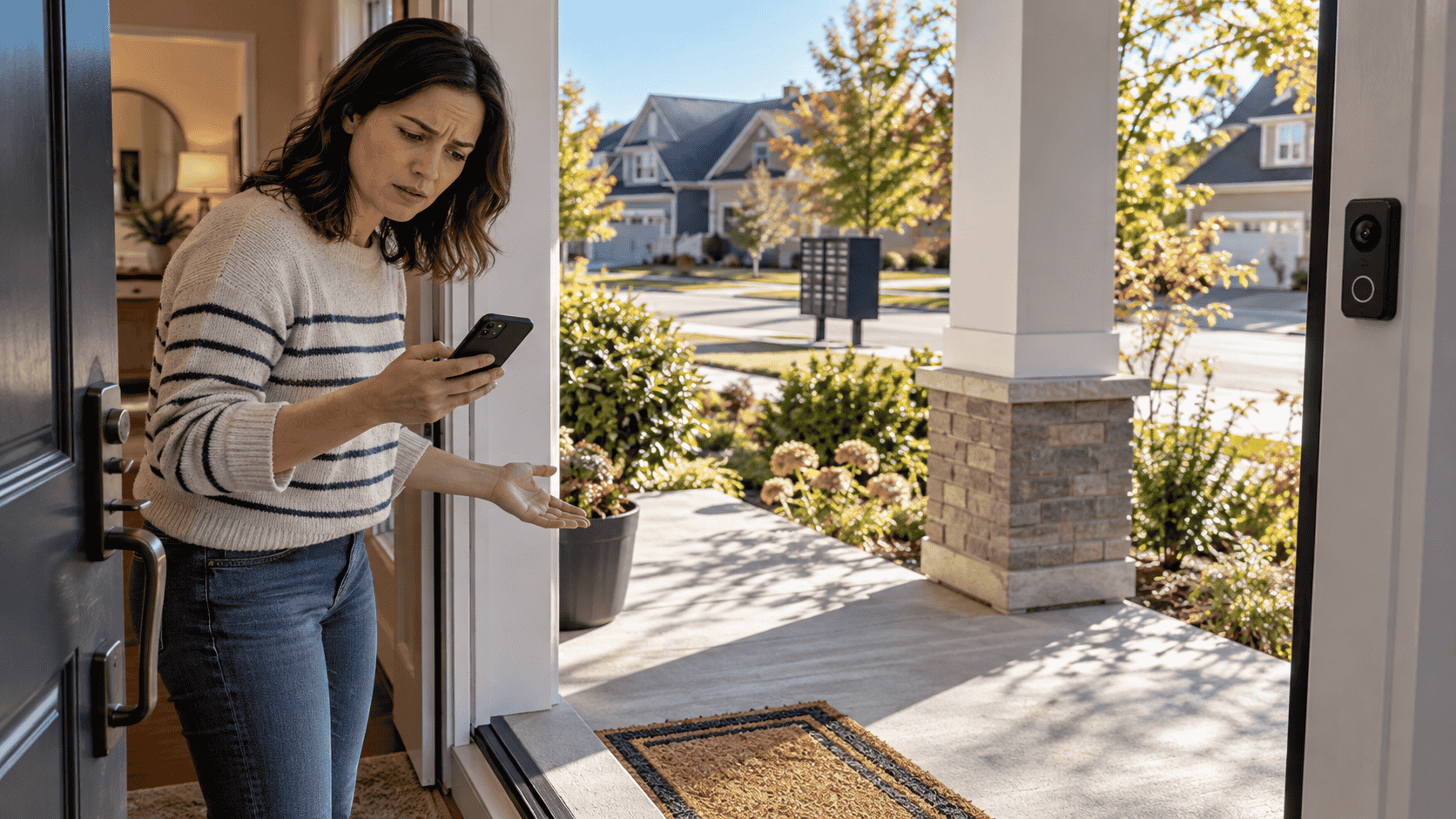
Your phone buzzes: “Delivered.” You open the front door, look at the porch—and there is nothing there. Before assuming your package was stolen, there is a much better order of operations that can help you find it, create the right evidence and know whether the carrier, seller or payment company should be your next call.
First: Do Not Immediately Assume It Was Stolen
Porch theft happens.
But a missing package can also be:
behind another door;
inside a parcel locker;
with a neighbor;
at an apartment office;
in the garage;
behind a planter;
at the wrong unit;
or simply somewhere the driver considered safer than the obvious front doorstep.
USPS specifically tells customers whose tracking shows “Delivered” to check locations including the garage, mailbox, porch, weather-protected areas, back entrances, household members and building management.
UPS gives similar advice, noting that drivers may leave packages out of plain sight and recommending that customers check exterior doors, porches, patios, garages and with neighbors.
So before you start a claim, spend five minutes searching.
Those five minutes may solve the entire problem.
Start With the Carrier’s Own Tracking Page
Do not rely only on the retailer's “Delivered” notification.
Open the carrier's official tracking page and enter the tracking number directly.
Look for:
the exact delivery time;
delivery location;
delivery photo;
signature information;
locker or pickup details;
and any notes attached to the delivery.
FedEx, for example, provides picture proof of delivery for eligible shipments, which can help you determine where a package was left.
A photograph can immediately reveal a problem.
Maybe that is your porch.
Maybe it is your neighbor's porch.
Maybe it is a building you have never seen before.
That information changes what you do next.
Check Every Door—Not Just the Front One
Drivers often try to leave packages where they are less visible from the street.
Check:
the front porch;
side door;
back door;
garage;
behind outdoor furniture;
behind planters;
under covered areas;
near gates;
and around other sheltered locations.
If you live in an apartment or condominium, check the mailroom, parcel room, locker system, reception desk and management office.
With USPS community mailboxes, a key inside your normal mailbox may mean the parcel is waiting in a separate parcel locker.
The package may be much closer than the tracking page makes it seem.
Ask the People Around You
This sounds obvious.
It is also surprisingly easy to skip when you are already frustrated.
Ask:
your spouse or partner;
children;
roommates;
neighbors;
front-desk staff;
building security;
reception;
or anyone else who could have accepted the delivery.
Someone may have moved the box inside and forgotten to mention it.
A neighbor may have taken it temporarily to keep it from sitting outside.
Or the driver may simply have delivered it one house away.
Compare the Delivery Photo With Your Home
If a delivery photo exists, do not just glance at the package.
Study the background.
Look at:
the door color;
doormat;
steps;
siding;
brick;
house numbers;
railing;
flooring;
plants;
mailbox;
and neighboring structures.
These small details can help determine whether the photo actually shows your property.
If it clearly shows another house, save the image.
Take a screenshot of the tracking status too.
Evidence becomes much more useful when you can show exactly what happened instead of simply saying:
“My package never arrived.”
Do Not Post the Delivery Photo Everywhere Yet
If the image shows somebody else's property, it can be tempting to post it immediately on neighborhood groups or social media.
A quieter approach may work faster.
Check nearby houses first if it is safe and obvious where the photo was taken.
If you cannot identify the location, contact the carrier and retailer.
Do not trespass onto private property or confront strangers over a package.
A misdelivery should remain a customer-service problem, not become a neighborhood confrontation.
USPS Says Give a “Delivered” Scan One Postal Business Day Before Escalating
USPS has particularly useful guidance for this situation.
If tracking shows “Delivered” but you still cannot locate the package, USPS says that once more than one postal business day has passed since the delivered scan, customers with eligible items can submit a service request to their local Post Office.
That is different from the longer Missing Mail process.
USPS says a formal Missing Mail search can generally be submitted starting seven days after the original mailing date.
So there are really two stages:
a local delivery investigation;
then, if necessary, a broader missing-mail search.
UPS Has Its Own Process
UPS says that when a package shows delivered but cannot be found, customers should first check hidden delivery locations and with people such as neighbors.
If it remains missing, UPS encourages customers to open a loss investigation within 30 days of the expected delivery date.
That deadline is worth remembering.
Do not leave a missing-package problem sitting unresolved for weeks because you assume it will eventually appear.
FedEx Lets You Report a Missing Package From Tracking
FedEx provides a direct missing-package process.
On eligible shipments, customers can enter the tracking number, choose Manage Delivery, select Report Missing Package and submit their contact information.
FedEx then assigns a case number for the report.
That case number matters.
Save it.
If you need to contact the seller later, you can show that you already opened an investigation with the carrier.
Contact the Seller Too
Remember who you actually paid.
Usually, it was not the delivery driver.
It was the retailer, marketplace or seller.
If the carrier cannot quickly locate the package, contact the seller and explain that tracking shows delivery but the order was not received.
Provide:
the order number;
tracking number;
delivery date;
carrier case number if available;
and any delivery photo showing the wrong location.
Retailer policies differ.
Some may replace the item.
Some may refund it.
Some may ask you to complete a carrier investigation first.
Some may require additional documentation for expensive products.
The important thing is to create a clear record early.
Do Not Delete Emails, Tracking Screens or Camera Footage
If the package remains missing, preserve evidence while it is still available.
Save:
the order confirmation;
shipping confirmation;
carrier tracking;
delivery photo;
customer-service conversations;
carrier case number;
and relevant doorbell-camera or security footage.
Security cameras often overwrite old footage automatically.
If the delivery time is known, save the relevant clip immediately.
Even footage showing that nobody approached your door around the claimed delivery time can be useful.
What If the Package Was Clearly Stolen?
If you can see on camera that the package was delivered and later taken, the problem is different.
You now have evidence of theft rather than a mysterious non-delivery.
Keep the video.
Notify the seller and carrier.
For a valuable item, you may also want to file a police report with the appropriate local agency.
A police report does not guarantee reimbursement, but a retailer, insurer or payment provider may sometimes request documentation when reviewing a high-value loss.
Do not physically confront someone you believe stole a package.
The object can be replaced.
A dangerous confrontation is not worth it.
What If the Seller Says, “Tracking Shows Delivered, So There’s Nothing We Can Do”?
This is where documentation matters.
Send the seller the evidence.
If the delivery photo shows the wrong property, say so.
If the carrier opened a missing-package investigation, provide the case number.
If the package was supposedly signed for, check the signature or recipient information.
If the shipment was marked delivered but never actually reached you, keep escalating through the retailer's formal support or dispute process.
Do not simply repeat:
“I never got it.”
Show why the delivery record may not prove that you received it.
Your Credit Card Can Be a Last Resort
If you paid by credit card and never received what you purchased, federal billing protections may become relevant.
The Federal Trade Commission says that if an order never arrives and the charge appears on your credit-card statement, you can dispute the charge as a billing error.
To preserve federal rights, the FTC advises sending the dispute within 60 days after the first statement containing the error was sent to you.
That does not mean you should immediately file a chargeback every time a package is one day late.
First give the seller and carrier a reasonable opportunity to investigate.
But do not let important dispute deadlines pass while customer-service conversations continue indefinitely.
Debit Cards Are Different
Do not assume debit-card purchases have exactly the same protections as credit-card purchases.
The FTC specifically notes that debit-card protections differ and advises consumers to contact their debit-card issuer or bank about available protections.
That is another reason payment method matters for expensive online purchases.
A credit card can provide an additional dispute mechanism when something goes badly wrong.
What If the Package Was Never Actually Shipped?
This is a different problem from a misdelivery.
Federal rules require most online sellers to ship orders within the promised timeframe.
If no shipping time was stated, the FTC says sellers generally must ship within 30 days.
When a seller cannot ship on time, it generally must tell the buyer about the delay and provide the option to accept the delay or cancel for a refund.
So “your package is coming soon” cannot remain an indefinite answer.
There is a difference between:
a package lost after shipment;
and a seller that never ships the product.
Be Extremely Careful With “Delivery Problem” Text Messages
Now comes another problem created by all this package anxiety.
Scammers know Americans are constantly waiting for deliveries.
The FTC said in 2026 that fake package-delivery notices remain a common type of scam text.
The message may say:
your address is incomplete;
your package cannot be delivered;
you owe a tiny redelivery fee;
or you need to confirm delivery details.
Then it provides a link.
Do not use that link.
Instead, open the retailer's app or type the carrier's official website yourself and check the real tracking number.
The FTC specifically recommends independently verifying delivery information rather than clicking links in unexpected package texts.
A Fake USPS Message Has an Especially Useful Red Flag
The U.S. Postal Inspection Service warns that if you receive an unsolicited USPS-style text containing an unfamiliar link and you did not initiate tracking for that package, do not click it.
USPS says its tracking texts are initiated by the customer and do not contain web links.
That is an excellent rule to remember when you are already stressed about a missing delivery.
Scammers want urgency.
You want verification.
Do Not Pay a Tiny “Redelivery Fee” Without Checking
A request for $0.30, $1 or another tiny amount may feel harmless.
The money may not be the real target.
Your card number may be.
A fake carrier site can collect:
your name;
address;
phone number;
credit-card number;
expiration date;
security code;
and other information.
The FTC warns that delivery scam links can lead to look-alike carrier websites designed to collect financial or personal information.
A tiny payment can expose a much larger financial account.
How to Make This Less Likely Next Time
No system eliminates package problems entirely.
But you can reduce the risk.
USPS offers Informed Delivery, which can provide information about expected mail and packages.
UPS My Choice can provide delivery-management options, including holding packages, redirecting certain deliveries or requesting delivery to a neighbor in eligible situations.
FedEx Delivery Manager can also allow eligible packages to be held at secure locations or redirected rather than left unattended.
For valuable purchases, consider:
signature-required delivery;
carrier pickup locations;
parcel lockers;
secure package rooms;
or delivery for a day when someone will be home.
Convenience matters.
But so does controlling where an expensive package ends its journey.
A Doorbell Camera Helps—but It Does Not Prevent Every Problem
A camera can show whether:
the driver arrived;
where the box was placed;
someone removed it;
or nothing was delivered at all.
That can be extremely useful evidence.
But a camera is mostly a documentation device.
It does not physically secure the package.
If theft is common where you live, a locker, pickup location or secure delivery area may provide more direct protection.
Expensive Deliveries Deserve a Different Strategy
Leaving a $20 household item on the porch is one thing.
Leaving a laptop, smartphone, jewelry purchase or other high-value item unattended all afternoon is another.
For expensive shipments, check delivery options before the package reaches the final truck.
If available, consider:
holding it at the carrier;
requiring a signature;
using a secure locker;
or redirecting it to a staffed location.
The best missing-package claim is the one you never have to file.
The Fastest Order of Operations
When tracking suddenly says delivered and the package is missing, do not spend the first hour jumping between customer-service chats.
Use a simple sequence.
Check the carrier's official tracking information.
Look at any delivery photo.
Search every likely delivery location.
Ask household members, neighbors or building staff.
Preserve screenshots and camera footage.
Then follow the carrier's missing-package process.
If it remains unresolved, contact the seller with the evidence.
And if a paid order ultimately never arrives and the seller will not resolve it, investigate the dispute protections provided by your payment method.
The sequence matters because each step gives you more information for the next one.
The Word “Delivered” Is a Scan, Not the End of the Investigation
Seeing that word can feel strangely final.
The system says the delivery happened.
You are standing at the door saying it did not.
But a tracking status is still evidence that can be investigated.
The box may be hidden.
It may be with a neighbor.
It may have gone to the wrong address.
The delivery record may include a photo that solves the mystery.
Or the package may genuinely have been stolen.
The important thing is not to panic and not to wait indefinitely.
Check.
Document.
Report.
Escalate.
And if an unexpected text appears while you are trying to solve the problem, do not let frustration push you into clicking a fake delivery link.
The package is already enough of a headache.
You do not need identity theft added to the order.
package says delivered but not received, package delivered but not received, package says delivered but not here, missing package, USPS package says delivered, UPS package missing, FedEx package not received, stolen package, package delivered to wrong address, package not received refund, missing delivery, porch theft, online order not received
Free VPNs Are Booming Again. What Are You Really Paying With?
Why Home Insurance Costs Are Rising So Fast
How Personal Loan APR Really Works
Your Car Insurance Renewal Went Up Even Without an Accident
Lifestyle
Money
Homeowner checking a delivery notification on a smartphone while looking at an empty front porch where a package was supposedly delivered.
Package Says Delivered but Is Missing
Your Package Says “Delivered”—But It Isn’t There. What Now?
Tracking says delivered but there’s no box outside. Here’s what to check first, when to contact USPS, UPS or FedEx, and when to involve the seller.
Your Package Says “Delivered.” Your Porch Says Otherwise.
Your phone says the package was delivered.
Your porch is empty.
Before assuming someone stole it, check one thing first: the carrier's actual delivery record.
A photo, hidden drop-off location, neighbor—or one wrong porch—can completely change what you should do next.
And if you get a text asking for a “redelivery fee” while you are searching, do not click it.
Reader Question
What is the strangest place a delivery driver has ever left one of your packages?
Research Notes
USPS says customers whose package is marked delivered should check locations such as the garage, porch, mailbox, weather-protected areas, household members and building management. If an eligible package remains missing for more than one postal business day after the delivered scan, customers can submit a service request to their local Post Office.
USPS says its Missing Mail search process generally becomes available seven days after the original mailing date, with different claim and service rules depending on the mail class and insurance.
UPS advises customers to check hidden exterior locations and neighbors when tracking shows delivery but the package cannot be found. UPS says customers can open a loss investigation and encourages doing so within 30 days of the expected delivery date.
FedEx allows customers with eligible shipments to use tracking tools and picture proof of delivery and to report a missing package through its Manage Delivery process.
The FTC says consumers who never receive an online order may have credit-card billing-dispute rights. To preserve federal rights, disputes generally need to be raised within 60 days after the first statement containing the error was sent. Debit-card protections differ.
The FTC and U.S. Postal Inspection Service warn about fake package-delivery texts designed to send consumers to fraudulent websites. Consumers should independently open the official retailer or carrier website instead of clicking unexpected delivery links.
Consumer Note
Carrier procedures, retailer replacement policies and payment-card dispute rules can vary by shipment, seller and payment method. Check the current official carrier, retailer and card-issuer requirements for your specific order.
package delivered but not received, package says delivered but not here, missing package, USPS package says delivered, UPS package not received, FedEx package missing, delivered package missing, stolen package, package not received refund, delivery photo wrong
Online Shopping, Package Delivery, USPS, UPS, FedEx, Consumer Tips, Missing Packages, Shopping, Scams, Everyday Problems
Your Package Says “Delivered”—But It Isn’t There. What Should You Do Next?