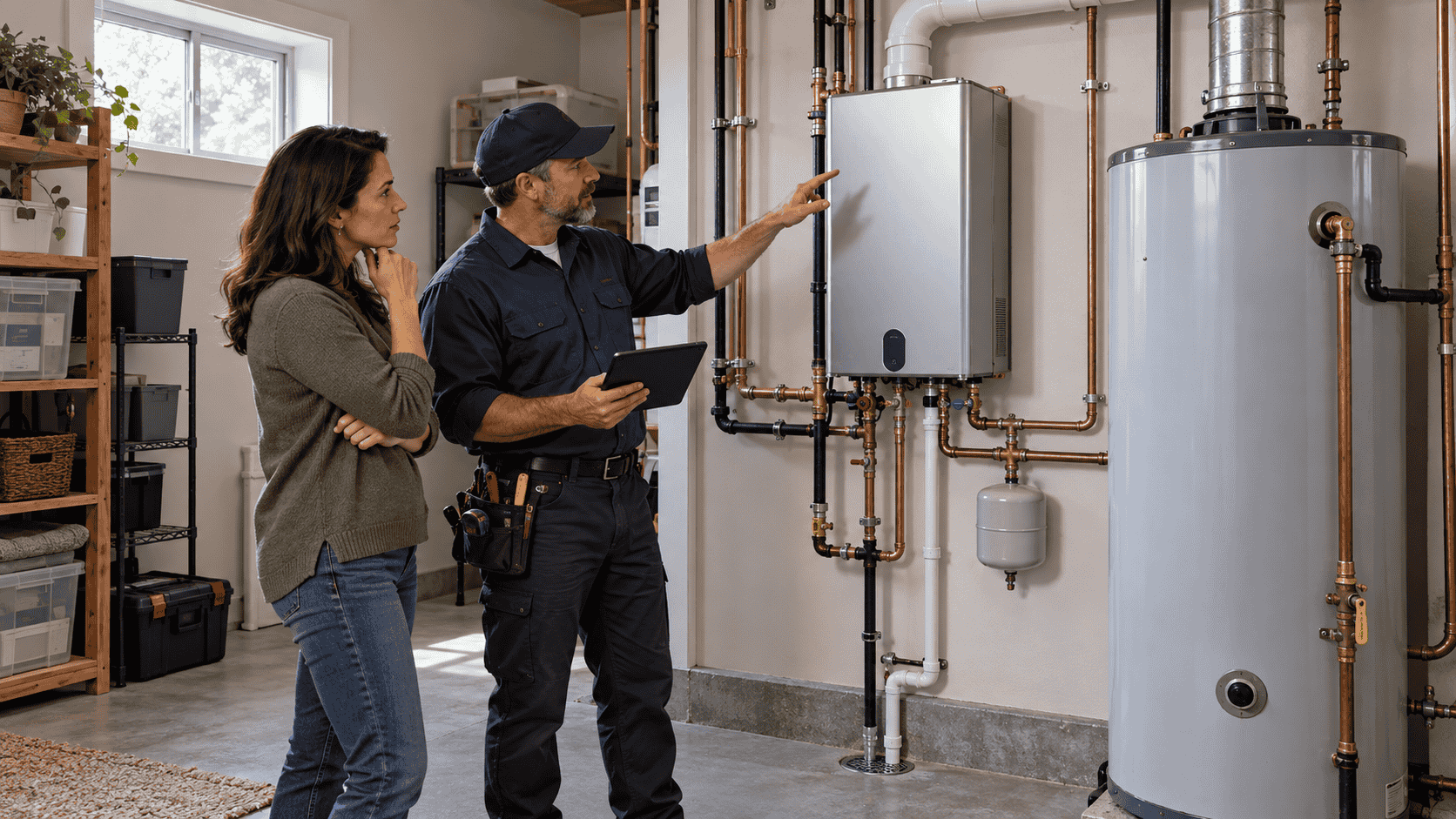
A tankless water heater sounds almost impossible to dislike: no giant tank, no keeping 40 or 50 gallons hot all day, more space in the utility room and a shower that supposedly never turns cold. But before replacing a perfectly ordinary storage heater, homeowners need to understand two things—the words “endless” and “efficient” do not necessarily mean “unlimited” and “cheaper.”
What a Tankless Water Heater Actually Does
A conventional storage water heater heats a reservoir of water and keeps it hot until somebody needs it.
A tankless water heater takes a different approach.
When you open a hot-water faucet, a flow sensor detects the demand. In a gas model, the burner activates and heats a heat exchanger. Cold water passes through that heat exchanger and leaves the unit at the selected temperature.
When you close the tap, heating stops.
The important advantage is obvious: the appliance does not spend all day maintaining a large tank of hot water.
ENERGY STAR says whole-home gas tankless units reduce standby energy losses by heating water only when it is required.
That is the basic efficiency argument.
But it is only the beginning of the decision.
“Endless Hot Water” Is Real—With an Asterisk
A properly sized tankless heater can continue producing hot water for a long shower because there is no fixed tank waiting to be emptied.
That is where the “endless hot water” claim comes from.
But the heater still has a maximum rate at which it can warm water.
Tankless capacity is measured in gallons per minute, or GPM, at a specified temperature rise.
If your household demands more hot water at one moment than the heater can produce, the lack of a tank does not magically create additional capacity.
ENERGY STAR's current requirements for certified gas-fired instantaneous water heaters include a maximum flow of at least 2.8 GPM over a 67°F temperature rise. Actual models can provide substantially more, but capacity varies.
So the more accurate promise is:
continuous hot water within the heater's rated capacity.
Two Showers Can Change Everything
Imagine someone taking a shower.
Then another shower starts.
The dishwasher is running.
Someone turns on a hot-water faucet.
A tankless heater now has to serve all of those demands at the same time.
If their combined flow exceeds the heater's capacity at the required temperature rise, something has to give.
Depending on the equipment and installation, flow may be limited or the delivered water may not stay as hot as expected.
This is why sizing a tankless unit requires more than knowing how many bathrooms a house has.
You need to consider how much hot water the household may use simultaneously.
Cold Groundwater Makes the Job Harder
The water entering your house is not always the same temperature.
A tankless heater in a warm climate may receive relatively warm incoming water.
The same model in a cold northern winter may receive much colder water.
Suppose you want 120°F water.
Heating incoming water from 70°F to 120°F requires a 50°F rise.
Heating 40°F water to 120°F requires an 80°F rise.
That larger temperature increase requires more heating power.
This is why a tankless heater's impressive headline GPM number should never be considered without looking at the temperature rise used to produce it.
ENERGY STAR defines GPM for instantaneous heaters in relation to a specified temperature rise for exactly this reason.
Tankless Does Not Mean Instant Hot Water
This may be the biggest surprise for homeowners.
A tankless heater can heat water on demand.
It cannot teleport that hot water through your pipes.
If your bathroom is 60 feet from the water heater, the cooled water already sitting in that plumbing still has to leave the faucet before newly heated water arrives.
The wait may therefore feel similar to a conventional water heater.
In some circumstances, a tankless unit can even add a few seconds while the heater detects flow and begins operation.
The distance between the heater and the faucet still matters.
That Morning Wait Is Mostly a Plumbing Problem
Think about what happens overnight.
Nobody uses hot water for hours.
The water sitting in the hot-water pipes cools toward room temperature.
In the morning, you open the shower.
That cooled water has to leave first.
Changing the heater does not remove the water sitting between the heater and the shower.
If reducing that wait is the goal, a demand-controlled hot-water recirculation system may help in appropriate homes.
ENERGY STAR says demand recirculating systems can return cooled water in the hot-water line to the heater rather than sending it down the drain while the homeowner waits.
But Do Not Run a Recirculation Pump Continuously Just for Convenience
There is a tradeoff.
Keeping hot water circulating through the house at all times can lose energy through the plumbing and consume electricity to run the pump.
ENERGY STAR warns that continuously operating recirculation systems can use more energy because of pumping and heat loss from the pipes.
Demand-controlled circulation is different.
It operates when hot water is actually wanted and then shuts down.
That distinction becomes especially important when the original reason for buying tankless was to reduce standby energy use.
So How Much Energy Can Tankless Actually Save?
Tankless heaters eliminate much of the standby loss associated with maintaining a large reservoir of hot water.
That can reduce fuel consumption.
ENERGY STAR currently estimates that an ENERGY STAR certified gas tankless water heater can save a family of four about $95 per year in gas costs compared with a standard gas storage water heater, or about $1,800 over the unit's expected life. Actual household savings will vary.
That sounds attractive.
But notice the size of the number.
If converting your house to tankless costs several thousand dollars more than installing another storage heater, $95 per year alone does not create a fast payback.
The installation cost matters enormously.
This Is Why “More Efficient” Does Not Automatically Mean “Cheaper”
Suppose replacing a conventional gas storage heater costs one amount.
Converting the same house to a high-efficiency tankless system costs $3,000 more.
If the new system saves around $100 per year in fuel, simple energy payback on that extra investment is roughly 30 years.
That does not mean tankless is a bad purchase.
The homeowner may value:
longer service life;
continuous hot water;
smaller physical size;
lower risk of a large tank rupture;
or additional usable space.
But those are benefits beyond the monthly utility bill.
The mistake is assuming efficiency alone always repays a large conversion premium quickly.
Replacement Is Much Easier When the House Is Already Designed for Tankless
Tankless economics can look very different in new construction.
If the house is being designed from the beginning for a tankless heater, the gas line, venting, electrical supply, condensate drain and mounting location can all be planned around it.
Retrofitting an existing house may require changes.
ENERGY STAR specifically advises homeowners to plan ahead because installing a gas tankless heater can take longer than installing a conventional storage model.
The appliance price is therefore only part of the project.
Your Existing Gas Line May Not Be Enough
Whole-house gas tankless water heaters can have large burner inputs because they need to produce significant heat immediately.
A conventional storage heater has time to heat water gradually.
Tankless does not.
That means some homes require gas-piping modifications to provide adequate fuel flow.
Whether this is necessary depends on the appliance, existing pipe size, pipe length, gas pressure and other appliances sharing the system.
This should be calculated—not guessed.
A wall-mounted heater that looks small can place a substantial instantaneous demand on the gas supply.
Venting Can Change Too
A modern high-efficiency condensing tankless gas heater does not necessarily use the same vent system as the old tank heater it replaces.
ENERGY STAR explains that certified condensing gas tankless heaters use a secondary heat exchanger to capture additional heat from combustion gases. These systems require appropriate venting and condensate drainage.
That can be excellent for efficiency.
It can also add complexity to a retrofit.
Before comparing prices, make sure every quote includes the complete installation—not simply the box hanging on the wall.
The Unit Still Needs Electricity
A gas tankless water heater burns gas for heat, but modern models generally rely on electricity for controls, ignition, sensors and fans.
That means a power outage can leave you without hot water even if natural gas service is still available.
This can surprise homeowners replacing an older storage gas heater with a standing pilot or another design that was less dependent on household electricity.
If outage resilience matters where you live, discuss it before buying.
Tankless Can Free a Surprising Amount of Space
This benefit is easy to underestimate.
A conventional storage heater occupies floor space.
A tankless unit is typically wall-mounted.
ENERGY STAR specifically highlights the space savings from eliminating the bulky storage tank.
In a large basement, that may not matter.
In a condominium, small utility closet or compact home, it can matter a lot.
Sometimes the value of tankless is measured in square feet rather than therms.
Tankless Units Can Last Longer
DOE's recent analysis of gas-fired instantaneous water heaters uses an average life of about 20 years, compared with roughly 14 to 15 years for gas storage water heaters.
That longer expected service life can change the economics.
A higher purchase price becomes easier to justify if the equipment lasts significantly longer.
But lifespan is not guaranteed.
Water quality, maintenance, installation quality and usage all matter.
The phrase “20-year water heater” should therefore be treated as an expected average in DOE's analysis, not a promise printed on every homeowner's calendar.
Hard Water Can Become the Hidden Maintenance Cost
Tankless systems pass water through relatively narrow heat-exchanger passages.
Mineral scale can accumulate on those surfaces, especially where water is hard.
DOE building-science guidance identifies scaling and inlet-strainer clogging as maintenance risks for tankless systems.
That means tankless is not a maintenance-free technology.
Depending on local water chemistry and manufacturer instructions, periodic flushing or descaling may be required.
If you live in a hard-water area, ask about maintenance before installation.
Do not wait until performance drops.
Skipping Maintenance Can Undermine the Reason You Bought It
Scale acts like insulation where you do not want insulation.
It can interfere with heat transfer and restrict water passages.
That may reduce performance and place additional stress on the equipment.
A homeowner comparing operating costs should therefore consider maintenance costs alongside fuel savings.
An efficient machine that receives no maintenance may not remain efficient indefinitely.
Electric Tankless Is a Different Conversation
The phrase “tankless water heater” covers more than one technology.
Whole-home electric tankless systems use powerful electric resistance elements to heat water almost instantly.
That can require very large electrical capacity.
The challenge is simple physics.
Heating several gallons of cold water every minute by dozens of degrees requires enormous instantaneous power.
A home that can easily support an electric storage tank may not automatically have enough electrical-service capacity for a large whole-home electric tankless heater.
Before buying one, confirm the required amperage, panel capacity and wiring upgrades.
Do Not Compare Electric Tankless With a Heat-Pump Water Heater as Though They Work the Same Way
They do not.
An electric tankless heater generally creates heat through electric resistance.
A heat-pump water heater moves heat from surrounding air into stored water.
That fundamental difference can make heat-pump water heaters dramatically more efficient in suitable installations.
So if your existing heater is electric and your main goal is to reduce electricity consumption, compare more than:
tank versus tankless.
Also compare:
electric resistance storage;
electric tankless;
and heat-pump water heating.
The most visually futuristic option is not automatically the least expensive to operate.
A Gas Tankless Heater Is Not Automatically the Greenest or Cheapest Choice Either
Energy economics vary by location.
Natural-gas rates vary.
Electricity rates vary.
Climate matters.
The equipment already installed in the house matters.
So does the cost of changing fuel sources.
A house that already has suitable gas infrastructure may face a very different decision from an all-electric house requiring a new gas service.
Start with your house rather than a generic ranking of technologies.
There Is Another 2026 Detail Homeowners Need to Know
Many water-heater articles still mention the U.S. federal Energy Efficient Home Improvement Credit as if it is currently available.
That information can now be outdated.
The IRS states that the Energy Efficient Home Improvement Credit cannot be claimed for qualifying property placed in service after December 31, 2025.
So a homeowner installing a tankless water heater in 2026 should not include the old federal credit when calculating payback.
State, local and utility rebates may still exist.
Verify them separately before signing a contract.
Do Not Let an Old Online Calculator Make the Decision for You
This matters because home-improvement content can remain online for years.
A calculator written in 2024 may still subtract a federal credit.
A contractor article may still describe incentives that expired.
A rebate may require specific efficiency ratings.
Another may be limited by utility territory.
When evaluating a 2026 project, confirm every incentive using a current official source.
The water heater may last 20 years.
The webpage you found through search may not have been updated for two.
ENERGY STAR Gives You a Useful Efficiency Benchmark
For current ENERGY STAR certification, a gas-fired instantaneous residential water heater must have a Uniform Energy Factor of at least 0.95.
It must also meet hot-water delivery, warranty and safety requirements, including a maximum flow rating of at least 2.8 GPM over a 67°F rise.
UEF is useful for comparing water-heater efficiency.
Higher is better.
But UEF alone does not tell you:
whether the unit is correctly sized;
whether your gas line needs replacement;
whether venting must change;
or whether installation costs make financial sense.
The sticker evaluates the equipment.
Your contractor still has to evaluate the house.
The Cheapest Tankless Quote May Leave Out the Expensive Parts
When comparing bids, ask whether the quoted price includes:
gas-line modifications;
venting;
condensate drainage;
electrical work;
water-line modifications;
permits;
isolation valves;
removal of the old heater;
commissioning;
and any required water-treatment measures.
A low equipment price can become a very different project once the existing house is inspected.
Get the complete installed price.
Not the appliance price.
Ask About Service Before You Buy
Tankless heaters contain sensors, controls, fans, valves and heat exchangers.
That means service expertise matters.
Before choosing a model, ask:
Who services this brand locally?
Are parts readily available?
How long is the heat-exchanger warranty?
How long are parts covered?
What maintenance does the manufacturer require?
What happens to warranty coverage if maintenance is ignored?
A sophisticated water heater that nobody nearby can repair is less attractive at 7 a.m. on a Monday when nobody can shower.
What Kind of Household Benefits Most?
Tankless becomes particularly interesting when several advantages line up.
The household regularly empties a storage tank.
Space is valuable.
The existing heater already uses gas.
The installation can be completed without extreme retrofit costs.
The household plans to remain in the property for many years.
The owner is willing to maintain the system.
And the unit can be sized to handle realistic simultaneous demand.
In that situation, tankless can offer both convenience and efficiency.
When Might a Storage Heater Still Be the Smarter Choice?
A conventional tank may remain attractive when upfront budget matters most.
It may also make sense when installation simplicity is valuable, hot-water demand is moderate and the existing infrastructure already matches a storage heater.
Modern storage heaters are not automatically inefficient relics.
High-efficiency storage options exist.
And for electric homes, heat-pump water heaters add another highly efficient storage-based option.
Tankless is a technology choice.
Not a universal upgrade.
The Most Important Number May Be GPM, Not Gallons
Storage heaters are usually discussed in gallons.
Forty gallons.
Fifty gallons.
Seventy-five gallons.
Tankless changes the language.
Now you care about gallons per minute.
Estimate the fixtures that may operate simultaneously.
A shower.
Another shower.
A faucet.
An appliance.
Then determine the temperature rise the heater must produce during the coldest incoming-water conditions your home is likely to experience.
ENERGY STAR specifically tells tankless buyers to estimate required capacity using GPM rather than storage volume.
That calculation is the difference between buying an endless-hot-water system and discovering its limits during the first busy morning.
Do Not Oversize Without Thinking Either
Buying far more capacity than the house needs can increase equipment cost unnecessarily.
Correct sizing is better than reflexively buying the biggest model.
The goal is enough capacity to serve realistic peak demand under difficult incoming-water conditions.
Not bragging rights.
A professional installer should be able to explain the sizing calculation rather than simply recommending the largest unit in the catalog.
What About the Fear of a Tank Flooding the House?
This is one of tankless water heating's appealing practical advantages.
There is no large reservoir of hot water waiting inside the appliance.
ENERGY STAR highlights the reduced concern about catastrophic tank leakage as one benefit of gas tankless systems.
That does not mean a tankless unit can never leak.
It contains plumbing connections, valves and internal water passages.
But it eliminates the possibility of the appliance's large storage tank rusting through and releasing its contents.
For an upstairs utility closet, that difference may carry real value.
Do the Math Before the Old Tank Fails
The worst time to investigate tankless water heating is when your existing tank has already leaked and the household has no hot water.
Then speed becomes more important than analysis.
If your water heater is ageing, get quotes while it still works.
Ask for three numbers:
the installed price of another comparable storage heater;
the installed price of an appropriately sized tankless system;
and the installed price of another high-efficiency alternative appropriate for your home's fuel source.
Then compare operating costs, maintenance, expected life and installation requirements.
That gives you a decision.
Not a sales pitch.
So, Do Tankless Water Heaters Really Save Money?
They can.
A tankless heater avoids much of the standby energy loss of a storage tank, and high-efficiency gas models can reduce fuel use.
They can also last longer, occupy less space and provide continuous hot water when properly sized.
But the financial answer changes when conversion requires expensive gas piping, venting, electrical work or other modifications.
And the phrase “endless hot water” needs its footnote:
the water can keep coming, but the heater can only warm so many gallons per minute.
Tankless also does not guarantee instant hot water at a distant faucet.
The water still has to travel through the plumbing.
So the smartest question is not:
“Is tankless better?”
It is:
“What will this specific system cost to install, maintain and operate in my specific house?”
If the numbers work—and the household values the other benefits—tankless can be an excellent upgrade.
If the financial case relies on exaggerated savings, an expired tax credit or the assumption that a tiny wall-mounted box can serve unlimited simultaneous demand, look again.
The tank may disappear.
The math does not.
tankless water heater, tankless water heater cost, tankless vs tank water heater, are tankless water heaters worth it, tankless water heater savings, gas tankless water heater, tankless water heater installation, endless hot water, tankless water heater lifespan, tankless water heater maintenance, water heater replacement, tankless water heater GPM, tankless water heater 2026
Your Water Heater Is Making That Noise for a Reason. Repair It—or Replace It?
A Heat Pump Is Basically an Air Conditioner That Runs Backwards
Your Furnace Still Works. So When Does Replacing It Actually Save Money?
Do You Really Need Air-Duct Cleaning? What the Evidence Says
Your AC Is Running but the House Is Still Hot
Home & Garden
Tankless Water Heaters Promise Endless Hot Water. Is It Worth the Cost?
Tankless water heaters can save energy and provide continuous hot water—but installation cost, flow limits and maintenance can completely change the math.
Tankless Water Heaters Promise Endless Hot Water. There’s a Catch.
A tankless water heater promises something every household wants:
endless hot water.
And technically, that can be true.
But “endless” does not mean unlimited.
Run enough showers and faucets at the same time and the number that suddenly matters is not tank size.
It is gallons per minute.
There is another surprise too: tankless does not necessarily mean hot water reaches your faucet any faster.
Reader Question
Would you pay more upfront for a tankless water heater if it lasted longer and never ran out during a normal shower?
Research Notes
ENERGY STAR explains that whole-home gas tankless water heaters heat water only when needed, eliminating much of the standby energy loss associated with maintaining a storage tank. Condensing ENERGY STAR gas tankless units use secondary heat exchangers to recover additional heat from combustion gases.
ENERGY STAR currently requires certified residential gas instantaneous water heaters to have a Uniform Energy Factor of at least 0.95 and a maximum flow of at least 2.8 GPM over a 67°F temperature rise.
ENERGY STAR estimates that a certified gas tankless unit can save a family of four approximately $95 per year in gas costs compared with a standard gas storage model, or about $1,800 over its expected life. Individual savings vary with energy prices, hot-water use and installation.
DOE's recent energy-conservation analysis estimates an average product life of approximately 20 years for gas-fired instantaneous water heaters, compared with roughly 14 to 15 years for gas storage water heaters.
DOE building-science guidance notes that tankless capacity depends on flow rate and temperature rise and identifies scale buildup and inlet-strainer clogging among maintenance considerations.
ENERGY STAR says demand-controlled hot-water recirculation can reduce the wait for hot water at distant fixtures, while continuously operating recirculation can increase energy consumption through pumping and heat loss from piping.
The IRS states that the federal Energy Efficient Home Improvement Credit cannot be claimed for qualifying property placed in service after December 31, 2025. Homeowners installing equipment in 2026 should verify current state, local and utility incentives rather than relying on older federal-credit information.
Safety Note
Gas water heaters involve fuel piping, combustion, venting, electricity and carbon-monoxide risk. Installation, gas-line modifications, venting and internal repairs should be performed by appropriately qualified professionals and comply with applicable codes. Water temperatures can also cause severe burns; follow manufacturer guidance for safe temperature settings.
tankless water heater cost, tankless vs tank water heater, are tankless water heaters worth it, tankless water heater savings, gas tankless water heater, tankless water heater lifespan, tankless water heater installation, endless hot water, water heater replacement
Tankless Water Heater, Water Heater, Home Improvement, Plumbing, Energy Efficiency, Home Maintenance, Gas Appliances, Utility Bills