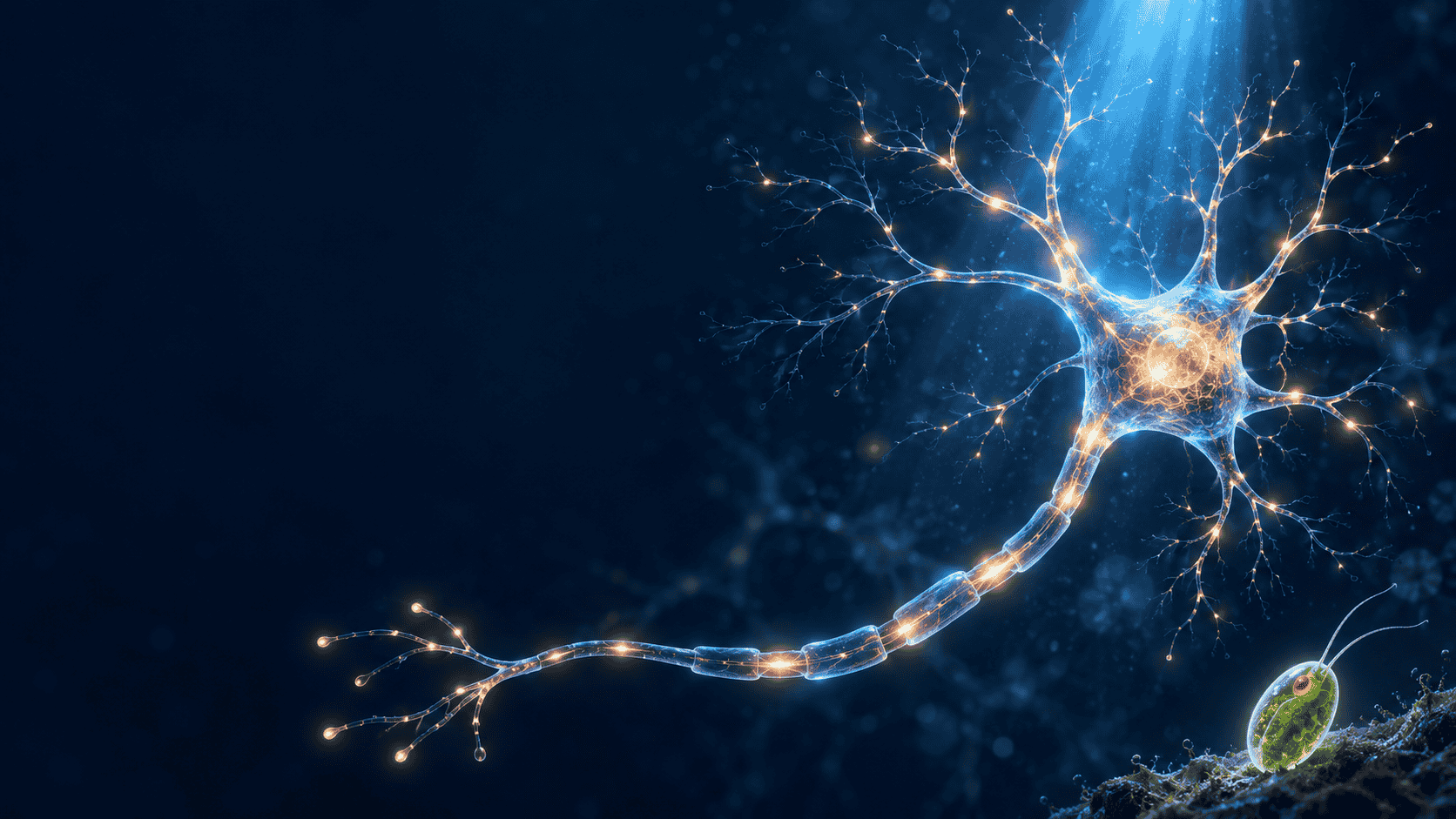
Three scientists have won the 2026 Nobel Prize in Physiology or Medicine for optogenetics, a method that lets researchers switch individual nerve cells on and off with light. Karl Deisseroth, Peter Hegemann and Georg Nagel share the prize, announced by the Nobel Assembly at the Karolinska Institutet on Monday, October 5, 2026. They split 12 million Swedish kronor, about US$1.2 million, equally.
The story starts with a single-celled green alga, not a brain. A protein that helps the alga swim towards light became one of neuroscience's most used tools, and it is now moving towards medicine. Here is what optogenetics is, how it works, what it has achieved and where it is still limited.
What is optogenetics?
Optogenetics combines light ("opto") with genetics. Researchers add the gene for a light-sensitive protein to chosen cells, then use light to control those cells, with precision in both time and place. The Nobel Committee describes it as a way to show how nerve cells shape memories, feelings and behaviour in the living brain.
Nerve cells talk to each other with tiny electrical signals. Those signals depend on ion channels, gateways in the cell membrane that let charged particles in and out. A light-gated channel opens when light hits it, so putting one into a neuron lets light fire that neuron. Anna Wedell, a member of the prize committee, said the method lets scientists map which cells are responsible for which function.
Laureate | Affiliation | Role in the discovery |
|---|---|---|
Peter Hegemann | Humboldt University of Berlin | Asked how a green alga swims towards light and helped identify the protein behind it |
Georg Nagel | University of Würzburg | Showed the protein is a light-gated ion channel that works in other cells |
Karl Deisseroth | Stanford University and Howard Hughes Medical Institute | Put the gene into nerve cells and turned the protein into a switch for the brain |
How optogenetics works, step by step
- Choose a light-sensitive protein. The classic one is channelrhodopsin, found on the surface of the alga Chlamydomonas, where it works as a light-gated ion channel.
- Deliver its gene to chosen cells. Researchers can limit the gene to particular types of neuron, so only those cells respond. A harmless virus is a common delivery vehicle.
- Let the cells build the protein. The cells make channelrhodopsin and place it in their outer membrane.
- Shine light on the cells. The original channelrhodopsin-2 responds to blue light; newer versions respond to red light, which travels deeper into tissue.
- Watch the effect. The channel opens, the neuron fires within milliseconds, and it stops when the light goes off. Other light-sensitive proteins can silence cells instead, which is how the method switches activity off.
The key finding by Hegemann and Nagel was that cells became sensitive to light once channelrhodopsin was introduced, regardless of cell type. That is why the tool works well beyond algae.
From alga to Nobel: the timeline
The path took about three decades, and it began with curiosity about how a microbe senses light.
When | Milestone |
|---|---|
Early 1990s | At the Max Planck Institute, Hegemann studies how the alga Chlamydomonas swims towards light |
Early 2000s | Hegemann and Nagel identify channelrhodopsin and show that light opens it, testing it in frog eggs and mammalian cells |
2003 | They publish their results on channelrhodopsin-2, which reacts strongly and quickly to a pulse of light |
2004 | Deisseroth's lab records its first experiment showing light activating neurons that carry channelrhodopsin |
2005 | Deisseroth's group uses blue light to control rat neurons |
After 2005 | The method is used in living mice, including to wake sleeping animals |
2021 | A first-in-human optogenetic therapy partly restores vision in a blind patient |
October 5, 2026 | Deisseroth, Hegemann and Nagel win the Nobel Prize |
Deisseroth, then training in medicine, heard about channelrhodopsin-2 and wrote to Nagel asking for the gene's DNA. That request led to the step that made the protein a brain tool.
What optogenetics is used for
In the lab, optogenetics has reshaped neuroscience. Researchers worldwide use it to trace the circuits behind memory, emotion and behaviour, and to study conditions such as depression, Parkinson's disease and schizophrenia in animal models.
Restoring sight
The clinical use closest to patients is vision. In retinitis pigmentosa, the light-sensing cells of the retina die, but other retinal neurons often survive. Optogenetic gene therapy gives those survivors a channelrhodopsin gene so they can respond to light, and patients wear special goggles that project light pulses onto the retina.
In a first-in-human study in 2021, led by José-Alain Sahel of the University of Pittsburgh and Botond Roska of the Institute of Molecular and Clinical Ophthalmology Basel, the therapy gave one blind patient partial recovery of visual function. Reporting says the patient could perceive and touch objects, and the approach has so far proven safe in early work.
What comes next
Researchers are now working on cell-specific delivery methods and on cable-free devices. A recent University of Pittsburgh project is testing an injectable gel to control how widely a therapy spreads across the retina. Neurological uses in people are further away.
Limits and open questions
The Nobel recognises a discovery and a tool, not a finished treatment. Optogenetic therapy in people still has real hurdles:
- It needs gene therapy. Cells must receive a foreign gene, usually through a viral vector, so delivery has to be precise and safe.
- Safety questions remain. Reviews flag specificity of delivery, possible off-target effects and immune reactions as the main concerns.
- Light must reach the cells. Shorter wavelengths such as blue light penetrate tissue less well than red light, which is why newer proteins are tuned to red.
- Results have been modest so far. Vision restored in early studies has been limited, and researchers are working to understand what holds performance back.
The retina is the most promising first target because the eye lets light in naturally. The brain, where light has to travel through tissue, is a harder problem.
Optogenetics FAQ
Who won the 2026 Nobel Prize in Medicine? Karl Deisseroth, Peter Hegemann and Georg Nagel, jointly, for their discoveries concerning light-gated ion channels and optogenetics.
What is channelrhodopsin? A protein from the alga Chlamydomonas that sits in the cell membrane and opens as a channel when light hits it. Hegemann and Nagel identified it, and Deisseroth used it to control nerve cells.
Is optogenetics used on people? Mainly in research. The nearest clinical use is gene therapy for blindness caused by retinal disease, which has been tested in early human studies.
Why did algae matter? The alga uses light to swim towards the sun, so evolution gave it a fast, built-in light switch. Scientists borrowed it for neurons.
How much is the Nobel Prize worth? 12 million Swedish kronor, about US$1.2 million, shared equally among the three winners.
Sources
Reporting based on the Nobel announcement coverage and expert commentary as of October 13, 2026.
- NobelPrize.org: press release and popular information
- STAT News: prize announcement
- C&EN: Optogenetics researchers win Nobel Prize
- CNN: Nobel Prize in medicine awarded to trio
- Optica: statement on the prize
- Clinical Lab: from algae to neural circuits
- Fierce Biotech: optogenetics in biotech
- Physics World: optogenetic therapy for vision
- Journal of Ophthalmic and Vision Research: optogenetic therapy for retinal disease
- Wikipedia: Karl Deisseroth
- optogenetics explained, nobel prize medicine 2026, Deisseroth Hegemann Nagel, channelrhodopsin, light-controlled neurons, optogenetics vision restoration, how does optogenetics work
- Optogenetics, Nobel Prize 2026, Neuroscience, Karl Deisseroth, Peter Hegemann, Georg Nagel, Channelrhodopsin, Gene Therapy, Medicine