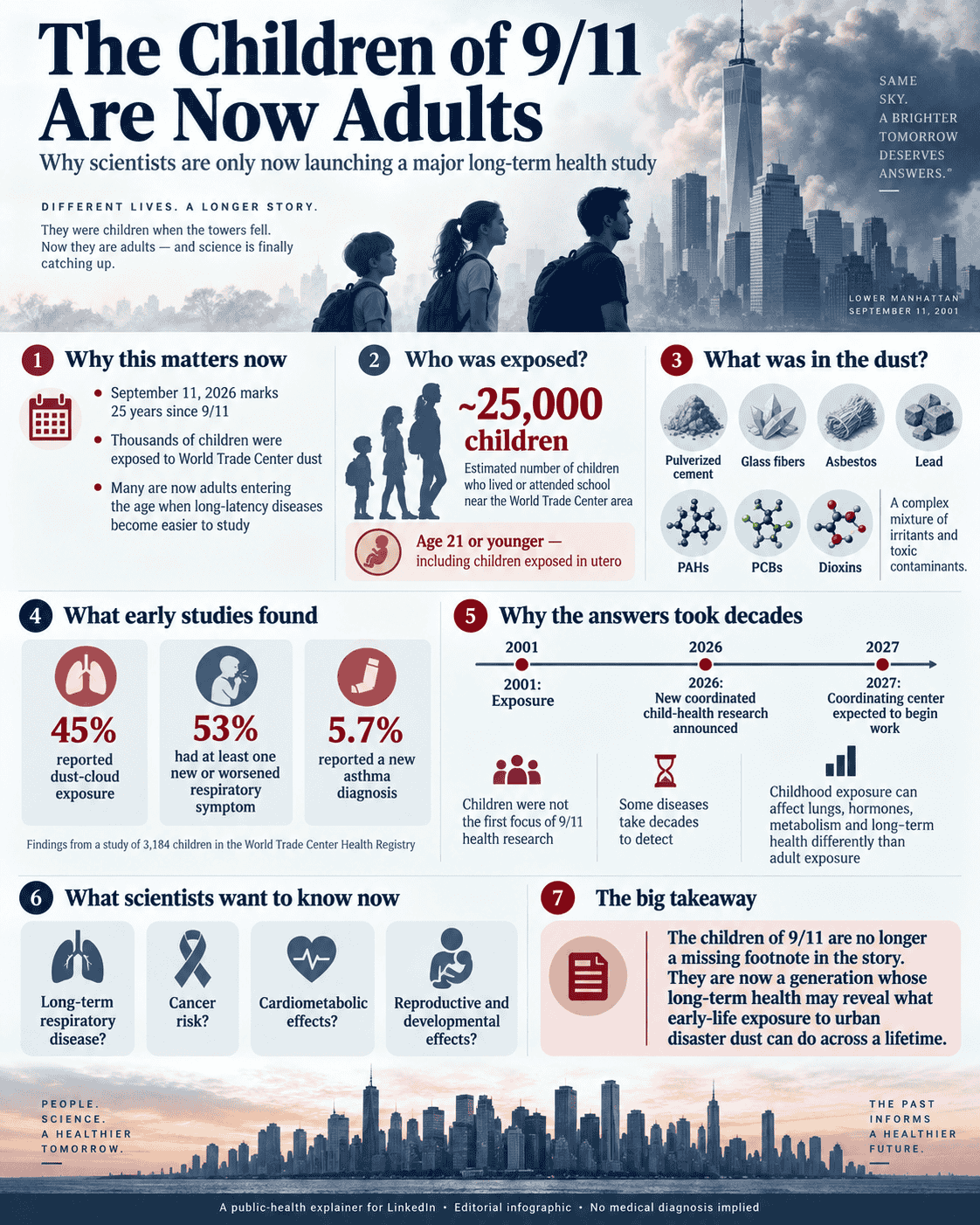
On September 11, 2001, thousands of children were living or attending school near the World Trade Center. Many breathed a dust cloud containing pulverized concrete, glass fibres, asbestos, metals and combustion products. Twenty-five years later, those children are adults—and scientists are preparing a major research effort to understand what childhood exposure may mean across an entire lifetime.
The Children of 9/11 Are Now Adults—What Did the Toxic Dust Do to Their Bodies?
Twenty-five years after the World Trade Center attacks, scientists are confronting a question that was never fully answered: what happened to the children who breathed the dust, lived in contaminated homes, attended nearby schools—or were still in the womb when the towers fell?
By History, Science & Health Desk | Friday, September 11, 2026
On the morning of September 11, 2001, some of the people exposed to the World Trade Center disaster were not firefighters.
They were not police officers.
They were not office workers escaping the towers.
They were children.
Some were walking to school.
Some were inside classrooms and apartments across lower Manhattan.
Some were toddlers.
Others had not yet been born.
When the Twin Towers collapsed, an enormous cloud of pulverized building material and combustion products spread through lower Manhattan and parts of Brooklyn.
Children ran through it.
Dust entered homes.
It settled on furniture.
It entered ventilation systems.
Fires continued burning in the debris for months.
Twenty-five years later, those children are now adults.
And American health authorities are finally preparing a major coordinated research effort specifically focused on people exposed to 9/11 at age 21 or younger—or while still in the womb.
The CDC's World Trade Center Health Program announced in August that it is establishing a new research coordinating center on early-life exposure, calling it an important first step toward understanding a population that has received far less attention than adult responders and survivors.
Reuters reports that approximately 25,000 children lived or attended school near the World Trade Center, and that the new effort could receive up to $50 million, with the coordinating center expected to begin work by July 2027.
That raises an uncomfortable question:
Why did it take 25 years?
The answer reveals how difficult long-term environmental health research can be—and how easy it is for children to disappear inside a disaster initially understood through its adult victims.
The World Trade Center Dust Was Not Ordinary Dust
The grey cloud that rolled through lower Manhattan looked like pulverized concrete.
It was far more complicated.
According to the CDC's World Trade Center Health Program, samples contained a mixture of:
cement,
cellulose,
glass fibres,
soot,
paint,
partially burned jet fuel,
plastics,
and other building materials.
Chemical analysis identified substances including:
lead,
cadmium,
chromium,
asbestos,
polycyclic aromatic hydrocarbons, or PAHs,
PCBs,
dioxins,
furans,
pesticides,
phthalates,
and other hydrocarbons.
The fires beneath the debris continued burning intermittently for more than three months, repeatedly producing smoke and combustion products while cleanup activity stirred settled dust back into the air.
A major environmental-health review later found that the dust was overwhelmingly composed of coarse particles and contained pulverized cement, glass fibres, asbestos, lead, PAHs, PCBs, dioxins and furans.
This was therefore not one exposure to one chemical.
It was a complex environmental mixture.
That makes determining long-term health effects much harder.
Children Are Not Just Smaller Adults
This is one reason the new research matters.
A ten-year-old and a forty-year-old exposed to the same environment do not necessarily face the same biological consequences.
Children are still developing.
Their:
lungs,
immune systems,
brains,
endocrine systems,
reproductive systems,
and metabolism
are changing rapidly.
They may also breathe more air relative to their body size than adults during physical activity and have many more years of life ahead during which long-latency diseases could emerge.
A child exposed at age five in 2001 is around 30 today.
Someone exposed in the womb may only now be entering their mid-twenties.
For diseases that take decades to become detectable, the passage of time is not merely an inconvenience.
It is part of what makes the research scientifically possible.
We Already Know the Children Had Respiratory Problems
This is not a completely unexplored population.
One of the most important early studies examined 3,184 children enrolled in the World Trade Center Health Registry.
Researchers found that:
45% had reported dust-cloud exposure,
53% experienced at least one new or worsened respiratory symptom,
and 5.7% received a new asthma diagnosis after 9/11.
Children exposed to the dust cloud had more than twice the odds of a new asthma diagnosis compared with those who were not exposed, after researchers adjusted for other factors.
The strongest signal appeared among the youngest children.
Those under five had asthma prevalence above national estimates when they were later surveyed.
That evidence matters.
But it answers primarily:
What happened in the first few years?
The new research asks something much larger:
What happens across an entire lifetime?
The Dust Did Not Simply Disappear From the Story
Researchers later looked for persistent chemical evidence in young people who had been exposed.
One study compared children who had been eight years old or younger on September 11 with a matched comparison group.
Blood samples taken between 2014 and 2016 showed significantly higher levels of several PFAS chemicals among the World Trade Center-exposed group, including PFOS and PFOA. Researchers concluded that longitudinal follow-up was needed to explore possible cardiometabolic and kidney-related consequences.
Another study examined adolescents more than 12 years after 9/11.
Researchers found significantly elevated concentrations of several dioxins and furans in exposed participants compared with a matched group.
Perhaps most interestingly, the strongest association was not simply with being caught in the giant dust cloud on September 11.
It was with chronic dust exposure inside homes.
That changes the way we think about the disaster.
The exposure did not necessarily end when the visible cloud cleared.
The Home May Have Become Part of the Exposure
Imagine returning to an apartment after the attacks.
Dust has entered through:
windows,
doors,
air-conditioning systems,
and ventilation.
It settles inside:
carpets,
furniture,
curtains,
books,
children's toys,
and ventilation ducts.
Every time someone cleans, walks across a carpet or disturbs a contaminated surface, particles can be resuspended.
This may help explain why some studies found associations with home dust exposure years later rather than simply with where a child happened to stand during the collapse.
It also illustrates one of the central difficulties of environmental disasters:
the visible event may last minutes.
The exposure environment can persist much longer.
What About Children Who Had Not Yet Been Born?
Another group presents an even harder question.
Pregnant women near the World Trade Center were exposed to:
air pollution,
dust,
toxic chemicals,
and extraordinary psychological stress.
Researchers have studied whether that exposure affected pregnancy and birth outcomes.
One analysis comparing siblings found that living in the dust-affected area while pregnant was associated with increased risks of premature delivery and low birth weight, with effects particularly pronounced among male fetuses exposed during the first trimester.
Another study of women delivering in lower Manhattan found lower term birth weight and shorter birth length among infants whose mothers lived close to the World Trade Center after the attacks, although environmental pollution and severe psychological stress are difficult to separate completely in this kind of observational research.
That uncertainty is precisely why longer follow-up matters.
Pregnancy outcomes tell us something about the first months of life.
They do not tell us what happens at:
age 10,
20,
30,
or 50.
Why Were Adults Studied More Intensively?
The earliest medical emergency was impossible to miss.
Firefighters and rescue workers inhaled enormous amounts of dust.
Many developed persistent:
cough,
asthma,
sinus disease,
gastroesophageal reflux,
and other respiratory problems.
Later studies identified increased burdens of cancers and other conditions in some exposed groups.
Responders were therefore the most visible population needing immediate monitoring.
They also had an organizational advantage.
Many belonged to:
fire departments,
police departments,
unions,
employers,
or organized responder groups.
Researchers could identify them and establish cohorts.
Children were dispersed across:
families,
schools,
neighborhoods,
and age groups.
Some moved away.
Some were too young to describe their exposure accurately.
Some parents may not have realized that ordinary household dust represented a research-relevant exposure.
And some children had not yet been born.
Building a scientifically reliable long-term cohort from that population is much more difficult.
The Federal Health Program Itself Arrived Years Later
The current World Trade Center Health Program traces its statutory foundation to the James Zadroga 9/11 Health and Compensation Act, passed in 2010, with the program operating from 2011.
It now provides medical monitoring and treatment for nearly 150,000 enrolled responders and survivors across the United States.
But the research literature remained far richer for adults.
The CDC now explicitly acknowledges that while research since 2011 has greatly expanded understanding of health effects among exposed adults, additional research is needed for people exposed at young ages.
The new coordinating center is intended to begin filling that gap.
Another Reason the Question Was Delayed: Some Diseases Need Time
Imagine trying to determine in 2005 whether a nine-year-old's 2001 exposure increased the risk of disease at age 45.
You cannot.
The person is only thirteen.
Many conditions have long latency periods.
Examples may include certain:
cancers,
cardiovascular diseases,
metabolic disorders,
reproductive conditions,
and chronic inflammatory illnesses.
This does not mean scientists expect every one of these diseases to be elevated among 9/11-exposed children.
That is exactly what the new research must determine.
A scientifically responsible investigation begins with:
Could this exposure affect long-term health?
not:
Which diseases can we blame on it?
Cancer Will Be One of the Hardest Questions
The word cancer understandably causes the greatest anxiety.
The World Trade Center dust contained known carcinogenic substances.
Adult responder and survivor studies have identified cancer patterns that continue to be monitored.
But childhood cancer-risk research faces several challenges.
Cancer is common enough across a lifetime that researchers need good comparison groups.
Different cancers have different causes.
Some may have latency periods lasting decades.
Exposure levels varied enormously.
Genetics, smoking, occupation, infections, lifestyle and unrelated environmental exposures can all influence risk later in life.
So if researchers eventually observe more cancers in an exposed group, they must determine whether the difference is statistically convincing and biologically plausible.
That is far more complicated than identifying one exposed person who becomes ill.
Why Can't Scientists Simply Compare Lower Manhattan With the Rest of New York?
Because populations differ before any disaster happens.
Families living in lower Manhattan in 2001 were not necessarily identical to families elsewhere in the city.
They could differ in:
income,
race and ethnicity,
housing,
access to healthcare,
diet,
parental education,
environmental exposures,
and many other factors.
Those differences can affect health decades later.
This is called confounding.
The new research therefore needs a carefully selected comparison population.
Reuters reports that the planned effort will include non-exposed individuals as a comparison group.
Researchers will then need to reconstruct exposure histories as accurately as possible.
Where did somebody live?
Which school did they attend?
Were they caught in the cloud?
Was their home contaminated?
How soon was it professionally cleaned?
Was a parent a responder?
Were they exposed to smoke from the debris pile?
Were they still in the womb?
Twenty-five years later, answering these questions reliably becomes extremely challenging.
9/11 Also Left a Psychological Exposure
Not every important health consequence came from chemicals.
Thousands of children:
saw the towers burn,
watched people flee,
were evacuated from schools,
lost family members,
heard explosions,
saw injured people,
or lived for months inside a city transformed by fear.
Among children in the World Trade Center Health Registry, researchers found that 3% met criteria for possible post-traumatic stress at the initial interview, while post-traumatic stress symptoms were associated both with dust exposure and with witnessing disturbing events.
That overlap creates another difficult research problem.
Physical exposure and psychological trauma occurred simultaneously.
Stress itself can influence:
sleep,
immune function,
cardiovascular health,
mental health,
behavior,
and healthcare use.
Untangling those pathways is extremely difficult.
And Then There Is the Question of What Authorities Said in 2001
One part of the history remains particularly uncomfortable.
On September 18, 2001, EPA Administrator Christie Whitman publicly said monitoring showed New Yorkers' air was safe to breathe.
Two years later, the EPA's own Office of Inspector General concluded that the agency did not have sufficient data and analysis to make such a blanket statement.
The inspector general noted that monitoring data were lacking for several pollutants and that the public statements were not adequately qualified for vulnerable groups such as children.
The report did not conclude that all of lower Manhattan was continuously unsafe.
It concluded that the certainty communicated publicly exceeded the evidence available at the time.
That distinction remains enormously important for disaster communication today.
When authorities do not know the long-term risk, saying:
“We do not yet know”
may be scientifically and ethically better than offering premature reassurance.
Why Does This Matter Outside New York?
Because the same problem keeps happening.
A disaster occurs.
There is:
smoke,
dust,
fire,
chemical contamination,
and damaged infrastructure.
The immediate emergency dominates attention.
Then people return home.
Children return to school.
Years pass.
The public moves on.
But biology does not follow the news cycle.
Consider children today exposed to:
wildfire smoke,
urban warfare,
building collapses,
chemical explosions,
industrial fires,
oil spills,
and extreme air pollution.
The 9/11 childhood cohort could help answer a much broader question:
What does a major toxic exposure during early life look like decades later?
That knowledge could influence future decisions about:
evacuation,
school closures,
indoor cleanup,
air-quality monitoring,
medical surveillance,
and how quickly children should return to disaster zones.
The scientific value may therefore extend far beyond those exposed in New York.
Why 25 Years May Actually Be the Beginning, Not the End
Anniversaries encourage us to think in finished chapters.
September 11, 2001.
Twenty-five years later.
History.
But environmental health works on a different timeline.
The children are only now reaching ages when scientists can begin asking questions about:
adult respiratory health,
reproductive outcomes,
cardiometabolic disease,
kidney health,
cancer,
and the interaction between childhood trauma and physical exposure across decades.
The coordinating center announced by the CDC is therefore not the final study.
It is infrastructure for the next generation of research.
Researchers will have to find participants.
Reconstruct exposures.
Build comparison groups.
Link medical records.
Collect biological samples.
Follow people over time.
And distinguish real signals from coincidence.
That process could last many years.
What Scientists Need to Know Now
The questions are remarkably broad.
Do childhood respiratory problems persist into middle age?
Does early exposure increase the probability of chronic obstructive lung disease?
Are there long-term cardiometabolic effects associated with PFAS exposure?
Do endocrine-disrupting chemicals affect reproductive health?
Do cancer rates eventually differ from comparable unexposed populations?
Were people exposed in utero affected differently from those exposed after birth?
Did household contamination matter more than the initial dust cloud for some chemicals?
Does childhood psychological trauma interact with physical disease later in life?
Which exposure markers remain measurable after decades?
And perhaps most importantly:
Who should receive medical monitoring before symptoms appear?
At present, science cannot answer all of those questions.
That is precisely why the research is being organized.
What We Should Not Claim
It is tempting to look at the toxic chemistry of the World Trade Center dust and jump directly to conclusions.
We should not.
The evidence does not establish that every exposed child will develop chronic disease.
It does not prove that a specific cancer diagnosed decades later was necessarily caused by September 11.
And detecting a contaminant in blood does not automatically mean that contaminant has caused illness.
Environmental epidemiology works through populations, probabilities and comparison.
Researchers look for:
consistent patterns,
dose-response relationships,
biological plausibility,
replication,
and alternative explanations.
That makes the science slower.
But it also makes the conclusions far more trustworthy.
The Children of 9/11 Are No Longer Children
That is what makes this anniversary scientifically different.
In 2001, these were:
preschoolers,
schoolchildren,
teenagers,
fetuses.
Today they are:
workers,
parents,
professionals,
and adults entering their thirties and forties.
Their bodies carry twenty-five years of history.
Some experienced respiratory illness soon after the attacks.
Some had measurable environmental contaminants more than a decade later.
Many appear healthy.
For some, important long-term outcomes may not emerge for years.
The new research will have to study all of them.
Not because scientists know something terrible is waiting.
But because we still do not know.
And after twenty-five years, uncertainty itself has become a public-health question.
The Most Important Lesson May Be About the Next Disaster
When the towers fell, emergency medicine focused—understandably—on saving lives.
Then came cleanup.
Then reconstruction.
Then long-term care for responders.
Children remained much less visible.
A quarter-century later, public health is returning to them.
The lesson for the next major environmental disaster should be simple:
Do not wait twenty-five years to build the childhood cohort.
Record exposure early.
Follow children from the beginning.
Preserve biological samples.
Document where they lived and went to school.
Track pregnancy exposures.
Monitor mental and physical health together.
And never assume that because the smoke disappears, the health story has ended.
On September 11, 2001, children were standing beneath one of the largest toxic urban dust clouds in modern American history.
On September 11, 2026, they are adults.
The question science is finally preparing to answer is not simply:
What happened to them then?
It is:
What did that day become inside a human body over twenty-five years?
The answer may help those families understand their own health.
It may also teach the world how to protect children when the next disaster fills a city with dust.
Frequently Asked Questions
How many children were exposed to the World Trade Center disaster?
Reuters reports that roughly 25,000 children lived or attended school near the World Trade Center around the time of the attacks. The new research initiative will focus broadly on people who were 21 or younger—or in utero—when exposed.
What was in the World Trade Center dust?
CDC lists building debris and combustion products including cement, glass fibres, soot, paint, jet-fuel residue and plastics, along with hazardous substances such as asbestos, lead and other metals, PAHs, PCBs, dioxins and furans.
Did 9/11 exposure increase asthma in children?
A study of 3,184 children in the World Trade Center Health Registry found that 5.7% had a new asthma diagnosis and that reported dust-cloud exposure was associated with approximately 2.3 times the odds of newly diagnosed asthma.
How many children reported respiratory symptoms?
In the same cohort, 53% reported at least one new or worsened respiratory symptom after 9/11.
Were toxic chemicals still detectable years later?
Yes. Studies found higher levels of several PFAS compounds in exposed children and elevated dioxin and furan concentrations in some exposed adolescents more than 12 years after the attacks. These findings indicate exposure; they do not by themselves prove a particular disease was caused.
Were unborn children affected?
Research has found associations between maternal exposure and outcomes including prematurity and low birth weight in some studies, particularly with first-trimester exposure. However, prenatal disaster research is complicated by environmental, psychological and demographic factors.
Why is the major child-health study only happening now?
Most early health programs and research concentrated on adult responders and survivors. The CDC says more work is now needed on people exposed early in life, while many potential long-latency outcomes can only be meaningfully studied as participants age.
What is the new World Trade Center research center?
The CDC's World Trade Center Health Program is establishing a research coordinating center focused on early-life exposure. It is intended to coordinate future research involving people exposed at age 21 or younger or in utero.
How much funding could the research receive?
Reuters reports that the effort could receive up to $50 million and that the coordinating center is expected to begin work by July 2027.
Does this mean exposed children will eventually develop cancer?
No. Exposure to carcinogenic substances does not mean every exposed person will develop cancer. Long-term research is needed to determine whether particular diseases occur at higher rates than in appropriate comparison populations.
Was the air declared safe after 9/11?
EPA Administrator Christie Whitman said on September 18, 2001 that monitoring indicated the air was safe to breathe. EPA's Office of Inspector General later concluded that the agency lacked sufficient data to make such a broad statement and that important qualifications—especially concerning vulnerable groups such as children—were not adequately communicated.
How many people are currently served by the World Trade Center Health Program?
CDC says the program now serves nearly 150,000 enrolled responders and survivors across the United States.
Why could 9/11 research matter for other disasters?
The findings could improve how governments monitor children after wildfires, wars, building collapses, industrial explosions and other events involving complex airborne contaminants and long-term environmental exposure.
Editorial / Health Note: Associations found in environmental-health studies do not prove that every illness occurring in an exposed person was caused by 9/11. The purpose of the new early-life research effort is to establish which long-term health effects, if any, occur more frequently in exposed populations and to improve evidence-based monitoring and care.
World Trade Center dust health, 9/11 toxic dust children, 9/11 health study 2026, World Trade Center childhood exposure, 9/11 asthma children, 9/11 cancer risk, September 11 health effects
environmental health monitoring, toxic exposure testing, respiratory health, long-term health screening, disaster medicine, public health research
September 11, 9/11, World Trade Center, Children's Health, Toxic Exposure, Asthma, PFAS, Dioxins, Public Health, Environmental Health