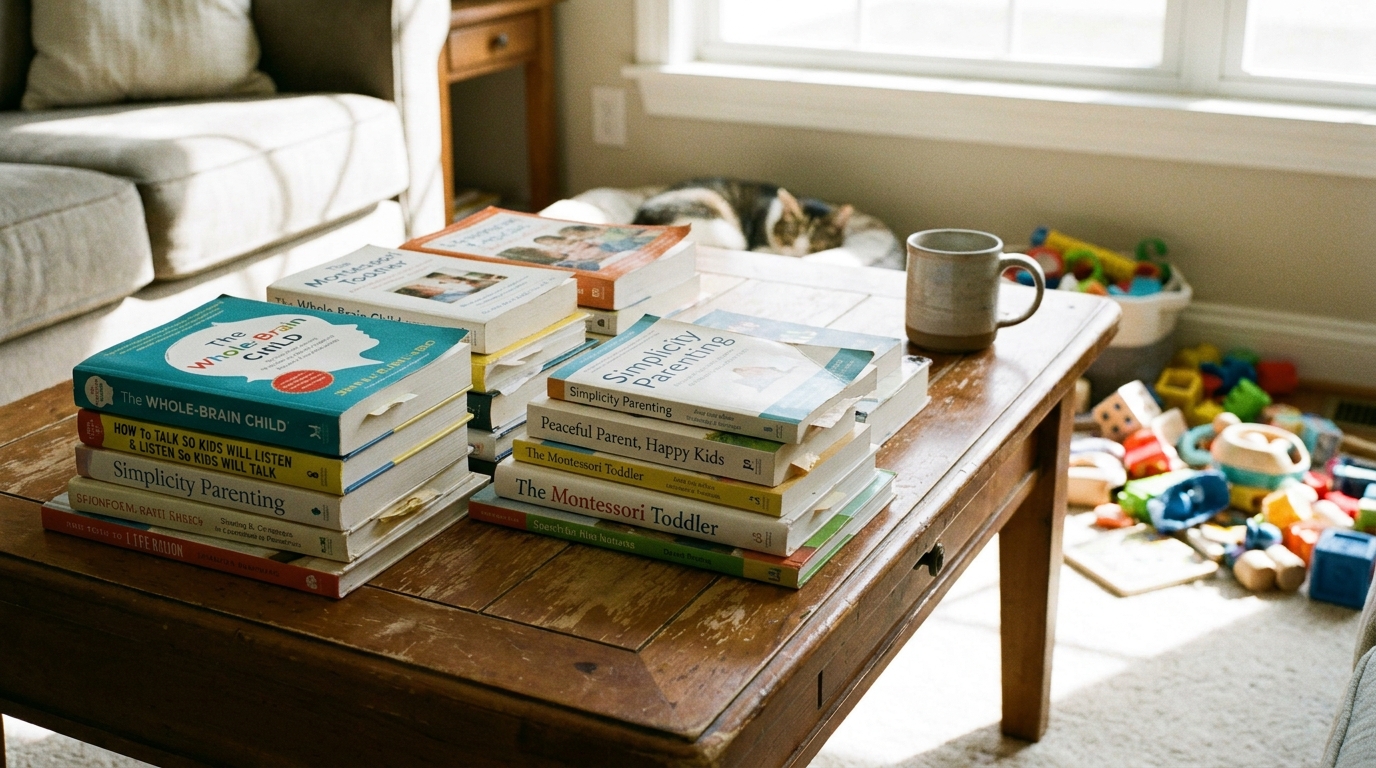
Best Parenting Books of 2026 That Will Actually Change How You Parent
Parenting books are everywhere — but only a handful will genuinely shift how you raise your children. Here are the ten books that the evidence, the experts, and parents who've read them say actually make a difference.
The Problem With Most Parenting Books
The parenting book industry publishes hundreds of new titles every year, the majority of which can be summarised in a sentence, repeat advice available freely elsewhere, or make claims the research doesn't support. The books worth reading are a small fraction of those published — and identifying them amid the noise is genuinely difficult for time-pressed parents.
The books on this list were selected against three criteria: they are grounded in credible psychological or developmental research; they offer actionable, practical shifts in approach rather than abstract principles; and parents who have read and applied them consistently report meaningful change in their family dynamics. Several are new in 2025–2026; others are established works that remain definitively the best available on their subject.
1. The Whole-Brain Child — Daniel J. Siegel and Tina Payne Bryson
Best for: Parents of children aged 2–12
Core insight: Children's emotional meltdowns are not manipulation or defiance — they are the literal result of an underdeveloped brain circuit being overwhelmed. Understanding the neuroscience changes how parents respond.
This is the book most consistently recommended by child therapists, paediatricians, and developmental psychologists as the single most practical introduction to child brain development for parents. Siegel and Bryson explain the distinction between the "upstairs brain" (the rational prefrontal cortex, still under construction until the mid-twenties) and the "downstairs brain" (the emotional, reactive limbic system) in terms any parent can apply in real time.
The 12 strategies — including "connect then redirect," "name it to tame it," and "engage the upstairs brain" — are immediately applicable and produce visible changes in family dynamics for most parents who implement them consistently. The illustrated chapters make it accessible even when read in fragments during nap times.
One key takeaway: When a child is emotionally dysregulated, logic and reasoning don't work because the rational brain is offline. Connection and co-regulation must come first — every time.
2. How to Talk So Kids Will Listen and Listen So Kids Will Talk — Adele Faber and Elaine Mazlish
Best for: All ages — genuinely transformative across toddlers through teenagers
Core insight: Most parent-child communication failures are caused by adults using communication patterns that inadvertently escalate conflict and shut down connection.
First published in 1980 and revised multiple times since, this book remains the definitive guide to parent-child communication — and nothing published since has superseded it. The comic-strip illustrations of before-and-after conversations make the contrast between dismissive and validating responses viscerally clear. Every parent who reads it recognises their own communication patterns in the "before" examples — and has immediate tools to change them.
The chapter on feelings — teaching parents to acknowledge rather than dismiss children's emotional experiences — is perhaps the single most impactful chapter in any parenting book. Sentences like "you seem really frustrated about that" instead of "you're fine, stop crying" change the entire emotional climate of a family when applied consistently.
One key takeaway: Children don't need us to fix their feelings — they need us to acknowledge them. Acknowledgment, paradoxically, makes the feelings resolve faster than dismissal does.
3. No-Drama Discipline — Daniel J. Siegel and Tina Payne Bryson
Best for: Parents who struggle with discipline conversations producing escalation, shutdown, or recurring behaviour problems
Core insight: The goal of discipline is not compliance — it is teaching. Every challenging behaviour is an opportunity to build skills and connection rather than simply impose consequences.
The follow-up to The Whole-Brain Child addresses specifically what to do when children misbehave — and makes the neuroscientific case for why punitive discipline approaches are both less effective and more damaging than connection-based discipline. The distinction between "immediate compliance" (what punitive discipline achieves) and "building the brain" (what children actually need from discipline) is the book's central insight.
One key takeaway: When and why to use time-ins rather than time-outs — and the research showing why time-outs, particularly for young children, often backfire by activating the threat response rather than developing self-regulation.
4. Hunt, Gather, Parent — Michaeleen Doucleff
Best for: Parents feeling overwhelmed by the demands of modern parenting and frustrated by children's perceived entitlement or refusal to cooperate
Core insight: Modern Western parenting has diverged dramatically from the child-rearing practices of the vast majority of human history — and many of the most stressful features of contemporary parenting are culturally specific, not universal.
Doucleff, an NPR science journalist and mother, spent time with indigenous communities in the Yucatán (Maya), the Arctic (Inuit), and Tanzania (Hadzabe) — three cultures known for raising remarkably cooperative, confident, and emotionally regulated children. What she found was a fundamentally different approach to the parent-child relationship: one built on inclusion in real work rather than age-segregated child-centred entertainment, on autonomy granted early, and on minimal direct instruction.
This is one of the most perspective-shifting parenting books of recent years. It doesn't tell you to parent exactly like Maya families — it reveals that many of the most exhausting features of Western parenting are choices, not necessities, and opens the possibility of doing things differently.
One key takeaway: Children who are included in real household tasks from very young ages — not asked to do fake, simplified "kids' chores" but genuinely contributing alongside parents — develop intrinsic motivation and capability that structured incentive systems don't produce.
5. The Anxious Generation — Jonathan Haidt (2024)
Best for: Parents of children aged 8 and above, particularly parents navigating the smartphone and social media decision
Core insight: The dramatic increase in adolescent mental health problems since 2012 is causally linked to the mass adoption of smartphone-based social media — and the solution requires collective action, not just individual parental choices.
Haidt's 2024 bestseller is the most important parenting-adjacent book of recent years — not a traditional parenting book but an evidence-based analysis of what has happened to childhood since the smartphone became ubiquitous. The data he presents on rates of depression, anxiety, self-harm, and loneliness among adolescents — particularly girls — before and after 2012 is both comprehensive and alarming.
His four recommendations — no smartphones before high school, no social media before 16, phone-free schools, and more unsupervised outdoor play — are presented not as individual parenting choices but as collective norms requiring community-level adoption. The book has directly influenced school policy debates in the UK, Australia, and the US.
One key takeaway: The decision about when to give a child a smartphone is not a private family matter that only affects your child — it affects their entire social environment, which is why individual parental restraint is insufficient and collective norms matter.
6. Untangled: Guiding Teenage Girls Through the Seven Transitions into Adulthood — Lisa Damour
Best for: Parents of girls aged 10–18
Core insight: Many of the behaviours parents find most alarming in teenage girls — withdrawal, emotional volatility, risk-taking — are developmentally normal and serve important psychological functions.
Damour's framework of seven transitions — separating from parents, contending with adult authority, setting aside childhood, entering the romantic world, dealing with cruelty, coping with stress, and caring for themselves — gives parents a map for understanding where their daughter is developmentally and what she actually needs at each stage. Her clinical experience as a psychologist working with adolescent girls makes the book feel specific, recognisable, and deeply reassuring.
One key takeaway: Teenage girls need parents who maintain warmth and connection even while enforcing boundaries — the parent who stays curious and present through the most difficult phases has far more influence than the parent who retreats into authority or disapproval.
7. Raising Good Humans — Hunter Clarke-Fields
Best for: Parents who recognise reactive, unconscious patterns in their own parenting and want to change them
Core insight: Mindful parenting — pausing before reacting — is a learnable skill that transforms the parent-child relationship and is best developed through practices the parent cultivates themselves, not through willpower alone.
Clarke-Fields integrates mindfulness practice with practical parenting strategy in a way that addresses the most common obstacle to implementing good parenting knowledge: the gap between knowing what to do and actually doing it in the moment of stress. The book is as much about the parent's inner work as about parenting techniques.
8. The Book You Wish Your Parents Had Read — Philippa Perry (2019, Still Definitive)
Best for: All parents, particularly those whose own childhood was difficult or who recognise intergenerational patterns they want to break
Core insight: The most powerful determinant of how you parent is how you were parented — and understanding that inheritance, rather than simply trying to do the opposite, is the path to genuine change.
Perry, a psychotherapist, writes with unusual directness and warmth about how our own unresolved childhood experiences drive our parenting reactions — particularly in moments of stress. The book's central argument — that the most important gift you can give your child is not technique but genuine relationship — is both liberating and challenging.
How to Actually Apply What You Read
Reading a parenting book produces zero benefit. Applying one technique from a parenting book, consistently, for three weeks produces measurable change. The mistake most parents make is reading widely and applying nothing systematically. A more effective approach:
Read one book at a time, slowly
Identify one specific technique to practice — not five, one
Practice it consciously for three weeks before adding anything else
If you have a partner, read together and discuss specifically how you'll implement
Expect regression — implementing new communication patterns is hard and you will revert under stress. That's normal, not failure
best parenting books 2026, must read parenting books, parenting advice books, The Whole Brain Child review, The Anxious Generation Haidt, how to talk so kids will listen, Hunt Gather Parent Doucleff, mindful parenting books, parenting books for toddlers, parenting books teenagers




Discussion
Comments
Approved comments are published after moderation to keep discussion useful and spam-free.
No comments yet. Start the discussion below.