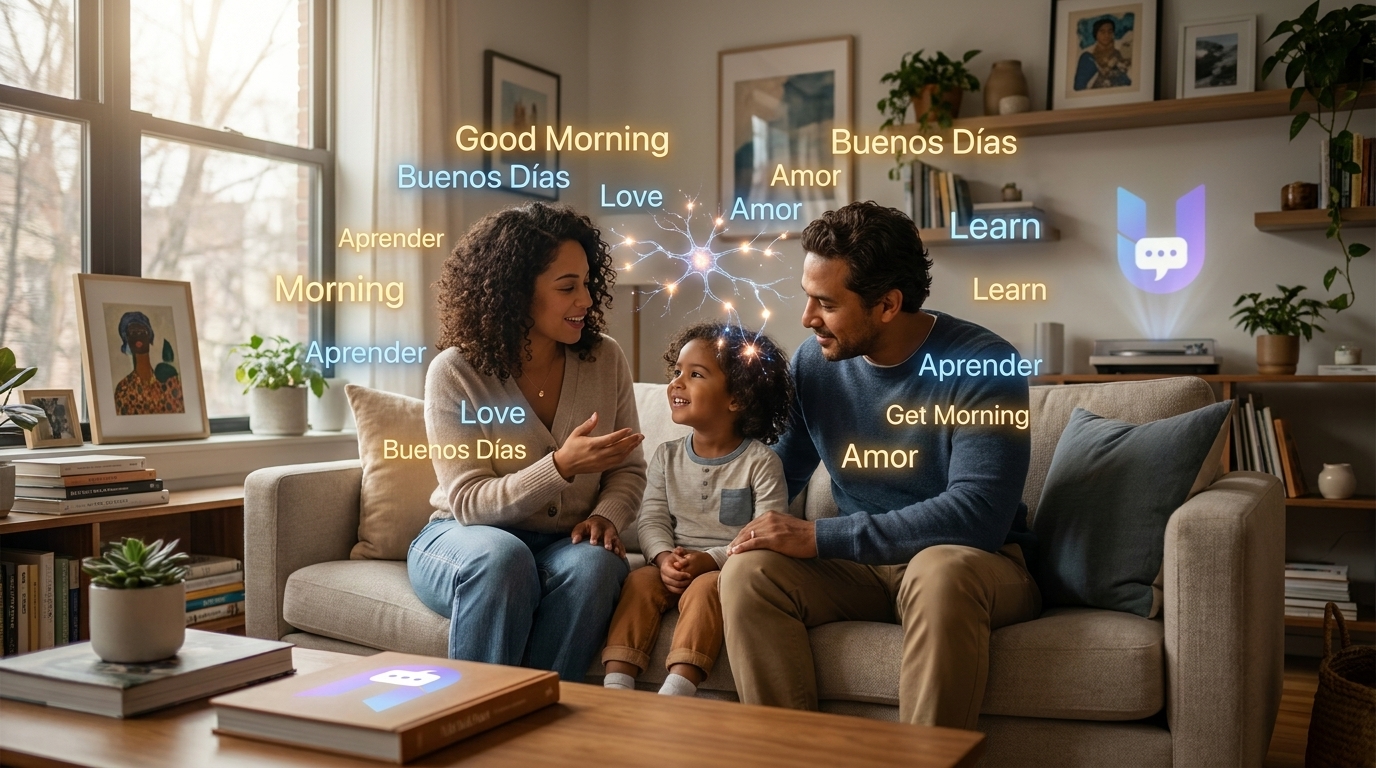
Raising Bilingual Children: The Science Behind Why Starting Before Age 3 Creates a Different Brain
For US and Dominican families navigating two languages, and UK families wanting to give children a lifelong advantage — the neuroscience of bilingualism has never been clearer. Here's what the latest research shows about when, how, and why early bilingual exposure changes a child's brain in ways that last a lifetime.
The Greatest Educational Gift You Can Give Before Kindergarten
In the Dominican Republic, growing up hearing Spanish and English simultaneously is not a parenting philosophy — it's a practical necessity in a country where tourism, business, and diaspora connections make bilingualism a daily economic reality. In Dominican-American communities across New York, New Jersey, and Florida, parents navigate a different version of the same question: how do we keep Spanish alive when every institution in our child's life operates in English? And in the UK, a growing number of parents — both immigrant families and English-speaking parents with no heritage language — are asking whether bilingualism is something they can intentionally create for their children.
The neuroscience now provides the clearest answers it ever has. The answer to whether bilingualism is worth pursuing is unambiguous — it is one of the most thoroughly documented cognitive advantages in developmental psychology. The question of when and how is more nuanced — and the research has corrected some long-standing myths that may have been holding families back.
What Happens to the Bilingual Brain at Different Ages
Ages 0–3: The Phonological Window
At birth, the human brain is capable of distinguishing every phoneme — every distinct sound unit — in every human language. A newborn in Santo Domingo can hear the difference between sounds that are meaningful in Mandarin; a newborn in London can detect phonetic distinctions relevant only to Zulu. This extraordinary capacity is the baseline from which language development begins.
Between birth and approximately three years of age, the brain undergoes a process called "phonological pruning" — it systematically reduces sensitivity to sounds that are not present in the languages the child is regularly exposed to, while sharpening sensitivity to the sounds that are. This is neurological efficiency: the brain is calibrating itself to the linguistic environment it actually inhabits.
For children exposed to two languages from birth, this pruning process happens differently. The brain maintains two separate phonological maps — one for each language — rather than collapsing into one. Neuroimaging studies using fMRI and EEG show that by 12 months, babies regularly exposed to two languages show neural responses to both languages' phoneme sets that are as sharp and distinct as monolingual babies' responses to their single language.
This is the biological foundation of what researchers mean when they say bilingual children have "different brains." It is not metaphorical. The neural architecture laid down in these first three years genuinely differs in measurable, structural ways.
What this means practically: Exposure before age three — even passive exposure through conversation in the home — is doing real neurological work. A Dominican grandmother speaking Spanish to a baby in a predominantly English-speaking household is not just preserving culture. She is physically shaping neural architecture. Every word counts, even before the child can respond.
Ages 3–7: Grammar and the Linguistic Operating System
Between ages three and seven, the brain shifts from phonological learning to grammatical acquisition. This is the period when children absorb the deep structural rules of language — not consciously, not through instruction, but through immersion and interaction. The complexity of what is acquired in this period is extraordinary: tense systems, agreement rules, subordinate clause structures, pragmatic conventions about how language is used socially.
For bilingual children in this window, the brain constructs two separate grammatical systems — but crucially, they are not stored in complete isolation. Research from the past decade using functional neuroimaging has shown that bilingual children develop a more interconnected language control system, involving the left inferior frontal cortex (Broca's area) and the anterior cingulate cortex — regions associated with executive function, attention control, and cognitive flexibility.
This is where what researchers call the "bilingual advantage" in executive function originates. The constant management of two grammatical systems — even when only one is being used — exercises the brain's cognitive control mechanisms. The bilingual child who speaks English at school and Spanish at home is doing a form of daily mental exercise that monolingual children simply don't perform.
Published in Developmental Science in 2023, a landmark longitudinal study following 1,200 children from age two through age seven across the UK and US found that bilingual children consistently outperformed monolinguals on tasks measuring attention switching, working memory, and inhibitory control — even after controlling for socioeconomic status, parental education, and maternal IQ. The effect was largest for children with the most balanced exposure between their two languages.
Ages 7 and Beyond: The Continuation, Not the Cutoff
The old understanding was that a rigid "critical period" for language acquisition closed sometime around puberty — after which second language learning became laborious and accented, and the cognitive benefits of bilingualism were unavailable. This picture has been substantially revised.
Research from 2020–2026 has clarified that there is no single critical period cutoff — there is a gradient of sensitivity that decreases gradually, with different linguistic systems (phonology, grammar, pragmatics) having different optimal windows. Children who begin learning a second language at age seven will not develop the same native-like phonological intuition as children exposed from birth — but they can achieve full grammatical fluency, and their brains show significant structural changes from the experience of managing two languages.
The most significant finding for families who are starting later: children who learn a second language in middle childhood (7–12) and achieve functional fluency still show the executive function advantages associated with bilingualism — they are smaller in magnitude than those of simultaneous bilinguals but measurable and durable. It is genuinely never too late, even if earlier is neurologically better.
The Critical Period Myth: What the Latest Research Actually Says
The "critical period hypothesis," formulated by linguist Eric Lenneberg in 1967, proposed that there was a biologically determined window — ending at puberty — during which language acquisition was possible. After this window closed, the hypothesis suggested, the brain lost the plasticity required for true language learning.
The influence of this hypothesis on parenting advice — and on parental anxiety — has been enormous and, the evidence now suggests, disproportionate to the science.
What the Hypothesis Got Right
Lenneberg was correct that there is a gradient of language learning sensitivity — that phonological acquisition is easier before age six than after, and that native-like accent is almost impossible to achieve in a language first encountered after puberty. The window is real for specific aspects of language.
What the Hypothesis Got Wrong
The hypothesis implied a relatively sharp cutoff and suggested that the ability to become a true bilingual was unavailable after puberty. Subsequent decades of research have comprehensively challenged this:
There is no single cutoff: Phonological sensitivity, grammatical acquisition, and vocabulary development have different optimal windows, different rates of decline, and different adult ceilings. Treating puberty as a single language learning deadline misrepresents the actual biology.
Adults can achieve full functional bilingualism: While native-like phonology is harder after childhood, grammatical fluency and full communicative competence are achievable at any age with sufficient exposure and motivation.
The cognitive benefits are available beyond childhood: A comprehensive 2024 meta-analysis of 94 studies found that even people who became functionally bilingual in adulthood showed significantly better performance on executive function tasks than monolinguals — smaller effects than childhood bilinguals, but present and consistent.
Heritage language speakers have unique advantages: Children raised in Dominican diaspora families who hear Spanish at home but don't actively use it show "heritage speaker" neurology — dormant phonological and grammatical sensitivity that can be reactivated rapidly with targeted exposure, even in adolescence or adulthood. The early exposure is not wasted even when the language becomes passive.
"The critical period is better understood as a sensitive period — a window of heightened opportunity, not a closing door. The biology is more forgiving than the textbooks of the 1980s suggested." — Dr. Naja Ferjan Ramírez, University of Washington Institute for Learning and Brain Sciences
Spanish-English Bilingualism: Specific Strategies for Dominican Diaspora Families
The specific challenge of Dominican-American and Dominican-British families is the asymmetry of linguistic environments. English is the language of school, peer relationships, media, and official life. Spanish — and specifically Dominican Spanish, with its particular phonology, lexicon, and cultural associations — is the language of home, family, and heritage. Without deliberate effort, the heritage language recedes across generations.
The OPOL Approach (One Parent, One Language)
The most researched bilingual family strategy is OPOL — One Parent, One Language — in which each parent consistently speaks their dominant or heritage language to the child, regardless of the language the other parent uses. Research shows that OPOL produces more balanced bilingualism than mixed-language environments because it creates reliable, person-associated language contexts.
For Dominican families where both parents are Spanish-dominant, the challenge is slightly different — creating consistent English exposure without undermining the Spanish foundation. In this context, OPOL might involve one parent committing to English with the child while the other maintains Spanish, or using the English-dominant school environment as the primary English input while ensuring Spanish is the home language.
The "Minority Language at Home" Strategy
For Dominican-American families in English-dominant environments, designating Spanish as the exclusive home language — and English as the school and outside world language — produces highly effective bilingualism. This requires commitment: not switching to English when the child responds in English, maintaining Spanish in the home even when it feels unnatural, and resisting the social pressure to assimilate linguistically.
Specific practices that research shows increase success:
Never translate immediately: When a child asks "What does that mean?" in English about a Spanish word, pause, rephrase, and contextualise in Spanish rather than providing the English equivalent. Translation shortcuts reduce the child's need to construct Spanish meaning independently.
Spanish media as standard home entertainment: Dominican TV programmes, Spanish-language children's content, and music in Spanish create passive exposure that supplements active conversation. Platforms including Netflix (now with extensive Dominican and Latin American content) and YouTube's Spanish children's channels provide accessible alternatives to English-only content.
Spanish-dominant relationships as anchors: Grandparents, cousins in the Dominican Republic via video call, and Spanish-dominant community relationships provide the social motivation for language maintenance that parental instruction alone cannot. The child who wants to talk to abuela has an intrinsic motivation that no flashcard system can replicate.
Heritage language literacy alongside English literacy: Reading in Spanish — starting with picture books and progressing to chapter books — builds the formal, written register of Spanish that home conversation alone doesn't develop. Spanish-language literacy also significantly improves English literacy, because the underlying reading skills transfer across alphabetic writing systems.
Addressing Language Mixing (Code-Switching)
Many Dominican families worry about "Spanglish" — the mixing of Spanish and English within a single conversation or sentence. The linguistic evidence is clear: code-switching is not a sign of confusion, incomplete learning, or linguistic failure. It is a sophisticated communicative behaviour that skilled bilinguals engage in strategically and rule-governedly.
Dominican-American communities have developed a rich, highly structured Spanglish that serves specific social and cultural functions — marking in-group identity, conveying nuances unavailable in either language alone, and signalling belonging. Discouraging all code-switching in the name of "proper" language use is both linguistically misinformed and potentially culturally damaging. What matters is that the child can also operate in each language independently, not that they never mix them.
Maintaining Heritage Language When English Dominates
The pattern across immigrant communities in the US and UK is well documented: first generation speaks heritage language primarily; second generation (the children) speaks both; third generation speaks English primarily. This trajectory is not inevitable — but reversing it requires deliberate, sustained effort.
The Three Enemies of Heritage Language Maintenance
School peer pressure: Children rapidly learn that English is the language of social belonging with peers. From around age five, children actively resist the heritage language because using it marks them as different. The solution is not to shame this — it is to make Spanish prestigious and associated with something the child values, not just with family obligation.
Media asymmetry: The child's most engaging media — games, YouTube, social platforms — operates overwhelmingly in English. Creating equivalent engagement in Spanish requires active curation. Dominican-specific content creators, Spanish-language gaming communities, and Latin music fandoms all provide culturally relevant Spanish exposure through media the child already values.
Parental language switching: When a parent switches to English in response to the child's English use, they signal that the Spanish communication attempt was unnecessary. Maintaining the language even when the child responds in English — gently acknowledging their English response in Spanish — maintains the expectation without confrontation.
The Extended Family Strategy
The most powerful heritage language maintenance mechanism available to Dominican families is regular, high-quality contact with Spanish-dominant relatives — particularly grandparents in the Dominican Republic. Video calling technology makes this more accessible than at any previous point in history. A weekly video call with grandparents in Santiago or Santo Domingo provides authentic, emotionally meaningful Spanish input that parental instruction simply cannot replicate in quality or motivational power.
When possible, regular visits to the Dominican Republic — especially extended summer stays — produce dramatic heritage language gains. Immersion in a Spanish-dominant environment, combined with the social motivation of wanting to communicate with cousins and community, accelerates heritage language development in weeks in ways that months of diaspora effort cannot match.
Schools and Programmes Actively Building Bilingual Children in the UK and US
United States: Dual-Language Immersion Programmes
The most effective school-based bilingual education model in the US is dual-language immersion (also called two-way immersion) — programmes where Spanish-speaking and English-speaking children learn together, with instruction delivered in both languages according to a structured schedule (typically 50/50 or 90/10 Spanish/English in the early years).
These programmes produce the strongest bilingual outcomes of any school model because they create genuine communicative need — English-speaking children need Spanish to communicate with Spanish-speaking classmates and vice versa — and because they give both languages genuine academic and social status. Children in dual-language programmes develop higher levels of both English and Spanish academic language than children in either English-only or transitional bilingual programmes.
Finding dual-language programmes: The National Dual Language Consortium (nationalduallan.org) maintains a searchable database of dual-language programmes across the US. Urban areas with significant Dominican populations — New York City, Boston, Providence, Miami — have extensive dual-language provision. New York City's public school dual-language programme network is the largest in the country, with Spanish-English programmes in all five boroughs.
United Kingdom: Language Education in 2026
The UK's approach to bilingual education has historically been less systematic than the US dual-language model, but significant provision exists and is expanding:
Spanish-medium independent schools: A small number of private schools in London offer Spanish-medium or Spanish-intensive instruction, primarily serving Spanish-speaking families. The Spanish school network (Colegios del Mundo IB) has multiple UK locations.
Spanish Saturday schools: Community-run Spanish language schools operating on weekends exist in most UK cities with significant Hispanic populations. The Spanish Association of Teachers of Spanish (ACLE) can direct families to local provision.
GCSE and A-Level Spanish: Heritage Spanish speakers who maintain fluency at home consistently outperform learnt-language students in GCSE and A-Level Spanish — providing genuine academic advantage in the UK qualifications system.
The Welsh bilingual model: Wales offers the UK's most extensive experience of state-school bilingual education, with Welsh-medium schools producing measurable cognitive advantages comparable to those documented in international bilingual research. The Welsh model is increasingly informing English-medium bilingual education policy across the UK.
The Bottom Line: Start Now, Keep Going
The neuroscience delivers a clear, consistent message. Starting before age three is better than starting at age seven. Starting at age seven is better than starting at fourteen. Starting at fourteen is better than never starting. And the benefits — cognitive, cultural, economic, social — compound across a lifetime.
For Dominican families in the US and UK, the stakes are particularly clear. The Spanish language is not just a communication tool — it is the carrier of Dominican identity, family connection, cultural continuity, and economic opportunity across both the diaspora and the increasingly Spanish-speaking economy of the United States. Raising a bilingual child is not a luxury or an aspiration. It is one of the most significant investments a parent can make in a child's future.
The brain is ready before the child can speak. The question is whether we give it the input it needs.
Keywords: raising bilingual children, bilingual kids benefits, teaching children two languages, Spanish English bilingual kids, Dominican diaspora bilingualism, heritage language maintenance, dual language immersion US, bilingual brain neuroscience, OPOL parenting strategy, bilingual children cognitive advantages, Spanish heritage language UK, bilingual education programmes



Discussion
Comments
Approved comments are published after moderation to keep discussion useful and spam-free.
No comments yet. Start the discussion below.