
China has begun one of the most aggressive cleanups of university programs anywhere in the world, and the numbers are difficult to ignore. Between 2021 and 2025, Chinese higher education institutions removed or suspended 12,200 undergraduate programs and introduced about 10,200 new ones. More than 30 percent of the country’s university programs were adjusted, according to Ministry of Education data cited by Xinhua and reported by the South China Morning Post and Le Monde.
This is not only an education story. It is a labor market story, an AI story and a national planning story. Beijing is trying to make the university system respond faster to the industries it believes will shape the next decade: artificial intelligence, robotics, semiconductors, digital agriculture, data governance, advanced manufacturing and other technology-heavy fields.
The cuts have reportedly affected parts of the arts, humanities, foreign languages, translation, management and some traditional media or design-related programs. At the same time, universities have been encouraged to create programs linked to AI, robotics, digital economy, chips, drones and interdisciplinary technology fields. Le Monde reported examples of new programs combining finance, AI, law and computer science, as universities try to build degrees around the digital economy rather than around older departmental boundaries.
For countries watching from outside China, the lesson is not that every humanities degree should be closed. That would be a crude reading of what is happening. The sharper point is that China has decided the degree catalog itself is part of national strategy.
Why Beijing moved so hard
China’s higher education overhaul is happening while graduate anxiety is rising. Reuters reported that the jobless rate among Chinese 16-to-24-year-olds, excluding college students, fell to 15.6 percent in May 2026, its lowest level in 11 months, but still a serious pressure point. Reuters also reported that a record 12.7 million university graduates were expected to enter the labor market in 2026.
That combination matters. A country can expand higher education for years, but if degrees do not translate into relevant work, the political and social pressure eventually lands back on the state. China appears to be asking a blunt question: are universities producing skills the economy can use, or are they producing credentials that no longer carry enough value?
The second pressure is technological competition. China’s latest five-year blueprint through 2030 places heavy emphasis on technological self-reliance, including AI, robotics, semiconductors, quantum technology and other advanced sectors. The Associated Press reported that the plan calls for annual R&D spending growth of at least 7 percent. Reuters also reported that the five-year plan pledges to accelerate technological self-reliance and expand AI use across the economy.
Seen from Beijing, university reform is part of that same contest. A semiconductor strategy needs engineers and materials scientists. An AI strategy needs computer scientists, data specialists and hardware talent. A robotics strategy needs manufacturing, control systems, mechanical engineering and applied AI. China is aligning academic supply with industrial demand more directly than most systems would attempt.
That approach has a cost. A centralized system can move quickly, but quick movement can also flatten academic diversity. Universities are not only employment machines. They also protect language, history, culture, law, ethics and social understanding. The risk is that a useful correction becomes an overcorrection.
AI is changing tasks before it changes degrees
The debate is often framed as "AI versus the humanities." That framing is too simple. AI is not attacking degrees as labels. It is changing the value of tasks.
Basic translation, routine reporting, template design, simple customer support, standard business summaries, entry-level data handling and repetitive administrative work are all more exposed to automation than they were a few years ago. Le Monde reported that China’s Communication University scrapped some specialized arts and language-related programs, with one university leader arguing that AI had already replaced much basic translation work.
That does not mean language, writing, media or design have no future. It means the human role has to move higher up the value chain. Translators need localization, cultural judgment, editing and domain expertise. Journalists need verification, investigation, data skills and audience understanding. Designers need taste, strategy, brand judgment and the ability to direct tools. Teachers need digital pedagogy, assessment design and human mentoring.
The problem is not the humanities. The problem is the unchanged humanities. The problem is not business education. The problem is business education without analytics, automation, operations and technology strategy. The problem is not media studies. The problem is media studies that ignore AI production, misinformation, platform distribution and data journalism.
A stronger education model would not set AI and human disciplines against each other. It would update every discipline with digital literacy, data awareness and practical projects.
What the China model gets right
China’s reform shows unusual seriousness about connecting education policy, industrial policy and employment policy. In many countries, these three systems barely talk to each other. Education ministries approve programs. Universities run them for years. Employers complain about weak skills. Students graduate into frustration. Then another committee is formed.
China is using state pressure to shorten that delay. Official Chinese reporting has also emphasized the scale of its education pipeline. During the 14th Five-Year Plan period, China’s higher education system produced more than 55 million graduates, while vocational education accounted for over 70 percent of the skilled workers newly added to modern industries, according to China’s State Council and education officials.
This does not make China’s model universally transferable. Other countries have different political systems, labor markets, academic traditions and social expectations. But the basic discipline of reviewing programs against future needs is hard to dismiss.
Universities everywhere should be asking uncomfortable questions. Which programs still lead to meaningful work? Which degrees need to be merged with digital skills? Which departments are teaching students to build portfolios rather than merely pass exams? Which faculties are preparing graduates for AI-assisted workplaces? Which programs survive only because they have always existed?
Those questions should not be asked once every 20 years. They should be part of an annual academic review.
Students need hybrid strength now
The safest graduate in the next decade will not be the person with only one narrow skill. It will be the person who can combine a serious field of study with digital capability and human judgment.
A student of English who understands AI-assisted editing, localization, SEO, digital publishing and audience strategy may be far more employable than a student who treats language as a purely traditional subject. A computer science student who cannot write, explain, collaborate or understand users may also be weaker than expected. A business graduate without data literacy will struggle. A media graduate without verification skills will struggle. An education graduate who does not understand AI tutoring and learning technology will be behind the classroom reality.
The same applies to agriculture, law, health, psychology, finance and public administration. Every field is being touched by AI, not always by replacing the profession, but by changing how the work is done.
Students should not read China’s reform as a reason to panic. They should read it as a reason to add proof of skill. A transcript is no longer enough. A portfolio matters. So do internships, projects, research briefs, dashboards, published writing, prototypes, presentations, community work and public evidence of learning.
A useful rule for students is simple: keep the degree, but upgrade the degree. Add AI literacy. Add data literacy. Add communication. Add one practical project each semester. Add one public proof of work.
The South Asian warning
For Pakistan and much of South Asia, the Chinese move should be read as an early warning rather than a model to copy wholesale. Pakistan does not need to close thousands of programs overnight. It does need a serious review of whether university degrees are connected to employability, innovation and national productivity.
Many students in the region still graduate with limited practical exposure, weak research training, little contact with industry and insufficient digital confidence. Families spend heavily on higher education because the degree still carries social hope. But the job market is becoming less sentimental. It rewards capability, adaptability and communication more than certificates alone.
A practical reform agenda would begin with AI literacy across disciplines. It would add digital skills to traditional programs, require portfolio-based assessment, expand internships, strengthen industry advisory boards and retrain teachers. It would also protect the humanities by modernizing them, not by treating them as decorative leftovers.
For example, a journalism department should teach AI verification, data journalism, misinformation tracking and video storytelling. An English department should teach digital publishing, localization and AI-assisted editing. A history department should teach digital archives, public history, documentary research and heritage communication. A business school should teach analytics, automation, product thinking and financial technology.
This is not radical. It is basic survival.
Schools are part of the same pipeline
China’s AI education push is not limited to universities. Beijing has moved to introduce AI education in primary and secondary schools, with reports saying schools must provide at least eight hours of AI instruction a year. Channel NewsAsia reported the policy in 2025, while Anadolu reported that children in Beijing would be able to take at least eight class hours of AI instruction from the fall semester.
That matters because university reform becomes more effective when students arrive with earlier exposure. If AI is treated as a late university specialization, countries will always be catching up. If it becomes a form of civic and workplace literacy, students can make better choices before they reach higher education.
Again, the goal should not be to turn every child into a coder. The goal is to make young people fluent enough to understand how AI systems affect learning, work, information, creativity and decision-making.
The real lesson is not to close, but to redesign
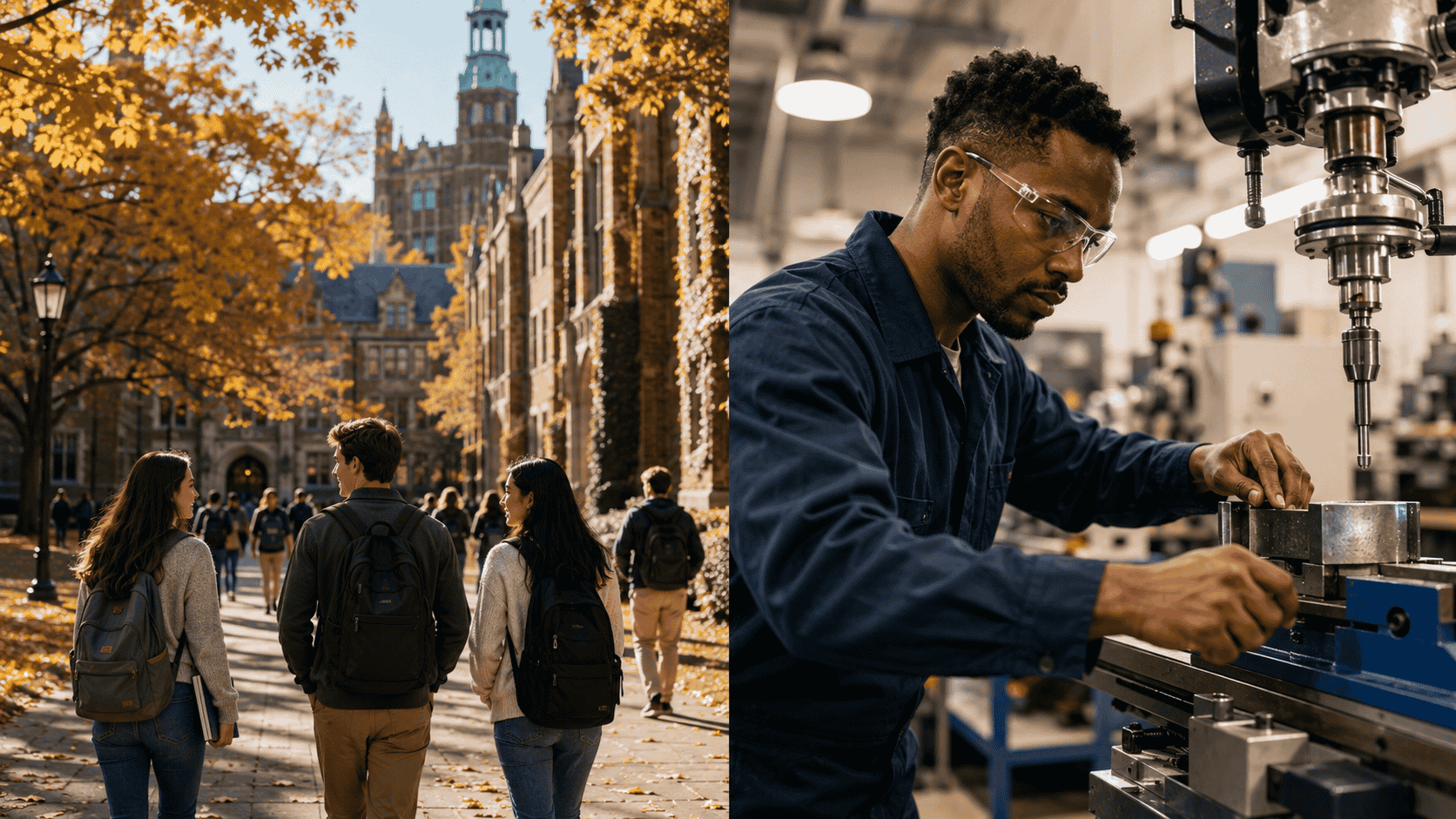
China’s decision to remove or suspend 12,200 programs will attract dramatic headlines, but the more useful lesson is less dramatic. Degree systems need maintenance. Some programs should close. Some should merge. Some should be redesigned. Some should be protected because their value is cultural, civic or intellectual, even if the labor market case is not immediate. But almost none can remain untouched.
The future university cannot operate as a degree factory. It has to become a place where students gain knowledge, build judgment, practice skills and leave with evidence of what they can do. That means labs, capstone projects, internships, research commercialization, entrepreneurship centers, writing support, AI ethics, career data and flexible certificates alongside traditional degrees.
China has chosen a state-led route. Other countries may choose slower, more consultative models. But delay is not a strategy. If universities keep defending outdated curricula while employers, tools and industries move on, students will pay the price first.
The degree is not dead. The old assumption behind the degree is. Four years in a classroom no longer guarantee relevance. The real question for universities is no longer only "What do we teach?" It is "What can our graduates actually do with what we teach?"
That is the question China is forcing onto the global education agenda.





Discussion
Comments
Approved comments are published after moderation to keep discussion useful and spam-free.
No comments yet. Start the discussion below.