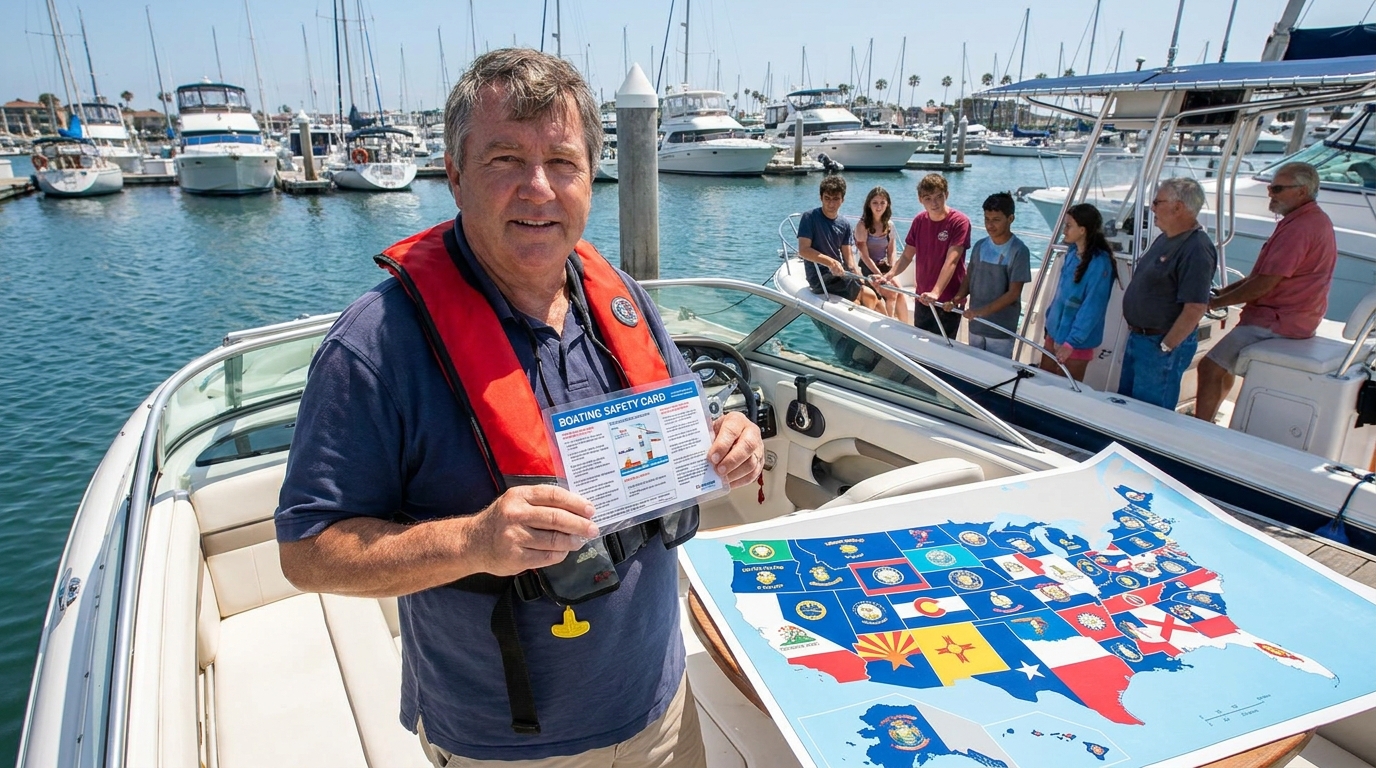
How to Get Your Boating License in 2026: State-by-State Complete Guide
Requirements vary significantly by state — and by age, boat type, and horsepower. Here's exactly what you need to do to become a certified, legal, and confident boat operator in 2026.
Do You Actually Need a Boating License?
The first clarification: the United States does not have a single federal boating license requirement. Boating education and certification requirements are set at the state level, and they vary considerably. In some states, any adult can operate any powerboat with no certification whatsoever. In others, certification is required for all operators of motorised vessels above a certain horsepower threshold.
What all states do require is boat registration for motorised vessels — a separate process from operator certification. And what virtually all states require for operators under a certain age (typically 16) is boater education certification.
Beyond legal requirements, boater education certification is genuinely valuable for safety and competence. The US Coast Guard reports that in the majority of fatal boating accidents, the operator had received no boating education. The time investment of a boater education course — typically 8–12 hours — produces measurable improvement in on-water safety and operator confidence.
The National Standard: NASBLA-Approved Certification
The National Association of State Boating Law Administrators (NASBLA) sets the minimum curriculum standards for boater education that most states accept. A NASBLA-approved boater education certificate is recognised for reciprocity in most US states — meaning if you earn certification in one state, most others will accept it.
Completing a NASBLA-approved course and passing the final exam (minimum passing score varies by provider but typically 70–80%) produces a boater education card that is permanent in most states — no renewal required. This card is the primary credential that satisfies state boater education requirements wherever they exist.
Online vs In-Person Courses: Which to Choose
Online Courses
Online boater education courses are available from several approved providers and represent the most convenient path to certification for most adults. They allow self-paced study, can be completed in as little as 3–4 hours (for the fastest learners) or spread across multiple sessions, and typically cost $25–$40 for the full course and certification.
The best online boater education providers in 2026:
Boat-Ed.com: The largest and most widely accepted online boater education provider in the US. State-specific courses that meet each state's exact curriculum requirements. $29.95 for most states. The most straightforward path to NASBLA certification.
BoatUS Foundation: Free online boater safety course accepted in most states. The free tier covers fundamental boating safety; state certification courses are also available. The best option for budget-conscious learners or those who want a free introduction before committing to a full certification course.
National Safe Boating Council: Offers the iBoatCourse online platform with state-specific compliance. Comparable to Boat-Ed.com in scope and quality.
In-Person Courses
The US Coast Guard Auxiliary and US Power Squadrons (now America's Boating Club) both offer in-person boater education courses throughout the country, typically at very low cost ($15–$30 including materials) or free. These courses run over multiple evenings or a full weekend and provide direct access to experienced boaters who can answer specific questions about local waterways, regulations, and conditions.
In-person courses are particularly valuable for beginners who want more than certification — who want the judgment and practical knowledge that comes from interacting with experienced boaters. The hands-on component (some in-person courses include time on the water) is not replicated by online equivalents.
Finding in-person courses: The US Power Squadrons course finder at americasboatingclub.org and the Coast Guard Auxiliary course finder at cgaux.org both locate nearby courses by zip code.
State-by-State Requirements: The Most Important States
California
All motorboat operators born on or after January 1, 1988, must have a California Boater Card to operate a motorized vessel. Operators born before this date are exempt but are encouraged to obtain certification. The California Boater Card requires completing a NASBLA-approved boater education course and passing the state exam. Cost: $3 for the card after course completion. Course: available online at Boat-Ed.com's California-specific portal.
Florida
All operators born on or after January 1, 1988, must have a Boating Safety Education ID Card (BSEID) to operate a vessel with 10 horsepower or more. Florida is one of the most important states for boating education enforcement — the state has one of the highest rates of recreational boating fatalities in the country and enforcement is active. Course: NASBLA-approved online or in-person. Cost: approximately $45 including the state card.
Texas
Operators under 13 cannot legally operate a motorised vessel. Operators aged 13–17 must have a boater education certificate. Adults face no mandatory education requirement. However, Texas Parks and Wildlife Department strongly encourages adult education and offers the course free online. Texas has no reciprocity requirement — out-of-state certificates are generally accepted.
New York
Operators born on or after May 1, 1996, who operate a vessel with more than 10 HP must have a Boating Safety Certificate. The New York state course is available online through approved providers. Cost: approximately $30.
Michigan
Operators under 16 must have a boating safety certificate to legally operate a motorised vessel. Adults face no mandatory requirement, though the Michigan DNR offers free online boater education.
Washington
Washington State requires boater education for operators 12–17 years old who operate vessels over 15 HP without adult supervision. Adult operators face no current mandatory requirement, though legislation has periodically proposed expanding requirements.
Colorado
Operators under 16 must have a boater education certificate. Adults are required to carry a boater education card if operating a vessel in Colorado with an out-of-state certificate.
What the Boating Safety Exam Covers
Regardless of state or provider, NASBLA-approved boater education exams cover the same core curriculum:
Navigation rules (COLREGs): Right-of-way rules for meeting, crossing, and overtaking situations. The most tested area in certification exams and the most important for preventing collisions.
Aids to navigation: Buoys, markers, and lights and what they indicate. The red-right-returning rule (red channel markers on your right when returning from open water) and its equivalents.
Required safety equipment: PFD (life jacket) requirements by vessel type and passenger age; fire extinguisher requirements; visual distress signal requirements; sound-producing device requirements.
Vessel registration: How to properly display registration numbers and validation decals.
Operating under the influence: Legal limits (0.08% BAC in federal waters and most states), penalties, and the physiological effects of alcohol on boating performance.
Weather awareness: Reading marine forecasts, recognising developing storms, appropriate responses to deteriorating weather.
Emergency procedures: Man overboard recovery, distress signals, VHF radio use (Channel 16), and emergency equipment deployment.
Environmental regulations: Discharge prohibitions, no-wake zones, protected areas, and proper waste disposal.
Beyond Certification: What the Exam Doesn't Teach
A boater education certificate proves you've passed an exam. It doesn't prove you can handle a boat in real conditions. The practical skills that actually make a safe and competent boat operator are developed on the water, not in a classroom or online course:
Docking in wind and current: The most anxiety-inducing skill for new boaters, requiring practice in varying conditions to develop genuine confidence
Reading water conditions: Distinguishing safe from dangerous conditions on the specific body of water you're operating on
Anchor deployment and retrieval: Practical skills rarely addressed in certification courses
Trailer launching and retrieval: A surprisingly complex skill that new boaters frequently struggle with at public ramps
Operating in limited visibility: Fog, darkness, and heavy rain require different operating practices than fair-weather daytime boating
The most effective supplement to certification is hands-on instruction from an experienced boater. The America's Boating Club (formerly US Power Squadrons) offers on-water instruction programmes. Many marinas offer new boater orientation sessions. And asking an experienced friend or family member to spend a few days on the water with you before solo operations is the single most valuable investment a new boat owner can make.
UK Boating Qualifications: A Brief Guide
For UK readers — there is no mandatory recreational boating licence requirement in the UK for inland or coastal waters. However, several voluntary qualifications are widely recognised and genuinely valuable:
RYA Powerboat Level 2: The standard qualification for powerboat handling, covering boat handling, navigation, safety procedures, and collision regulations. Two-day practical course, approximately £250–£350. The benchmark qualification for UK powerboat operators.
RYA Day Skipper (Power): More comprehensive qualification covering offshore navigation, meteorology, and passage planning. Required for insurance on many vessels over 6 metres.
Canal & River Trust Boat Licence: Required for any boat navigating Environment Agency or Canal & River Trust waters. An annual licence fee rather than a skills certification.
how to get boating license 2026, boating certification US, state boating requirements, NASBLA boating course, boat safety exam guide, online boating course, boating license California Florida Texas, US Coast Guard boating safety, RYA powerboat licence UK, boating education card
Discussion
Comments
Approved comments are published after moderation to keep discussion useful and spam-free.
No comments yet. Start the discussion below.