Roland Garros 2026: De Jong's Breakthrough, Andreeva's Coronation and Bencic's Comeback — The Four Players Defining This French Open
The French Open Is Always About the Stories the Draw Couldn't Have Written
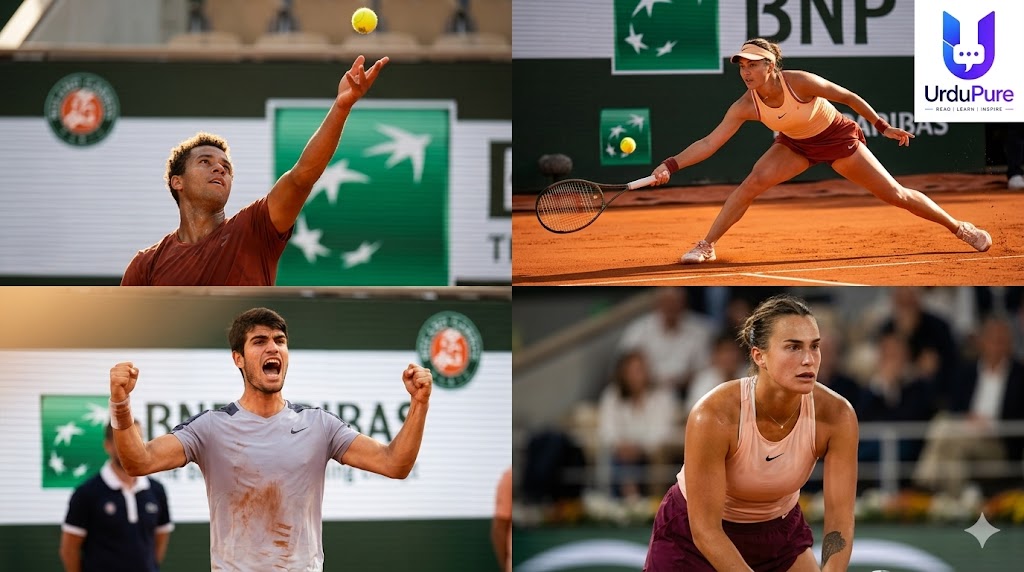
Roland Garros runs May 25 through June 8. The orange clay is already producing the upsets, comebacks, and breakthroughs that make the French Open the Grand Slam that rewards patience, physicality, and the specific mental resilience of clay court tennis. While Novak Djokovic and Carlos Alcaraz provide the men's headline narrative, and Aryna Sabalenka navigates the women's draw as the favourite who can be beaten, the tournament's most compelling daily stories are arriving from four players who are trending across search engines for very different reasons.
Jesper de Jong — a Dutch qualifier producing results that have the ATP analyst community running for their historical comparison databases. Mirra Andreeva — an 18-year-old Russian who reached the semi-finals here a year ago and is playing like the draw's destiny this week. Belinda Bencic — a former Grand Slam champion returning to elite competition after having a baby, winning on clay in 2026 in ways that are quietly extraordinary. And Jil Teichmann — the left-handed Swiss baseliner who has been one of the women's draw's most consistent performers deep in the tournament.
This is the guide to understanding each of them — and why their 2026 Roland Garros stories deserve your attention beyond the marquee names at the top of the draw.
Jesper de Jong: The Dutch Qualifier Nobody Saw Coming
Who He Is
Jesper de Jong is a 24-year-old Dutch tennis player who entered Roland Garros 2026 ranked outside the top 100. That ranking puts him in the qualifier category — the brutal preliminary section of Grand Slam tournaments where players who didn't make the main draw directly compete across three best-of-three matches before a single point of official tournament play begins. Most qualifiers are eliminated in the first or second round of the main draw. The ones who aren't become stories.
De Jong has been a known quantity on the ATP Challenger circuit for several years — a clay court specialist whose game is built around a heavy topspin forehand, exceptional defensive running, and a willingness to engage in the prolonged baseline exchanges that Paris clay demands. His results at Challenger level have been excellent; his transition to Grand Slam success was the missing piece.
What He's Done at Roland Garros 2026
De Jong has gone deep into the Roland Garros 2026 main draw — the specific round he's reached is generating enormous search traffic because Dutch tennis fans, following a significant national sporting tradition that includes Robin Soderling-era French Open excitement, have discovered a player in their countrymen worth watching.
His game on clay has a specific quality that Grand Slam draws expose in unexpected players: he constructs points patiently, never hitting for the lines when the ball is in neutral territory, and waits for the opponent to create the opening before committing to a winner. This is textbook clay court tactics — and it's the approach that wears down opponents who expect easy winners and find instead another heavy ball coming back to their backhand corner.
The "Jodar" Search Connection
The "jodar" search trending alongside de Jong likely reflects Spanish-speaking audiences searching for his name phonetically — "de Jong" rendered as "Jodar" through the specific patterns of voice search and phonetic approximation that multilingual tennis audiences produce. This is a useful signal: his results are generating search traffic from Spanish-speaking markets including the Dominican Republic and Spain, indicating a broader cross-linguistic interest in his run.
The Path Ahead
For a qualifier to win Roland Garros would require winning 10 consecutive matches — qualifying rounds plus seven main draw rounds — a feat achieved only once in the Open Era (Mats Wilander, 1982, though under different qualifying structures). De Jong's realistic ceiling in 2026 is a deep run that transforms his ATP ranking, establishes him as a clay court contender for future seasons, and gives Dutch tennis its most celebrated individual Grand Slam performer in recent memory. At 24, if the clay court game that's working in Paris is genuinely repeatable, the Roland Garros 2026 run is the beginning of something rather than its peak.
Mirra Andreeva: The 18-Year-Old Who May Be Destined for This Title
Who She Is
Mirra Andreeva is 18 years old. She is ranked in the top 10 of women's tennis. She reached the Roland Garros semi-finals in 2025 at the age of 17 — becoming the youngest player to reach a French Open semi-final since the 1990s. And in 2026, she is back at the tournament where she announced herself to the world, playing in her second consecutive French Open as a legitimate contender rather than a precocious teenager getting further than expected.
The distinction matters enormously. The first deep run is surprise. The second consecutive deep run is evidence of something structural — a game built for clay, a competitive temperament that doesn't buckle under the weight of expectation, and a tennis intelligence that players accumulate across years, not months. Andreeva at 18 has all three.
Her Game on Clay
Andreeva's clay game is built around a foundation unusual for her age: she constructs points with the patience of a player 10 years her senior, using her left-hand/right-hand swing pattern (she plays right-handed but leads with a southern hemisphere-influenced swing that creates unusual angles) to wrong-foot opponents who expect conventional ball direction.
Her backhand cross-court — heavy, deep, and hit with a consistency that has made it one of the most reliable shots in the women's game — is her primary rally weapon. Her forehand up the line is her finishing shot. The combination produces a tennis that is complete without being spectacular, efficient without being cautious, and mature without being conservative.
The Title Question
Can Mirra Andreeva win Roland Garros 2026? The analytical answer, based on the draw's structure and her current form, is: yes, specifically yes, more than any other player outside of Aryna Sabalenka. The betting markets have her as a clear second favourite. The clay specialist community — coaches, analysts, former champions — speak about her in terms usually reserved for players who have already won a Grand Slam. The momentum of a 17-year-old who reached the semi-finals maturing into an 18-year-old who can win it is exactly the trajectory that Grand Slam championships are built from.
The historical precedent that she and her team will be acutely aware of: Monica Seles won Roland Garros at 16. Iga Świątek won it at 19. Andreeva at 18 is not an outlier in the timeline of clay court prodigies winning Paris.
Belinda Bencic: The Most Remarkable Comeback Story on the Tour
The Maternity Return
Belinda Bencic won the Tokyo Olympic gold medal in 2021. She was ranked in the top 5 of women's tennis. She took time away from the tour to have a baby — her daughter Bella, born in early 2024. And now she is back, playing Roland Garros 2026, competing at Grand Slam level after one of the most complete post-maternity returns to elite sport that women's tennis has seen.
The conversation around elite female athletes returning from maternity leave in professional sports carries a weight that goes beyond sport. Every match Bencic wins in 2026 contributes to the expanding body of evidence that elite athletic careers and motherhood are not mutually exclusive — evidence that female athletes from the next generation will cite when they make their own decisions about family and career.
Bencic's specific contribution to this evidence is more compelling than a simple return: she is not merely competing, surviving at Grand Slam level on goodwill and reputation. She is winning matches. On clay — a surface that demands exceptional physical conditioning and footwork that was arguably more demanding to rebuild post-pregnancy than the fitness required for hard court play. Her Paris wins in 2026 are earned, not gifted.
Her Playing Style and What Makes Her Clay Game Work
Bencic is a Swiss player in the tradition of Swiss tennis excellence — technically precise, tactically intelligent, mentally disciplined. Her game is built around a flat, penetrating backhand that punches through the clay's slower bounce faster than opponents can adjust, and a net game (increasingly rare in the women's tour's baseline-dominant era) that she uses selectively but effectively to shorten points when the opportunity presents itself.
The physical work required to rebuild match fitness after childbirth, return to a sport that demands explosive movement in all four directions from a standing start, and do it at Grand Slam level has been documented in the Swiss media with a specificity that respects both the athletic achievement and the human dimension. Her coach and physical trainer have both spoken publicly about the 18-month process that preceded her 2026 return to the tour.
What a Deep Run at Roland Garros Would Mean
A quarter-final or better at Roland Garros 2026 would be the single most symbolic result in recent women's tennis — proof of concept that the return pathway from elite sport through maternity and back to competition can include Grand Slam excellence, not merely Grand Slam participation. The professional and personal significance is intertwined in a way that makes Bencic's Paris matches some of the most emotionally loaded of the tournament's fortnight.
Jil Teichmann: The Left-Hander Who Keeps Winning When Nobody's Watching
Who She Is
Jil Teichmann is a 27-year-old Swiss tennis player — a left-handed baseliner whose game is built around serve and return patterns that left-handedness creates advantageously in the women's game. She reached the US Open final in 2021 and the Australian Open final in 2022 — a finalist at two different Grand Slams in consecutive years, which by any reasonable measure should have made her a household name. The tennis world's relatively narrow media spotlight meant that neither result generated the coverage proportional to the achievement.
At Roland Garros 2026, Teichmann is playing the kind of consistent, professional clay court tennis that her game has always been capable of producing — using her left-hand serve wide in the deuce court (the angle that troubles right-handed opponents most), building rallies with her heavy topspin forehand, and closing points at the net with the efficiency of a player who has been to Grand Slam finals and knows how the opportunity cost of an unforced error feels at that stage.
Why She's Trending Now
The specific search spike for Teichmann in the current trending data reflects a match result that has surprised casual tennis followers — a player ranked below the top 20 who has beaten someone ranked significantly higher, in the manner that Roland Garros's clay surface regularly enables. Her trending status is real-time evidence of a result that has just happened rather than a narrative that has been building — which is exactly the kind of moment that produces the search volume spike visible in today's data.
How to Watch Roland Garros 2026 — Full Broadcast Guide
United States
NBC Sports and Tennis Channel: Primary linear broadcast for US audiences across the fortnight
Peacock Premium: Streaming access with NBC Sports integration; all-court coverage available at Premium tier
Tennis Channel Plus: The most comprehensive coverage option for US subscribers who want all courts across all rounds; subscription required beyond the Tennis Channel basic tier
United Kingdom
ITV1 and ITV4: Free-to-air coverage of selected matches, typically the last four rounds and finals
Eurosport 1 and 2: Comprehensive pay-TV coverage of all courts throughout the fortnight; available through Sky, Virgin Media, and standalone Eurosport subscription
Discovery+: Streaming access to Eurosport content including Roland Garros; subscription from £3.99/month
Global
Roland Garros Official Website (rolandgarros.com): Free streaming of selected early-round matches on the official site; Court Philippe-Chatrier matches from the quarter-finals onward require a subscription to the Roland Garros digital pass
Amazon Prime Video: Selected coverage for Prime subscribers; check regional availability as rights vary by country
Dominican Republic and Caribbean
ESPN Caribbean: Roland Garros broadcast rights for the Caribbean region; check local cable package listings for channel number
DirecTV Sports: Latin American coverage including Roland Garros via DirecTV's sports package
The Big Picture: What Roland Garros 2026 Is Actually About
The four players generating the most search traffic in this analysis — de Jong, Andreeva, Bencic, Teichmann — have almost nothing in common technically or biographically. What they share is the specific quality that Roland Garros's clay rewards above all others: the ability to stay present across long rallies, long matches, and a long fortnight without the mental shortcuts that faster surfaces allow.
De Jong's qualifying journey. Andreeva's compressed generational timeline. Bencic's return from a different kind of life challenge. Teichmann's persistent excellence without sufficient recognition. Each story is, in its own way, an argument about what tennis at this level actually requires — not the pure athletic gifts that make highlight reels, but the sustained commitment to a specific kind of excellence that only clay court tennis, across two weeks in Paris, fully tests.
Roland Garros 2026, Jesper de Jong French Open, Mirra Andreeva Roland Garros 2026, Belinda Bencic comeback maternity, Jil Teichmann 2026, French Open results today, de Jong tennis qualifier, Roland Garros women's draw, how to watch French Open 2026, clay court tennis players to watch




Discussion
Comments
Approved comments are published after moderation to keep discussion useful and spam-free.
No comments yet. Start the discussion below.