From digital hardware fixes to autonomous fleets launching in global megacities, the automotive industry is undergoing its most significant structural operating shift in decades.
The lines between the technology sector and the automotive industry have dissolved. mechanical horsepower is no longer the primary differentiator; in 2026, competitiveness is measured in processing power, battery unit economics, and autonomous safety validation.
As we enter the second half of the year, major global automakers are aggressively restructuring their fundamental operating models. Whether you are an EV enthusiast, an investor, or planning your next vehicle purchase, these are the five critical technology trends defining 2026.
1. The Era of the "Software-Defined Vehicle" (SDV) and Zonal Architecture
Automakers are accelerating the transition to SDVs, giving them centralized digital control over virtually every automotive function.
This shift moves vehicles away from dozens of separate, disconnected ECUs (Electronic Control Units) toward 3–5 powerful central domain controllers connected by high-speed Ethernet. This hardware simplification is the enabler for SDV capabilities.
The Impact on Ownership:
пост-purchase Upgrades: Your vehicle becomes upgradeable for years.
Instead of waiting for a new model year, you buy a software patch. OTAs Replace Recalls: Over-the-Air (OTA) updates can now deploy code tweaks to rectify physical hardware behavior, potentially saving automakers billions in physical recall costs.
The Subscription Model Booms: Automakers are locking premium features behind paywalls.
Examples include: Performance boosts (e.g., faster 0-60 times).
Advanced Driver Assistance Systems (ADAS) capabilities (e.g., highway hands-free).
Premium infotainment and gaming packages.
2. Battery Evolution: Lowering the Cost of Entry
The electric vehicle market is currently undergoing a massive structural shift in its battery supply chain to optimize unit economics. The singular goal is driving down the entry-level cost of EVs to match internal combustion engines (ICE).
The Pivot to LFP (Lithium Iron Phosphate)
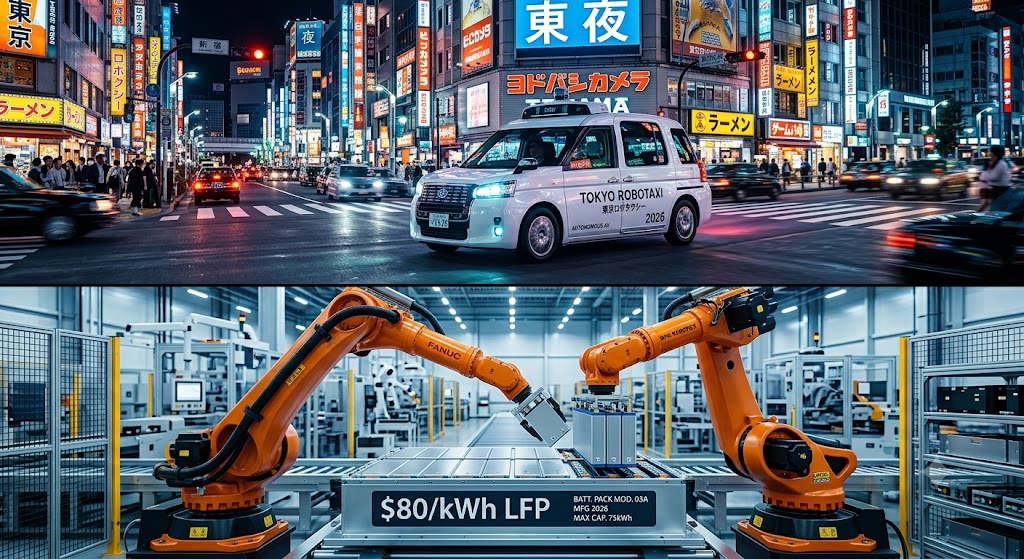
In 2026, North American automakers have largely adopted LFP chemistry for economy models. LFP eliminates costly nickel and cobalt, making entry-level vehicles significantly more affordable.
| Battery Type | Cost (2026 Est.) | Energy Density (Cell) | Key Characteristics |
| LFP (Iron Phosphate) | ~$80–$100/kWh | 160–190 Wh/kg | Lowest cost, extreme longevity (3000+ cycles), highly durable, charges to 100% daily. |
| NMC/NCA (Nickel-Based) | ~$120–$150/kWh | 250–300 Wh/kg | Longest range, higher performance, faster charging, prefers 80% daily charge cap. |
The LMR (Lithium Manganese-Rich) Horizon
While LFP is the 2026 reality, the next leap is already visible. General Motors has formalized plans to transition to LMR batteries toward the end of the decade.
3. Waymo and the Massive Robotaxi Expansion
Driverless vehicles are no longer a futuristic concept confined to test tracks; they are a present-day reality rapidly scaling across metropolitan areas.
Global 2026 Scaling
Throughout 2026, Waymo is executing its largest simultaneous expansion, actively deploying fleets in over 20 new global cities, including major hubs like London, Tokyo, and Seoul, alongside new US markets like Las Vegas and San Diego.
The Safety and Liability Balance
While skeptics exist, data submitted to the Traffic Injury Prevention Journal reveals that Waymo’s autonomous vehicles are involved in significantly fewer injury-causing collisions compared to human-operated benchmarks.
However, the "expert consensus" bottleneck in 2026 isn't raw capability; it’s the legal validation of rare "edge cases." Regulatory bodies are currently debating how to standardize liability when an autonomous system makes an error a human never would, such as stopping abruptly for a shadow.
4. Advanced High-Speed Collision Avoidance Becomes Standard
Vehicle safety systems have made rapid technological leaps, specifically concerning automatic emergency braking (AEB) capabilities. AEB technology is now scaling to save lives at deadlier, higher speeds.
In 2025, the IIHS tested AEB systems at elevated speeds ranging from 31 to 43 mph. Of the 30 vehicles tested, 22 secured a "good" or "acceptable" rating.
"Good" Performers: These vehicles flawslessly avoided a target passenger vehicle and the majority successfully prevented a collision with a motorcycle.
"Acceptable" Performers: These systems effectively warned drivers and prevented crashes in most low-speed trials, but their performance dropped off at higher speeds.
This testing confirms that AEB is reducing the odds of major, high-speed accidents, forcing automakers to standardize advanced camera and radar/LiDAR systems even on economy trims.
5. Smart Manufacturing on the Factory Floor
Behind the scenes, the actual construction of these vehicles is transforming.
In 2026, leading automakers are deploying:
Generative AI "Copilots": These systems assist plant personnel in drastically reducing troubleshooting time during complex machinery maintenance.
Private 5G Networks: Ultra-reliable, low-latency connectivity is now mandatory to manage massive automated guided vehicle (AGV) assembly systems.
The Bottom Line:
The 2026 automotive landscape is defined by the seamless integration of zonal hardware architecture, smart safety systems, and hyper-efficient manufacturing. As AEB systems standardize high-speed crash avoidance and automakers refine $80/kWh LFP packs, the modern vehicle is rapidly becoming the most sophisticated piece of technology the average consumer will ever own.