By Julian Sterling | July 19, 2026
For decades, the integration of robotics into automotive manufacturing was a slow, highly choreographed dance. Traditional robotic arms required massive capital investment, completely redesigned factory floors, and years of union negotiations before a single unit was installed. But the arrival of the modern, bipedal humanoid robot—designed to seamlessly step into human workspaces without requiring factory reconfiguration—has violently accelerated that timeline.
Now, that acceleration has triggered a historic breaking point.
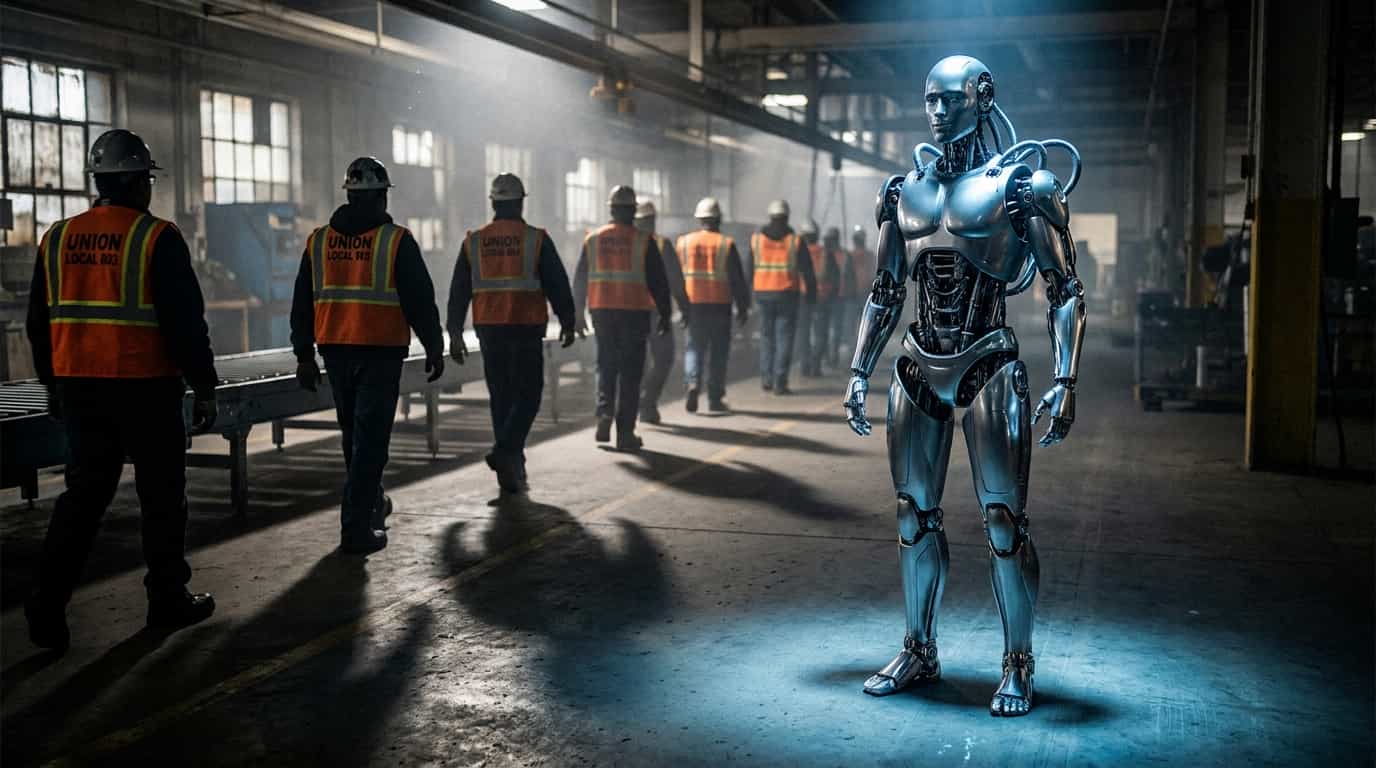
From July 13 to 15, Hyundai Motor’s 40,000-member South Korean labor union launched a three-day rolling strike. With 34,000 workers staging four-hour daily walkouts, it marks the very first time an automotive factory has been shut down explicitly over the planned deployment of humanoid robots.
The work stoppage has severely disrupted production at Hyundai's Ulsan assembly complex—cutting global volume by an estimated 5,000 vehicles and costing the automaker over $134 million in lost sales. As the AI arms race spills out of the server farm and onto the factory floor, the dispute in South Korea serves as a critical warning for the entire global manufacturing sector.
1. Background & Context: The Atlas Invasion Plan
The strike is a direct response to a massive automation roadmap unveiled by Hyundai Motor Group this past May. Having finalized a full buyout of Boston Dynamics from SoftBank, Hyundai executives presented a highly aggressive deployment plan to investors.
The automaker intends to deploy more than 25,000 Boston Dynamics Atlas humanoid robots across its global factories. The phased rollout is slated to begin at Hyundai's non-union Metaplant in Georgia by 2028, expanding to component assembly and complex operations by 2030.
The Korean Metal Workers Union, which represents the Hyundai employees, authorized the strike following what leadership characterized as a total lack of consultation regarding automation timelines. Union secretary-general Byun Jun-hwan made the labor position absolutely clear: workers want strict safeguards, stating that the Atlas humanoid robot must never step onto a production line without employees agreeing to it first.
2. Technical Challenges: Why Humanoids Break the Rules
To understand why this specific class of robot has triggered such a severe labor response, you have to look at the form factor.
Industrial analysts note that humanoid robots completely eliminate the multi-million dollar reconfiguration costs associated with traditional automation. Because an Atlas unit has arms, legs, and hands, it can theoretically walk into an existing workstation designed for a human, pick up the same tools, and perform the same tasks without any structural facility redesign.
This physical adaptability destroys the capital barriers that previously gave unions leverage. Historically, the immense cost and time required to build specialized robotic cells extended negotiation windows, giving labor representatives years to secure workforce transition agreements. With humanoids, deployment timelines are suddenly measured in months, not years.
Furthermore, while Hyundai executives previously stated that humanoid integration would focus purely on ergonomically challenging tasks, union documents reportedly suggest pilot programs were scheduled to place up to 60 Atlas units into full-time roles currently staffed by human workers.
3. Expert Commentary: The "Employment Shock"
The core of the dispute rests on how companies define "workforce restructuring" in the age of embodied AI.
The union is bracing for an "employment shock," demanding that management provide guaranteed employment and working conditions tied directly to AI and factory automation. Specifically, union negotiators are demanding a six-month moratorium on humanoid deployments, entirely company-funded retraining programs, and a binding commitment that no current assembly worker will face termination due to automation through 2029.
Management has thus far balked at these terms. Hyundai views the union's demands for AI-related employment guarantees and workforce restructuring limits as highly challenging. Adding fuel to the fire, the union previously rejected a management counteroffer that included monthly raises and performance bonuses, indicating that cash compensation is no longer enough to buy labor peace when existential job security is on the line.
4. Scenario Analysis: The Economics of the Biped
Why is Hyundai pushing so hard, so fast? The unit economics of mass-produced humanoid robots are simply too lucrative for automakers to ignore.
The Optimistic Case for Automakers: Early production units of Atlas currently cost between $130,000 and $140,000. However, Hyundai projects that once cumulative production exceeds 50,000 units, the per-unit cost will plummet to roughly $30,000. If an automaker can replace a $70,000-a-year human worker (who requires benefits, breaks, and pensions) with a $30,000 robot that can operate in the dark, 24/7, the margin expansion is monumental.
The Neutral Case (The Hybrid Floor): Management and labor reach a tense compromise. The union secures its six-month moratorium and retraining guarantees. Humanoids are slowly integrated, but strictly relegated to heavy-lifting logistics and hazardous chemical handling, preserving human headcount on the final assembly line.
The Pessimistic Case for Labor: Hyundai leverages its non-unionized U.S. operations to bypass South Korean labor resistance. The automaker proceeds with its $26 billion commitment to U.S. operations—which includes a new robotics factory capable of churning out 30,000 robots annually—and shifts higher volumes of automated production overseas, gradually starving the unionized plants of future investment.
5. Risks & Trade-offs: The Global Precedent
What makes the Hyundai strike so critical is that it is the first of its kind, but almost certainly not the last.
Other automakers are already introducing humanoid technology. Mercedes-Benz announced pilot deployments of Apptronik Apollo units at its Alabama plant earlier this year, and Stellantis is integrating Agility Robotics' Digit humanoids for parts delivery. While those deployments haven't triggered strikes yet, United Auto Workers (UAW) leadership has already explicitly stated that humanoid deployment will be a central, highly contested priority in their 2027 contract talks.
The risk for manufacturers is that deploying robots too aggressively fractures their current workforce before the technology is fully capable of running the line independently.
6. Future Outlook: The Bottom Line
Negotiations between the Hyundai union and management are scheduled to resume shortly, with the proposed six-month robot moratorium acting as the primary wedge issue. Meanwhile, automotive industry conferences scheduled for the fall have hastily added sessions dedicated entirely to humanoid integration and labor relations.
The Bottom Line:
For years, tech CEOs have promised that humanoid robots would simply take over the "dull, dirty, and dangerous" jobs that humans didn't want to do anyway. The 34,000 auto workers currently refusing to build cars in South Korea suggest a very different reality. The technology has matured, the economics are viable, and the battle over who gets to physically build the future has officially begun.