
The Invisible Layer of Technology That Is Quietly Reshaping Business
Beyond the Interface: The Rise of AI Middleware
When future historians write the definitive account of the mid-2020s digital revolution, they will likely note a fascinating paradox: the technology that had the greatest economic impact on global business was the technology nobody actually saw.
For the past few years, the public face of artificial intelligence has been the user-facing interface—the conversational chatbot, the generative design window, the flashing text prompt. However, standard human-to-computer text windows are inherently bottle-necked by human speed.
The real transformation is occurring deep within the enterprise tech stack. A complex, hidden ecosystem of backend orchestration fabrics, state runtimes, and standardized data-routing infrastructure has emerged. This is the invisible layer of technology, and it is quietly rewriting how modern corporations function.
What Comprises the Invisible Layer?
The invisible layer can be thought of as a new form of cognitive middleware. It sits precisely between raw large language models (LLMs) and a company's fragmented data ecosystem (such as ERPs, CRMs, cloud storage, and legacy codebases).
Rather than requiring a human to manually copy information from an email, paste it into an AI tool, review the result, and manually update a database, this hidden infrastructure acts as an autonomous routing fabric.
From Chatbot Wrappers to Graph State Engines
Traditional Approach (The API Mesh): Disconnected applications requiring custom, brittle API configurations for every single interaction. If one application changes its output format, the entire integration breaks.
The Invisible Layer Alternative (The Orchestration Fabric): AI models natively read and write data across multiple systems by dynamically invoking tools managed by central state machines, maintaining stability even when underlying data formats shift.
Three Invisible Pillars Re-engineering Enterprise Workflows
1. The Model Context Protocol (MCP)
Historically, the primary bottleneck in scaling enterprise AI was integration. Software engineers had to write custom API connectors to allow an AI model to read data from a secure database or write data to an internal application.

This friction has been largely solved by the widespread adoption of open-source connectivity standards, most notably the Model Context Protocol (MCP). MCP provides a universal, standardized plumbing blueprint for how an autonomous agent securely requests data from a repository and feeds it back into an LLM framework. By decoupling the interface from the data source, MCP allows developers to plug secure corporate data directly into various AI engines with zero custom coding overhead.
2. Stateful Graph Routing (LangGraph & Runtimes)
Early automation pipelines were strictly linear: if X happens, execute Y. But real business operations are messy, conditional, and full of edge cases.
The invisible layer leverages stateful graph routing engines, such as LangGraph and state-machine frameworks. These platforms structure business logic as interactive, directed graphs.
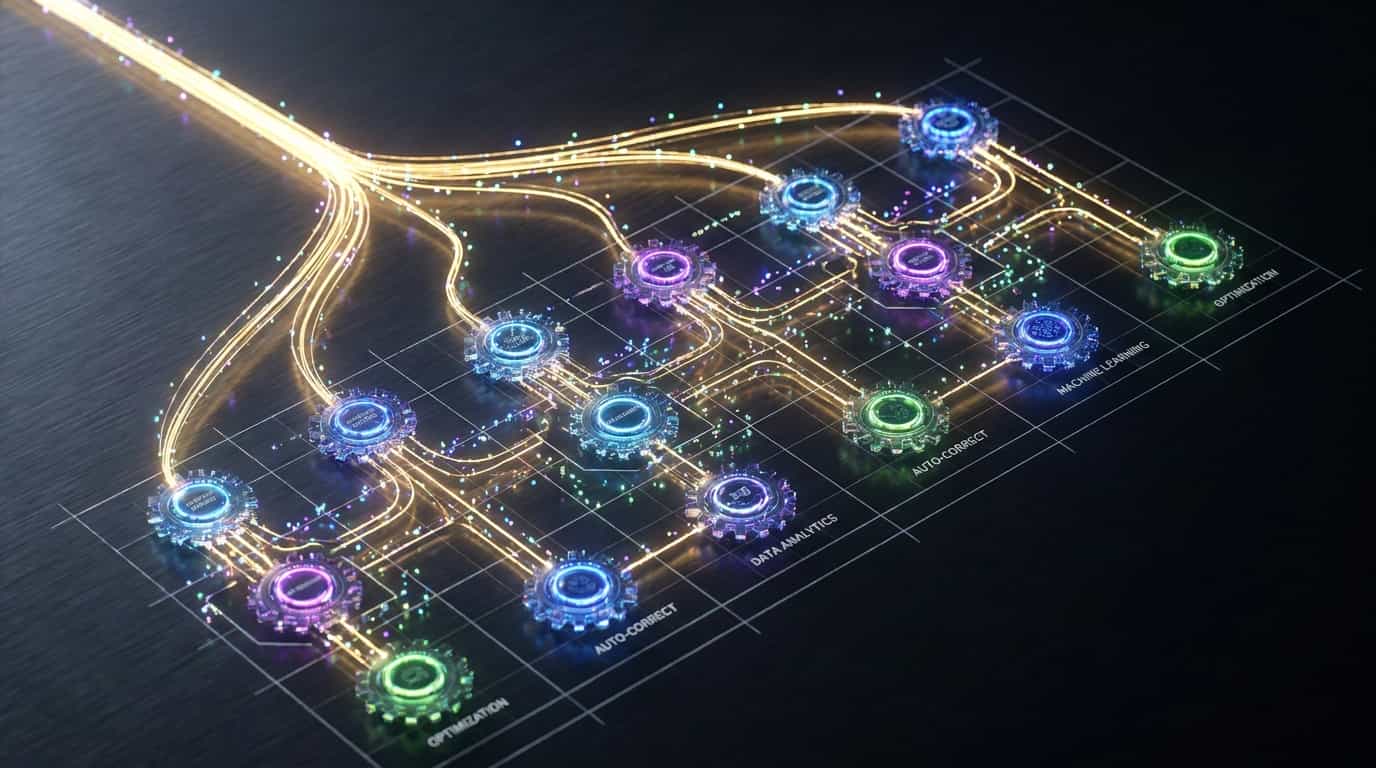
How it works in practice: An orchestrator agent receives a high-level corporate objective, breaks it down into a visual map of sub-tasks, delegates those tasks to highly specialized sub-agents, monitors their outputs for errors, and self-corrects the route in real-time if an unexpected variable occurs—all completely backgrounded from human oversight.
3. Guardian Enclaves and Token FinOps
Because these backend autonomous agents operate continuously across cloud servers, unchecked runtime loops can quickly incur thousands of dollars in unexpected API token expenses.
To mitigate this, companies are installing quiet monitoring wrappers:
Guardian Agents: Autonomous auditing systems that inspect the input and output parameters of execution agents to prevent prompt injection and data leaks.
FinOps Routing Layers: Intelligent gatekeepers that dynamically route simple tasks to cheap, lightweight models, reserving expensive frontier models exclusively for highly complex reasoning challenges.
The Strategic Impact: Workflow Automation Over Task Automation
The true value of this invisible technology layer lies in its scope. Traditional software platforms automate isolated tasks (e.g., generating an invoice). The invisible layer automates entire, cross-departmental workflows (e.g., identifying a supply chain anomaly, cross-referencing vendor contracts, renegotiating an invoice delta via an autonomous procurement bot, and updating the ledger).
By turning corporate memory from a fragmented collection of siloed application databases into an active, interconnected knowledge graph, businesses are experiencing unprecedented optimization cycles. According to recent enterprise infrastructure studies, companies utilizing unified agentic middleware fabrics have observed an immediate 30% reduction in workflow latency and an exponential drop in software maintenance costs.
The Imperative for Corporate Leadership
For chief technology officers and business leaders, the strategic mandate has shifted. Building standalone, proprietary front-end AI tools is increasingly a race to the bottom. The sustainable competitive advantage now belongs to organizations that build robust, secure, and highly observable backend plumbing.
The businesses that successfully scale this decade will not be those with the flashiest user interfaces; they will be the ones that quietly and meticulously perfect the invisible layer connecting their data to the future of autonomous execution.
invisible technology layer, enterprise AI middleware, Model Context Protocol, MCP framework, LangGraph enterprise, stateful graph routing, autonomous routing fabric, backend AI orchestration, business workflow automation, token FinOps, AI governance 2026, cognitive middleware, legacy system integration