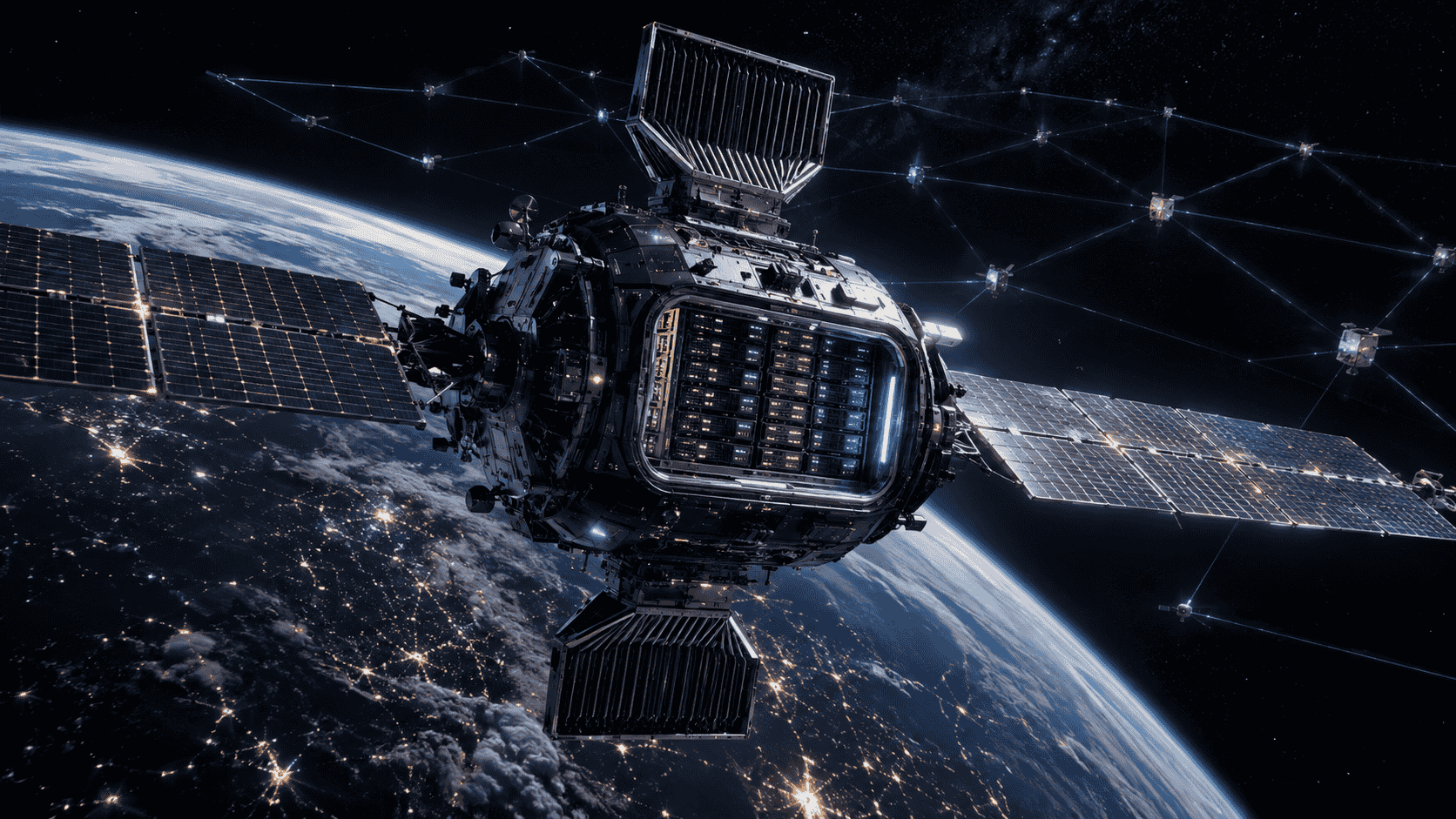
The traditional data center is facing an existential crisis. As the computational burden of generative artificial intelligence grows, the tech industry is migrating infrastructure into Low Earth Orbit to escape Earth's energetic and thermal constraints.
By Deep Tech & Aerospace Desk | Sunday, August 9, 2026
The traditional server infrastructure model is colliding with physical limits. As the computational burden of artificial intelligence grows exponentially, the tech industry is urgently seeking to decouple this growth from Earth's finite energy, land, and water resources.
In 2026, the paradigm of space-based AI data centers has decisively shifted from science fiction to tangible commercial validation. Through the integration of Orbital Edge Computing (OEC) and autonomous AI hardware, Low Earth Orbit (LEO) is transforming from a passive communication relay into a massive, decentralized computing engine. Here is a deep dive into the technology powering the orbital edge.
1. The Energy Crisis and The Vacuum Catalyst
The primary driver behind launching servers into space is thermal and energetic sustainability. Large-scale orbital compute concepts aim to utilize sun-synchronous "dawn-dusk" orbits to maximize access to solar power and reduce thermal cycling.
Operating in a vacuum fundamentally changes hardware design. Because there is no air to carry heat away, thermal management relies entirely on conducting heat to specialized radiators for dissipation. This unique environmental constraint has forced hardware manufacturers to prioritize "performance-per-watt" as a strict mandate, making highly efficient edge computing a requirement for survival in space.
2. Commercial Milestones of 2025-2026
The groundwork for this migration was aggressively laid over the last 18 months through a series of high-profile proof-of-concept missions:
- Starcloud's In-Orbit AI: In December 2025, Nvidia-backed Starcloud successfully trained an AI model in orbit for the first time using NVIDIA GPUs, validating the reality of in-space data processing.
- Axiom Space ISS Node: In August 2025, Axiom Space partnered with Red Hat and Microchip Technology to deploy an orbital data center (ODC) node to the International Space Station, creating a scalable LEO testbed for machine learning workloads.
- Specialized Hardware Integration: To handle AI processing, engineers are utilizing rugged, space-rated Small Form Factor systems, such as the S-A1760 Venus. This unit incorporates the NVIDIA Jetson TX2i System-on-Module to deliver 1 TFLOPS of compute at remarkable energy efficiency.
3. Collaborative Orbital Edge Intelligence (COEI)
Historically, OEC relied on centralized control mechanisms, which limited connectivity, caused high coordination overhead, and drained satellite batteries. In 2026, the industry is pivoting toward a decentralized networking model known as Collaborative Orbital Edge Intelligence (COEI).
Under the COEI paradigm, LEO satellites belonging to completely different corporate providers can collaborate dynamically without a centralized controller. This allows for the creation of multi-party, multi-orbit megaconstellations. This collaborative architecture is heavily paired with Federated Learning, allowing distributed machine learning models to train across decentralized space sources without ever needing to beam raw, high-volume data back to terrestrial servers.
4. Agentic AI: From Passive Sensors to Autonomous Decision-Makers
By moving intelligence directly to the point of action, satellites are no longer just passive cameras; they have evolved into autonomous agents.
- Intelligent Data Filtering: On-board AI drastically reduces bandwidth waste by discarding low-value telemetry, such as cloudy frames captured during routine Earth observation.
- Real-Time Crisis Response: Edge AI can immediately flag anomalies, surfacing urgent events like early wildfire signatures to first responders without waiting for ground-station processing, saving critical time.
- Mission Resilience: Autonomous systems allow spacecraft to maintain operations and navigate hazards independently, remaining fully functional even when terrestrial connectivity drops or goes dark.
5. Democratizing Terrestrial Connectivity
Beyond corporate logistics, OEC is fundamentally changing human communication at the edge. Traditional geostationary satellites operate roughly 36,000 kilometers above Earth, creating massive latency that makes real-time communication feel sluggish. Modern LEO satellites operate much closer, typically between 300 and 1,200 kilometers, dropping latency to levels that allow for near-instant interaction.
This mesh network makes advanced assistive technologies—such as real-time sign-language recognition—accessible even in deeply remote villages. By relying on local edge AI inference and LEO backhaul, sensitive audio and visual data never has to leave the user's personal device to be processed in a distant cloud, simultaneously ensuring maximum privacy and high-speed accessibility.
FAQ
Q: What is Orbital Edge Computing (OEC)?
A: OEC is a paradigm that equips Low Earth Orbit (LEO) satellites with specialized edge computing hardware, enabling on-orbit data processing and machine learning inference directly in space. This reduces latency by processing data in orbit rather than transferring massive raw files to terrestrial data centers.
Q: What was the first AI model trained in space?
A: In December 2025, Starcloud, backed by NVIDIA, achieved a major milestone by successfully training an AI model in orbit for the first time utilizing NVIDIA GPUs.
Q: What is Collaborative Orbital Edge Intelligence (COEI)?
A: COEI is a decentralized networking approach where LEO satellites from various providers collaborate to process data without relying on a centralized ground controller. This allows for the creation of multi-party megaconstellations that handle data more reliably and energy-efficiently.