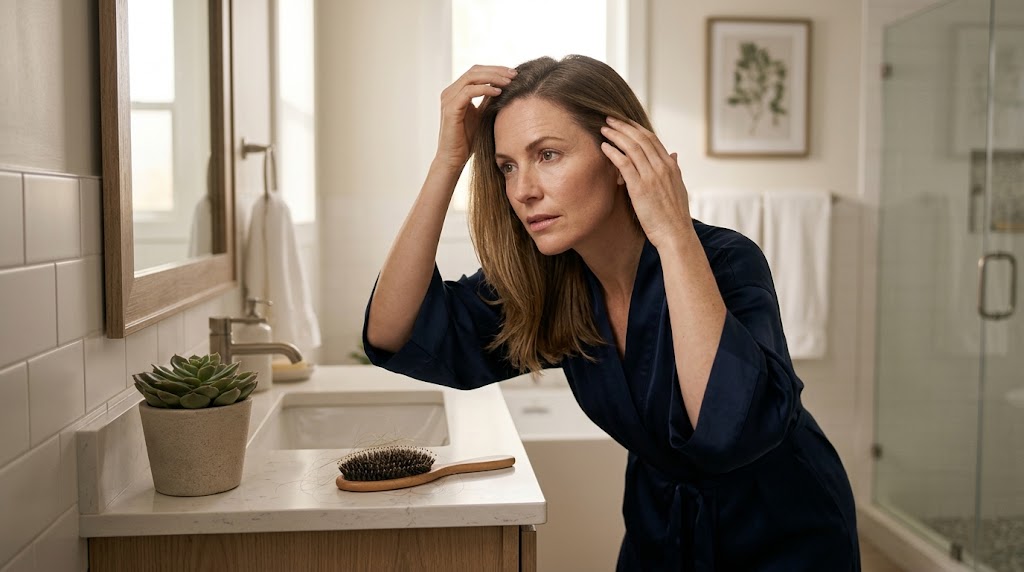
Something is happening in bathrooms around the world.
More hair in the shower drain. More strands caught in brushes. More people photographing their hairline under harsh bathroom lights and wondering whether the part in their hair looks wider than it did six months ago.
And more people are searching for answers.
Recent consumer data cited by Vogue shows Google interest around hair loss has risen sharply, while major beauty retailers have also reported strong growth in sales of hair-loss and scalp-care products. What was once marketed mainly as an ageing man's problem has become a mainstream concern involving women, younger consumers, wellness shoppers and people undergoing rapid weight loss.
But there is an important problem.
“Hair loss” is not one condition.
Stress can trigger shedding. Genetics can gradually shrink follicles. Hormonal changes can affect growth cycles. Illness, childbirth, nutrition, autoimmune disease, hairstyles and medications can all play roles.
And now another factor has entered public conversation:
GLP-1 weight-loss drugs.
Hair Loss and Hair Shedding Are Not Always the Same Thing
Seeing extra hair fall out can be frightening, but dermatologists distinguish between several different processes.
The American Academy of Dermatology notes that people normally shed roughly 50 to 100 hairs a day. A temporary increase in shedding can occur after major physical or emotional stress and is commonly called telogen effluvium.
That stressor can be dramatic illness or surgery.
But it can also be:
rapid weight loss,
childbirth,
major psychological stress,
or another significant change in the body.
The unusual part is timing.
The shedding may not begin immediately.
Someone can experience a major stressor and only notice increased hair falling out months later.
That delay can make identifying the trigger surprisingly difficult.
Why Rapid Weight Loss Matters
Hair is biologically expensive.
Your body has more urgent priorities than maintaining thick hair during periods of major physiological change.
If energy intake falls rapidly, weight drops quickly, protein consumption changes or nutrient intake becomes inadequate, hair growth cycles can shift.
More follicles may enter a resting stage.
Months later, those hairs shed.
This is one reason dramatic dieting has long been associated with temporary hair shedding.
But the enormous popularity of GLP-1 medicines has brought the issue to a much larger audience.
What Does the Research Say About GLP-1 Drugs?
A 2026 systematic review examining GLP-1 therapies found that semaglutide and tirzepatide appeared most frequently in reports involving hair loss, with telogen effluvium and androgenetic alopecia among the patterns identified.
The authors emphasized that rapid weight loss may be an important contributor and that stronger prospective research is still needed to establish exactly why the association occurs.
A separate 2026 meta-analysis covering nine interventional studies and 4,114 GLP-1 users found a higher reported risk of hair loss among users compared with placebo groups. The pooled event rate in its single-arm analysis was approximately 3.9%.
That deserves attention.
But it does not mean every person who takes these medicines will lose their hair.
Nor does it prove that the drug molecule itself is always the cause.
The American Academy of Dermatology says sudden weight loss, reduced food intake and potential nutritional changes are among the possible explanations and notes that researchers still need more evidence to determine the mechanisms.
Stress Is Still a Major Part of the Story
Weight loss is only one factor.
Psychological stress can also push more hairs into a shedding phase.
The American Academy of Dermatology identifies stressful events—from serious illness to bereavement and intense work pressure—as potential triggers for telogen effluvium.
That matters because modern hair anxiety can create its own feedback loop.
You notice shedding.
You become anxious.
You examine your scalp constantly.
You photograph it.
You compare today's image with last month's.
You search online.
The anxiety increases.
And stress itself may already be one of the factors influencing your hair cycle.
Social Media Has Turned the Scalp Into a New Beauty Category
Beauty marketing used to focus heavily on the visible strand.
Shampoo made hair shiny.
Conditioner made it soft.
Styling products controlled shape.
Now the industry increasingly talks about the scalp.
Serums.
Exfoliants.
Growth products.
Supplements.
Red-light devices.
Scalp massagers.
Hair-density tracking.
The language increasingly resembles skincare.
That commercial shift reflects a deeper change: consumers are treating hair preservation as a long-term wellness project rather than simply using products to make existing hair look better.
The danger is that an anxious consumer can easily spend large amounts of money treating the wrong problem.
Hair shedding caused by a temporary stressor is not identical to hereditary pattern hair loss.
An autoimmune condition is different again.
So is breakage caused by chemical or mechanical damage.
Not Every Viral Hair Product Has Strong Evidence
The size of the market creates an obvious incentive.
If millions of people are frightened about losing hair, there is enormous money in promising to stop it.
That means consumers encounter:
oils,
vitamins,
gummies,
shampoos,
serums,
laser devices,
scalp treatments,
and influencer routines.
Some treatments have meaningful clinical evidence for specific forms of hair loss.
Others have considerably weaker evidence.
And something being described as "natural" tells you almost nothing about whether it addresses the biological reason your hair is thinning.
The first useful question is therefore not:
“What should I buy?”
It is:
“What type of hair loss or shedding is actually happening?”
Nutrition Matters—But More Is Not Automatically Better
Hair requires nutrients.
But that does not mean swallowing more supplements necessarily creates more hair.
Deficiencies in certain nutrients can contribute to hair problems, and people undergoing substantial dietary change may need their nutrition assessed.
But taking large quantities of supplements without knowing whether a deficiency exists can be unnecessary and, in some cases, harmful.
The smarter approach is diagnosis before supplementation rather than allowing social-media algorithms to diagnose your scalp.
Why Women Are Driving More of the Conversation
Hair loss has historically been advertised as a male problem.
That was always incomplete.
Women experience pattern hair loss, postpartum shedding, hormonal changes, autoimmune hair loss and temporary shedding after physiological stress.
What has changed is visibility.
Women are discussing it openly.
Before-and-after photographs circulate widely.
Hair toppers and extensions are discussed without the secrecy they once carried.
Dermatologists and creators talk openly about thinning.
And GLP-1-associated concerns have brought another large population into the discussion.
The result is a cultural shift.
Hair loss is moving from something people quietly hide toward something they actively research.
When Is Hair Shedding Worth Getting Checked?
A sudden change deserves attention if it is significant, persistent, patchy, painful or accompanied by scalp inflammation or other symptoms.
A dermatologist or appropriate medical professional can distinguish between different forms of hair loss far more reliably than a viral video can.
That is particularly important because earlier diagnosis can matter for conditions where ongoing follicle damage may eventually become difficult to reverse.
The Bigger Story Is Not That Everyone Is Going Bald
Search trends can make a concern look universal.
It isn't.
The more interesting story is that several modern trends have collided at once:
rapid weight-loss treatments,
high stress,
greater health awareness,
beauty culture,
social-media comparison,
better public discussion of women's hair loss,
and a huge commercial scalp-care industry.
That combination has transformed hair into one of the newest wellness battlegrounds.
And perhaps the most useful thing consumers can learn from the trend is simple:
Hair falling out is a symptom, not a diagnosis.
Before buying the serum, supplement, laser helmet or miracle oil, find out what your hair is actually trying to tell you.
hair loss, thinning hair, hair shedding, telogen effluvium, GLP-1 hair loss, semaglutide hair loss, tirzepatide hair loss, stress hair loss, rapid weight loss hair loss, scalp health, female hair loss, hair growth
Why does it suddenly feel like everyone is talking about hair loss?
Search interest is climbing, scalp-care businesses are booming and new research is examining a possible connection between hair shedding, rapid weight loss and widely used GLP-1 medicines.
The surprising part: what looks like “hair loss” may actually represent several very different biological processes.