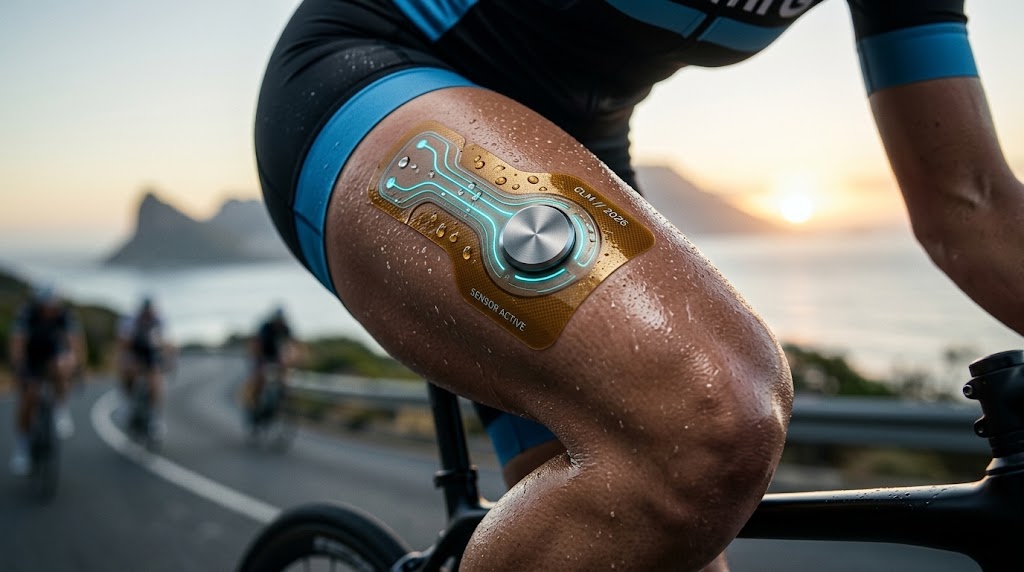
Heart rate tells you how hard the cardiovascular system is working. A lactate monitor may reveal something different: how the body's metabolism responds as intensity climbs. In 2026, continuous lactate sensing moved significantly closer to becoming a practical wearable—but sweat and blood are not interchangeable, and the technology is not yet a universal replacement for laboratory testing.
Beyond Heart Rate: Continuous Lactate Monitors Are Finally Leaving the Lab in 2026
For decades, serious endurance athletes stopped mid-test to prick a finger and measure blood lactate. In 2026, a new generation of wearable biosensors is trying to turn that single laboratory snapshot into a continuous metabolic movie.
By Deep Tech & Fitness Desk | Tuesday, September 8, 2026
Your smartwatch already knows a remarkable amount about you.
Heart rate.
Running pace.
Sleep.
Blood oxygen.
Skin temperature.
GPS distance.
Estimated VO₂ max.
Some watches can even produce an electrocardiogram.
But one of the most useful measurements in endurance physiology has stubbornly remained outside the mainstream wearable ecosystem.
Lactate.
For cyclists, runners, rowers and other endurance athletes, lactate testing has traditionally required blood.
An athlete increases exercise intensity.
A coach pauses the test.
A small blood sample is collected—often from a fingertip or earlobe.
The lactate concentration is measured.
Intensity increases again.
Another sample.
Repeat.
Those measurements help identify where the athlete's metabolism begins changing rapidly as exercise intensity climbs.
It is powerful information.
It is also inconvenient.
Now wearable companies and university laboratories are trying to remove the interruptions.
The objective is something sports science has wanted for years:
continuous lactate data while the athlete is actually moving.
In 2026, that idea became considerably more credible.
Commercial sweat sensors are appearing.
Peer-reviewed studies are showing that carefully processed sweat signals can estimate useful exercise thresholds.
And minimally invasive microneedle sensors have now tracked lactate continuously in real athletes while correlating strongly with conventional blood measurements.
The result could become one of the biggest changes in serious fitness wearables since continuous glucose monitoring.
But the science needs careful explanation.
First: Lactate Is Not the Enemy
For generations, athletes were taught a simple story.
Exercise becomes intense.
Muscles run out of oxygen.
“Lactic acid” builds up.
That causes burning and fatigue.
Modern exercise physiology has largely moved beyond that explanation.
Lactate is produced even under aerobic conditions.
It can be transported between tissues.
Muscles and the heart can use it as fuel.
The liver can recycle it into glucose.
It also appears to participate in cellular signaling and adaptation.
High lactate therefore does not simply mean:
your muscles are full of toxic waste.
During increasingly intense exercise, blood lactate rises when the rate of appearance begins exceeding the body's capacity to clear and oxidize it.
That makes lactate extremely useful as a marker of changing metabolic intensity.
It does not make lactate itself the sole cause of exhaustion.
A 2025 physiological review concluded that elevated lactate alone has relatively little direct detrimental effect on muscle force and that exercise fatigue results from several interacting processes.
That distinction matters because a wearable lactate monitor should not become another device telling athletes:
“Lactate bad. Lower number good.”
The value lies in the pattern.
Why Athletes Care About Lactate Threshold
Imagine gradually increasing cycling power.
At low intensity, lactate production and clearance remain relatively balanced.
As workload rises, the relationship begins changing.
Eventually blood lactate increases more rapidly.
Exercise physiologists use several related concepts—including lactate thresholds and maximal lactate steady state—to estimate intensities an athlete may be able to sustain and to guide training.
For an endurance athlete, knowing these transition points can help distinguish:
easy aerobic work,
sustainable tempo,
threshold training,
and much harder efforts.
The traditional method can be accurate.
But it produces snapshots.
A continuous monitor could show the curve between those snapshots.
That is the promise.
Why Heart Rate Isn't Enough
Heart rate remains incredibly useful.
It is inexpensive to measure.
Chest straps are highly mature.
But heart rate is an indirect indicator of metabolic workload.
It changes with factors including:
heat,
hydration,
fatigue,
stress,
caffeine,
altitude,
illness,
and accumulated training.
Two workouts performed at the same power output can therefore produce different heart-rate responses.
Lactate measures a different part of the physiology.
That does not mean lactate replaces heart rate.
The better future may be sensor fusion:
heart rate + power + pace + lactate + temperature + recovery data.
Instead of one imperfect metric, the athlete gets several views of the same effort.
The Big 2026 Divide: Sweat or Interstitial Fluid?
Continuous lactate technology is developing along two main paths.
The first is sweat sensing.
Completely non-invasive.
No needle.
The sensor sits against the skin and analyzes perspiration.
The second is interstitial-fluid sensing.
This resembles continuous glucose monitors more closely.
Tiny microneedles or filaments penetrate only a short distance beneath the skin to access fluid surrounding cells.
That approach is technically minimally invasive rather than fully non-invasive.
Both methods have advantages.
And importantly, they do not measure exactly the same thing.
IDRO Is Bringing Sweat Lactate Into a Commercial Wearable
One of the clearest consumer-facing examples is IDRO.
The company's system uses a skin-mounted cartridge connected to an electronic reader.
Sweat enters a microfluidic pathway.
It reaches electrochemical sensors.
The reader processes the electrical signal and streams lactate measurements to a smartphone over Bluetooth.
IDRO also measures sweat pH and temperature.
The company's current commercial system is listed for sale, rather than merely being a laboratory prototype. Its disposable cartridge can support measurements for up to around eight hours of exercise once sufficient perspiration is available.
IDRO says the technology was developed with extensive testing involving Olympic athletes and their support teams. That is a company claim, not independent evidence that Olympic organizations have universally adopted the product.
That distinction is worth preserving.
How the Sweat Sensor Works
The basic electrochemistry is clever.
Many wearable lactate biosensors use an enzyme such as lactate oxidase.
The enzyme reacts selectively with lactate.
That biochemical reaction produces an electrochemical signal.
Electrodes convert the chemistry into a tiny measurable current.
More lactate changes the signal.
A processor converts that into an estimated concentration.
Microfluidic channels are crucial because sweat on skin is messy.
Fresh sweat can mix with old sweat.
Sweat rate changes.
Evaporation changes concentrations.
Movement contaminates samples.
A well-designed microfluidic patch continually directs fresher sweat toward the sensing area instead of simply measuring a puddle sitting on the skin.
The technology resembles a miniature chemistry laboratory strapped to the body.
IDRO's 1–50 mmol/L Claim Needs Context
IDRO currently says its sensor can measure sweat lactate across approximately 1–50 mmol/L.
It also reports a strong correlation of R² = 0.95 when its sweat measurements were compared with ion chromatography, with differences of roughly 2–11%.
That sounds excellent.
But there is a very important distinction:
Ion chromatography validates whether the device measures lactate in sweat accurately.
It does not automatically prove that the sweat lactate value equals blood lactate.
Those are different biological questions.
Earlier peer-reviewed work behind the integrated sensor platform demonstrated a validated wearable range around 1–20 mM and showed continuous measurement in cyclists and kayakers.
So the accurate interpretation is:
IDRO has strong evidence that it can measure sweat lactate itself.
Converting that signal into the same physiological meaning athletes traditionally derive from blood requires another layer of validation.
Sweat Lactate Is Not Simply Blood Lactate Coming Through the Skin
This is probably the biggest misconception around CLMs.
Sweat glands can produce lactate locally.
Sweat rate changes its concentration.
Skin location matters.
Temperature matters.
Exercise intensity matters.
The delay before sweating begins matters.
A 2024 review of wearable lactate systems concluded that the relationship between sweat and blood lactate remains complex and that broader validation across sports is still needed.
A 2026 study comparing different biofluids made the problem especially clear.
Researchers found a strong correlation between interstitial-fluid lactate and blood lactate, with ρ = 0.93 in their small experiment.
Sweat lactate showed a much weaker relationship with blood lactate when treated directly.
That sounds like bad news for sweat sensors.
But researchers have found a possible solution:
don't interpret raw sweat concentration alone.
The Breakthrough May Be the Algorithm, Not the Sensor
A fascinating 2026 development comes from work that combines sweat chemistry with other physiological variables.
Instead of asking:
What is the lactate concentration in this drop of sweat?
researchers can also consider:
how fast sweat is being produced,
heart rate,
temperature,
and how the lactate signal changes over time.
In July 2026, researchers reported a wearable system that estimated sweat lactate excretion rate rather than relying only on concentration.
After correcting for sweat rate, the threshold heart rate identified by the sweat system closely matched the blood-lactate threshold, with a reported maximum difference of only 3 beats per minute in the study.
The authors still explicitly cautioned that the physiological meaning of sweat lactate remains under discussion.
That is important.
The technology is improving partly because researchers are learning that context matters as much as chemistry.
Another 2026 Study Reached an Even More Important Threshold Result
Researchers publishing in Medicine & Science in Sports & Exercise evaluated continuous, non-invasive sweat-inferred blood lactate against capillary blood sampling and gas-exchange measurements.
They examined whether the wearable approach could identify the second metabolic threshold and maximal lactate steady state.
The results showed close agreement.
For maximal-lactate-steady-state power, the average difference between capillary blood and the sweat-inferred method was just 2 watts, with a mean absolute percentage error of around 2.5%.
That is exactly the kind of evidence continuous lactate wearables need.
It moves the debate from:
Can we detect lactate in sweat?
to:
Can the signal tell athletes something they currently pay laboratories to measure?
The study did have industry links: several authors were employees, shareholders or founders associated with Onalabs Inno-Hub, which the paper disclosed.
That does not negate the result.
It is simply relevant context when evaluating emerging commercial technology.
Microneedles May Produce the More Direct Lactate Signal
The alternative route avoids sweat entirely.
In 2026, researchers at the University of California San Diego reported the first-in-human use of a continuous microneedle interstitial-fluid lactate sensor in Division I collegiate baseball pitchers.
The study involved 11 pitchers.
The sensor contained lactate-oxidase-modified platinum microneedles on the non-dominant arm.
It continuously measured interstitial lactate while players completed a two-hour protocol involving warm-up, pitching and recovery.
The device was calibrated against conventional capillary blood-lactate measurements.
The continuous readings followed blood lactate strongly and revealed short-lived spikes associated with pitch intensity and inning transitions that individual blood samples could easily miss.
Lactate rose during pitching and returned toward baseline roughly 20–30 minutes afterward.
That is an excellent demonstration of why continuous monitoring might matter.
The useful information isn't merely:
your lactate is 5.2 right now.
It is the shape of the entire response.
This Is Much Closer to the CGM Model
A continuous glucose monitor usually does not measure blood directly.
Its tiny sensor measures glucose in interstitial fluid beneath the skin.
Continuous lactate monitors based on microneedles can use a similar biological compartment.
That is why interstitial lactate may ultimately be easier to map quantitatively to systemic blood lactate than sweat.
The trade-off is obvious.
It is not completely non-invasive.
A microscopic sensor crosses the skin barrier.
Many athletes may consider that trivial—CGM users already tolerate similar devices for days at a time.
Others will prefer a completely external sweat patch.
This may create two different CLM markets rather than one winner.
Abbott Is Interested—but Not for Your Sunday Bike Ride Yet
The draft connects Abbott with athlete-focused continuous lactate tracking.
That needs correction.
Abbott absolutely is developing continuous lactate sensing.
But its publicly disclosed 2026 program is primarily medical, not a consumer Zone 2 fitness product.
During its Q2 2026 update, Abbott said it expects to begin patient enrollment in the fourth quarter for clinical studies of a wearable continuous lactate monitoring sensor designed to reduce sepsis risk.
Abbott also has a significant intellectual-property history around continuous analyte sensing that includes lactate.
But a patent mentioning lactate should not be interpreted as proof that an Abbott consumer sports CLM is commercially available.
The company's current announcement shows something arguably more significant:
continuous lactate monitoring could eventually extend far beyond sport.
Why Lactate Matters in Critical Care
Elevated lactate can be clinically important in conditions involving:
sepsis,
shock,
poor tissue perfusion,
and critical illness.
Hospitals measure blood lactate because trends can provide useful information about a patient's physiological state.
But today's clinical measurements are usually intermittent.
A continuous medical lactate monitor could theoretically reveal whether a patient's trajectory is:
improving,
stable,
or deteriorating
between blood draws.
That is why Abbott is pursuing the technology for sepsis rather than merely chasing the fitness-wearable market.
The same biomarker may eventually serve completely different worlds:
an Olympic cyclist
and
an intensive-care patient.
Wearable Sweat Sensors Are Becoming Multiplexed Too
Another major 2026 advance suggests lactate may not remain a standalone metric.
In May, researchers reported in Nature Biomedical Engineering a wireless, battery-free sweat sensor capable of monitoring:
lactate, glucose, cortisol and urea simultaneously.
The researchers designed sensing surfaces that could be regenerated electrically instead of becoming progressively saturated.
They demonstrated stable sensing performance for up to 21 days in ex-situ and in-situ validation.
This points toward a much bigger wearable future.
Today's watch shows:
heart rate.
Tomorrow's biochemical wearable may show an entire molecular panel.
Not one number.
A metabolic dashboard.
Does a CLM Finally Give You the Perfect Zone 2?
Not quite.
“Zone 2” has become one of fitness culture's favorite phrases.
Unfortunately, there is no single universally agreed consumer definition.
Some people define training zones using percentages of maximum heart rate.
Others use ventilatory thresholds.
Others use blood lactate.
Others use power or pace.
A continuous lactate system could make individualized metabolic thresholds much easier to observe.
That could be substantially better than calculating:
220 minus age
and applying a generic percentage.
But lactate still needs interpretation.
The same absolute lactate number does not mean exactly the same thing for every person.
Training status matters.
Recent meals matter.
Exercise mode matters.
Testing protocol matters.
The value of CLM may therefore be less about telling everyone:
2 mmol/L = Zone 2
and more about revealing an individual's repeatable physiological pattern.
Continuous Data Could Change the Meaning of Threshold
Traditional lactate testing produces maybe five or eight points during an incremental test.
Continuous monitoring could produce hundreds.
That opens an intriguing possibility.
Instead of thinking about threshold as one number measured in a laboratory every few months, coaches could observe how the metabolic response changes:
day to day,
during training blocks,
after illness,
in heat,
at altitude,
during recovery,
or as fitness improves.
A threshold becomes less like a yearly test result.
More like a moving physiological state.
That could be genuinely transformative for elite endurance training.
But More Data Can Also Make Athletes Worse
Wearables have another problem.
Humans love numbers.
Especially athletes.
Resting heart rate.
HRV.
Sleep score.
Training readiness.
Glucose.
VO₂ max.
Recovery score.
Now lactate.
A new biomarker can provide insight.
It can also create another number people obsess over without understanding it.
Lactate should not become something users constantly try to suppress.
High lactate during high-intensity exercise is normal.
Producing and using lactate is part of healthy metabolism.
A sprint that generates high lactate is not a “bad workout.”
A threshold session is specifically intended to challenge metabolism differently from an easy endurance ride.
The wearable should inform the training objective.
Not redefine physiology as a video game where the lowest number wins.
“Preventing Overtraining” Is Too Strong
Another claim in the original draft needs restraint.
A CLM may reveal metabolic strain during a session.
That does not mean it can diagnose or prevent overtraining syndrome.
Overtraining is a complex condition involving:
training volume,
recovery,
sleep,
nutrition,
psychological stress,
immune function,
and many other factors.
Lactate response can be one data point.
It is not a universal overtraining alarm.
The same applies to injury prediction.
The 2026 pitcher study showed that continuous lactate profiles corresponded with metabolic workload and fatigue-related changes.
That does not establish that a CLM can predict every injury before it happens.
The Freshest 2026 Patch Shows How Fast the Sensors Are Improving
A particularly timely study published in Talanta on September 1 reported a microfluidic wearable patch using cobalt oxide/cobalt phosphate nanozyme electrodes.
The system measured sweat lactate across a broad 1–80 mM range, with a reported detection limit of 0.3 mM.
During vigorous on-body exercise testing, the researchers reported accuracy above 91% under their validation method.
That does not turn the prototype into a finished Garmin competitor.
It does show how quickly the underlying sensor technology is developing.
Researchers are moving beyond:
Can we detect the molecule?
toward:
Can the system survive real movement, real sweat and changing environmental conditions?
That is exactly the transition wearable biosensing needs.
The Biggest Remaining Problem Is Trust
A heart-rate chest strap has a relatively simple job.
Detect electrical activity produced by the heart.
Lactate sensing is much messier.
A commercial CLM has to answer:
Does the sensor drift?
Does temperature change the reading?
What happens if sweat rate doubles?
Does location on the body matter?
How much delay exists?
What happens before the athlete begins sweating?
Can one sensor be compared with another?
How does the measurement relate to blood lactate?
Does the same algorithm work for cycling and running?
For men and women?
For elite athletes and beginners?
For hot climates and cold climates?
The technology becomes mainstream only when coaches can trust it without needing to become electrochemists.
The Finger Prick Isn't Dead Yet
For now, conventional blood-lactate testing remains extremely useful.
It has decades of sports-physiology interpretation behind it.
A capillary sample tells coaches something well characterized.
Continuous wearables must prove that their convenience does not come at the cost of physiological meaning.
Sweat sensors have made huge progress.
Microneedle interstitial sensors may have a more direct relationship with blood.
But neither should yet be described as having universally replaced conventional testing.
The real 2026 milestone is:
the replacement finally looks technically plausible.
Could Continuous Lactate Become Bigger Than CGM in Fitness?
Probably not in the same way.
Glucose is central to diabetes management for hundreds of millions of people.
That medical need created enormous manufacturing scale and regulatory investment for CGMs.
Lactate has a different market.
Its first consumer audience is likely to be:
competitive cyclists,
runners,
triathletes,
rowing programs,
professional teams,
sports laboratories,
and serious endurance enthusiasts.
But lactate may eventually have something CGMs do not:
a bridge from elite sport into critical-care medicine.
Athletes want to understand performance.
Doctors may want to understand deterioration in sepsis.
Two completely different applications.
One analyte.
That could drive significant investment.
2026 May Be the Year Metabolic Wearables Became a Category
The bigger story may therefore extend far beyond lactate.
First came heart rate.
Then GPS.
Then sleep.
Then continuous glucose.
Now researchers are building wearable sensors for:
lactate,
ketones,
cortisol,
urea,
electrolytes,
and other molecular signals.
Abbott's 2026 Libre Duo already demonstrates another part of this trend by combining continuous glucose and ketone sensing for diabetes care.
The wearable is evolving from a motion tracker into a biochemistry platform.
That is the shift worth watching.
From Fitness Tracker to Metabolic Dashboard
Imagine an endurance athlete several years from now.
The watch shows pace.
A chest strap measures the heart.
A tiny patch measures lactate.
Another sensor monitors temperature and hydration.
Software combines those streams with:
sleep,
training history,
weather,
power output,
and nutrition.
During a long ride, the system notices that the athlete is producing a different metabolic response from the previous week's identical power.
Maybe it is heat.
Maybe fatigue.
Maybe insufficient recovery.
Maybe improved fitness.
The system does not simply show another graph.
It interprets the relationship among all the signals.
That is where continuous lactate may become valuable.
Not as the “ultimate metric.”
As another missing piece of the physiological puzzle.
The End of the Blood Prick?
Not yet.
But perhaps the beginning of its decline in sports testing.
IDRO has put a real-time sweat lactate system into commercial form and says it has tested the technology extensively with Olympic athletes.
A 2026 study has shown that properly processed sweat-derived data can closely estimate important metabolic training thresholds.
Another wearable research system identified lactate-threshold heart rate within a few beats per minute of conventional blood testing.
And researchers have now continuously monitored interstitial lactate in collegiate athletes using microneedles while validating the signal against blood.
Meanwhile, Abbott is preparing clinical trials for a continuous lactate sensor aimed not at runners—but at sepsis.
Those developments together are much more consequential than declaring CGMs obsolete.
The first generation of fitness wearables told us:
how far we moved.
The next told us:
how fast our hearts were beating.
Today's devices estimate:
how well we recovered.
The emerging generation wants to answer a deeper question:
What is happening chemically inside the body while we perform?
Lactate may be the first biomarker to make that transition at scale.
If the sensors prove reliable enough, the athlete of the future may look back at stopping a treadmill every few minutes for a finger prick the same way we now look at running without GPS:
perfectly possible,
scientifically useful,
but strangely incomplete.
The metabolic wearable era is beginning.
Frequently Asked Questions
What is a continuous lactate monitor?
A continuous lactate monitor is a wearable sensor designed to measure lactate repeatedly during exercise or other physiological conditions. Current approaches include non-invasive sweat sensing and minimally invasive interstitial-fluid sensing.
Are continuous lactate monitors available in 2026?
Some sports-focused systems are now commercially available. IDRO currently markets a sweat-based real-time lactate system. Many other continuous lactate technologies remain in research, clinical testing or early-access stages.
Does IDRO require a needle?
No. IDRO measures lactate from sweat using a skin-mounted cartridge, electrochemical sensors and a reusable reader.
Does a sweat lactate value equal blood lactate?
Not necessarily. Sweat lactate is influenced by local sweat-gland metabolism and sweat rate. Researchers are developing algorithms that combine sweat measurements with other physiological data to infer blood-relevant exercise thresholds.
How accurate is the IDRO sensor?
IDRO reports R² = 0.95 when its sweat lactate measurements were compared with ion chromatography, with differences of around 2–11%. This validates the sweat measurement itself; it should not be interpreted as identical agreement with blood lactate.
Can a sweat sensor identify lactate threshold?
Emerging evidence says it may. A 2026 study found close agreement between sweat-inferred lactate and capillary blood measurements for second metabolic threshold and maximal lactate steady state.
What is an interstitial-fluid lactate sensor?
It uses tiny microneedles or another shallow sensor to measure lactate in the fluid surrounding cells beneath the skin. In 2026, researchers validated such a system in collegiate baseball pitchers against capillary blood lactate.
Is an interstitial sensor non-invasive?
Strictly speaking, no. Because microneedles cross the skin barrier, it is better described as minimally invasive.
Does lactate cause muscle fatigue?
Lactate itself is not simply the cause of exercise fatigue. It is an important metabolic fuel and signaling molecule, while fatigue involves multiple biochemical and physiological mechanisms.
Can a CLM tell me my Zone 2?
Potentially, but interpretation depends on how the training zone is defined. Continuous lactate may help determine individualized metabolic thresholds more accurately than generic heart-rate formulas, but there is no universal lactate number defining Zone 2 for everyone.
Can a continuous lactate monitor prevent overtraining?
There is not enough evidence to make that claim. Continuous lactate can provide useful information about exercise intensity and metabolic response, but overtraining is influenced by many physiological and psychological factors.
Is Abbott launching a fitness lactate monitor?
Abbott has publicly disclosed development of a wearable continuous lactate sensor, but its 2026 clinical program is aimed at reducing sepsis risk, not yet a consumer endurance-training product.
Could lactate monitoring be useful outside sports?
Yes. Continuous lactate trends could potentially have applications in critical care, sepsis monitoring and other medical settings where blood lactate is already clinically important.
Health & Editorial Note: Continuous lactate wearables are an emerging technology. Sweat lactate, interstitial-fluid lactate and blood lactate are related but not interchangeable measurements. Consumer devices should not be used to diagnose medical conditions unless specifically cleared and prescribed for that purpose. Performance claims should be interpreted according to the measurement medium and validation method used.
lactate wearable, IDRO lactate monitor, sweat lactate sensor, continuous lactate tracking, lactate threshold training, microneedle lactate sensor, endurance training technology
lactate monitor, sports wearable, endurance training technology, cycling fitness sensor, running performance tracker, sports science equipment, metabolic monitoring wearable
Lactate, Fitness Wearables, Endurance Training, Running, Cycling, Sports Science, Biosensors, IDRO, Exercise Physiology, Metabolic Health