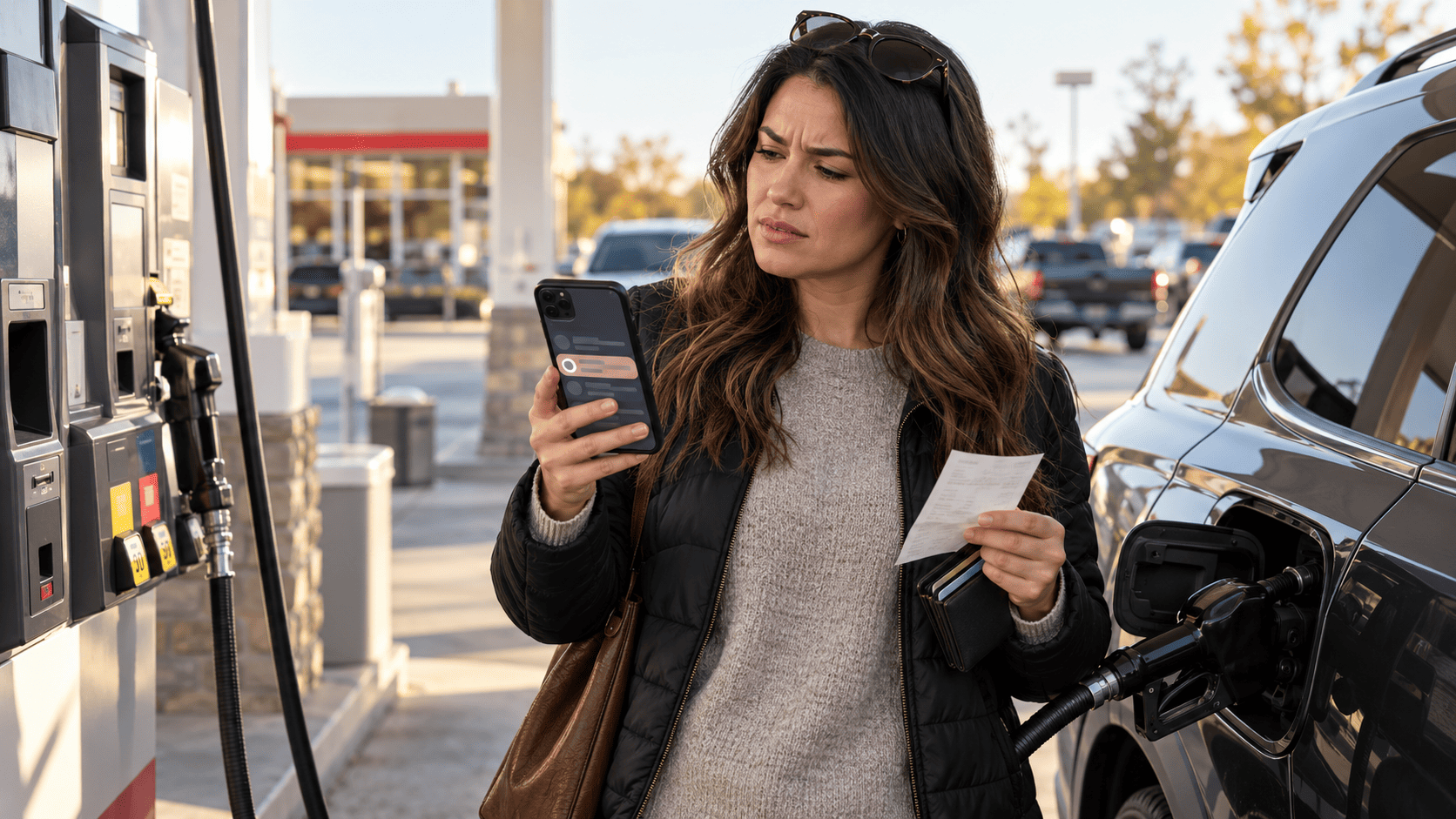
You spend $43 at a gas station, check your banking app and see a much larger amount marked “pending.” Or you leave a hotel, pay the final bill and discover that hundreds of dollars of your available credit are still tied up. Before assuming you were overcharged, it helps to understand what a pending transaction actually is—and when it stops being normal.
“Pending” Usually Means the Transaction Is Not Finished Yet
When you use a credit card, the payment does not necessarily move from you to the merchant instantly.
The merchant first asks the card issuer to authorize the transaction.
That authorization confirms that the account is valid and that sufficient credit is available.
The charge may then appear in your banking app as “pending” while the merchant completes the transaction and submits the final amount for settlement.
Capital One describes a pending credit-card transaction as a charge that has been authorized by the issuer but has not yet been fully processed by the merchant.
So “pending” does not automatically mean something is wrong.
It usually means the payment is somewhere between approval and completion.
How Long Should a Pending Charge Take?
There is no single universal timer.
Capital One says credit-card transactions commonly post within about 72 hours, although some can take up to five days. Chase says everyday pending transactions are commonly processed within three to five business days. The exact timing depends on the merchant, issuer, payment network and type of transaction.
Some specialized authorization holds can last longer.
Hotels, rental-car companies and other businesses sometimes maintain holds while the final amount remains uncertain. Chase notes that merchant authorization holds can last from several days to roughly a week depending on the circumstances, while Capital One notes that some types of holds may remain longer.
A pending charge that has been there for one afternoon is therefore very different from one that has remained unchanged for an unusually long period.
Why Does the Pending Amount Look Higher Than What You Spent?
This is where people often panic.
You know exactly what you bought.
Your banking app appears to show something else.
But some merchants do not know the final amount when the card is first authorized.
That happens commonly at:
gas stations;
hotels;
rental-car companies;
restaurants;
and some travel businesses.
The merchant or payment system may therefore authorize an estimated amount first and replace it with the actual charge later.
The strange number you see may be a temporary authorization rather than the amount that will eventually appear on your statement.
Gas Stations Are a Classic Example
When you insert a card at a gas pump, the station does not yet know whether you are going to buy $12 of fuel or fill the entire tank.
The payment system therefore needs a way to verify that funds are available before allowing fuel to flow.
Visa explains that pay-at-the-pump transactions can involve temporary account holds because the final fuel amount is not known when authorization occurs. The final purchase later replaces the temporary authorization.
So if you buy a relatively small amount of gas and initially see a much larger pending authorization, do not immediately assume the station permanently charged you that amount.
Check what ultimately posts.
Debit Cards Make Gas-Pump Holds Feel Much Worse
The mechanics matter more when the card is attached directly to your checking account.
A credit-card authorization hold temporarily reduces your available credit.
A debit-card hold can temporarily make part of the money in your bank account unavailable.
Visa says debit-card holds at businesses such as hotels, gas stations and rental-car companies temporarily set aside funds until the actual payment is processed.
Capital One similarly warns that debit-card holds can reduce the available account balance while they remain pending.
That can create a real cash-flow problem.
Imagine having $500 available and suddenly seeing a large temporary hotel or fuel authorization blocking a significant portion of it.
The money may not have been permanently spent.
But you may not be able to use it until the hold clears.
Hotels Can Tie Up Even More
Hotels often need to cover more than the advertised room price.
There may be:
taxes;
room-service charges;
minibar purchases;
parking;
damage;
or other incidentals.
So a hotel may authorize an amount greater than the nightly room rate when you check in.
Chase explains that a hotel hold can cover the expected room cost plus potential incidental expenses.
The final transaction should reflect what you actually owe.
But the temporary hold can remain visible for some time after checkout while the merchant and issuer complete processing.
This is why travelers sometimes leave a hotel having paid the bill but still see less available credit than expected.
Rental Cars Work Much the Same Way
A rental company does not know the complete final cost when it hands you the keys.
Fuel charges, additional rental time, damage or other costs could alter the final bill.
So rental companies commonly use authorization holds too.
If you are traveling with limited available credit or checking-account funds, these holds can matter.
It is worth asking the hotel or rental company how much it expects to authorize before handing over the card.
That can prevent a nasty surprise later.
Restaurants Create Another Strange-Looking Pending Amount
Restaurants can be confusing for the opposite reason.
Sometimes the first pending transaction reflects the meal before the tip has been fully processed.
The final amount may therefore be higher once the gratuity is added.
Capital One specifically lists restaurant tips as one reason a pending amount can differ from the amount that eventually posts.
This means neither number should necessarily be treated as final while the transaction is still pending.
Wait for the posted transaction before deciding whether the restaurant actually charged the wrong amount.
A Pending Charge Can Reduce What You Can Spend
Suppose your credit limit is $5,000.
You have no existing balance.
A hotel places a $1,000 authorization hold.
Even though that $1,000 has not yet become a posted purchase, your available credit can temporarily fall to roughly $4,000.
Capital One and Chase both explain that pending authorizations can reduce available credit before becoming part of the posted account balance.
This distinction explains why someone may think:
“My balance isn't that high. Why is my card being declined?”
The answer may be hiding in the pending transactions.
Does a Pending Charge Already Cost You Interest?
Typically, no.
Capital One states that pending credit-card charges do not accrue interest while they remain pending.
The transaction has not yet become part of the posted balance.
Once it posts, normal account terms apply.
That means a pending charge is affecting your available credit before it necessarily becomes part of the balance on which your bill is calculated.
Why Can't the Bank Just Delete a Pending Charge?
Because the transaction may still change.
The final restaurant total may include a tip.
The hotel may release part of an incidental hold.
The gas-station authorization may become the actual amount of fuel purchased.
Or the merchant may never complete the transaction at all.
That is why many card issuers do not treat a normal pending transaction like a posted charge that can immediately be disputed.
Chase says most pending credit-card transactions cannot be disputed until they post. Capital One similarly says authorized pending charges generally must finish processing before a normal transaction dispute can begin.
If you recognize the merchant but believe the amount is wrong, the fastest first call is often the merchant.
The Merchant May Be Able to Fix It Faster
Suppose you cancel an order immediately.
Or a hotel agrees that an incidental hold should have been released.
The merchant may be able to cancel or release an authorization before normal settlement finishes.
Chase recommends contacting the merchant directly when someone wants to stop or cancel a pending transaction because the merchant may be able to remove it before it posts.
This is why calling your card issuer first can sometimes lead to a frustrating answer:
“We have to wait.”
The issuer may be seeing an unfinished authorization that only the merchant can properly finalize or release.
But Fraud Is Different—Do Not Wait
There is one major exception.
If the pending charge is clearly not yours, do not sit quietly for five days waiting to see what happens.
Capital One advises customers who see an unauthorized pending credit-card charge to begin the fraud-reporting process immediately rather than waiting for the transaction to post.
Other issuers similarly tell customers to report suspected unauthorized card use promptly.
A transaction that you recognize but think is incorrect is a billing problem.
A merchant you have never dealt with charging your card is potentially fraud.
Those are different situations and should be treated differently.
Before Reporting Fraud, Check the Merchant Name Carefully
Not every unfamiliar transaction is fraudulent.
A restaurant may bill under the legal name of the company that owns it.
A small store may use the name of its parent business.
A subscription may appear under a payment processor.
A spouse or authorized user may have made the purchase.
Chase recommends reviewing transaction details before labeling a charge fraudulent because merchant names can sometimes differ from the name consumers recognize.
Take a minute to investigate.
But if you still believe the transaction was unauthorized, contact the issuer promptly.
What If the Pending Charge Simply Disappears?
A pending authorization does not always become a completed purchase.
Sometimes a merchant never completes it.
The temporary authorization may then disappear.
That does not automatically mean you received something for free.
A merchant may still submit a legitimate completed transaction later according to its processing procedures.
The safest approach is to continue treating the money as spent until you know the transaction has been canceled or permanently resolved.
Chase specifically recommends thinking of pending transactions as money already committed to a purchase so you do not accidentally overspend while processing continues.
Why Weekends Can Make Everything Feel Slower
A transaction made late Friday may appear to sit still through the weekend.
Business-day processing, merchant batch schedules and holidays can all affect when a purchase moves from pending to posted.
Chase notes that posting dates can differ from transaction dates because of merchant processing and non-business days such as weekends and holidays.
So three calendar days are not necessarily three business days.
This becomes especially noticeable around long holiday weekends.
Online Shopping Can Stay Pending for a Different Reason
Some online merchants do not complete a credit-card charge until the product actually ships.
That means an authorization may appear before the final payment is captured.
Chase notes that some online purchases remain pending because the retailer waits until shipment before fully processing the payment.
For preorders, split shipments and backordered products, payment behavior can become even more complicated.
This is another reason to look at both the retailer's order status and the card transaction before assuming something went wrong.
What If You See the Same Purchase Twice?
First determine whether both charges are actually posted.
Sometimes what looks like a duplicate can involve one temporary authorization and one final transaction during processing.
The key question is what remains after everything posts.
If two final posted charges remain for one purchase, that is no longer simply a pending-transaction issue.
Contact the merchant and ask it to correct the duplicate.
If the merchant does not resolve it, duplicate charges can qualify as billing errors that can be disputed with the credit-card issuer. The FTC specifically lists being charged twice for the same transaction among examples of credit-card billing errors.
What If the Final Posted Amount Is Wrong?
Once a transaction posts, the picture becomes much clearer.
Compare the posted amount with your:
receipt;
hotel folio;
restaurant bill;
rental agreement;
fuel receipt;
or online order confirmation.
If the numbers do not match, contact the merchant.
Many mistakes can be resolved quickly without a formal credit-card dispute.
But keep records.
Save screenshots.
Save receipts.
Write down when you called.
If the issue eventually becomes a formal dispute, that documentation matters.
There Is an Important 60-Day Credit-Card Rule
If a posted credit-card charge is genuinely wrong and the merchant does not fix it, federal billing-error protections may apply.
The Consumer Financial Protection Bureau and Federal Trade Commission say that to preserve rights under the Fair Credit Billing Act, a written billing-error notice generally must reach the credit-card issuer within 60 calendar days after the issuer sent the statement containing the error.
The dispute address may be different from the address used for payments.
Your statement or card agreement should explain where billing-error notices must be sent.
Do not wait months while repeatedly negotiating with a merchant and accidentally allow the federal dispute window to pass.
The Issuer Has Deadlines Too
Once a proper billing-error notice is received, federal rules give the card issuer specific responsibilities.
The CFPB says the issuer generally has 30 days to acknowledge the dispute unless it has already resolved the issue, and it must complete its investigation within two billing cycles, subject to a 90-day maximum.
During that process, you generally remain responsible for paying the undisputed portion of your bill.
That is very different from simply refusing to pay the entire statement because one transaction is wrong.
Debit-Card Problems Need Faster Attention
Credit and debit cards may look almost identical in your wallet.
Their legal protections are not identical.
A debit transaction can directly affect money in your checking account.
The CFPB advises consumers to notify their bank or credit union promptly about unauthorized electronic transactions. For certain debit-card situations, how quickly the consumer reports the problem can affect legal protections.
This is particularly important if a debit card is lost or stolen.
Do not assume the same credit-card dispute timetable automatically applies.
Contact the bank immediately.
This Is Why a Hotel Hold Can Be More Painful on Debit
Imagine a hotel authorizes several hundred dollars for your room and incidentals.
On a credit card, that generally reduces available credit.
On a debit card, the same type of authorization can temporarily reduce the money available in your checking account.
If rent, utilities or automatic payments are about to leave that account, the difference matters.
This does not mean a debit card cannot be used.
It means you should understand how much the merchant plans to hold and whether your remaining available balance is sufficient for other obligations.
Ask Before You Hand Over the Card
One simple question can prevent a lot of stress:
“How much will you authorize on my card?”
Ask it at:
hotels;
rental-car counters;
and other businesses that commonly use deposits or incidental holds.
Also ask when the merchant expects the hold to be released.
You may not control exactly how quickly your issuer restores the available funds afterward, but at least you will know what to expect.
An authorization hold is far less alarming when you knew it was coming.
Do Not Judge a Transaction From a Push Notification Alone
Real-time card alerts are useful.
But the amount in an alert may reflect an authorization rather than the final settled transaction.
Visa notes that transaction alerts may differ from final amounts in situations such as restaurants and pay-at-the-pump fueling because the total is not yet known when initial authorization occurs.
So keep the alert.
But also check the final posted transaction.
The settled amount is what matters for determining whether you were actually overcharged.
When Should You Actually Start Worrying?
A normal pending transaction usually deserves patience.
Concern becomes more reasonable when:
you do not recognize the merchant;
the merchant confirms it canceled the transaction but the hold remains unusually long;
a routine purchase remains pending far beyond your issuer's normal processing period;
the final posted amount is incorrect;
the same purchase posts more than once;
or a hotel, rental company or other merchant cannot explain a large authorization hold.
At that point, contact the merchant and card issuer with the transaction details.
Do not rely on guesswork.
The Fastest Order of Operations
If a pending card transaction looks strange, use a simple sequence.
First, identify the merchant.
Second, determine whether the charge is still pending or has actually posted.
Third, compare it with the receipt or expected amount.
Fourth, ask yourself whether this is the kind of merchant that commonly uses authorization holds—such as a hotel, gas station, restaurant or rental-car company.
If you recognize the transaction but the pending amount looks strange, give normal processing time or contact the merchant.
If it posts incorrectly, request a correction and use your issuer's dispute process if necessary.
If you do not recognize the transaction at all, report suspected fraud promptly.
The distinction between those situations can save hours of unnecessary panic.
The Word “Pending” Is Doing More Work Than It Looks
It can mean:
the merchant has not finalized the purchase;
a restaurant is waiting to include a tip;
a gas station is replacing an authorization with the actual fuel amount;
a hotel is holding money for incidentals;
an online store has not shipped the order;
or a transaction is simply moving through the payment system.
That little gray word in a banking app hides a surprisingly complicated process.
Most of the time, it resolves without the cardholder doing anything.
But when it does not, the most important thing is knowing whether you are looking at:
a temporary hold;
an incorrect posted charge;
or genuine unauthorized activity.
Those require three very different responses.
So the next time your phone shows a strange pending amount, do not start with:
“Where did my money go?”
Start with:
“Has this transaction actually finished yet?”
Often, it hasn't.
pending credit card charge, pending transaction, pending charge how long, credit card authorization hold, credit card hold, gas station card hold, hotel credit card hold, pending debit card transaction, pending transaction wrong amount, pending restaurant charge, credit card charge pending for days, duplicate credit card charge, credit card dispute
How Personal Loan APR Really Works
Your Car Insurance Renewal Went Up Even Without an Accident
Your Package Says “Delivered”—But It Isn’t There. What Should You Do Next?
Free VPNs Are Booming Again. What Are You Really Paying With?
Why Home Insurance Costs Are Rising So Fast
Money
Lifestyle
Consumer looking confused at a pending credit-card transaction on a smartphone while holding a gas-station receipt.
Why Is My Credit Card Charge Still Pending?
A card charge can stay pending for days—and sometimes the amount looks completely wrong. Here’s why gas stations, hotels and restaurants do it and when you should act.
You Spent $43. Why Is Your Card Holding Much More?
You buy gas.
Your banking app suddenly shows a much larger pending amount.
Did the station overcharge you?
Usually, there is another explanation.
Hotels, gas stations, restaurants and rental-car companies often authorize money before they know the final amount—and debit-card users can feel the effect immediately because real checking-account funds may become temporarily unavailable.
The key is knowing when to wait and when a “pending” charge is actually a warning sign.
Reader Question
What is the longest you have ever waited for a pending card charge or hotel hold to disappear?
Research Notes
Capital One's current guidance says a pending credit-card transaction has been authorized but has not yet been fully processed by the merchant. It says transactions commonly post within roughly 72 hours, although some may take up to five days.
Chase says everyday pending transactions commonly process within three to five business days, with timing depending on the merchant, issuer, payment network and type of transaction. It also notes that most pending credit-card charges cannot be disputed until they post.
Authorization holds are common at hotels, rental-car companies, gas stations and restaurants because the final amount may not be known when the transaction is first authorized. These holds temporarily reduce available credit or, with debit cards, available bank-account funds.
The FTC and CFPB state that federal credit-card billing-error protections generally require a written dispute notice within 60 days after the issuer sends the statement containing the error. Issuers generally must acknowledge a qualifying dispute within 30 days and resolve it within two billing cycles, not exceeding 90 days.
The CFPB advises consumers to promptly notify their bank or credit union about unauthorized debit-card or other electronic-fund-transfer activity because different rules and reporting timelines apply to bank-account transactions.
Consumer Note
Card-issuer policies, merchant authorization practices and processing times vary. For a specific pending transaction, check your issuer's current terms and contact the merchant or issuer directly. Suspected unauthorized activity should be reported promptly.
pending transaction, pending charge how long, credit card hold, authorization hold, gas station card hold, hotel credit card hold, pending debit card transaction, pending charge wrong amount, pending transaction disappeared, credit card dispute
Credit Cards, Banking, Pending Transactions, Debit Cards, Personal Finance, Consumer Tips, Fraud, Hotels, Gas Stations