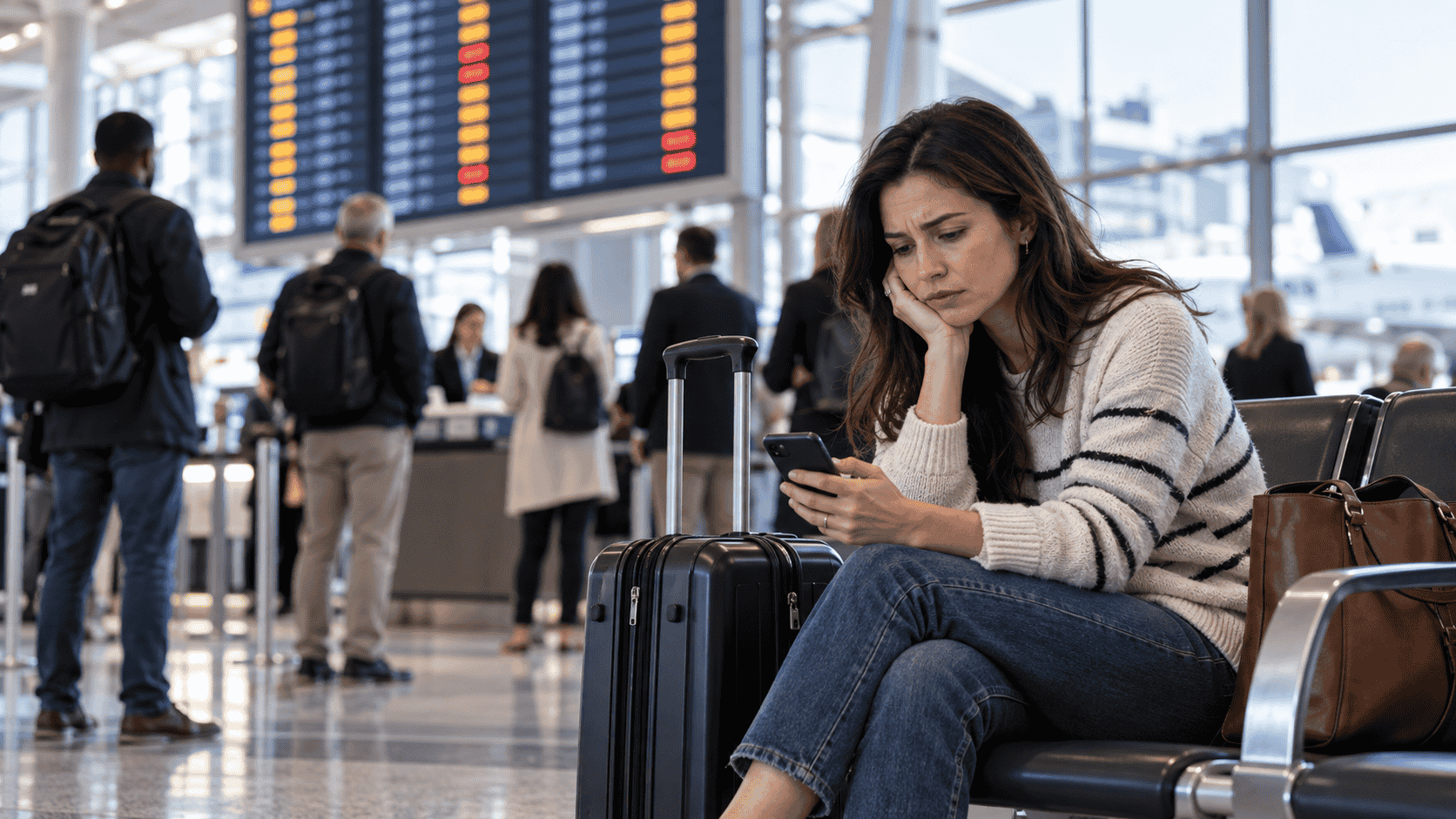
You are already at the airport when the departure time moves back by an hour. Then another hour. Then the gate changes. Finally the flight is canceled, and everyone around you starts asking the same questions: Do I get my money back? Does the airline owe me a hotel? What about food? And if they put me on tomorrow’s flight, do I have to accept it?
Start With the Most Important Distinction: Refund or Rebooking
When an airline cancels your flight, you generally have a choice.
You can accept the airline’s alternative transportation.
Or you can decline the alternative and seek a refund when DOT refund rules apply.
The U.S. Department of Transportation says that when an airline cancels a flight or makes a significant change, passengers are entitled to a refund if they choose not to accept the significantly changed flight, rebooked flight, travel credit or another alternative offered by the airline.
That applies even to many tickets sold as “non-refundable.”
The word “non-refundable” does not allow an airline to keep your money when the airline cancels the transportation and you decline its substitute.
But If You Take the Replacement Flight, You Usually Give Up the Refund
This is where people sometimes become confused.
Suppose your original flight is canceled.
The airline puts you on another flight later that evening.
You take it.
DOT says passengers who accept and travel on an alternative flight generally are not entitled to a refund for the original ticket simply because the original schedule was disrupted.
You received the transportation.
That does not necessarily mean you cannot receive other amenities when the disruption was within the airline’s control.
But the ticket-refund question changes once you accept and use the replacement travel.
What Counts as a “Significant” Delay or Change?
DOT rules now give passengers concrete thresholds.
For a domestic itinerary, a significant change includes a flight that is scheduled to depart three or more hours earlier or arrive three or more hours later than originally scheduled.
For an international itinerary, the threshold is six or more hours earlier or later.
Significant changes can also include:
a change in the departure or destination airport;
an increase in the number of connections;
a downgrade to a lower class of service;
or certain accessibility-related itinerary changes for passengers with disabilities.
That is much clearer than the old world where each airline could use a different definition of a meaningful schedule change.
A Two-Hour Delay Does Not Automatically Mean a Federal Cash Payout
This is one of the biggest misconceptions among U.S. travelers.
Unlike some other jurisdictions, the United States generally does not require airlines to pay automatic cash compensation merely because your domestic flight is delayed for several hours.
DOT says airlines have their own policies regarding compensation and amenities for delays and cancellations. If an airline has made specific commitments in its customer-service plan, DOT can hold it accountable to those commitments.
So the answer to:
“My flight is delayed three hours. How much cash do I get?”
is usually:
not automatically anything under general federal delay rules.
But that does not mean you should simply sit at the gate and ask for nothing.
The Reason for the Delay Matters
This is the second major distinction.
DOT’s airline dashboard focuses heavily on “controllable” delays and cancellations.
A controllable disruption is essentially one caused by the airline.
DOT gives examples including:
maintenance;
crew problems;
cabin cleaning;
baggage loading;
and fueling.
Those are different from disruptions caused by:
severe weather;
air-traffic-control restrictions;
airport closures;
or other circumstances outside the airline’s control.
Airline commitments to meals, hotels and other assistance often depend on that distinction.
If the Airline Caused the Delay, Ask About a Meal
According to DOT’s current Cancellation and Delay Dashboard, all of the large U.S. airlines shown on the dashboard commit to providing a meal or meal voucher when a controllable delay results in a passenger waiting three hours or more.
That means if your flight is delayed because of an airline-controlled issue and you are going to be stuck at the airport for several hours, ask directly:
“Is this considered a controllable delay, and am I eligible for a meal voucher?”
Do not assume someone will automatically find you in the terminal and hand you one.
Policies exist.
Passengers still need to know to ask.
An Overnight Delay Can Trigger Hotel Commitments
An overnight delay is much more expensive than a late departure.
Now the passenger may need:
a hotel;
transportation to the hotel;
food;
and another trip back to the airport.
DOT’s current dashboard shows that many major U.S. airlines commit to providing complimentary hotel accommodations and ground transportation when a controllable overnight delay or cancellation strands a passenger.
But commitments are not identical across every carrier.
That is why the DOT dashboard is so useful.
You can look up your specific airline rather than relying on a generic social-media post.
Weather Changes the Answer
Suppose a major snowstorm closes the airport.
The airline did not create the storm.
That usually means the airline’s voluntary meal and hotel commitments for controllable disruptions may not apply in the same way.
You should still ask what assistance is available.
Airlines sometimes provide options even when they are not required by their formal commitments.
But do not assume a weather cancellation automatically produces a free hotel.
The refund right is a different issue.
If the airline cancels the flight and you decide not to travel, DOT refund rules can still apply regardless of why the flight was canceled.
That distinction is extremely important.
Weather may affect meals and hotels.
It does not automatically erase the refund option when the airline cancels your flight and you decline alternative transportation.
You Do Not Have to Accept a Travel Voucher Instead of a Refund
Airlines may offer:
travel credits;
vouchers;
miles;
future discounts;
or rebooking.
Sometimes one of those is genuinely useful.
But when you are legally entitled to a refund, you should understand that accepting a voucher can change your options.
DOT says an automatic refund is due when the passenger declines the significantly changed flight, rebooking, travel credit or other alternative compensation.
Before clicking:
“Accept travel credit”
ask yourself whether you actually want a future airline credit instead of your money back.
Credits can expire.
They may have restrictions.
Cash does not require another trip.
How Quickly Must the Refund Arrive?
DOT says eligible automatic refunds must generally be provided within:
seven business days for purchases made by credit card;
or 20 business days for purchases made by cash or another form of payment.
The refund should go back to the original form of payment.
That matters because some passengers are offered airline credits by default and assume that is all they can receive.
If you qualify for a refund and do not accept another option, know the timeline.
What If You Bought the Ticket Through an Online Travel Agency?
Third-party bookings can make the process less obvious.
You may have paid:
an online travel agency;
a corporate travel provider;
a credit-card travel portal;
or another ticket agent
rather than the airline directly.
The refund process can therefore involve the company that actually processed the ticket sale.
Keep:
your booking confirmation;
ticket number;
payment record;
cancellation notice;
and communications from the airline.
Do not assume the airline and travel agent each think the other one is handling it.
Identify who took the payment and who is responsible for processing the refund.
Do Not Cancel the Flight Yourself Before You Know Your Options
This can be an expensive mistake.
Imagine your flight is severely delayed.
You get frustrated.
You open the app and voluntarily cancel your non-refundable ticket before the airline formally cancels the flight or before you confirm that the schedule change qualifies for a refund.
Now the record may look like a passenger-initiated cancellation.
That can complicate the refund question.
Before clicking cancel, understand what the airline is offering and what the disruption officially is.
A five-minute conversation can protect hundreds of dollars.
Take Screenshots
Airline apps change quickly during disruptions.
A flight can show:
delayed;
then delayed again;
then canceled;
then rebooked.
Save evidence as the situation evolves.
Screenshot:
the original itinerary;
the delayed departure time;
the cancellation notice;
the new itinerary;
the reason shown in the app;
and any voucher or refund offer.
Also keep:
meal receipts;
hotel receipts;
ground-transportation receipts;
and emails or text messages.
If you later need to ask the airline for reimbursement or file a DOT complaint, documentation is much stronger than memory.
The Airline Has to Tell You About Flight-Status Changes
DOT says that when a flight is scheduled to depart within seven days, airlines must provide status updates within 30 minutes after they become aware of a change.
The information must be updated on the airline’s website and telephone reservation system, as well as airport flight-status displays under the airline’s control.
That does not guarantee you will love the answer.
But airlines cannot simply know a flight was canceled and leave customers staring at an unchanged departure screen indefinitely.
The App May Know Before the Gate Agent Does
During major disruptions, airport lines can become enormous.
Meanwhile, the airline app may already offer:
automatic rebooking;
alternate flights;
standby options;
refund choices;
or airport changes.
Check the app immediately.
Then compare what it offers with what you actually want.
Sometimes you can solve the problem before reaching the customer-service desk.
But Do Not Accept a Bad Rebooking Too Quickly
Imagine the airline automatically rebooks you for two days later.
That is technically an alternative.
It does not mean you must take it.
Look for another flight on the same airline.
Ask whether a partner airline is available.
DOT’s dashboard shows that several major carriers commit to rebooking passengers on partner airlines or airlines with which they have agreements after controllable disruptions.
Not every carrier makes that commitment.
Again, the specific airline matters.
Ask One Very Useful Question
At the service desk, instead of saying:
“What can you do for me?”
ask:
“Is this disruption considered within the airline’s control?”
That one answer can affect:
meal vouchers;
hotel accommodation;
ground transportation;
and rebooking commitments.
Then ask what your airline’s customer-service plan provides for that type of disruption.
Specific questions get more useful answers than general frustration.
What If You Miss a Connection Because the First Flight Was Late?
If all flights are on the same ticket, the airline will generally work to rebook you after a missed connection caused by a delay.
The exact options depend on the itinerary, carrier and cause.
If the delay is controllable, the airline’s dashboard commitments may also become relevant.
But separate tickets create more risk.
If Airline A delivers you late and you miss an unrelated separately purchased ticket on Airline B, the second airline may treat you as a passenger who simply missed the flight.
That is why very tight self-created connections can be financially risky.
Separate Tickets Can Turn One Delay Into Two Problems
Suppose you book:
Chicago to New York on one airline;
then New York to London on an unrelated ticket.
You save $150.
The first flight is four hours late.
The second flight leaves without you.
The second airline may have no responsibility for the first airline’s delay because the tickets were not part of one protected itinerary.
The cheap itinerary suddenly becomes expensive.
When self-connecting, leave more time than you think you need.
What About Your Checked Bag?
A canceled or changed itinerary can separate passengers from baggage.
If your checked bag is mishandled, report it immediately and keep the baggage claim information.
DOT rules also provide refunds of checked-bag fees in certain significantly delayed baggage situations.
DOT says that when a passenger files a mishandled-baggage report, the checked-bag fee must be refunded if the bag is not delivered within 12 hours after a domestic flight arrives at the gate, or within 15 or 30 hours for an international itinerary depending on the length of the flight.
The baggage fee is different from compensation for lost property.
But it is still money passengers often forget they paid.
Paid for Wi-Fi That Never Worked? That Can Be Refundable Too
Suppose you paid extra for:
Wi-Fi;
seat selection;
inflight entertainment;
or another ancillary service.
Then the airline did not provide it.
DOT says passengers are entitled to a refund for an ancillary service they paid for when the airline fails to provide that service.
Save the receipt.
If you paid for something the airline never delivered, ask for that fee back.
What If You Paid for a Better Seat and Got Downgraded?
A downgrade can also be a significant change.
DOT includes being moved to a lower class of service among the situations that can trigger refund rights when the passenger declines the changed transportation.
If you accept the downgraded flight, separately ask the airline how it will refund the fare difference or paid seat-related charges.
Do not assume the system automatically catches every ancillary difference.
What If the Airline Says “Operational Reasons”?
That phrase does not tell you much.
Ask what it actually means.
Crew?
Maintenance?
Aircraft availability?
Weather?
Air-traffic control?
The category can matter.
If airline employees cannot explain at the gate, the app or customer-service system may later provide more detail.
Keep records of what you are told.
A vague label should not stop you from asking whether the airline considers the disruption controllable.
Do Airlines Owe Cash for Your Lost Time?
Generally, not automatically under U.S. federal rules simply because you waited several hours.
DOT’s current dashboard shows that the major U.S. carriers listed do not commit to cash compensation merely because a controllable cancellation or delay causes a wait of three hours or more.
Some airlines do commit to other forms of goodwill compensation—such as vouchers or miles—in certain situations.
That is why stories about travelers receiving $500 in Europe cannot simply be applied to a domestic U.S. itinerary.
Different legal systems have different passenger rules.
Travel Insurance Is a Separate Layer
If an airline does not cover a hotel because the cancellation was weather-related, travel insurance or certain credit-card travel protections may still cover some expenses depending on the policy.
That is not an airline obligation.
It is a separate contract.
Check:
trip-delay coverage;
trip-interruption coverage;
required delay duration;
covered reasons;
maximum reimbursement;
and required receipts.
Do not assume the phrase “travel protection” means every inconvenience is covered.
Your Credit Card May Already Include Travel Protections
Some premium credit cards provide trip-delay or trip-cancellation protections when the trip was purchased with that card.
Coverage varies dramatically.
One card may reimburse meals and lodging after a qualifying delay.
Another may not.
Some require a delay of a specific number of hours.
Others require an overnight delay.
Before purchasing separate insurance for every domestic trip, check what benefits you already have.
But verify the current card terms.
Benefits can change.
Keep Every Receipt During an Overnight Disruption
Even if you do not yet know who will reimburse you, keep receipts.
Meals.
Hotel.
Taxi.
Rideshare.
Toiletries.
Other reasonable expenses.
If the airline, insurer or credit card later provides reimbursement, documentation will likely matter.
Taking a photo of each receipt immediately is useful because paper receipts have a remarkable ability to disappear during travel.
Do Not Book the Most Expensive Hotel in Town and Assume Someone Else Will Pay
If the airline will not issue a hotel voucher directly and you plan to seek reimbursement later, ask what amount it will cover.
“Reasonable expenses” is not a blank check.
A $180 airport hotel may be easier to justify than a $900 luxury suite.
Get the airline’s policy in writing where possible.
If travel insurance is involved, check its limits before spending.
A Weather Cancellation Still Gives You Choices
Suppose a hurricane causes your flight to be canceled.
The airline may not owe meals or a hotel under its controllable-delay commitments.
But you still have decisions.
You can accept a rebooked flight.
You can choose another itinerary.
Or, if DOT refund conditions are satisfied and you no longer want to travel, you can decline the alternative and receive the required refund.
Weather affects the reason for disruption.
It does not mean you are forced to accept any replacement schedule the airline offers.
Do Not Confuse “Refund” With “Reimbursement”
These are different.
A refund returns money you paid the airline for transportation or services you did not accept or receive.
Reimbursement pays you back for additional expenses, such as:
food;
hotel;
or transportation
that you paid because of the disruption.
You may qualify for one and not the other.
That vocabulary helps when communicating with the airline.
Instead of saying:
“I want my money back,”
be specific.
“I am requesting a ticket refund.”
Or:
“I am requesting reimbursement for the hotel caused by the controllable overnight cancellation.”
What If the Airline Refuses a Refund You Believe You Are Owed?
Start with the airline.
Keep the response.
If the issue remains unresolved, DOT says passengers can file an air-travel service complaint with the Department.
Include:
your itinerary;
ticket information;
dates;
what happened;
what the airline offered;
what you requested;
and supporting documents.
Clear documentation makes a complaint much easier to understand.
The DOT Dashboard Is Worth Bookmarking Before You Fly
The DOT Cancellation and Delay Dashboard compares the customer-service commitments of major U.S. airlines.
It includes whether carriers commit to:
rebooking on their own airline;
rebooking on partner airlines;
meals after certain controllable delays;
hotels for controllable overnight disruptions;
ground transportation;
and certain other forms of compensation.
The dashboard does not replace each airline’s full contract or customer-service plan.
But during an airport meltdown, it is far more useful than guessing.
A Five-Minute Pre-Trip Check Can Save an Hour at the Airport
Before an important trip:
install the airline app;
make sure your phone number and email are attached to the reservation;
enable flight notifications;
save the airline’s customer-service number;
know whether you checked a bag;
and understand any travel protections on the card used to purchase the flight.
If weather looks threatening, monitor the itinerary before leaving home.
A proactive rebooking option is far more pleasant from your couch than from a line of 200 people at Gate 37.
The Fastest Order of Operations When Your Flight Goes Wrong
When the delay appears, check the airline app immediately.
Determine the stated cause if available.
Look at alternative flights before everyone else begins searching.
If the flight is canceled or significantly changed, decide whether you still want to travel.
If yes, pursue the best rebooking.
If no, determine whether you qualify for a refund and avoid accepting a voucher you do not actually want.
For a controllable delay, ask about meals.
For a controllable overnight disruption, ask about hotel and ground transportation.
Screenshot everything.
Keep receipts.
Then escalate through the airline and DOT if necessary.
So What Does the Airline Actually Owe You?
There is no one answer for every delay.
But there is a simple framework.
If the airline cancels your flight or makes a qualifying significant change and you decline the alternative travel, federal refund rules can entitle you to your money back.
If you accept the replacement flight, you generally give up that ticket-refund claim.
If the disruption was within the airline’s control, the airline may also have enforceable commitments covering meals, hotels, ground transportation or rebooking.
If weather caused the problem, those amenities may be more limited.
And ordinary U.S. delays generally do not create an automatic federal cash-compensation right simply because you lost several hours.
The biggest mistake is assuming:
“They canceled it, so I have to take whatever they give me.”
You do not always have to.
Sometimes you want the replacement flight.
Sometimes you want the voucher.
Sometimes you want the refund.
The important thing is knowing which one you are accepting before clicking the button.
-----------------------------------------------------------------
flight delayed or canceled rights, canceled flight refund, flight delay compensation USA, airline refund rules, DOT airline refund, airline hotel voucher, flight delay meal voucher, significant flight delay, canceled flight what to do, airline passenger rights, missed connection rights, flight cancellation refund USA, airline delay hotel, airline rebooking rights
Travel Insurance: What Does It Actually Cover?
Your Package Says “Delivered”—But It Isn’t There. What Should You Do Next?
Why Is That Credit Card Charge Still Pending? And Why Is the Amount Wrong?
Your Credit Score Dropped—and You Didn’t Miss a Payment. What Happened?
Solo Travel
Travel
Money
Airline passenger checking a canceled or delayed flight notification on a smartphone while waiting with luggage inside a busy U.S. airport terminal.
What Are Your Rights When a Flight Is Canceled?
Your Flight Was Delayed or Canceled. What Does the Airline Owe You?
Canceled flight? Long delay? Here’s when U.S. travelers can get a refund, meal, hotel or rebooking—and why the cause of the disruption matters.
Social Title
Your Flight Was Canceled. Don’t Automatically Accept the Voucher.
Social Hook
Your flight is canceled.
The airline offers you tomorrow morning.
Then a travel credit.
Should you take it?
Maybe.
But if the airline canceled or significantly changed your flight and you decide not to travel, federal rules may entitle you to a refund instead.
And if the airline caused the disruption, ask one question at the airport:
“Is this considered a controllable cancellation?”
That answer can determine whether meals, a hotel and transportation are on the table.
Reader Question
What is the longest flight delay you have ever experienced—and did the airline give you anything for it?
Research Notes
DOT says passengers are entitled to refunds when an airline cancels a flight or significantly changes it and the passenger declines alternative transportation, a travel credit or other offered compensation. Eligible refunds are generally due within seven business days for credit-card purchases and 20 business days for cash purchases.
DOT defines a significant change as including domestic itineraries that depart three or more hours earlier or arrive three or more hours later, and international itineraries that shift by six or more hours. Changes in airports, added connections, downgrades and certain accessibility-related changes can also qualify.
DOT’s current Cancellation and Delay Dashboard distinguishes controllable disruptions—such as maintenance, crew, baggage-loading and fueling problems—from circumstances outside an airline’s control. Major airlines make different commitments concerning meals, hotels, ground transportation and partner-airline rebooking.
The dashboard currently shows that the listed major U.S. airlines commit to meals or meal vouchers when a controllable delay causes a wait of at least three hours, while hotel and ground-transportation commitments for overnight disruptions vary by carrier. None of the airlines listed commits to automatic cash compensation merely for a controllable three-hour delay.
DOT also requires refunds for certain unprovided ancillary services and checked-bag fees when baggage is significantly delayed under defined conditions.
Consumer Note
Airline commitments can change, and international itineraries may also be covered by other countries’ passenger-rights laws. Before relying on a specific meal, hotel, rebooking or reimbursement benefit, check the current DOT dashboard, the airline’s customer-service plan and any applicable travel-insurance or credit-card policy.
flight delay compensation USA, canceled flight refund, airline refund rules, flight delay meal voucher, airline hotel voucher, flight canceled what to do, DOT airline refund, significant flight delay, missed connection rights, airline passenger rights
Flight Delays, Canceled Flights, Airline Refunds, Travel, Airports, Passenger Rights, Holiday Travel, Airlines, Travel Tips, Everyday Problems