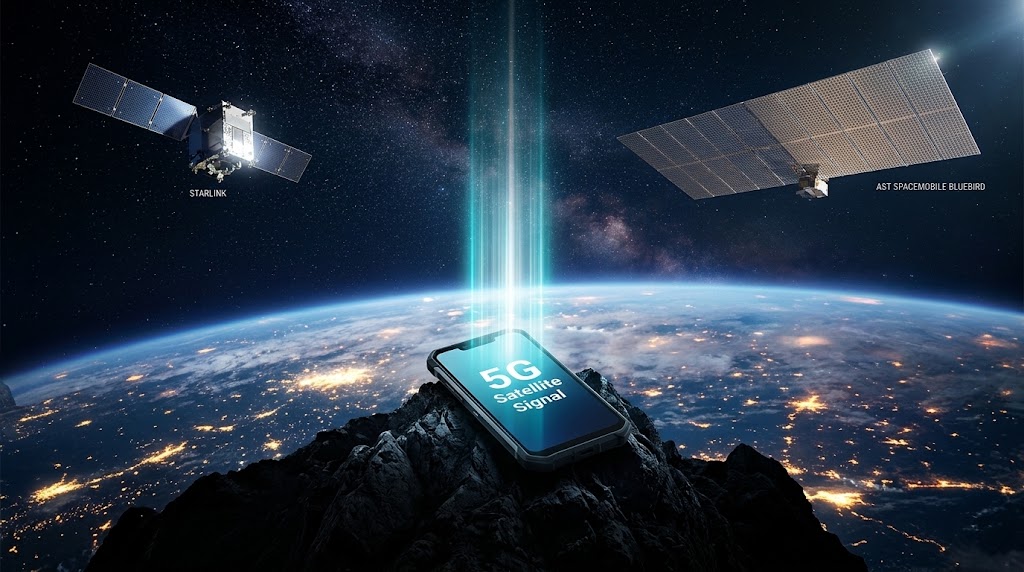
The End of the Dead Zone: Inside the Starlink vs AST SpaceMobile Satellite-to-Phone War
Your smartphone is beginning to acquire a second cellular network—one that doesn't end when the towers do. In 2026, SpaceX and AST SpaceMobile are proving that ordinary phones can connect directly to satellites, but they are taking radically different paths to get there.
By Space & Deep Tech Desk | Wednesday, September 2, 2026
There is a familiar moment on almost every long road trip.
Four bars.
Three.
One.
Then nothing.
The music stops loading.
Messages wait.
Maps become less useful.
The phone in your hand—which can translate languages, recognize faces and run artificial-intelligence models—suddenly becomes strangely helpless because the nearest cellular tower is too far away.
For decades, the solution required different hardware.
A satellite phone.
A satellite messenger.
A large antenna.
Or an expensive terminal with a clear view of the sky.
That separation is beginning to disappear.
In 2026, an ordinary smartphone can increasingly communicate directly with satellites in low Earth orbit using cellular spectrum and technology designed to make the spacecraft behave, from the handset's perspective, more like extremely distant cell towers.
No Starlink dish.
No giant antenna sticking out of the phone.
No dedicated Iridium handset.
The device already in your pocket.
Two companies now represent the most important competing architectures in this market:
SpaceX's Starlink Direct to Cell, increasingly branded around Starlink Mobile and T-Mobile's T-Satellite service in the United States;
and
AST SpaceMobile, whose enormous BlueBird satellites are designed from the beginning to deliver higher-capacity cellular broadband directly to ordinary phones.
One company is betting heavily on constellation scale.
The other is betting heavily on antenna scale.
The outcome could reshape what consumers mean when they say:
“I have no signal.”
The Dead Zone Is Not Dead Yet
Before declaring victory, one important correction.
Cellular dead zones have not disappeared.
Satellite-to-phone service still depends on:
regulatory approval,
participating mobile operators,
compatible spectrum,
supported devices and software,
satellite visibility,
available capacity,
and the particular service enabled in each country.
Forests, buildings, terrain and indoor environments can also complicate satellite links.
What has changed is more important than the slogan.
For the first time, mobile-network operators increasingly have a practical way to extend their networks beyond their terrestrial towers without requiring customers to carry separate satellite hardware.
That means the dead zone is evolving from:
a permanent boundary of the cellular network
into:
an area where the phone may fall back to a lower-capacity space-based layer.
That is a profound architectural shift.
1. Starlink Already Has the Scale Advantage
SpaceX's biggest advantage is almost impossible for another satellite startup to reproduce quickly.
It builds rockets.
It builds satellites.
It launches those satellites using its own rockets.
And it already operates one of the largest satellite constellations ever created.
SpaceX says it completed deployment of the first generation of its Starlink Direct to Cell constellation with more than 650 satellites, launched over an 18-month period.
Its 2025 progress report said the Direct-to-Cell network had already expanded across 22 countries on six continents, with more than six million monthly customers and potential access for hundreds of millions of mobile subscribers through operator partnerships.
That does not mean every person in all 22 countries receives identical service.
Local carriers still determine:
availability,
pricing,
device support,
spectrum,
and functionality.
But from a deployment perspective, Starlink has already achieved something its competitors have not:
hundreds of cellular-capable satellites in orbit.
That gives SpaceX an enormous head start in geographic reach.
2. These Satellites Are Basically Cell Towers That Never Touch the Ground
A Starlink Direct to Cell satellite carries an advanced cellular modem that SpaceX describes as functioning like an eNodeB, effectively a 4G LTE cell site in space.
The satellite communicates with the customer's phone using spectrum supplied by a mobile-network partner.
The data then travels through Starlink's satellite network and laser links before reaching the operator's terrestrial network.
From the mobile carrier's perspective, Starlink can behave somewhat like a roaming partner.
From the consumer's perspective, the experience is designed to feel much simpler:
the terrestrial network disappears,
the phone sees satellite coverage,
and selected communications continue.
That is the technological trick behind direct-to-cell.
SpaceX did not redesign the consumer phone.
It redesigned the satellite network to reach the phone that already exists.
3. Starlink Is No Longer Just an Emergency Texting System
This is one of the biggest corrections to the original article.
Starlink Direct to Cell began commercially with messaging.
That was logical.
Text messages contain tiny amounts of data and can tolerate delays.
But the service has moved beyond SMS.
T-Mobile expanded its T-Satellite system in October 2025 to support selected data-enabled apps including:
WhatsApp,
Google Maps,
AllTrails,
AccuWeather,
X,
and other communications, navigation and safety tools.
T-Mobile specifically said WhatsApp could support voice and video chat over the satellite connection.
Starlink's current mobile-business page says satellite data is available through 40+ apps and more than 100 devices.
It also describes:
app-based voice today,
video and messaging services,
with native cellular calling and broader broadband capability still part of the future roadmap.
So Starlink's current limitation is no longer:
text only.
It is better described as:
selective, constrained mobile data rather than full terrestrial-broadband replacement.
That distinction matters.
4. Why Can't Starlink Simply Give Every Phone 200 Mbps?
Physics.
A Starlink dish is a powerful electronically steered antenna with its own power supply.
A smartphone is not.
Your phone contains a relatively small antenna and transmits using a limited amount of battery power.
Yet the signal must travel hundreds of kilometres into space.
Then the satellite has to separate that weak signal from interference and simultaneously communicate with many other devices across a huge geographic footprint.
That is an extraordinarily difficult radio link.
This is why current satellite-to-phone systems prioritize services that tolerate limited bandwidth.
Messaging.
Location.
Weather.
Navigation.
Compressed data.
Selected voice and app traffic.
Direct-to-cell is not simply:
normal 5G tower performance, except the tower is in space.
The distance and power budget fundamentally change the engineering.
5. AST SpaceMobile Looked at That Problem and Built an Enormous Antenna
AST SpaceMobile's solution is visually spectacular.
Instead of relying primarily on a very large number of comparatively smaller satellites, AST is building satellites with enormous phased-array antennas.
Its first five commercial BlueBird satellites used approximately 693-square-foot arrays.
The company's next-generation BlueBirds increase that to nearly 2,400 square feet, or roughly 223 square metres.
AST describes them as the largest commercial phased arrays deployed in low Earth orbit.
Why build something so large?
Because a large antenna can create highly focused beams and improve the link budget between the satellite and a tiny ordinary smartphone antenna.
AST's strategy is essentially:
make the spacecraft do more of the hard radio work so the phone doesn't have to.
6. The New BlueBirds Are Enormous by Communications-Satellite Standards
AST's next-generation spacecraft combine those large arrays with a custom processor called AST5000.
The company says each next-generation BlueBird is designed to support:
10 GHz of processing bandwidth,
more than 2,000 coverage cells,
and
peak data transmission exceeding 150 Mbps per coverage cell.
That last phrase needs highlighting:
per coverage cell.
Not per smartphone.
If a satellite cell has 150 Mbps of capacity and 500 users are actively sharing it, those users do not each receive 150 Mbps.
Capacity is shared.
Actual performance depends on:
number of users,
radio conditions,
operator spectrum,
service configuration,
and network load.
So the correct claim is not:
AST gives phones 150 Mbps.
It is:
AST's next-generation satellite architecture targets more than 150 Mbps of peak aggregate capacity within individual satellite coverage cells.
Still impressive.
Just technically accurate.
7. AST Has Now Reached BlueBird 13
The deployment gap between the two competitors remains huge.
AST's first five commercial satellites—BlueBird 1 through 5—launched in September 2024.
Then came a much larger next-generation series:
BlueBird 6 — December 23, 2025
BlueBird 7 — April 19, 2026
BlueBird 8, 9 and 10 — June 17, 2026
BlueBird 11, 12 and 13 — August 5, 2026
That means AST has now launched 13 commercial BlueBird spacecraft, plus the earlier BlueWalker 3 prototype.
Compared with more than 650 Starlink Direct-to-Cell satellites, that looks tiny.
But AST believes its larger satellites allow the network to operate with far fewer spacecraft.
The company's long-term architecture calls for roughly 90 satellites for continuous global service, rather than tens of thousands.
The strategy could not be more different.
8. Starlink Scales Satellites. AST Scales Each Satellite.
This is the heart of the competition.
Starlink
Hundreds of cellular-capable satellites.
Integrated with a much larger Starlink constellation.
SpaceX-controlled manufacturing.
SpaceX-controlled launch capability.
Laser backhaul.
Rapid replenishment.
Broad operator network.
AST SpaceMobile
Far fewer spacecraft.
Much larger antennas.
Higher intended capacity per satellite.
Strong partnerships with existing mobile operators.
Designed around full broadband-style cellular services.
Launches distributed across several external providers.
Neither architecture is obviously destined to win every market.
They optimize different variables.
SpaceX has overwhelming constellation scale.
AST is trying to make each individual satellite dramatically more powerful.
9. Ironically, SpaceX Also Launches AST Satellites
This is one of the more amusing details in the rivalry.
AST competes against SpaceX in direct-to-device connectivity.
It also buys launches from SpaceX.
BlueBird 8, 9 and 10 launched aboard a Falcon 9.
BlueBird 11, 12 and 13 also launched aboard Falcon 9 on August 5.
Other AST spacecraft have used:
India's launch infrastructure,
and
Blue Origin's New Glenn.
So AST's launch strategy is not simply a weakness.
It is a diversification strategy.
But SpaceX clearly has one enormous advantage:
when SpaceX needs another Direct-to-Cell launch, it does not have to negotiate with a competitor for the rocket.
That vertical integration could matter greatly as constellations need constant expansion and replacement.
10. AST Wants to Work Through the Carriers You Already Use
AST's business model is not about asking consumers to abandon AT&T or Verizon.
It wants the satellite layer to become part of those existing networks.
In the United States, its major carrier relationships include:
AT&T
and
Verizon.
AST says it now works with more than 50 mobile-network operators globally, whose networks collectively serve nearly three billion subscribers.
The phone keeps its ordinary SIM or eSIM.
The terrestrial carrier remains the customer relationship.
Satellite coverage becomes an extension of the existing network.
That distinction may prove commercially important.
Consumers generally do not want another telecom account.
They want their existing phone to continue working.
11. AT&T's AST Service Is Still Emerging
AST's technological demonstrations have been impressive.
Using ordinary smartphones, the company has previously demonstrated:
voice,
text,
video,
and 5G connections through space.
But widespread commercial service should not be overstated.
AT&T says it is working toward voice, data and text satellite connectivity for ordinary smartphones and has indicated that selected FirstNet first responders will receive beta satellite capabilities in 2026, ahead of wider deployment.
AST itself describes its initial U.S. phase as supporting beta users through AT&T and Verizon with non-continuous nationwide coverage while the constellation continues growing.
That puts AST in a very different commercial position from Starlink.
Starlink already has wide-scale consumer deployment.
AST has demonstrated more ambitious broadband capabilities but is still building the orbital density required for continuous service.
12. The Difference Is Availability vs Capacity
This may be the simplest way to explain the competition in 2026.
Starlink currently wins availability.
AST is betting on capacity.
SpaceX can already point to:
hundreds of satellites,
millions of users,
large-scale mobile partnerships,
commercial messaging,
and increasingly useful app data.
AST can point to:
far larger antenna arrays,
broadband-oriented architecture,
strong carrier relationships,
and new spacecraft designed for substantially higher capacity.
The question is whether AST can deploy enough of those enormous satellites quickly enough.
And whether SpaceX's next-generation Direct-to-Cell spacecraft erase the capacity advantage before AST reaches continuous coverage.
That is the real race.
13. SpaceX Is Already Preparing Its Next Generation
SpaceX's current Direct-to-Cell constellation is not the final architecture.
Starlink says future mobile satellites will expand current data, voice, video and messaging capabilities into true broadband directly to mobile phones.
This matters because SpaceX's current performance should not be treated as a permanent limitation.
The company has:
Starship,
additional spectrum,
larger future satellites,
rapid manufacturing,
laser networking,
and enormous capital resources.
Reuters reported in February 2026 that SpaceX had deepened its mobile strategy with a major acquisition of additional EchoStar spectrum rights, strengthening the company's long-term ability to expand direct-to-device capacity.
So AST is not racing today's Starlink.
It is racing the Starlink network that may exist several years from now.
14. Starlink's Secret Weapon Is Not the Satellite. It Is the Factory.
A communications company can design an extraordinary satellite.
Then it must manufacture hundreds.
Then launch them.
Then replace them.
Then continuously improve them.
SpaceX has spent years learning how to mass-produce satellites.
Starlink's normal broadband constellation already numbers in the thousands.
SpaceX's Direct-to-Cell architecture benefits from that industrial machine.
Its first-generation mobile constellation reached more than 650 satellites in just 18 months.
That may ultimately matter more than any single radio specification.
Telecommunications infrastructure wins at scale.
Not in PowerPoint presentations.
15. AST's Secret Weapon Is the Antenna
AST's core engineering thesis is almost the reverse.
Why launch thousands of mobile satellites if a much larger array lets each spacecraft do more?
Its 2,400-square-foot antenna can generate many highly focused cellular beams.
The AST5000 processor is designed to support thousands of active cells.
And the company says the architecture is capable of delivering ordinary services people associate with terrestrial mobile broadband:
calls,
video,
streaming,
apps,
downloads,
and messaging.
If AST's economics work, its smaller constellation could provide attractive capacity without requiring Starlink-scale satellite numbers.
The trade-off is that every satellite becomes:
larger,
more complex,
more expensive,
and more valuable.
Lose one Starlink D2C satellite and it is one node among hundreds.
Lose one high-capacity BlueBird in a small constellation and the impact may be more significant.
Distributed scale and concentrated capability come with different risks.
16. Which One Is Faster?
The answer depends on what “faster” means.
If you mean:
Which has the more ambitious published per-cell broadband specification?
AST.
Its next-generation BlueBird architecture targets more than 150 Mbps per coverage cell.
If you mean:
Which system can more consumers actually use today?
Starlink.
Its Direct-to-Cell constellation is dramatically larger and already supports commercial messaging and selected data applications across multiple markets.
If you mean:
Which gives one individual phone the fastest download speed in the real world?
There is no simple universal answer yet.
Actual performance varies according to:
spectrum,
satellite geometry,
network loading,
device,
carrier,
and application.
This is why quoting satellite peak capacity as consumer speed is dangerous.
17. The Most Important Feature May Not Be Streaming Netflix
Satellite-to-phone companies naturally talk about broadband.
But the most valuable applications may require far less data.
Imagine:
a broken-down car beyond terrestrial coverage,
a hiker with an injury,
a farmer hundreds of kilometres from a major city,
a delivery fleet operating in remote regions,
a wildfire destroying terrestrial towers,
an earthquake disabling local networks,
a fishing vessel near the coast,
or an emergency responder entering a rural disaster zone.
In those situations, the killer application may simply be:
message delivered.
Or:
location transmitted.
Or:
map loaded.
Or:
voice call completed.
Direct-to-cell does not need to replace fibre to transform connectivity.
It needs to provide enough network when the alternative is nothing.
18. Disaster Resilience Could Become a Massive Market
Terrestrial mobile networks are incredibly reliable.
They are also terrestrial.
Towers depend on:
power,
fibre,
microwave backhaul,
roads,
fuel,
and local infrastructure.
Hurricanes can damage them.
Floods can isolate them.
Wildfires can destroy them.
Earthquakes can cut fibre.
Satellite networks create geographic separation between the user and much of the infrastructure providing coverage.
SpaceX has already activated emergency Direct-to-Cell connectivity during major disasters, including U.S. hurricane and wildfire responses.
AST is designing part of its U.S. service around FirstNet public-safety requirements.
This may become one of satellite cellular's strongest commercial arguments:
not replace terrestrial networks,
but make them harder to completely lose.
19. Satellite Coverage Could Become a Feature Inside Ordinary Mobile Plans
This may be where consumers notice the revolution.
Today we compare mobile plans using:
data allowance,
5G coverage,
roaming,
hotspot data,
international minutes.
Soon another line could become routine:
Satellite coverage included.
T-Mobile has already moved in this direction with T-Satellite.
Other operators are developing comparable AST-based services.
Satellite connectivity may become less like buying a satellite product and more like buying:
premium roaming for places without towers.
That could create a large new recurring-revenue category for telecom operators.
Day passes.
Premium plans.
Emergency access.
Business packages.
Fleet packages.
International satellite roaming.
The satellite disappears into the phone bill.
20. International Satellite Roaming Is Already Emerging
There is another fascinating possibility.
Traditional roaming occurs when your phone connects to another country's terrestrial network.
Satellite roaming could allow the same device to fall back to participating satellite networks across national boundaries.
KDDI announced in April 2026 that its au Starlink Direct customers would begin gaining satellite roaming access across additional countries including Canada, the Philippines and New Zealand, alongside the United States.
Starlink says mobile partners can receive reciprocal access in participating partner countries.
If this model grows, a traveller could someday have:
terrestrial 5G in cities,
partner mobile networks while roaming,
and satellite fallback when both disappear.
The phone would choose the infrastructure.
The user might barely notice.
21. This Could Matter Enormously to Countries With Difficult Geography
Consider:
mountainous Pakistan,
the Australian Outback,
Canadian wilderness,
Pacific islands,
African rural regions,
desert highways,
Andean communities,
remote farms,
or disaster-prone coastal areas.
Building terrestrial towers across every square kilometre is expensive.
Satellite coverage changes the economics.
That does not mean satellites replace terrestrial 4G, 5G or fibre.
Those technologies provide far greater local capacity where population density justifies infrastructure.
Instead, satellite-to-cell can fill the geographic holes where building a full terrestrial network makes less economic sense.
Fibre wins capacity.
Towers win dense mobile coverage.
Satellites win reach.
The future network is likely to use all three.
22. Pakistan Is a Particularly Interesting Future Market
For Pakistan, direct-to-cell could eventually address a problem very different from urban fibre competition.
Major cities already have extensive cellular networks.
The harder areas include:
remote mountain roads,
parts of Balochistan,
rural agricultural regions,
disaster zones,
high-altitude communities,
and areas where floods or landslides temporarily cut terrestrial connectivity.
Starlink already has relationships with operators across several global markets, while its broader partnership with telecom group VEON is particularly relevant because VEON operates major mobile businesses in multiple developing markets, including Pakistan through Jazz. Reuters reported in late 2025 that the Starlink-VEON agreement was designed to enable Direct-to-Cell integration across VEON markets, although implementation remains country- and regulation-dependent.
That does not mean Starlink satellite-to-phone service is automatically available to Pakistani subscribers today.
It does make Pakistan an important market to watch.
23. Why Fibre Still Wins
Whenever a new satellite technology appears, people ask:
Will this replace fibre?
No.
Not for dense fixed broadband.
A fibre-optic cable can carry enormous amounts of data.
One fibre strand does not need to share its entire capacity with everyone across hundreds of square kilometres of land beneath a satellite beam.
Direct-to-cell is solving a different problem.
Fibre asks:
How do we deliver enormous capacity to fixed locations?
Direct-to-cell asks:
How do we provide some connectivity almost anywhere?
Those are complementary goals.
A city apartment should use fibre.
A stranded driver in a mountain valley cannot.
The same person may need both technologies during the same day.
24. Why 5G Towers Still Win Too
Terrestrial cellular towers also have a huge capacity advantage.
A city can contain hundreds or thousands of sector antennas reusing spectrum across relatively small geographic areas.
Satellite beams cover much larger regions.
That means satellite capacity is inherently more constrained when huge numbers of people use the network simultaneously.
This is why direct-to-cell should initially be viewed as a coverage layer rather than a replacement for dense terrestrial networks.
Imagine the network hierarchy:
Wi-Fi indoors
terrestrial 5G/4G where available
satellite fallback where towers disappear
The phone moves between them.
Connectivity becomes layered.
25. Apple Helped Teach Consumers to Expect Satellite Connectivity
SpaceX and AST are not entering a market with zero consumer awareness.
Apple introduced satellite-based emergency features in earlier iPhone generations.
Other smartphone makers followed with their own emergency-satellite capabilities.
Those systems differ technically from carrier-based direct-to-cell, but they changed consumer expectations.
People now understand the idea:
my phone can talk to space.
Direct-to-cell takes that concept further.
Instead of a tightly controlled emergency interface, the ambition is to make satellite connectivity look more like ordinary cellular service.
That may accelerate adoption enormously.
26. The Regulatory Battle Will Be as Important as the Engineering Battle
Satellites cross borders every few minutes.
Spectrum rights do not.
Every country manages radio frequencies.
Mobile operators own or license terrestrial spectrum.
Satellite companies need permission to reuse those frequencies from orbit without creating harmful interference.
This makes direct-to-cell partly a telecommunications-policy problem.
A technically functioning satellite can fly over an entire country while being legally unable to offer ordinary commercial service there.
The winner of this market therefore needs more than:
satellites,
antennas,
and software.
It needs:
carrier agreements,
spectrum rights,
regulatory approvals,
and international coordination.
Starlink's growing operator network gives it an advantage.
AST's strategy of partnering deeply with incumbent mobile operators gives it another kind of advantage.
Both understand that telecom is as much about regulation as radio engineering.
27. The Smartphone Battery Is Part of the Network Architecture
There is another constraint people rarely discuss.
A satellite cannot simply demand that a phone transmit at enormous power.
The phone runs from a small battery.
High radio-transmission power generates heat and drains that battery.
This is another reason AST emphasizes its giant orbital antenna.
A more capable satellite receiver can potentially maintain useful links while requiring less from the handset.
AT&T specifically describes AST's large array as potentially improving performance and reducing the power required for the phone to reach the satellite.
In direct-to-cell engineering, the satellite is not the only system being optimized.
The battery in your pocket is part of the equation.
28. Who Wins: Starlink or AST SpaceMobile?
The answer in September 2026 is:
Starlink is winning deployment scale.
It has hundreds of Direct-to-Cell satellites and established consumer service.
AST is pursuing a higher-capacity architecture with dramatically larger individual spacecraft.
It has credible carrier partners and increasingly powerful BlueBirds, but its constellation remains much smaller.
The future outcome depends on several things:
how rapidly AST can launch,
how much real-world capacity BlueBird provides,
how Starlink's next generation performs,
spectrum availability,
operator economics,
device support,
regulatory approvals,
and what consumers are willing to pay.
The market may not ultimately have a single winner.
AT&T customers do not necessarily care whether T-Mobile's satellite vendor has more satellites.
They care whether their own phone works.
That means mobile carriers could keep several satellite ecosystems commercially viable.
Starlink vs AST SpaceMobile in September 2026
| Feature | Starlink Direct to Cell / Mobile | AST SpaceMobile |
|---|---|---|
| Commercial satellites | 650+ Direct-to-Cell satellites | 13 BlueBird commercial satellites launched, plus BlueWalker 3 prototype |
| Architecture | Large constellation of smaller cellular-capable spacecraft integrated with Starlink | Smaller planned constellation using exceptionally large phased arrays |
| U.S. flagship carrier | T-Mobile | AT&T and Verizon |
| Current consumer maturity | Commercial messaging and selected satellite data/app services | Beta/early service development while constellation expands |
| Voice | App-based voice available; native calling planned | Architecture designed for native broadband voice |
| Data | Selected apps available; next generation targets broader broadband | Next-gen BlueBird targets >150 Mbps peak capacity per coverage cell |
| Satellite antenna strategy | Smaller individual satellite arrays, constellation scale | Nearly 2,400 sq ft next-generation phased arrays |
| Launch advantage | SpaceX manufactures and launches its own network | Uses multiple providers including SpaceX, Blue Origin and Indian launch services |
| Biggest strength today | Scale and availability | Per-satellite capacity ambition |
| Biggest challenge | Increasing broadband capacity to ordinary handsets | Deploying enough spacecraft for continuous large-scale coverage |
Sources: SpaceX/Starlink and AST SpaceMobile.
The End of the Dead Zone
The most important thing about direct-to-cell technology may eventually be how unremarkable it becomes.
Today, connecting a phone to a spacecraft still feels futuristic.
A few years from now, you may simply see a tiny icon appear on the screen.
No tower.
Satellite acquired.
Message sent.
Map updated.
Call connected.
Then the terrestrial network returns and the phone switches back.
No user decision.
No satellite expertise.
No special antenna.
No dramatic moment.
That is what technological maturity looks like.
The extraordinary becomes invisible.
SpaceX has already demonstrated that hundreds of low-Earth-orbit satellites can extend ordinary mobile networks far beyond tower coverage.
AST SpaceMobile is betting that much larger orbital antennas can push that same concept toward true cellular broadband with far fewer satellites.
One architecture emphasizes scale.
The other emphasizes power per spacecraft.
But both are moving toward the same destination:
a world in which the phrase
“there is no mobile network here”
means something very different from what it used to.
The cellular network is no longer only on Earth.
Part of it is now flying overhead.
Frequently Asked Questions
What is Direct to Cell?
Direct-to-cell technology allows ordinary mobile phones to communicate directly with satellites using cellular frequencies, without requiring a conventional satellite phone or large external antenna.
Does Starlink Direct to Cell require a special phone?
Starlink says its system works with compatible existing LTE smartphones without requiring specialized satellite hardware. Device and service support still depend on the participating mobile operator.
How many Starlink Direct-to-Cell satellites exist?
SpaceX says more than 650 first-generation Direct-to-Cell satellites have been launched.
Is Starlink Direct to Cell still text-only?
No. Messaging was the first commercial service, but Starlink and T-Mobile now support selected data applications. Starlink says data works through more than 40 apps on 100+ devices, while app-based voice is available today. Native cellular voice and broader broadband remain future capabilities.
Can you use WhatsApp through Starlink satellites?
T-Mobile says supported T-Satellite users can use WhatsApp functionality including messaging and app-based voice/video features while on satellite coverage, subject to compatible devices and service conditions.
How many AST SpaceMobile satellites are in orbit?
AST has launched commercial BlueBird satellites numbered 1 through 13, in addition to its earlier BlueWalker 3 prototype. The latest three—BlueBird 11, 12 and 13—launched on August 5, 2026.
How large are AST SpaceMobile's BlueBird satellites?
The next-generation BlueBirds use phased arrays approaching 2,400 square feet, or roughly 223 square metres.
Does AST SpaceMobile provide 150 Mbps to each phone?
No. AST states that next-generation BlueBirds are designed for more than 150 Mbps of peak data transmission per coverage cell. That capacity is shared among users and should not be interpreted as a guaranteed 150 Mbps individual-phone download speed.
Which carriers use AST SpaceMobile in the United States?
AST's major U.S. mobile-network partners include AT&T and Verizon. Initial services are being introduced through testing and beta deployments as the constellation grows.
Is AST SpaceMobile commercially available everywhere in the United States?
Not as continuous nationwide consumer broadband yet. AST currently describes its early U.S. phase as non-continuous coverage and beta service while additional BlueBird satellites are deployed.
Which is better, Starlink or AST SpaceMobile?
Starlink currently has a major advantage in deployed satellite count and commercial availability. AST is designing its much larger BlueBird satellites for higher broadband capacity per spacecraft. The better service for an individual consumer will ultimately depend on carrier, location, pricing, coverage and network capacity.
Will satellite-to-phone replace cellular towers?
No. Terrestrial cellular towers provide far greater capacity in populated areas. Direct-to-cell is better understood as a complementary layer that extends coverage beyond the terrestrial network.
Will satellite-to-phone replace fibre internet?
No. Fibre provides vastly greater fixed broadband capacity. Satellite-to-phone solves mobility and geographic coverage problems rather than replacing high-capacity fixed networks.
Can Direct to Cell work during natural disasters?
Potentially yes. Satellite networks can provide a backup layer when terrestrial infrastructure is damaged. SpaceX has already used Direct-to-Cell capability during emergency events, while AT&T and AST are developing public-safety applications through FirstNet.
Could Starlink Direct to Cell eventually work in Pakistan?
Potentially, but availability requires local regulatory approval, spectrum arrangements and a participating mobile operator. Starlink has a global Direct-to-Cell partnership with VEON, whose portfolio includes Jazz in Pakistan, but this should not be interpreted as confirmation that commercial Starlink Direct-to-Cell service is currently available in Pakistan.
Editorial Note: Direct-to-device satellite connectivity is changing rapidly. Satellite counts, mobile-operator participation, supported apps, coverage areas and service capabilities vary by country and may change frequently. AST SpaceMobile's published 150+ Mbps specification refers to peak capacity per satellite coverage cell, not a guaranteed individual-user speed. Starlink's current Direct-to-Cell service has expanded beyond messaging but does not yet provide terrestrial-5G-like broadband universally.
Starlink Direct to Cell 2026, AST SpaceMobile BlueBird, satellite to smartphone, T-Satellite, AT&T satellite service, Verizon AST SpaceMobile, 5G from space, direct-to-device satellite
satellite internet, mobile plans, 5G connectivity, rural broadband, satellite phone service, telecom infrastructure, mobile roaming, business connectivity, emergency communications, IoT connectivity
Starlink, AST SpaceMobile, Direct to Cell, Satellite Internet, 5G, T-Mobile, AT&T, Verizon, Smartphones, Rural Connectivity