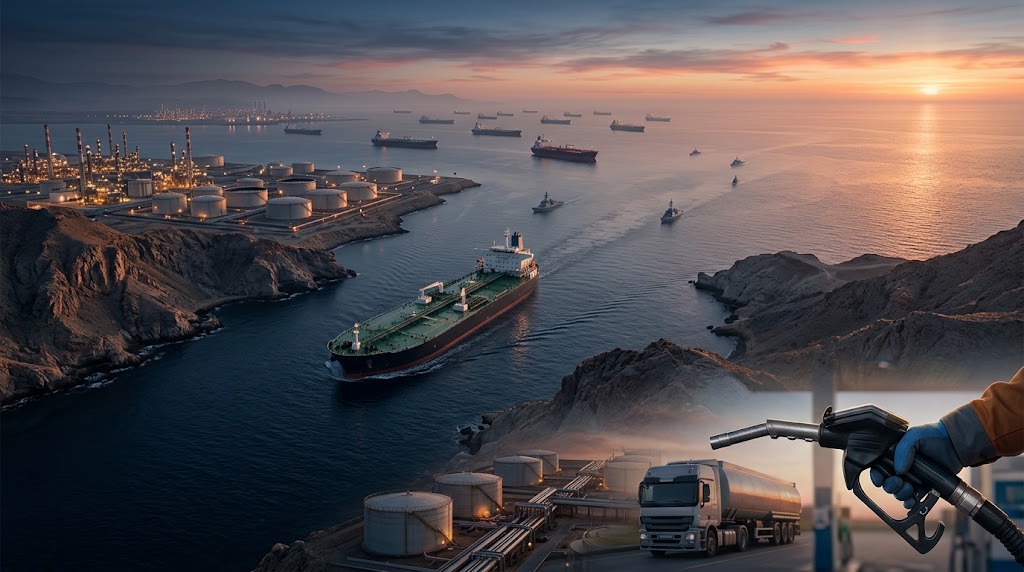
A tanker attack thousands of kilometres away can eventually change what you pay at a petrol station. The reason is the Strait of Hormuz: a narrow sea passage that normally carries roughly one-fifth of global petroleum consumption. In September 2026, renewed attacks and falling tanker traffic have pushed that risk back into oil prices.
Why the Strait of Hormuz Can Raise Your Petrol Price: The 2026 Oil Chokepoint Crisis Explained
By Global Affairs & Energy Desk | Monday, September 7, 2026
A few kilometres of sea between Iran and Oman can influence the price of almost everything.
That sounds absurd until you look at a map.
The Strait of Hormuz is the narrow maritime exit from the Persian Gulf into the Gulf of Oman and Arabian Sea.
Through it move oil and liquefied natural gas produced by some of the world's biggest energy exporters.
Saudi Arabia.
The United Arab Emirates.
Qatar.
Kuwait.
Iraq.
And, under normal circumstances, Iran itself.
Before the current conflict, more than 20 million barrels of crude oil and petroleum liquids moved through Hormuz every day.
The U.S. Energy Information Administration says flows averaged 20.9 million barrels per day in the first half of 2025, equivalent to roughly 20% of global petroleum-liquids consumption and around one-quarter of the world's maritime oil trade.
That is why a military incident in this one waterway can become a problem for motorists, airlines, factories and households thousands of kilometres away.
And on September 7, that risk is rising again.
What Happened This Weekend?
Tensions between the United States and Iran escalated sharply after vessels were attacked in and around the Gulf.
U.S. Central Command said American forces struck three Iranian crude-oil carriers on September 5 after Iran launched ballistic missiles at two U.S. Navy ships.
Iran, meanwhile, said it had targeted several vessels operating in or near the Strait of Hormuz.
Reuters reported that commercial tankers have increasingly become part of the economic pressure campaign between the two sides.
The shipping market responded quickly.
Over the past ten days, the average number of observed commodity ships crossing Hormuz fell to roughly 10 per day, the lowest level since May, according to Kpler data cited by Reuters.
That compares with much heavier traffic during normal conditions.
The important point is not that the strait has completely closed.
It hasn't.
The problem is uncertainty.
A shipping company now has to ask:
Will my tanker be targeted?
Will insurance cover it?
Will a crew agree to sail?
Will the ship be delayed?
Will a restricted zone be declared?
Will another military exchange occur before the cargo leaves the Gulf?
Every one of those questions has a price.
Oil Markets Add the Risk Before the Fuel Is Actually Missing
Oil markets do not wait until petrol stations run dry.
They price expectations.
If traders believe future supply may become harder to obtain, crude prices can rise immediately.
Today, Brent crude climbed to around $96.80 per barrel, while U.S. West Texas Intermediate reached roughly $92.14, according to Reuters.
Brent had already gained about 7.8% during the previous week, with WTI rising nearly 10%.
That does not mean every petrol price around the world will increase by 7.8%.
Crude oil is only one part of the final retail price.
But it raises the starting cost for refiners.
And when crude becomes expensive at the same time as shipping becomes risky, the pressure can spread through the entire fuel system.
Why Hormuz Is So Difficult to Replace
The obvious question is:
Why not send the oil somewhere else?
Some Gulf producers can.
But only partly.
Saudi Arabia operates its East-West pipeline, allowing some crude to move toward the Red Sea.
The UAE has a pipeline that can move crude from Abu Dhabi toward Fujairah, outside Hormuz.
The EIA estimates that major Saudi and UAE bypass pipelines together can provide around 4.7 million barrels per day of alternative capacity.
That sounds large.
It is.
But compare it with more than 20 million barrels per day that normally moved through Hormuz before the conflict.
The arithmetic is the problem.
Alternative pipelines can reduce the damage.
They cannot simply replace the strait.
Other diversion routes can also be:
longer,
more expensive,
or constrained by capacity.
That is why Hormuz is known as an oil chokepoint.
A huge flow of energy passes through a geographically narrow place with limited substitutes.
The 2026 Disruption Has Already Been Enormous
The current crisis did not begin this weekend.
It has been reshaping oil markets for months.
EIA estimates that oil and petroleum-liquid flows through Hormuz averaged only 4.9 million barrels per day in the second quarter of 2026.
That was down from approximately 21.6 million barrels per day in the fourth quarter of 2025, before the conflict.
The result was dramatic volatility.
Brent crude traded above $100 per barrel during parts of the second quarter and reached approximately $118 per barrel on April 29 before falling sharply later in June.
A June U.S.-Iran memorandum briefly improved expectations.
Traffic began recovering.
Oil prices fell.
Then attacks on tankers resumed.
By late July, Brent had again reached roughly $105 per barrel as shipping disruptions intensified.
September's renewed vessel attacks show why traders remain nervous.
The problem is not simply how much oil is moving today.
It is whether anybody can confidently predict how much will move next week.
How Does an Attack Near Iran Reach Your Local Petrol Pump?
The chain begins with crude oil.
A refinery buys crude.
If crude becomes more expensive, the refinery's raw material costs rise.
But there is another layer.
Tankers themselves become more expensive to operate in dangerous waters.
Insurance premiums can increase.
Shipowners may demand higher freight rates.
Crews face greater risk.
Some tankers may delay departure or avoid the route entirely.
That can make the physical movement of oil more expensive even before the commodity price itself changes.
Refineries then convert crude into products such as:
petrol,
diesel,
jet fuel,
kerosene,
and other petroleum products.
If refined fuels become scarce in a particular region, their prices can rise faster than crude itself.
That is especially important for diesel.
Reuters reported last week that U.S. retail diesel reached record levels as the latest Middle East supply disruption intensified.
And diesel matters far beyond motorists.
Diesel Is Where an Oil Crisis Becomes a Food and Inflation Story
Petrol is highly visible.
People see the price every time they fill a car or motorcycle.
Diesel works more quietly through the economy.
It powers:
trucks,
buses,
construction machinery,
agricultural equipment,
generators,
and freight networks.
If diesel becomes more expensive, a trucking company pays more to move goods.
That increase can eventually reach the price of:
vegetables,
cement,
consumer products,
factory inputs,
and imported goods.
A farmer may pay more for fuel.
A logistics operator may raise rates.
A manufacturer may pay more to operate backup generators.
An airline sees higher jet-fuel costs.
A shipping company sees higher bunker-fuel costs.
This is how an oil shock becomes an inflation shock.
Not because every company instantly raises prices.
Because energy sits inside almost every supply chain.
Why Pakistan Is Particularly Exposed
Pakistan imports a large share of its petroleum requirements.
That means international prices matter directly.
Pakistan's fuel-pricing system also incorporates international product benchmarks and the exchange rate.
OGRA's published pricing framework explains that ex-refinery petroleum pricing uses Arab Gulf Platts benchmark prices, together with procurement premiums, freight and incidentals.
The formula also incorporates the PKR/USD exchange rate.
The final ex-depot consumer price can then include:
the ex-refinery price,
Inland Freight Equalization Margin,
distribution margin,
dealer commission,
Petroleum Levy,
and applicable sales tax.
So Pakistan's petrol price is not simply:
Brent crude × exchange rate.
Several components sit between global oil and the pump.
But the connection remains powerful.
If Gulf product prices rise and the rupee weakens simultaneously, the pressure becomes stronger.
If global oil rises while the rupee strengthens, some of that pressure can be reduced.
And government decisions on levies and taxation can influence how much of an international movement is ultimately passed to consumers.
This Is Why Petrol Prices Don't Move Exactly With Brent
People often see oil rise 5% and expect petrol to increase 5%.
That is not how fuel pricing works.
Imagine crude rises sharply today.
The petrol being sold at your local station may have been:
purchased earlier,
refined earlier,
shipped earlier,
and priced according to a defined government review period.
There can therefore be a delay.
Refined-product prices also do not always move exactly with crude prices.
During a refinery shortage, petrol or diesel can become expensive even when crude moves less.
Currency rates matter too.
Taxes matter.
Government policy matters.
Freight matters.
Dealer margins matter.
That is why the best way to understand a potential Pakistan fuel-price change is to watch several indicators together:
international petrol and diesel benchmarks,
Brent crude,
the rupee-dollar exchange rate,
government levy decisions,
and the official pricing notification.
Does Today's Oil Rise Guarantee Another Petrol Increase in Pakistan?
No.
And this distinction is important.
Today's global oil-price movement increases the risk of upward pressure.
It does not allow us to predict an exact future Pakistani petrol price.
The government could adjust levies.
International prices could fall before the next pricing calculation.
The rupee could move.
The geopolitical situation could suddenly improve.
Shipping traffic could recover.
So anyone claiming today:
“Petrol will definitely rise by Rs10”
or
“diesel will increase by exactly Rs15”
without the official calculation is speculating.
The responsible conclusion is:
renewed Hormuz disruption is creating upward pressure on the international cost components that eventually influence Pakistan's fuel prices.
Why China and Asia Matter So Much
Hormuz is particularly important for Asia.
China, India, Japan and South Korea are among the biggest buyers of Middle Eastern energy.
Reuters reports that China's seaborne crude imports in August remained far below their pre-conflict levels.
Asian seaborne crude imports overall have also fallen significantly since the conflict intensified.
When Asian refiners cannot obtain normal volumes from the Gulf, they look elsewhere.
Russian oil.
West African oil.
U.S. crude.
Latin American barrels.
That changes global trade routes.
And when many buyers suddenly compete for the same alternative barrels, prices can rise in places that never depended heavily on Hormuz in the first place.
That is why an oil chokepoint is a global problem.
The barrels do not disappear neatly from one region.
The entire market rearranges itself.
Natural Gas Is Part of the Story Too
Hormuz is not only about crude oil.
Qatar is one of the world's biggest exporters of liquefied natural gas.
Much of that LNG normally leaves through the Strait of Hormuz.
This year, disruption has already forced unusual logistics.
Reuters reported that Qatari and UAE LNG cargoes were transferred between ships outside the strait to keep cargoes moving toward markets including India and Japan.
Asian spot LNG prices have been affected sharply by the disruption.
Higher gas prices can feed into:
electricity,
fertilizer,
industry,
and heating costs.
So the economic risk extends beyond petrol stations.
Why Can't OPEC+ Simply Pump More Oil?
OPEC+ met on September 6 and decided to keep its October production policy unchanged.
But today's market problem is not purely a question of how much oil exists underground.
It is also:
Can the oil physically reach buyers?
A producer may have spare capacity.
That capacity has limited usefulness if:
its export terminal is threatened,
tankers will not load,
shipping routes are blocked,
or the available pipeline cannot carry the additional barrels.
Reuters notes that OPEC+ influence over actual supply is currently constrained because of the continuing regional conflict.
This is why geopolitical supply disruptions can behave differently from normal production cuts.
A cartel can reverse a voluntary cut.
A damaged shipping system can take much longer to normalize.
Could Oil Go Much Higher?
It could.
It could also fall quickly.
That is the frustrating part.
Oil prices are extremely sensitive to expectations.
A ceasefire or credible shipping agreement could send prices lower.
A major attack on export infrastructure could send them sharply higher.
The EIA's August outlook assumed Hormuz traffic would gradually recover and forecast Brent eventually declining toward an average of $78 per barrel in the fourth quarter of 2026.
It also expected most shut-in production to return by early 2027.
But that forecast was completed before the latest attacks.
Today's market is effectively asking whether that recovery timetable has become too optimistic.
Reuters reports some analysts now expect restricted Middle Eastern exports to persist through the end of the year.
Forecasts will continue changing with the conflict.
A Small Strait With an Enormous Economic Shadow
Look again at the map.
Hormuz is not a giant ocean.
At its narrowest navigable area, shipping traffic is concentrated into tightly controlled sea lanes.
Yet behind those lanes sit some of the world's largest petroleum reserves.
That geography creates a remarkable imbalance.
A local military confrontation becomes:
an oil-price problem.
The oil-price problem becomes:
a transport problem.
The transport problem becomes:
an inflation problem.
And the inflation problem reaches:
families,
businesses,
governments,
and central banks.
That is why financial markets react to tanker attacks almost immediately.
They are not pricing only the damaged vessel.
They are pricing the possibility of what comes next.
What Should Readers Watch Now?
The most useful indicator is not every dramatic political statement.
Watch the physical energy system.
Are more tankers crossing Hormuz?
Are very large crude carriers departing safely?
Are shipping-insurance costs falling?
Is Brent crude stabilizing?
Are Saudi and UAE bypass pipelines moving more oil?
Are Gulf exporters restarting shut-in production?
Does Iran implement its proposed restricted shipping zone?
And most importantly:
do the United States and Iran move toward another practical shipping arrangement?
Those developments matter more to fuel prices than political rhetoric alone.
Why a Tanker Attack Thousands of Kilometres Away Matters to You
The connection from Hormuz to an ordinary petrol station can feel almost invisible.
But the chain is logical.
A tanker becomes harder to move.
Shipping risk rises.
Oil supply becomes less certain.
Traders bid up crude prices.
Refineries pay more.
Fuel import costs increase.
Exchange rates amplify or reduce the effect.
Governments calculate new retail prices.
Truckers pay more for diesel.
Transport costs spread through the economy.
Eventually the original event—
a projectile striking a ship far out at sea—
can appear in a household budget as:
a more expensive commute,
a higher delivery charge,
or a more expensive bag of groceries.
That is globalization in one of its clearest forms.
The world economy has spent decades building an extraordinarily efficient energy system.
Oil can move from the Persian Gulf to a refinery thousands of kilometres away with remarkable reliability.
But efficiency creates dependence.
When huge flows of energy pass through one narrow waterway, that waterway becomes everybody's concern.
On September 7, 2026, the Strait of Hormuz is reminding the world of that fact again.
The petrol pump may be local.
The price behind it is global.
Frequently Asked Questions
What is the Strait of Hormuz?
The Strait of Hormuz is a narrow waterway between Iran and Oman connecting the Persian Gulf with the Gulf of Oman and Arabian Sea. It is one of the world's most important energy-shipping routes.
How much oil normally passes through the Strait of Hormuz?
Before the 2026 conflict severely disrupted shipping, flows were above 20 million barrels per day. EIA says 20.9 million barrels per day moved through the strait in the first half of 2025, equivalent to about 20% of global petroleum-liquids consumption.
How much oil was moving through Hormuz during the 2026 conflict?
EIA estimates flows fell to an average of only 4.9 million barrels per day in the second quarter of 2026, compared with 21.6 million barrels per day in Q4 2025.
What is happening in Hormuz now?
Renewed U.S.-Iran military exchanges have included attacks on tankers and other vessels. Reuters says observed commodity-ship traffic recently fell to an average of about 10 vessels per day, the lowest since May.
What is the oil price today?
On September 7, Reuters reported Brent crude around $96.80 per barrel and U.S. WTI around $92.14 amid renewed concern about Gulf supply disruption.
Why does Hormuz affect petrol prices?
Disruption can reduce available oil supply while increasing tanker freight, insurance and risk costs. Higher crude and refined-product prices can eventually feed into retail petrol and diesel prices.
Will petrol prices in Pakistan definitely increase?
Not necessarily. Pakistan's retail prices depend on several factors, including international petroleum-product benchmarks, the rupee-dollar exchange rate, freight, margins, levies and government decisions. Hormuz disruption creates upward pressure but does not by itself determine the exact next price.
How are Pakistan petroleum prices calculated?
OGRA's published framework includes Arab Gulf Platts benchmarks, procurement premiums and freight, the exchange rate, inland freight, distribution and dealer margins, Petroleum Levy and applicable sales tax.
Why is diesel especially important?
Diesel powers much of the freight, agriculture, bus transport, construction and industrial backup-generation system. Higher diesel prices can therefore spread into the cost of goods and food.
Can Saudi Arabia bypass the Strait of Hormuz?
Partly. Saudi Arabia and the UAE operate pipelines that can move some oil outside Hormuz. EIA estimates combined key bypass capacity at roughly 4.7 million barrels per day—far below normal Hormuz volumes.
Does Qatar's LNG also pass through Hormuz?
Yes. Qatar's LNG exports depend heavily on the waterway. Recent disruption has already forced unusual ship-to-ship transfers outside Hormuz for some cargoes.
Could oil fall again quickly?
Yes. A credible ceasefire, safe-shipping agreement or sustained recovery in tanker traffic could reduce the geopolitical risk premium quickly.
What should consumers watch?
The most useful indicators are Brent crude prices, actual tanker traffic through Hormuz, the PKR/USD exchange rate for Pakistani readers, official petroleum-price notifications and whether the latest military escalation begins to ease.
Editorial Note: This article explains how the Strait of Hormuz can influence consumer fuel prices; it does not predict a specific future petrol or diesel price for Pakistan. Oil and shipping conditions are changing rapidly. Current market figures are based on reporting available on September 7, 2026, while Pakistan's final retail prices depend on the applicable official pricing formula and government notification.
petrol prices Pakistan, Hormuz crisis oil prices, Iran US oil conflict, Brent crude September 2026, diesel prices, global oil chokepoint, Pakistan fuel prices, tanker attacks Hormuz
Strait of Hormuz, Oil Prices, Petrol, Diesel, Iran, United States, Energy Crisis, Pakistan, Inflation, Shipping