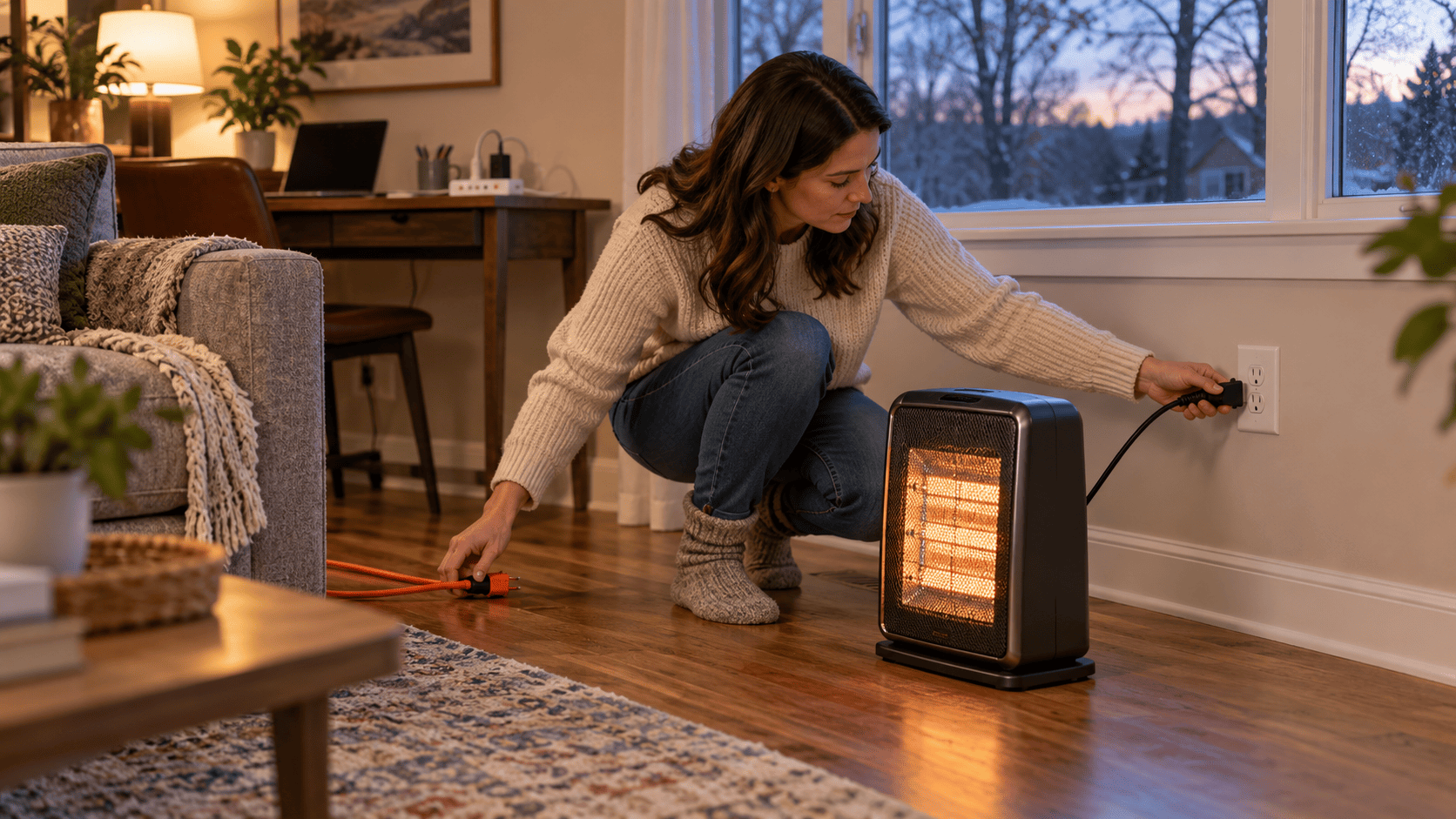
Can You Plug a Space Heater Into an Extension Cord? Why Fire-Safety Experts Say No
The bedroom is cold, the nearest wall outlet is across the room, and an extension cord seems like an obvious solution. But portable electric heaters draw enough power that this ordinary household shortcut can create an overheating and fire hazard. The U.S. Consumer Product Safety Commission says space heaters should be plugged directly into a wall outlet—never into an extension cord or power strip.
The Rule Is Simpler Than Most People Expect
For an electric portable space heater:
Use a wall outlet.
Not an extension cord.
Not a power strip.
Not a multi-outlet adapter.
Not another extension cord connected to the first one.
CPSC's current winter safety guidance explicitly tells consumers to plug electric space heaters directly into wall outlets and never use an extension cord or power strip.
The National Fire Protection Association gives the same advice.
This is not simply a recommendation for very old heaters.
It applies to ordinary portable electric space heaters used in homes today.
Why Is a Space Heater Different From a Phone Charger?
The important difference is electrical demand.
A portable heater turns electrical energy into heat and can place a substantial continuous load on the electrical circuit.
An extension cord adds another electrical connection and another length of conductor between the outlet and the appliance.
If that cord, plug or connection cannot safely handle the load, resistance can generate unwanted heat.
That heat may occur:
inside the extension cord;
at the plug;
at the receptacle;
or at another connection point.
CPSC warns that electrical products and extension cords can present fire and shock hazards when they are unsuitable, damaged or improperly used.
With a space heater, the safest approach is to eliminate the extension cord entirely.
A Power Strip Does Not Make It Safer
This is another common misunderstanding.
A power strip may look more substantial than an extension cord.
Some have:
surge protection;
an illuminated switch;
a circuit breaker;
or several heavy-looking outlets.
That does not make a power strip the recommended connection for a portable heater.
CPSC says never plug an electric space heater into a power strip.
NFPA gives the same direct-to-wall recommendation.
A surge protector is designed to protect equipment against certain electrical surges.
It is not permission to connect every high-load appliance to it.
Do Not Plug Several Things Into the Same Heater Circuit
Even when the heater is plugged directly into the wall, loading the same circuit with other high-demand appliances can create problems.
NFPA specifically advises not plugging other devices into the same circuit being used for a space heater because doing so could result in overheating.
That means the wall receptacle itself is only part of the picture.
Several outlets in one room may belong to the same branch circuit.
A heater plus another large appliance can create more electrical demand than expected.
If operating the heater repeatedly trips a breaker, do not keep resetting the breaker and pretending nothing happened.
The circuit needs attention.
A Tripped Breaker Is a Warning, Not an Inconvenience
Circuit breakers exist to interrupt unsafe electrical conditions.
If turning on the heater causes the breaker to trip repeatedly, stop using that setup.
Do not solve the problem by:
installing a larger breaker yourself;
moving the heater onto a random extension cord;
or repeatedly resetting the breaker.
The problem could involve:
circuit loading;
the heater;
the outlet;
or household wiring.
A qualified electrician can determine what is actually happening.
A breaker that repeatedly trips is communicating information.
Listen to it.
What If the Heater Cord Does Not Reach the Outlet?
Move the heater.
That answer may be inconvenient.
It is still the answer.
Choose a location where the heater's own manufacturer-supplied cord can reach an appropriate wall receptacle without being stretched, pinched or routed through a walking path.
Do not choose the heater location first and then engineer a chain of cords to make electricity reach it.
Choose a safe electrical connection first.
Then place the heater appropriately around it.
Do Not Run the Heater Cord Under a Rug
A cord disappearing under a rug looks tidy.
It also hides the cord from view and can expose it to physical wear.
U.S. Fire Administration guidance warns against running extension cords under rugs or carpets because walking over them can damage insulation and create a fire or electrical shock hazard.
The same general principle applies to the heater's own power cord:
keep it visible;
keep it out of traffic;
do not pinch it beneath furniture;
and protect it from damage.
Electrical safety should not be sacrificed for a cleaner-looking floor.
Keep Three Feet of Space Around the Heater
Electricity is only half of the problem.
The heater itself is intentionally producing heat.
CPSC recommends keeping portable heaters at least three feet away from combustible materials such as:
bedding;
curtains;
furniture;
and other things that can burn.
USFA and NFPA give the same three-foot guidance.
Three feet can feel like a lot in a small bedroom.
That does not make the recommendation optional.
Your Bed Is Not a Safe Heater Stand
Do not place a portable heater:
on a bed;
on upholstered furniture;
on a chair;
or on another unstable surface.
NFPA recommends placing electric portable heaters on a solid, flat surface.
This reduces the chance of tipping and keeps the heater away from materials that can ignite.
Carpeted rooms deserve particular attention.
Follow the manufacturer's placement instructions for your specific heater.
Look for Tip-Over Protection
Modern portable heaters often include a safety feature that shuts the unit off if it tips.
NFPA recommends choosing a space heater with an automatic tip-over shutoff.
That feature is valuable.
It is not a substitute for correct placement.
A heater with tip-over protection can still be unsafe if it is:
surrounded by clothing;
plugged into a power strip;
covered;
or left running unattended.
Safety features provide another layer of protection.
They do not cancel unsafe use.
Overheat Protection Is Worth Looking For Too
NFPA also recommends choosing a heater with a thermostat and overheat protection.
Overheat protection is intended to shut down the appliance when internal temperatures become abnormal.
Again, that does not mean you should deliberately restrict airflow or use the heater incorrectly.
It means a properly designed heater has additional protection if something begins going wrong.
When buying a heater, safety features deserve at least as much attention as:
remote controls;
timers;
display screens;
and aesthetic design.
Use a Heater Listed by a Qualified Testing Laboratory
NFPA recommends purchasing portable heaters bearing the mark of a qualified testing laboratory.
That provides evidence that the product was evaluated to applicable safety requirements.
Avoid buying an unknown heater solely because it is unusually cheap.
Also check for recalls, particularly if:
the heater is older;
was purchased secondhand;
or has behaved abnormally.
A bargain is no bargain if the product has a known safety defect.
Check the Cord Before the First Cold Night
A heater can sit in a closet for eight months.
Before plugging it in again, inspect:
the power cord;
plug;
heater housing;
and controls.
USFA says portable heaters should be checked for cracked or damaged cords and broken plugs before use.
Do not tape over a damaged heater cord and continue using it.
Do not bend a damaged plug back into shape.
And do not assume a heater is safe because it worked last winter.
Physical damage deserves proper repair or replacement.
What If the Plug Feels Warm?
A small amount of warmth around some electrical equipment can occur during use.
But a plug or outlet that becomes very hot deserves immediate attention.
NFPA says consumers should check for a secure plug-to-outlet fit and warns that if the plug becomes very hot—or does not fit snugly—the outlet may need replacement by a qualified electrician.
Do not normalize:
scorch marks;
melting;
discoloration;
a burning smell;
crackling;
or excessive heat.
Stop using the heater on that outlet and have the problem evaluated.
A Loose Outlet Can Be a Real Problem
You plug the heater in.
The plug feels loose.
It partly falls out if touched.
That is not something to solve with:
tape;
a furniture brace;
or bending the plug blades.
A loose electrical connection can generate heat.
NFPA specifically recommends professional outlet replacement when the plug-to-outlet connection is not secure.
A qualified electrician should handle a worn or damaged receptacle.
The heater should not become the test instrument for how loose an outlet can get.
Do Not Cover the Heater
A portable heater needs airflow.
Do not drape:
clothing;
towels;
blankets;
or wet gloves
over it.
Do not use the heater as a clothes dryer.
Combustible material placed directly against a heating appliance can create obvious fire risk.
If wet clothing needs drying, use an appropriate drying method.
A space heater is not a drying rack with electricity.
Never Put It Right Beside the Bed
Cold bedrooms create one of the most tempting unsafe setups:
heater beside the mattress;
blanket hanging close to the heater;
extension cord stretching across the room;
heater running through the night.
That combination contains several hazards at once.
CPSC says heaters should be at least three feet from bedding and other combustible material and should be turned off when people are sleeping.
If the bedroom is consistently too cold without running a portable heater overnight, the underlying heating problem may deserve attention.
Turn It Off Before You Go to Sleep
CPSC's 2026 guidance is explicit:
Turn off portable heaters when sleeping.
NFPA says heaters should be turned off and unplugged when you leave the room or go to bed.
A timer may sound convenient.
It does not change the basic recommendation.
Do not leave the portable heater operating while you sleep.
Do Not Leave It Running When You Leave the Room
The heater should be something you actively supervise.
Not background equipment you forget about.
Turn it off when leaving.
That includes quick departures that turn into long ones.
You may intend to walk downstairs for two minutes.
Then the phone rings.
Then someone arrives.
Then thirty minutes pass.
An unattended heater does not know you planned to return quickly.
Children and Space Heaters Need Distance
NFPA recommends keeping children away from portable space heaters.
The concern is not only fire.
A heater can also create burn risk.
Young children may:
touch the housing;
pull a cord;
knock the heater over;
or move objects closer to it.
The safest heater location is one that does not sit directly in normal play or walking areas.
Pets Can Knock Them Over Too
A dog can bump a heater.
A cat can investigate it.
A wagging tail can move lightweight objects.
Pet bedding itself is combustible material.
Treat pets as another reason to create a clear safety zone around portable heating equipment.
Tip-over protection helps.
Good placement helps more.
Never Block an Exit With a Heater
NFPA recommends keeping heaters away from foot traffic and never using them where they block an exit.
Imagine needing to leave a room quickly during an emergency.
You should not have to step over:
a heater;
its cord;
or furniture repositioned around it.
Heating one corner of a room should not compromise your escape path.
A Bathroom Creates Additional Electrical Concerns
Electricity and water require careful separation.
Do not automatically move an ordinary space heater into a bathroom because the room feels cold.
Use only equipment specifically approved by the manufacturer for the intended environment and follow its installation and clearance requirements.
Never place a portable electrical heater where it can fall into:
a bathtub;
shower;
sink;
or other water source.
When a room combines water and electricity, improvisation is especially risky.
Do Not Use the Oven to Heat the House
If central heating stops working, opening the oven door can feel like an emergency solution.
It is not a safe substitute for home heating.
USFA specifically advises people not to use a stove to heat the home.
Fuel-burning appliances can also create carbon monoxide hazards when used improperly.
Use heating equipment only for the purpose and installation for which it was designed.
Electric Space Heaters Do Not Produce Carbon Monoxide—but Fuel-Burning Heaters Can
An ordinary electric resistance space heater does not burn fuel, so it does not generate carbon monoxide through combustion.
Portable heaters that burn fuel are different.
Fuel-burning equipment requires correct ventilation and appropriate use.
NFPA notes that carbon monoxide can be created when fuels burn incompletely and recommends carbon monoxide alarms to provide early warning.
Do not apply electric-heater advice blindly to:
kerosene heaters;
propane heaters;
or other fuel-burning units.
Follow the specific manufacturer's safety requirements.
Smoke and Carbon Monoxide Alarms Still Matter
Cold weather means more heating equipment is operating throughout the home.
CPSC's winter safety guidance recommends functioning smoke and carbon-monoxide alarms as part of household heating safety.
Test alarms according to their manufacturer's instructions.
Make sure they are:
properly installed;
within their service life;
and operational.
A smoke alarm does not make unsafe heater use acceptable.
It provides a warning if prevention fails.
Why Are Portable Heaters Such a Fire Concern?
Because they combine several things that demand respect:
electric current;
high surface or air temperatures;
combustible household materials;
and sometimes unattended operation.
CPSC estimates portable heaters, including electric space heaters, were involved in an average of approximately 1,600 fires per year, resulting in an estimated average 70 deaths and 150 injuries annually during 2020–2022.
Those numbers do not mean portable heaters should never be used.
They mean the small appliance deserves much more attention than a table lamp.
The Most Dangerous Setup Often Looks Completely Ordinary
Picture this:
a portable heater beside the couch;
plugged into a power strip;
the power strip beneath a rug;
curtains nearby;
heater running while everyone goes upstairs.
Nothing in that scene looks dramatic.
There are no sparks.
No smoke.
No flames.
That is exactly why ordinary household shortcuts can become dangerous.
Safety is often about correcting the setup before anything looks wrong.
Can a Space Heater Save Money?
Potentially, in limited situations.
Heating one occupied room instead of raising the thermostat for an entire home can sometimes reduce total heating demand.
But that depends heavily on:
the home's primary heating system;
electricity prices;
heater use;
insulation;
room size;
and how much central heating is actually reduced.
Running several electric space heaters throughout a house can quickly undermine the idea of targeted heating.
A space heater is best thought of as supplemental heat.
Not automatically a cheaper replacement for the home's main heating system.
One Heater Per Room Can Become Expensive Fast
People sometimes start with one heater in a cold office.
Then another appears in the bedroom.
Another in the basement.
Another near the couch.
At that point, the household may be using multiple high-demand electric appliances simultaneously.
That increases both:
electricity consumption;
and electrical circuit loading.
If several rooms are consistently uncomfortable, investigate the home's heating system, insulation, air leakage and ductwork rather than automatically building a collection of portable heaters.
A Cold Room May Be Telling You About the House
If one room always needs a space heater, ask why.
Possible causes include:
poor insulation;
air leakage;
weak HVAC airflow;
duct problems;
closed or obstructed registers;
thermostat location;
or an undersized or unbalanced heating system.
The heater treats the symptom.
It does not necessarily solve the cause.
For a home you expect to live in for years, fixing the underlying comfort problem may be more effective than plugging in supplemental heat every winter.
Do Not Buy a Bigger Heater Before Checking the Room
If the heater struggles to warm the space, a more powerful portable appliance is not automatically the right answer.
Check:
room size;
insulation;
drafts;
door and window leakage;
and manufacturer recommendations.
A room leaking heat rapidly can make almost any portable heater appear ineffective.
Solving the leakage may improve comfort without increasing electrical demand.
What If You Have No Free Wall Outlet?
This is an electrical-system problem, not an extension-cord problem.
If a room requires a portable heater but lacks an appropriate wall receptacle in a safe location, consider having a qualified electrician evaluate the room.
The correct long-term solution may involve:
additional receptacles;
circuit evaluation;
or other electrical work.
A permanent electrical need should not be solved indefinitely with a temporary cord.
The Five-Minute Space Heater Safety Check
Before using the heater tonight, check:
Is it plugged directly into a wall outlet?
Is the plug secure?
Does the cord have cracks or damage?
Is the heater on a solid, flat surface?
Is there at least three feet of clearance from bedding, curtains and furniture?
Is the heater away from walkways and exits?
Does it have tip-over protection?
Are children and pets kept away?
Will you turn it off when leaving the room?
Will you turn it off before sleeping?
If any answer is no, fix the setup before switching the heater on.
What Should You Do If You Smell Burning?
Turn the heater off.
Unplug it if doing so can be done safely.
Do not continue running it simply to see whether the smell disappears.
A first-use smell from dust and a genuine electrical overheating smell are not something you should diagnose casually while the equipment continues heating.
Inspect the heater and outlet.
If you see:
melting;
scorching;
damaged wiring;
or excessive heat,
stop using the equipment and have the problem evaluated.
If smoke or fire develops, leave the home and call emergency services.
What If the Outlet Is Discolored?
Stop using that outlet for the heater.
Brown marks, melted plastic or discoloration can indicate heat damage.
Do not hide it behind the heater and move the plug to the other socket in the same receptacle.
NFPA advises professional replacement when an outlet provides a poor plug fit or the connection becomes excessively hot.
Visible damage makes professional evaluation even more important.
Do Not “Upgrade” the Extension Cord
A common internet argument goes like this:
“What if I buy a really heavy-duty extension cord?”
That misses the central point.
CPSC does not say:
“Use a sufficiently heavy-duty extension cord.”
It says:
plug the space heater directly into a wall outlet—never into an extension cord or power strip.
For household consumers, that is the clearest rule to follow.
There is no reason to turn a simple recommendation into an electrical engineering experiment.
The Safest Extension Cord for a Portable Space Heater Is No Extension Cord
That is the line worth remembering.
If the heater cannot reach a wall outlet safely:
move the heater;
use another safe room location;
or address the electrical setup.
Do not solve distance with another cable.
The purpose of a space heater is comfort.
It should not require creating a new hazard to provide it.
So Can You Plug a Space Heater Into an Extension Cord?
CPSC, NFPA and the U.S. Fire Administration all give the same answer:
No.
Plug portable electric space heaters directly into a wall outlet.
Keep at least three feet between the heater and anything that can burn.
Turn it off when:
you leave the room;
or go to sleep.
And pay attention to the electrical connection.
If the plug becomes very hot or fits loosely, NFPA says the outlet may need to be replaced by a qualified electrician.
The inconvenient truth is also the easiest one to remember:
If the heater's cord does not reach the wall outlet, the heater is in the wrong place.
Move it.
Do not extend it.
---------------------------------------------------------------
space heater extension cord, can you plug space heater into extension cord, space heater power strip, can you plug space heater into surge protector, portable heater safety, space heater wall outlet, extension cord overheating, space heater fire risk, space heater outlet hot, winter heating safety, electric space heater safety, power strip heater fire, space heater bedroom safety
Why Does Your Smoke Alarm Always Chirp at 3 A.M.? There’s a Reason
Your Electric Bill Jumped—But You Didn’t Use More Power. What Changed?
Your Furnace Still Works. So When Does Replacing It Actually Save Money?
Why Are Your Windows Wet Every Morning? What Condensation Is Telling You About Your Home
Your Dryer Needs Two Cycles to Dry Clothes. That Can Be a Warning Sign
Home & Garden
Homeowner moving a portable electric space heater away from an extension cord and plugging it directly into a wall outlet.
Can You Plug a Space Heater Into an Extension Cord?
Using a Space Heater? Never Plug It Into This
CPSC says portable electric space heaters should be plugged directly into a wall outlet—not an extension cord or power strip. Here’s why it matters.
Your Room Is Cold. The Outlet Is Too Far Away. Don’t Make This Shortcut.
The space heater is here.
The wall outlet is over there.
The extension cord seems obvious.
CPSC says don’t do it.
Portable electric heaters should be plugged directly into a wall outlet—not an extension cord or power strip.
And if the plug or outlet becomes very hot, that is not something to ignore.
There is also a simple three-foot rule every space-heater owner should know before winter.
Have you ever used a space heater with an extension cord or power strip without realizing safety agencies advise against it?
Research Notes
CPSC's 2026 winter-heating guidance says portable electric space heaters should be plugged directly into a wall outlet and never into an extension cord or power strip. It also recommends keeping heaters at least three feet from combustible materials and turning them off while sleeping.
CPSC estimates portable heaters, including electric space heaters, were involved in an average of about 1,600 fires annually during 2020–2022, resulting in an estimated average of 70 deaths and 150 injuries per year.
NFPA recommends choosing a portable electric heater listed by a qualified testing laboratory and equipped with thermostat, overheat protection and automatic tip-over shutoff. It recommends a solid, flat placement surface, three feet of clearance and direct connection to a wall receptacle.
NFPA also advises consumers not to plug other equipment into the same circuit used by a space heater. If the heater plug does not fit securely in the outlet or becomes very hot, NFPA says a qualified electrician may need to replace the outlet.
The U.S. Fire Administration likewise advises checking portable heater cords and plugs for damage, keeping heaters three feet from combustible objects and plugging heaters directly into wall outlets rather than extension cords or power strips.
Safety Note
Portable heaters can present fire, burn and electrical hazards. Follow the heater manufacturer's instructions and current CPSC/NFPA guidance. Stop using equipment with damaged cords, plugs, outlets, unusual overheating, smoke, sparks or burning odors. Electrical outlet or household wiring problems should be evaluated by a qualified electrician.
can you plug space heater into extension cord, space heater power strip, space heater wall outlet, space heater fire risk, portable heater safety, extension cord overheating, space heater outlet hot, space heater safety tips, electric heater winter safety
Space Heaters, Winter Safety, Home Heating, Electrical Safety, Fire Prevention, Extension Cords, Home Maintenance, Cold Weather, Home & Garden, Everyday Problems