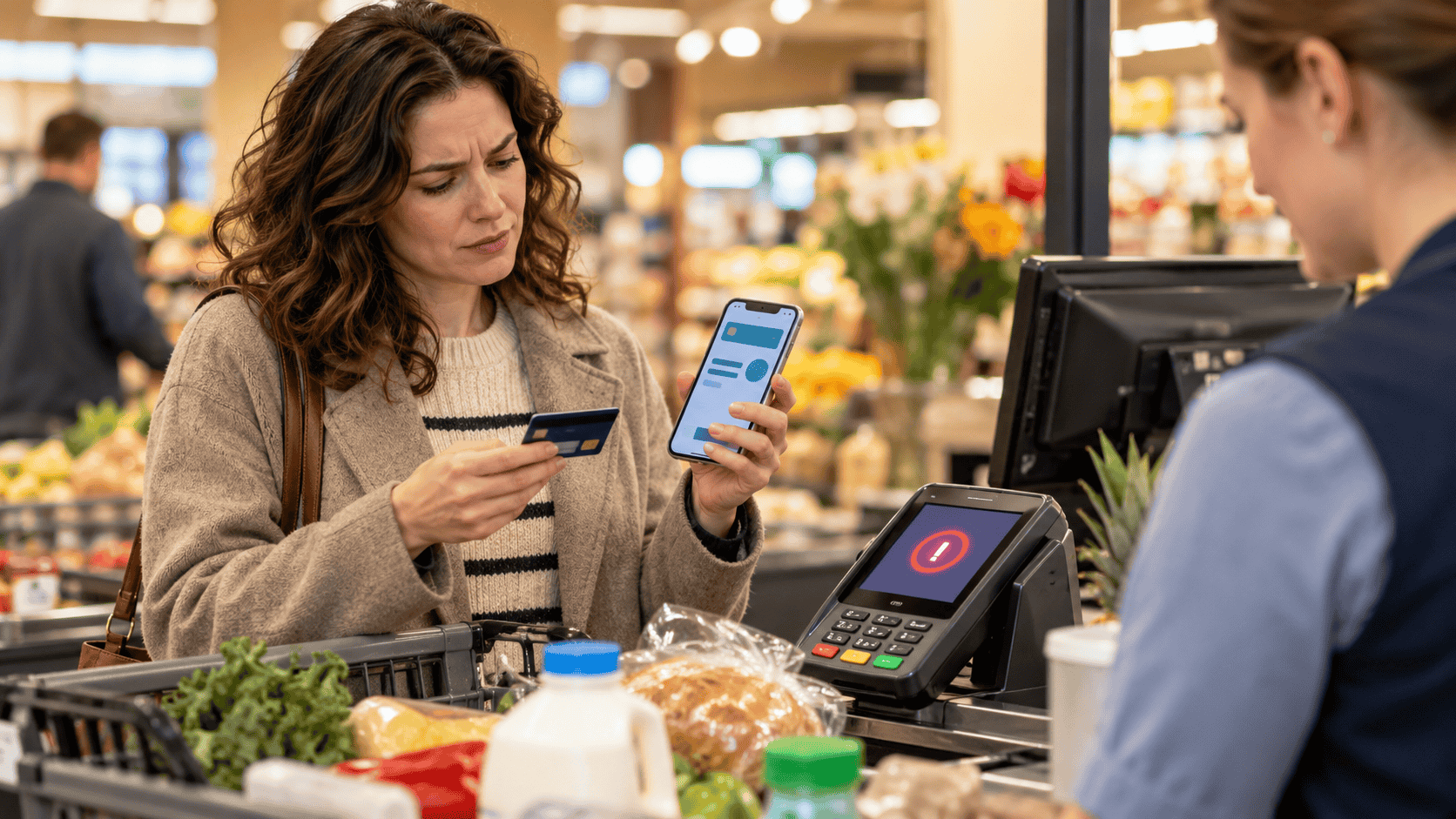
Your banking app shows money in the account—or your credit card still has available credit—yet the payment terminal flashes “Declined.” Before assuming your account has been emptied or your card is broken, know that banks can reject an individual transaction for reasons ranging from fraud protection and temporary authorization holds to spending limits, incorrect billing information and simple processing failures.
Having Money Does Not Guarantee Every Transaction Will Be Approved
A card payment is not simply a merchant asking, “Does this person have money?”
The merchant sends an authorization request through the payment network to the card issuer. The issuer then decides whether to approve that particular transaction.
For credit cards, CFPB explains that authorization confirms both that the account is valid and that enough credit appears to be available. But a transaction can still fail because of account conditions or a technical problem.
Visa likewise says the bank or card issuer is normally the best source for the specific decline reason.
So if your app shows $2,000 and a $40 purchase fails, the displayed balance is only one clue.
1. A Pending Transaction May Already Be Using Part of Your Balance
This is one of the easiest explanations to miss.
Imagine your checking account shows:
$500 current balance.
But yesterday you:
bought $120 of groceries;
paid $80 for gas;
and have a $200 hotel authorization still pending.
The money may still appear in parts of your transaction history while some of it is already unavailable for new spending.
CFPB explains that an available balance generally accounts for pending authorized debits, while the ledger or current balance may not reflect those holds in the same way.
That means the most important number for a debit-card purchase is usually your available balance, not simply the largest balance shown on the screen.
2. A Hotel, Gas Station or Rental Car Company May Have Placed a Hold
Some merchants do not know the final transaction amount when they first run your card.
Hotels may need to account for incidental charges.
Rental car companies may place an authorization above the quoted rental amount.
Gas stations can request a temporary authorization before they know how much fuel you will pump.
Those holds can temporarily reduce available funds or available credit.
CFPB-hosted card agreements illustrate that hotel, restaurant, gas-station and rental-car transactions may place holds greater than the eventual purchase amount and that the hold can remain until the final transaction is submitted.
That explains a familiar scenario:
You have enough money for dinner.
Your card is declined.
But the real problem is the hotel deposit holding several hundred dollars in the background.
A Gas Pump Can Decline a Card That Works Inside
Pay-at-the-pump terminals can be especially confusing.
A fuel station may request a temporary authorization before fuel is dispensed.
If that authorization exceeds the amount currently available, the pump may decline the transaction even though you have enough money to purchase the amount of fuel you actually want.
Some card agreements specifically advise customers in that situation to pay inside with the cashier instead.
So if the pump says no, trying the same card inside for a specific dollar amount can sometimes produce a different result.
3. Your Bank May Think the Purchase Looks Suspicious
Fraud systems constantly evaluate transactions.
That protection can sometimes stop a legitimate purchase too.
Visa identifies suspected fraud as one of the major reasons transactions are declined.
CFPB also notes that transactions can be rejected when circumstances suggest fraud, including unusually heavy card use over a short period.
Examples might include:
a purchase much larger than your normal spending;
several purchases in rapid succession;
an unusual online merchant;
activity in an unexpected location;
or a transaction pattern that looks different from your normal behavior.
The bank does not necessarily “know” the transaction is fraudulent.
Its system may simply decide it needs additional verification.
Check Your Phone Before Trying the Card Five More Times
Your bank may have sent:
a push notification;
text message;
email;
or app alert
asking whether you recognize the transaction.
If you confirm it was you, the bank may allow you to retry.
But do not respond to an unexpected message by clicking random links or providing passwords.
If you are unsure whether a fraud alert is legitimate, open your bank's official app or call the number printed on the back of the card.
The FTC specifically advises consumers to contact a bank through its official app, website, statement or card number rather than trusting contact information supplied by an unexpected caller or message.
4. You May Have Hit a Daily Spending or Withdrawal Limit
Having $5,000 in an account does not necessarily mean you can spend or withdraw all $5,000 in one transaction.
Cards can have:
daily purchase limits;
ATM withdrawal limits;
cash-advance limits;
transaction-count limits;
or other security restrictions.
CFPB notes that prepaid cards, for example, may impose purchase, reload and cash-withdrawal limits, and those limits vary by provider.
Credit-card agreements can also permit issuers to restrict the number or value of transactions for security reasons.
That can explain why:
a $200 purchase works;
then a much larger purchase does not;
even though the account still has money or credit.
ATM Limits Are Especially Common
Suppose your checking account contains $3,000.
You try to withdraw $1,500 from an ATM.
The machine declines it.
That does not necessarily mean the $3,000 is unavailable.
You may simply have exceeded:
your bank's daily withdrawal limit;
the ATM operator's transaction limit;
or another restriction.
Mastercard's transaction-processing guidance includes specific decline responses for transactions that exceed withdrawal limits.
Try checking the bank app or contacting the bank rather than repeatedly attempting different ATMs.
5. Your Online Billing Information May Not Match
The card works perfectly at a grocery store.
Then an online purchase fails.
The problem may be the information entered at checkout.
CFPB says online prepaid-card purchases can be declined when the address or ZIP code provided to the merchant does not match what the card provider has on file.
Similar verification systems are widely used for online card transactions.
Double-check:
card number;
expiration date;
security code;
billing address;
and ZIP code.
A simple typo can look like a security problem.
A Recently Replaced Card Can Break Subscriptions
If your card was:
lost;
stolen;
expired;
or replaced after suspected fraud,
you may now have a new:
card number;
expiration date;
security code;
or all three.
A streaming service or other merchant may still be trying to charge the old credentials.
CFPB advises consumers who receive replacement cards to update automatic payments linked to the previous card.
So when one subscription suddenly fails while ordinary purchases work, check what payment information that merchant has stored.
6. Your Credit Card May Have Less Available Credit Than You Think
A credit card balance and available credit are different things.
Suppose your limit is $5,000 and your posted balance is only $2,000.
You might assume you have $3,000 available.
But pending purchases or merchant authorization holds may already be reserving part of that credit.
CFPB regulations recognize that hotel authorization holds, for example, can reduce available credit before the final purchase posts.
A merchant can therefore receive a decline even though your statement balance appears comfortably below your credit limit.
Check available credit, not only the last statement balance.
A Payment You Just Made May Not Have Restored Credit Yet
You pay $1,000 toward the credit card.
Then immediately try to make another $1,000 purchase.
Depending on the issuer and payment method, your available credit may not yet reflect the full payment.
Look at the account's current available-credit figure.
Do not assume that submitting a payment means the credit line was restored instantly.
If timing is critical, ask the issuer when the payment becomes available for new purchases.
7. The Card or Account May Have a Status Problem
Sometimes the explanation is much simpler.
The card may be:
expired;
not activated;
temporarily locked in the banking app;
reported lost;
replaced;
or restricted.
CFPB lists expired, lost or stolen cards among examples of situations in which an issuer may refuse a point-of-sale transaction.
For prepaid cards, CFPB also notes that failure to activate or register the card can prevent transactions.
Look at the physical card.
Then open the banking app.
A card accidentally left in a “locked” state after a previous security concern can create a surprisingly confusing checkout experience.
8. Sometimes Nothing Is Wrong With Your Account
Payment systems can fail.
The merchant terminal may be offline.
Communication with the issuer may fail.
A processor may experience an interruption.
CFPB specifically notes that a credit-card authorization can fail because the merchant is unable to connect with the issuer due to a technological glitch.
That is why one declined transaction does not automatically mean:
your bank froze the account;
you ran out of money;
or someone stole your identity.
Try another terminal or payment method.
If the card fails repeatedly across unrelated merchants, then contact the issuer.
Should You Keep Trying the Same Card Repeatedly?
Usually, not indefinitely.
One retry after checking the details may be reasonable.
Ten rapid retries are rarely helpful.
If the decline is caused by:
fraud protection;
a spending limit;
a locked card;
or insufficient available funds,
repeated attempts may simply continue failing.
Visa distinguishes between some “soft” declines that may later be retried and harder declines, such as a lost or stolen card status, that should not simply be attempted again.
Check the account instead.
What Should You Do at the Checkout Counter?
Use the fastest troubleshooting order.
First, try the transaction once more if the merchant suspects a terminal issue.
If it still fails:
open your bank app;
check available balance or credit;
look for fraud alerts;
check whether the card is locked;
review pending transactions;
and use another payment method if necessary.
Then contact the card issuer privately.
Do not read account numbers, PINs or security codes aloud at a busy register.
Do Not Give Your PIN to Someone Claiming to Be the Bank
A declined transaction creates exactly the kind of urgency scammers exploit.
Someone may call or text claiming:
“Your card has been blocked.”
Then they ask for:
your PIN;
one-time verification code;
password;
or remote access to your phone.
The FTC warns that legitimate fraud departments should be verified independently and advises consumers not to give unexpected callers account information or verification codes.
Hang up.
Open the official app or call the number on the card.
What If You See Transactions You Did Not Make?
That changes the situation immediately.
Do not concentrate only on getting the next transaction approved.
Report the unauthorized activity.
CFPB says consumers should notify their bank or credit union promptly about unauthorized debit-card or electronic transactions. Federal protections can depend partly on how quickly the problem is reported.
For debit cards, speed is particularly important because the transaction involves money directly leaving the deposit account.
Freeze or lock the card through your bank's official tools if appropriate and contact the issuer.
Debit Card and Credit Card Declines Are Not Quite the Same
A debit card generally spends money from your bank account.
A credit card uses borrowed credit up to the issuer's approved limit.
CFPB explains this distinction clearly: debit cards access money you already have, while credit cards access credit that must later be repaid.
So when a debit card is declined, check:
available account funds;
pending transactions;
holds;
daily limits;
and account status.
For a credit card, also check:
available credit;
credit limit;
payment status;
and account restrictions.
The word Declined can look identical on the terminal even though the underlying reason is completely different.
The Fastest Way to Find the Real Reason
If nothing obvious appears in your banking app, call the issuer.
Use:
the number on the back of the card;
the official banking app;
or the bank's verified website.
Visa says the issuer or bank is best equipped to explain the specific reason a transaction was declined.
Ask:
“Was this transaction declined by you?”
“What reason code do you see?”
“Is there a hold or spending restriction?”
“Do I need to confirm this purchase?”
“Can I safely retry it?”
That is more useful than guessing.
So Why Was Your Card Declined When You Had Money?
Because the bank was not evaluating only the number you saw on the screen.
The transaction may have collided with:
pending authorizations;
a hotel or gas-station hold;
a fraud alert;
a purchase limit;
incorrect online billing details;
reduced available credit;
a locked or expired card;
or a temporary payment-system failure.
Visa's own payment data identifies insufficient funds, suspected fraud and approval-amount limits among major causes of declined transactions.
The best response is therefore not:
“But I know I have money!”
It is:
“What did the issuer see when this transaction was authorized?”
Check available funds.
Check pending holds.
Check security alerts.
Then contact the issuer if the answer is still unclear.
A declined card can be embarrassing for thirty seconds.
Most of the time, the explanation is much less dramatic than it feels at the register.
card declined even though I have money, debit card declined, credit card declined, why is my card being declined, card declined with money in account, available balance card declined, pending transaction hold, gas station card declined, hotel authorization hold, card fraud alert, debit card spending limit, credit card available credit
Why Is That Credit Card Charge Still Pending? And Why Is the Amount Wrong?
Your Bank Balance Was Positive. So Why Did You Get an Overdraft Fee?
Your Credit Score Dropped—and You Didn’t Miss a Payment. What Happened?
How Personal Loan APR Really Works
Money
Lifestyle
American shopper looking puzzled at a declined card payment while checking a mobile banking app that still shows available funds.
Why Was My Card Declined Even Though I Have Money?
Your Card Was Declined—but You Have Money. What Happened?
A positive balance does not guarantee every card purchase will be approved. Holds, fraud protection, spending limits and payment glitches can all cause a decline.
Social Title
Your Bank App Shows Money. So Why Did Your Card Just Get Declined?
Social Hook
Your banking app shows plenty of money.
The cashier runs your card.
Declined.
What happened?
It may have nothing to do with being broke.
A hotel hold, gas-station authorization, fraud alert, daily spending limit or even one wrong billing detail can stop an otherwise valid card.
Before trying the card again and again, check one number:
available balance—not just current balance.
Reader Question
What was the strangest reason your bank ever gave you for declining a legitimate purchase?
Research Notes
CFPB explains that card authorization is the process by which a merchant asks an issuer to approve a transaction. Credit-card authorization can fail because of account problems, insufficient available credit or technological issues between the merchant and issuer.
CFPB says available balances can differ from ledger balances because pending authorized transactions and available deposits affect how much money is actually available to spend.
Visa identifies insufficient funds, suspected fraud and transactions exceeding approval amounts among major decline causes in recent global VisaNet data.
Merchant authorization holds at hotels, restaurants, rental-car companies and gas stations can temporarily reduce available funds or credit before the final purchase amount settles.
CFPB says incorrect billing addresses or ZIP codes, fraud alerts, insufficient funds and spending limits can cause certain online card transactions to be declined.
Consumer Note
Banks, card issuers and payment networks use different authorization and fraud-control systems. A decline reason can only be confirmed by the card issuer. Never provide a PIN, password or one-time security code to an unexpected caller claiming to help with a declined transaction.