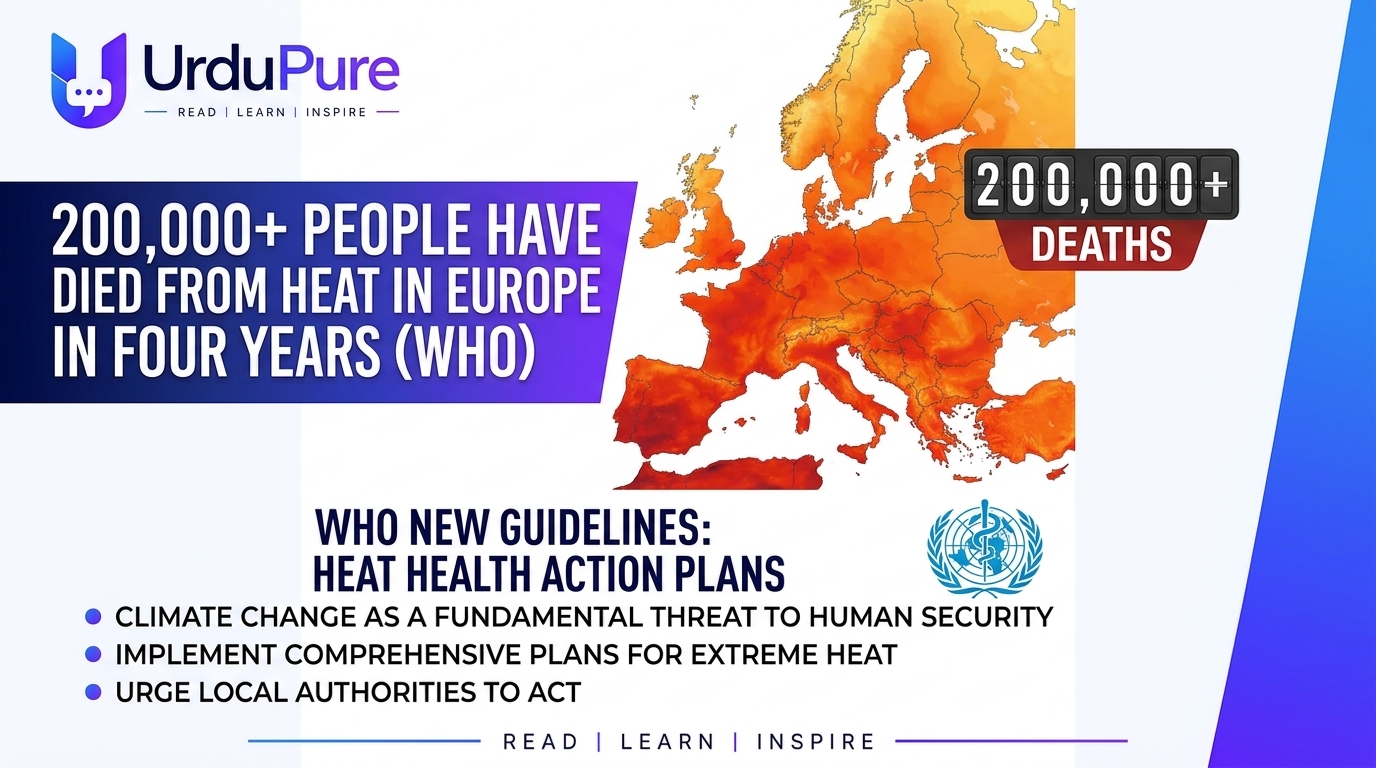
200,000 Dead From Heat in Europe Alone — The WHO's Warning Is Addressed to the Entire World
Two hundred thousand human lives. In four years. All from heat. All preventable.
That was the verdict delivered by the World Health Organization (WHO) on June 11, 2026, when it launched sweeping new global guidelines in Berlin — and it sent a warning that no government on any continent can afford to ignore.
The 200,000 deaths cited by WHO are from Europe alone. Globally, the picture is far more severe. Heat kills hundreds of thousands of people every single year, across every inhabited region on Earth — and that toll is accelerating as the planet warms faster than any generation in human history has experienced.
"The impacts of climate change are a clear and present danger, and its most immediate and lethal manifestation is extreme heat," said Dr Hans Henri Kluge, WHO's Europe director, at the Berlin launch. "Heatwaves are no longer freak weather anomalies. They are now a recurring crisis inflicting suffering, claiming lives and fracturing our health systems and infrastructure."
The European Toll: 200,000 in Four Years
Europe has become the starkest illustration of what happens when a warming planet meets an ageing, urbanised population without adequate preparation.
More than 200,000 lives have been lost to heat in Europe since 2022 — roughly the population of a mid-sized city, erased not by war or pandemic, but by temperatures that governments had the knowledge and tools to address. Most of those deaths were entirely preventable, Kluge said, and the number was "the tip of the iceberg, with millions more people being affected physically and mentally."
The data on which countries are hit hardest is striking: most premature deaths have occurred in Italy, followed by Spain, Germany and Greece, with Greece recording the highest number per million inhabitants. In 2022 alone — a single summer — Italy recorded 18,010 heat-related deaths, Spain 11,324, and Germany 8,173. In 2025, Germany's Robert Koch Institute documented approximately 2,500 more heat-related deaths, predominantly among older people.
And the trend is worsening. Europe is warming at roughly twice the global average. Global temperatures reached 1.37°C above pre-industrial levels in 2025 and are expected to breach the critical 1.5°C threshold within four years. Without urgent intervention, WHO estimates the European annual heat death toll alone could reach 120,000 by 2050.
The Global Picture: Asia Accounts for Nearly Half of All Heat Deaths
As alarming as Europe's numbers are, they represent only a fraction of the global heat death toll — and not even the largest fraction.
According to WHO's own factsheet on heat and health, approximately 489,000 heat-related deaths occur globally every year, based on studies from 2000 to 2019. Of those, 45% are in Asia and 36% in Europe. Asia — home to the majority of the world's population, concentrated in some of its hottest and most climatically vulnerable regions — bears a disproportionate and largely invisible burden.
Research published in 2025 found that in 2021 alone, South Asia recorded over 209,000 deaths attributed to high temperatures, and Southeast Asia a further 32,000. These are not projected figures — they are recent recorded deaths. And they are projected to rise dramatically: South Asia is on course to exceed 400,000 annual heat deaths by 2045 if current trajectories continue.
Heat-related mortality for people over 65 has already increased by approximately 85% between 2000–2004 and 2017–2021. The pace of increase is accelerating alongside the pace of warming.
The Middle East: When Heat Exceeds Human Survivability
Perhaps nowhere illustrates the lethal extremes of our warming world more vividly than the Middle East — a region warming at nearly twice the global average, where summer temperatures already regularly exceed 50°C.
In June 2024, during the Hajj pilgrimage in Mecca, Saudi Arabia, temperatures soared to a record-breaking 51.8°C (125°F). At least 1,301 pilgrims died from heat-related causes — heatstroke, dehydration, organ failure. Over 2,764 cases of heat-related illness were reported in a single day. Researchers found that the upper limits of human physiological heat tolerance were exceeded for a total of 43 hours across the six days of Hajj — meaning conditions existed in which the human body physically cannot cool itself, regardless of health status or fitness.
The pilgrims who died came from across the Muslim world: at least 658 from Egypt, around 90 from India, 60 from Jordan, 144 from Indonesia, and dozens from Tunisia, Iran and elsewhere. Eighty-three percent were unregistered pilgrims who had walked long distances under direct sun without access to air-conditioned shelter — a reminder that vulnerability to heat is inseparable from vulnerability to poverty and exclusion.
Climate projections for the region are harrowing. Analysis published in Nature indicates that heat events of this magnitude in Mecca may become a regular annual occurrence under continued warming — threatening the viability of one of the world's largest annual human gatherings.
Africa: The Continent Most Exposed With the Least Protection
Sub-Saharan Africa faces what climate scientists describe as a convergence of extreme heat exposure and minimal adaptive capacity — a combination that will produce some of the world's most severe heat mortality in coming decades.
Heat already contributes substantially to mortality across the continent through its interaction with other conditions: cardiovascular disease, malaria, dengue, food insecurity, and the physical demands of predominantly outdoor agricultural labour. The World Meteorological Organization (WMO) has noted that heatwaves across Africa have exacted a heavy toll on labour productivity, crop yields, and educational access — with school closures during extreme heat events affecting millions of children.
In Southern Africa, climate models point toward conditions approaching non-survivable wet-bulb temperatures in some areas under continued warming — a threshold beyond which no amount of shade, water, or rest can prevent the body from overheating. Early 2026 already saw record temperatures of 44.8°C in parts of South Africa.
The Americas and Oceania: No Region Is Spared
The global reach of the heat crisis spans every populated continent. In early 2026, extreme heat and widespread wildfires affected southern South America, with temperatures in parts of Argentina and Chile approaching 50°C, triggering severe fire outbreaks with significant human and ecological consequences.
Australia experienced a severe heatwave in January 2026, with inland southeastern temperatures nearing 50°C and extreme fire danger comparable to the devastating 2019–20 Black Summer. New Zealand is recording extreme heat events four to five times more frequently than would be expected without long-term warming.
In North America, the United States, Canada and Mexico have all seen record heat events in recent years — from the Pacific Northwest's deadly 2021 heat dome, which killed hundreds in a region accustomed to temperate summers, to successive record-breaking summers in the US Southwest. The 2026 FIFA World Cup venues in the United States and Mexico were subject to the first-ever cooling breaks in World Cup history — a small but telling symbol of how normalised extreme heat has become even in sport.
Who the Heat Kills: The Anatomy of an Unequal Crisis
Heat does not kill randomly. It kills with a disturbing precision that follows the contours of inequality, age, and vulnerability.
According to WHO, the most at-risk populations globally are consistent across regions:
Older adults — Heat-related mortality rises sharply with age. The elderly, especially those living alone without family or community support, are the largest group of heat fatalities worldwide.
Infants and young children — Whose thermoregulatory systems are still developing and who depend entirely on caregivers to recognise and respond to heat danger.
People with chronic diseases — Cardiovascular disease, diabetes, kidney disease, respiratory conditions, and mental illness are all dramatically worsened by heat. Cardiovascular diseases in particular occur more frequently or worsen sharply under heat stress.
Outdoor workers — Agricultural labourers, construction workers, delivery workers, and street vendors face direct occupational heat exposure with little legal protection in most of the world. In South and Southeast Asia, the Middle East, and much of Africa, these workers form the backbone of the economy — and are the most exposed.
Low-income populations — Who cannot afford air conditioning, live in poorly insulated housing in urban heat islands, and lack access to cooling centres or medical care.
Migrants and undocumented workers — Frequently excluded from formal health communication systems and early warning alerts, living in informal settlements with no cooling infrastructure.
Rising global temperatures, rapid urbanisation and demographic ageing are converging globally to increase both exposure to heat and vulnerability to its effects, the WHO warns.
The WHO's New Framework: Eight Steps Every Country Must Take
The June 11 Berlin announcement was not merely a statement of alarm — it was the launch of the updated Heat–Health Action Plans (HHAP) Guidance, the second edition of a framework first published in 2008, now comprehensively revised to reflect 18 years of accumulated science, implementation experience, and climate data.
The guidance is structured around eight core elements — a universal framework applicable to any country, from Norway to Nigeria, from Germany to Bangladesh:
Governance — Clear legal and institutional frameworks assigning responsibility for heat response, with dedicated funding and cross-ministry coordination. Heat deaths cannot remain everyone's abstract concern and therefore no one's concrete responsibility.
Heat–Health Warning Systems — Timely, accurate alert systems calibrated to local climate conditions, communicated through channels that actually reach vulnerable populations.
Populations at Increased Risk — Formal mapping of the elderly, chronically ill, isolated, outdoor workers, and urban poor — linked directly to warning systems so alerts trigger proactive outreach, not just generic broadcasts.
Communication — Life-saving messages co-designed with communities in local languages and formats, reaching transient populations, migrants, and those without digital access.
Health System Resilience — Backup power for cooling systems, protected temperature-sensitive medication, real-time surveillance of heat-related morbidity, and infrastructure prepared for surging patient loads during extreme events.
Reducing Heat Exposure — Urban redesign using the "sponge-city" principle: permeable surfaces, expanded tree canopies, reflective materials, and preserved natural ecosystems that actively cool the landscape. "Nature can help us combat the heat if we let it," said German Federal Environment Minister Carsten Schneider at the Berlin launch.
Heat–Health Surveillance — Real-time data systems tracking hospital admissions, emergency calls, and mortality during heat events so responses can be scaled and targeted as conditions evolve.
Monitoring, Evaluation and Learning — Systematic post-event review so every heatwave improves future response. Heat preparedness must evolve as the climate does.
The Urban Heat Island: Cities as Ground Zero
One of the most pressing themes in the WHO guidance is the role of cities. Dense urban environments are significantly hotter than surrounding countryside — the Urban Heat Island effect — because dark surfaces, dense infrastructure, and absence of vegetation trap and amplify heat rather than dispersing it.
"Large, densely built-up cities are particularly vulnerable to the dangers of summer heat," noted Berlin Senator for Health Ina Czyborra at the launch.
This is a global reality. Whether it is Lagos, Jakarta, Cairo, Mumbai, São Paulo, or Houston — the world's rapidly growing megacities are concentrating vulnerable populations in environments that magnify heat extremes. The shift to urban living, combined with climate change, is creating a convergence of risk that no city on any continent is fully prepared for.
Workers of the World: A New Legal Mandate
The updated WHO guidance takes an unusually direct stance on occupational heat protection. The framework mandates that employers worldwide implement mandatory acclimatisation periods, provide shaded rest areas, adapt protective equipment, and — critically — establish clear channels that empower workers to halt unsafe labour and seek medical care without fear of economic reprisal.
This is a radical shift in global labour norms. In most of the world, outdoor workers in agriculture, construction, and delivery have no legal protection during heat emergencies. The WHO guidance, backed by the 2023 Budapest Declaration on Environment and Health and the UN's 2024 global call for action on extreme heat, now frames this as a fundamental human rights issue — not a weather inconvenience to be quietly endured.
Heat as a Global Social Justice Issue
WHO is unusually direct: "Protection against heat is also a social issue."
The 1,301 pilgrims who died at Hajj in 2024 were overwhelmingly those without access to air-conditioned transport or tents. The 200,000 Europeans who died since 2022 were disproportionately elderly people living alone with no one to check on them. The 209,000 South Asians who die annually from heat are concentrated among outdoor workers and the rural poor.
Heat follows inequality with the precision of a heat-seeking missile. Any response that does not put equity — access to cooling, proactive outreach to the isolated, worker protections for the informal sector, warning systems in local languages — at its centre will fail the people who need it most.
Implementation: The Gap Between Knowledge and Action
The first WHO HHAP guidance was published in 2008. In the 18 years since, implementation has lagged badly. A survey of the WHO European Region found only 17 of 27 responding countries had a national heat-health action plan in place. Outside Europe, the gaps are even wider.
The updated 2026 guidance is designed to close this gap — providing both new and existing programs with a practical, implementation-oriented framework. The stated ambition is uncompromising: "zero heat-related deaths" as the long-term goal, with every avoided death representing a life saved, a family spared, a community strengthened.
A Warning to the Whole World
Two hundred thousand dead in Europe. Nearly half a million globally every year. 1,300 pilgrims in Mecca on a single June week. Record temperatures on six continents in a single year. A 1.5°C threshold closing within four years.
The WHO's June 11, 2026 announcement is not a regional health bulletin. It is a global emergency call — addressed to every government, every city planner, every employer, and every citizen on a warming planet.
Heat has quietly become the deadliest climate-related hazard in human history. It kills more people than floods, more than storms, more than any individual extreme weather event — and it does so invisibly, in homes and on roadsides and in fields, far from the cameras. That invisibility is part of what makes it so deadly.
The science, the guidelines, and the evidence all exist. They have existed for years. The question that history will answer is whether governments acted on them — or waited to count more bodies.
As Dr Kluge said in Berlin: "Heat is a silent killer. But it is not an inevitable one."
WHO heat deaths Europe 2026, 200000 heat deaths Europe WHO, extreme heat global crisis 2026, WHO heat health action plan eight elements, heatwave deaths world, heat deaths Asia Middle East Africa, Hajj heat deaths 2024, climate change heat mortality global, Hans Kluge WHO Berlin heat guidelines, extreme heat silent killer WHO 2026






Discussion
Comments
Approved comments are published after moderation to keep discussion useful and spam-free.
No comments yet. Start the discussion below.