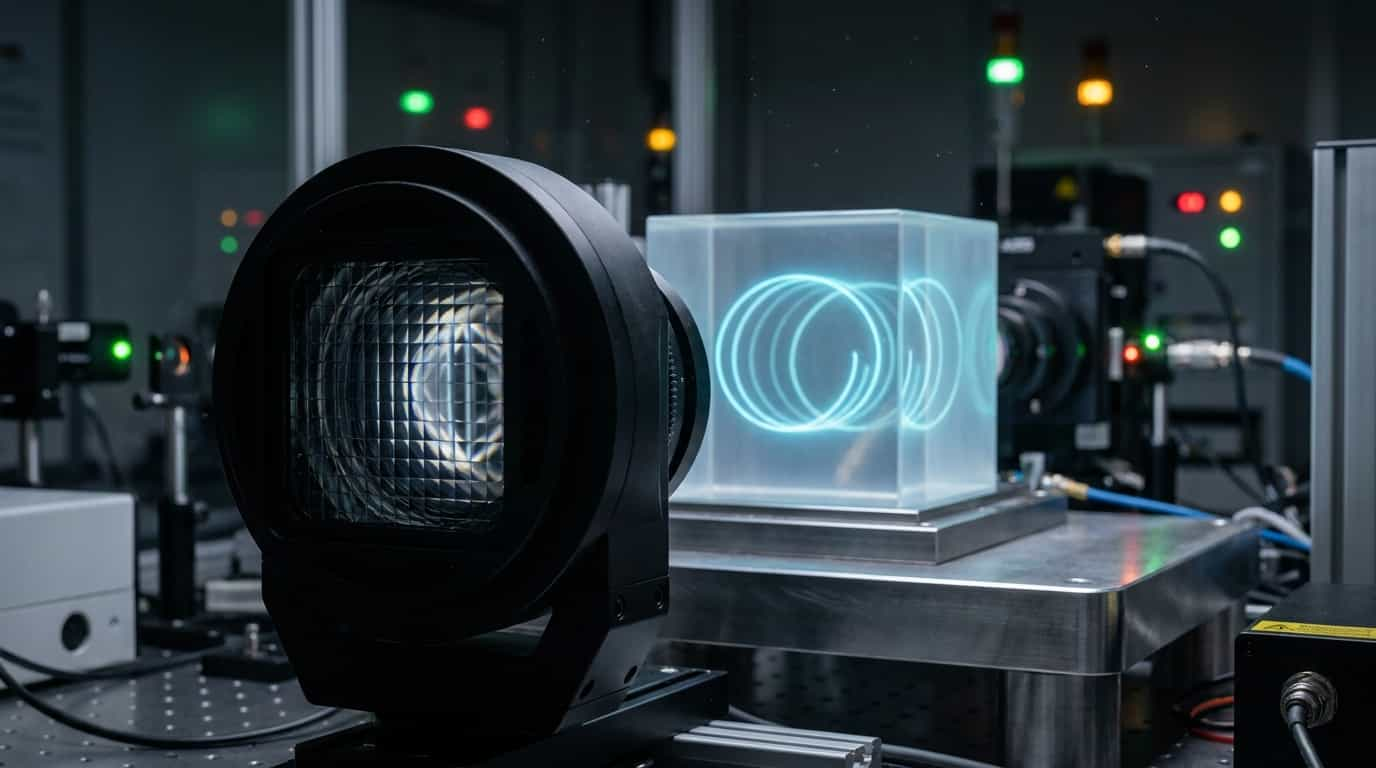
By turning consumer light-field photography into a quantum physics tool, PLATON replaces millions of detector components with a single block of plastic.
By Clara Marini | July 19, 2026
In the world of experimental particle physics, tracking the universe's most elusive ghosts requires an astonishing amount of complexity. To catch a neutrino or trace the path of a dark matter candidate, traditional detectors must segment a massive volume of material into millions of tiny, individually wired detector elements. It is a brute-force approach to engineering: more pixels, more wires, more data channels, and higher costs.
But a collaborative team of Swiss researchers has just demonstrated a radically elegant alternative.
Published in Nature Communications, scientists from ETH Zurich and EPFL have unveiled PLATON (Plenoptic Analysis of Particle Tracks). Funded by the Swiss National Science Foundation, PLATON replaces traditional, highly segmented electronics with an advanced light-field camera, an ultra-sensitive photon sensor, and an AI transformer architecture.
The result is a system that can reconstruct the complex, three-dimensional trajectories of subatomic particles through a solid, unsegmented block of plastic scintillator—even when the particle leaves behind as few as five individual photons of light. By shifting the burden of tracking from hardware complexity to computational intelligence, PLATON could fundamentally change the economics of particle colliders and medical diagnostics alike.
1. Background & Context: The Scintillation Problem
When a charged particle tearing through space smashes into a scintillating material, it transfers energy to the atoms in its path. As those atoms return to their ground state, they release that energy as tiny, faint flashes of visible light. For decades, physicists have used these brief photons to determine where a particle traveled and how it interacted.
Historically, mapping these flashes meant chopping the scintillating material into a grid of tiny, isolated blocks, each hooked up to its own sensor channel. If a particle passed through block A, then block B, then block C, you could map its trajectory.
But as detectors scale up to the size of buildings—like the upcoming Deep Underground Neutrino Experiment (DUNE) in the United States—this architecture becomes a logistical nightmare. The physical wiring, power consumption, and data management required for millions of channels are massive bottlenecks. PLATON avoids this entirely by looking at a single, unbroken block of scintillator from the outside using an incredibly advanced camera system.
2. Technical Challenges: Turning Photography into Physics
The core breakthrough of PLATON lies in its adaptation of plenoptic (light-field) photography.
An ordinary camera records a flat image because it only captures the intensity and color of light hitting a two-dimensional sensor plane. A light-field camera, however, also records the direction from which that light arrived. By placing a micro-lens array (MLA)—a sheet containing thousands of microscopic lenses—between the main camera lens and the imaging sensor, the system captures a scene from thousands of slightly different angles simultaneously.
[Incoming Photon] ---> [Main Lens] ---> [Micro-Lens Array (MLA)] ---> [SwissSPAD2 Sensor]
                                              |
                                     (Captures Intensity,
                                     Position, & Direction)
For particle detection, this directional data is the missing link needed to calculate depth and reconstruct a 3D track from a single vantage point. To capture the incredibly faint light inside a scintillator, the ETH Zurich team, led by Professor Davide Sgalaberna, senior scientist Dr. Saúl Alonso-Monsalve, and PhD student Till Dieminger, paired this micro-lens array with a highly specialized sensor called SwissSPAD2.
Developed by Professor Edoardo Charbon’s Advanced Quantum Architecture Lab at EPFL, SwissSPAD2 is a single-photon avalanche diode array. It doesn't just take pictures; it counts individual photons with picosecond-level time resolution, allowing the system to operate at the absolute quantum limit of light detection.
3. Expert Commentary: Enter the Subatomic Transformer
Capturing the photons is only half the battle; reconstructing the 3D path of a particle from a jumble of raw light data requires immense computing power. To do this, the PLATON team bypassed traditional geometric imaging algorithms in favor of artificial intelligence.
The researchers developed an image-processing method based on a neural network using a Transformer architecture—the exact same underlying math that powers modern large language models (LLMs).
Instead of processing words in a sentence, PLATON's Transformer analyzes the spatial and temporal patterns of the scintillation photons hitting the SwissSPAD2 sensor. It identifies quantum correlations in where and when individual photons appear, instantly mapping them back to the original 3D subatomic interaction.
During laboratory testing, the prototype proved it could reliably calculate spatial resolution down to extreme limits, successfully reconstructing particle positions inside the plastic block using light levels ranging from a few hundred photons down to a mere five photons.
4. Scenario Analysis: Scalability and the DUNE Factor
Can a camera-based system truly compete with legacy hardware in massive physics experiments? Simulations conducted by the team suggest that the scaling laws favor PLATON heavily.
| Detector Feature | Traditional Segmented System | Upgraded PLATON System |
| Material Structure | Millions of individual, wired pieces | Single, unsegmented block |
| Electronic Channels | Escalates linearly with volume | Highly restricted; bound only to camera sensor array |
| Spatial Resolution | Hard-capped by physical segment size | Variable via AI inference ($<1\text{ mm}$ expected) |
| Low-Momentum Sensitivity | High particle energy thresholds required | Captures low-momentum final-state protons with high purity |
Through extensive modeling, the team simulated an unsegmented PLATON detector with a target volume of $10\text{ cm} \times 10\text{ cm} \times 10\text{ cm}$. The neural network achieved a spatial resolution below $1\text{ mm}$. Furthermore, the authors note that with continued optical optimization, sub-millimeter tracking accuracy can realistically scale to massive active volumes larger than $1\text{ m}^3$, opening the door for massive neutrino observatories to slash their electronics budgets by orders of magnitude.
5. Risks & Trade-offs: The Optical Shielding Problem
While PLATON drastically simplifies detector electronics, it introduces new vulnerabilities to the experimental setup.
Traditional segmented detectors are physically shielded from cross-talk because light cannot travel between insulated segments. In an unsegmented PLATON block, light travels freely. This means any secondary reflections, optical imperfections in the plastic, or external light leaks can completely blind the hyper-sensitive SwissSPAD2 sensor.
Additionally, relying entirely on an AI Transformer for track reconstruction introduces a "black box" risk. If the neural network encounters a highly unusual, exotic particle decay that wasn't adequately covered in its simulated training data, it could misinterpret the photon correlations, leading to false positives or missed discoveries. Physicists will need to rigorously validate the AI's boundaries before relying on it for frontier discoveries.
6. Future Outlook: From Particle Colliders to Cancer Scans
History has shown that breakthroughs in particle detection rarely stay confined to high-energy physics labs; the World Wide Web was built to share data at CERN, and proton beam therapy evolved directly from accelerator research. PLATON is already following this exact trajectory.
Because the system is unparalleled at tracking faint, 3D light signatures in real time, the ETH Zurich researchers have already filed three separate patents to adapt PLATON for Positron Emission Tomography (PET) scans.
In medical imaging, applying PLATON's light-field camera and AI transformer could allow PET scanners to trace radioactive oncology tracers inside the human body with vastly superior resolution and at a fraction of the current hardware cost.
The Bottom Line:
By combining quantum-grade single-photon sensors with the computational patterns of modern AI, PLATON proves that hardware complexity can be engineered away. The ability to track invisible particles in 3D without dividing the tracking medium represents a massive leap forward. Whether it's deployed to catch a morphing neutrino deep underground or to map a tumor in a clinical oncology wing, this light-field camera is shedding new light on the invisible world.





Discussion
Comments
Approved comments are published after moderation to keep discussion useful and spam-free.
No comments yet. Start the discussion below.