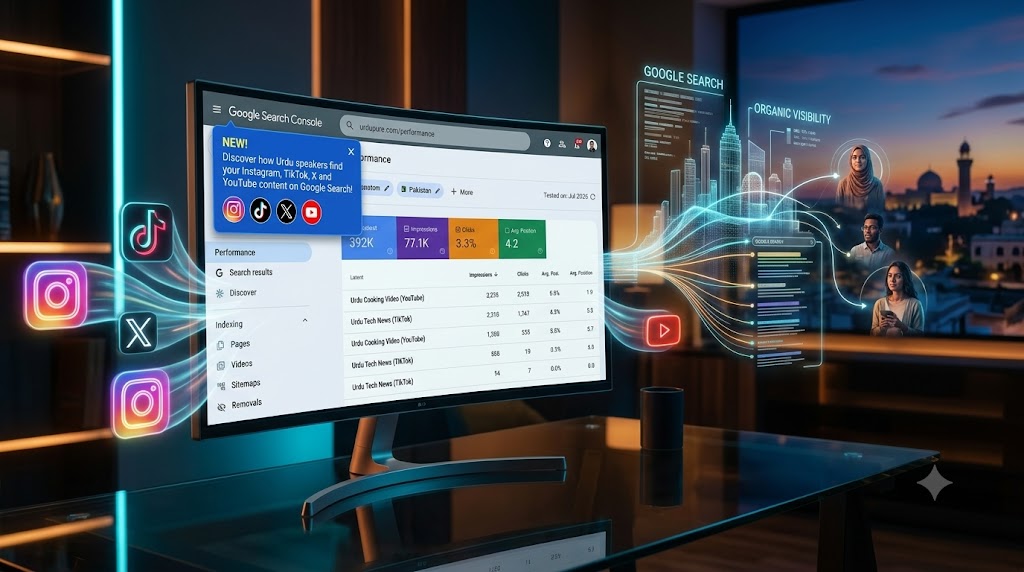
Google Search Console Now Tracks Social Media Content: Complete 2026 Guide
Google has quietly removed one of the biggest blind spots in modern search marketing.
For years, publishers and businesses could use Google Search Console to understand how their websites appeared in Google Search. They could measure clicks, impressions, search queries, click-through rates and rankings for web pages.
But what happened when a YouTube video, Instagram post, TikTok clip or post on X appeared directly in Google?
Until recently, that picture was far less clear.
That changed in July 2026 when Google introduced platform properties in Google Search Console, giving creators and publishers a new way to understand how content published on major social and video platforms performs across Google.
The supported platforms currently include:
- TikTok
- X
- YouTube
For publishers, brands, creators and businesses investing heavily in social content, this could become one of Search Console's most useful additions in years.
What Are Google Search Console Platform Properties?
A platform property is a new type of property inside Google Search Console.
Traditionally, Search Console properties represented websites or sections of websites.
You might have a property for:
- example.com
- www.example.com
- example.com/blog/
- a specific URL-prefix
Google has now expanded that idea beyond websites.
A creator can add a supported social account or channel as its own Search Console property.
That means your YouTube channel, Instagram account, TikTok account or X profile can potentially have its own Search Console reporting environment.
Once verified and connected, Google can show how content from that platform is performing when people discover it through Google.
This is a major distinction.
Search Console is not replacing Instagram Insights, YouTube Analytics or TikTok Analytics.
Instead, it answers a different question:
How are people discovering my social content through Google?
That is the part marketers have historically struggled to measure.
What Can You Measure?
Google says platform properties provide reporting on content performance and traffic trends.
The familiar Search Console Performance report can provide metrics such as:
- Total clicks
- Total impressions
- Average click-through rate
- Average search position
- Search queries
- Individual posts generating traffic
Depending on where eligible content appears, reporting may also include performance from Google Discover and Google News.
This creates an entirely different layer of social analytics.
Imagine publishing a YouTube video titled:
“How to Apply for a UAE Driving Licence – Urdu Guide”
YouTube Analytics can tell you how people discovered that video inside YouTube.
Search Console can help reveal how people discovered the content through Google.
Those are two very different sources of intelligence.
Search Console Is Becoming More Than a Website SEO Tool
This development reflects a much broader change in online search behaviour.
Google results are no longer dominated exclusively by traditional web pages.
Depending on the query, search results can contain:
- YouTube videos
- Short-form videos
- Social posts
- Images
- Discussion results
- News
- Forums
- Product listings
- Local results
- AI-generated summaries
- Traditional web pages
The modern search results page is increasingly multimedia.
That means a company's organic search presence is no longer limited to its website.
A brand could potentially dominate a search result through several properties simultaneously:
- Its website
- Its YouTube channel
- Its Instagram content
- Its TikTok videos
- Its profile on X
Search Console's platform properties make part of this wider organic footprint measurable.
Why This Matters for Content Creators
Consider a creator publishing an educational article and then repurposing the same subject into several formats.
They might publish:
- A 1,500-word website article
- A 10-minute YouTube tutorial
- A 45-second TikTok video
- An Instagram Reel
- A thread on X
Previously, website SEO performance and social platform performance largely existed in different analytics environments.
Now creators can begin examining an additional question:
Which version of the content performs best when Google users search for the topic?
Sometimes Google may prefer the detailed article.
For another query, a video might perform better.
For visual searches, Instagram content could attract visibility.
For timely discussions or first-hand commentary, another social format may surface.
That information can influence what creators publish next.
A Major Opportunity for Pakistani and Urdu Publishers
The feature is particularly interesting for publishers working with regional and local-language content.
Pakistan has an enormous audience consuming information through a mixture of:
- Google Search
- YouTube
- TikTok
- Urdu-language websites
- English-language websites
- Roman Urdu searches
A publisher such as UrduPure, for example, might publish an Urdu article while also producing related video or social content.
Platform properties create an opportunity to study which formats Google users are actually discovering.
Imagine publishing content about:
“Dubai visit visa requirements for Pakistanis”
The subject could exist as:
- An English article
- An Urdu article
- A YouTube explainer
- An Instagram Reel
- A TikTok video
Instead of evaluating every channel only through its internal analytics dashboard, Search Console can provide additional insight into what Google itself is surfacing.
That can help publishers make better editorial decisions.
How to Add a Social Platform to Google Search Console
Google's setup process is considerably simpler than the complicated workarounds marketers previously used.
Step 1: Open Google Search Console
Sign in to the Google account you use to manage Search Console.
Step 2: Open the Property Selector
Use the property selector in the Search Console sidebar.
Choose:
Add property
Step 3: Select a Supported Platform
If platform properties have been enabled for your account, supported options can include:
- TikTok
- X
- YouTube
Step 4: Connect the Account
Choose the platform you want to track and follow Google's verification process.
Ownership must be verified before Search Console provides access to the property's data.
Depending on the situation, verification may use an existing website connection or direct authentication with the relevant platform.
Step 5: Allow Data to Accumulate
Google notes that it can take several days before reporting begins appearing.
Do not expect a complete dashboard immediately after connecting the account.
Google is also rolling the feature out gradually, so some Search Console users may not yet see the platform-property options.
The Performance Report
The Performance report is likely to become the most important area for marketers using platform properties.
It enables creators to investigate metrics including impressions and clicks generated by Google.
Suppose one YouTube video receives:
100,000 Google impressions but only 1,200 clicks.
That immediately raises an optimization question.
Why are users seeing the result but not selecting it?
Possible issues could include:
- A weak video title
- Poor alignment with search intent
- An unattractive thumbnail
- Stronger competing results
- A title written for YouTube recommendations rather than Google Search
- An unclear content proposition
Search Console gives creators another source of evidence for diagnosing those problems.
Search Queries Could Be the Most Valuable Data
One of the biggest opportunities is understanding the searches associated with social content.
Creators frequently optimize videos based primarily on keywords suggested by their social platform.
But Google Search behaviour can differ dramatically.
For example, YouTube viewers might search:
Laravel tutorial Urdu
while Google users might search:
How to install Laravel on Ubuntu VPS
Those searches express slightly different intentions.
A publisher who understands both environments can optimize content much more intelligently.
Search Console therefore becomes valuable not just as a reporting system, but as an editorial research tool.
Use Search Console Insights for Content Decisions
Google also provides an Insights report for platform properties.
Instead of requiring detailed analysis of rows of performance data, Insights is designed to give creators a broader overview.
It can surface information such as:
- Recent traffic trends
- Top-performing content
- Content gaining traction
- How users discover the account
For publishers managing dozens or hundreds of pieces of content, this high-level view can make editorial planning much faster.
Rather than guessing which subjects deserve follow-up content, creators can identify themes Google users are already responding to.
Social SEO Is Now Much More Measurable
The feature strengthens an emerging discipline sometimes described as social SEO.
Social SEO means optimizing social-media content not only for the platform where it is published, but also for discovery through search engines.
For example, a YouTube video's title should not be treated merely as a YouTube headline.
It can also function as a Google Search headline.
Likewise, profile descriptions, captions, video descriptions, topics and entity information can contribute to how clearly search engines understand a creator or brand.
The objective should not be keyword stuffing.
The objective should be clarity.
Google should easily understand:
- Who created the content
- What the content is about
- Which entity or brand it represents
- Which audience it serves
- Which question it answers
- How it relates to other authoritative content from the publisher
Combine Website SEO With Social SEO
The strongest strategy is not choosing between websites and social media.
It is connecting them.
Suppose UrduPure publishes an article titled:
“How AI Is Changing Education in Pakistan”
The content strategy could include:
Website
Publish the complete research-based article.
YouTube
Produce an explanatory video discussing the major findings.
Create visual summaries and short clips.
TikTok
Publish short answers addressing specific questions from the article.
X
Publish key statistics, observations and links to deeper resources.
Search Console can then help reveal which assets Google users actually find.
That information can guide the next round of publishing.
SEO + GEO: Build an Entity, Not Just a Page
This change also matters as publishers adapt to Generative Engine Optimization (GEO) alongside traditional SEO.
Modern search systems increasingly attempt to understand entities, expertise, relationships and information across multiple sources.
A publisher therefore benefits from maintaining a consistent identity across:
- Its website
- Author pages
- Social profiles
- YouTube channels
- Structured data
- About pages
- Editorial profiles
- Citations and mentions across the web
Your website should remain the authoritative home of your brand and original content.
Social channels can then reinforce that entity with additional formats, conversations, videos and first-hand expertise.
The result is a stronger digital footprint than publishing isolated articles alone.
Geographic SEO Still Matters
There is another meaning of GEO that remains especially important for regional publishers: geographic search optimization.
A Pakistani publisher should pay attention to where search demand originates.
Topics may perform differently among audiences in:
- Pakistan
- Saudi Arabia
- United Arab Emirates
- United Kingdom
- United States
- Canada
Urdu-speaking audiences in those markets often search differently.
For example:
Saudi work visa Urdu
may signal different intent from:
Saudi work visa requirements Pakistan 2026
Likewise:
best perfume wholesale Karachi
has a strongly local commercial intent.
When geographic reporting is available for the relevant Search Console data, combining location, query and content analysis can reveal opportunities that broad global metrics hide.
Don't Confuse Google Impressions With Platform Views
This distinction is essential.
A TikTok impression in Search Console does not mean someone saw your video while scrolling through TikTok.
An Instagram impression in Search Console does not represent Instagram feed reach.
These are Google-related performance measurements.
Your platform analytics remain necessary for understanding performance inside each social network.
Think of the two systems as complementary.
Platform analytics answers:
How did my content perform inside the platform?
Google Search Console answers:
How did my content perform when Google surfaced it?
Together, those datasets create a much fuller picture.
What Should Publishers Do Now?
If platform properties are already available in your Search Console account, begin establishing a baseline.
Add the accounts you actively manage.
Then monitor:
- Queries producing impressions
- Posts generating Google traffic
- High-impression, low-CTR content
- Fast-growing topics
- Platform differences
- Evergreen content
- Geographic differences where available
- Website versus social content performance
Avoid changing everything immediately.
Collect enough data to identify meaningful patterns.
Then optimize.
A Practical Content Workflow
A modern publishing workflow could now look like this:
1. Discover
Identify topics through Search Console, Trends, audience questions and editorial research.
2. Publish
Create the strongest authoritative version on your website.
3. Repurpose
Adapt the subject intelligently for YouTube, Instagram, TikTok and other relevant platforms.
4. Measure
Use platform analytics to understand native performance.
5. Measure Google Discovery
Use Search Console platform properties to understand Google visibility.
6. Compare
Determine which topics, formats and platforms perform best for particular search intentions.
7. Expand
Create follow-up articles, videos and social content around proven demand.
That creates a feedback loop between search data and publishing.
Frequently Asked Questions
Can Google Search Console track Instagram?
Yes. Google's new platform properties support Instagram, allowing eligible creators and publishers to monitor how their Instagram content performs when discovered through Google.
Can Search Console track TikTok videos?
Yes. TikTok is one of the supported platforms for platform properties.
Does Google Search Console now track YouTube?
Yes. YouTube channels can be added as platform properties, enabling creators to examine Google-driven performance alongside their existing YouTube Analytics data.
Can Search Console track X?
Yes. X is currently included among the supported platforms.
Do I add social profiles as normal website properties?
No. Google introduced a separate platform-property type specifically for supported social and video services.
Does it show likes and followers?
No. Search Console is designed to show Google-related search and discovery performance. Native engagement metrics such as followers, likes and in-platform reach should still be monitored through each platform's analytics system.
Can I see which posts perform best?
Yes. Google says Performance reports can be filtered and sorted to identify specific posts that generate traffic.
Can I see search queries?
Yes. Search Console can help show which search terms are leading users to supported platform content.
Is the feature available to everyone?
Not necessarily yet. Google is rolling platform properties out gradually, so some accounts may receive access before others.
Is Google Search Console free?
Yes. Google Search Console remains a free service.
The Bigger Search Shift
The significance of platform properties goes beyond another analytics dashboard.
Google is acknowledging something publishers have experienced for years:
The web is no longer divided neatly into “websites” and “social media.”
A user's search journey might begin with Google, continue on YouTube, move to Instagram and eventually end on a company's website.
Another user may never visit the website at all.
For publishers, that changes what search visibility means.
Ranking one webpage is no longer the entire objective.
The bigger opportunity is to build a recognizable, authoritative presence across the formats where people search, watch, read and discover information.
Google Search Console's platform properties finally provide creators with more visibility into that wider ecosystem.
For publishers creating Urdu, English and regional content for audiences in Pakistan and around the world, this is particularly valuable.
The next time a social video unexpectedly explodes—or disappears—from Google Search, you may no longer have to guess why.
Search Console may finally show you.






Discussion
Comments
Approved comments are published after moderation to keep discussion useful and spam-free.
No comments yet. Start the discussion below.