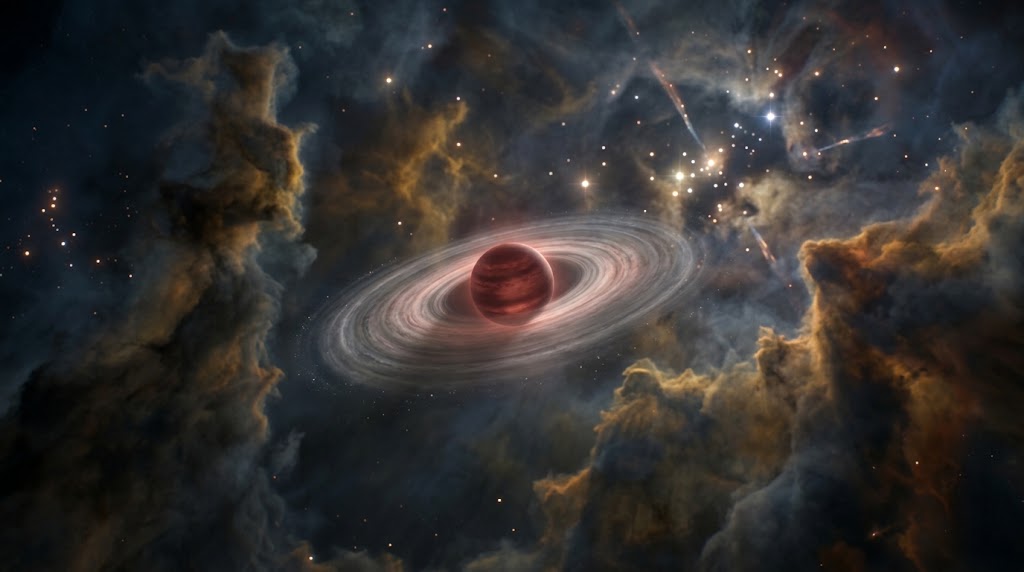
A World That Could Build Worlds: Webb Finds Planet-Sized Objects That Shouldn't Exist
Imagine finding something only about twice as massive as Jupiter.
You would probably call it a planet.
But what if it was born more like a star?
And what if this tiny object was surrounded by a disk of material from which even smaller planets might eventually emerge?
That is the strange possibility raised by new observations from NASA's James Webb Space Telescope.
Webb has examined IC 348, a spectacular stellar nursery about 1,000 light-years from Earth in the constellation Perseus, and discovered extraordinarily lightweight brown dwarfs.
Some have masses of only around twice that of Jupiter.
They are the least massive brown dwarfs yet identified.
And scientists did not expect objects created through the star-formation process to become this small.
One of the lightest objects produced an even more intriguing clue: evidence of a disk around it.
That disk raises a remarkable possibility.
A body with roughly planetary mass may itself possess the raw material from which smaller worlds could form.
The discovery pushes astronomers into one of the most confusing territories in modern astronomy:
Where exactly does a planet stop being a planet—and where does a star begin?
NASA announced the new IC 348 results on September 15, 2026.
First, These Objects Are Not Ordinary Planets
Calling these objects "planet-sized" can easily create the wrong picture.
They are brown dwarfs.
Brown dwarfs occupy an unusual region between stars and giant planets.
A normal star becomes massive enough for enormous pressure and temperature in its core to sustain hydrogen fusion.
That nuclear fusion produces the energy that makes stars such as our Sun shine for billions of years.
Brown dwarfs never accumulate enough mass to maintain that process in the same way.
They can be much more massive than Jupiter, but they are not fully fledged stars.
That has earned them the popular nickname "failed stars."
But even that description is imperfect.
Brown dwarfs are fascinating astronomical objects in their own right.
The crucial distinction involves how they form.
Giant planets are generally thought to develop inside disks surrounding young stars.
Brown dwarfs, by contrast, can form through the gravitational collapse of clouds of gas—the same broad process that produces stars.
And that is what makes Webb's latest discovery so important.
Scientists are now finding objects that appear to have formed through a star-like process but ended up with only around two Jupiter masses.
That is extraordinarily small.
Webb Went Looking for the Bottom of Star Formation
IC 348 is an ideal natural laboratory for this question.
It is relatively nearby in astronomical terms, located roughly 1,000 light-years away, and contains a rich population of young stars and brown dwarfs.
The region is still actively displaying the violence and beauty of stellar birth.
Young stars illuminate enormous clouds of gas and dust.
Protostars fire jets into surrounding material.
Glowing structures form when those high-speed streams collide with the environment around them.
But researchers were interested in something less visually dramatic and potentially more scientifically disruptive.
They wanted to find out:
How small can an object become and still form like a star?
Using Webb's extremely sensitive Near-Infrared Camera, or NIRCam, astronomers searched for faint candidates.
They then used Webb's Near-Infrared Spectrograph, or NIRSpec, in 2025 to study their spectra and determine more about their properties.
The result pushed brown dwarfs into a mass range that researchers had struggled to explore before.
Webb identified brown dwarfs with masses as low as roughly twice Jupiter's mass—only about 0.19% of the mass of our Sun.
NASA says these are the least massive brown dwarfs currently known.
That Is Smaller Than Theory Likes
This is where the story becomes more than a catalogue of unusual objects.
Star formation begins when sufficiently dense regions inside cold molecular clouds collapse under gravity.
As the material contracts, it can fragment into smaller concentrations.
Those concentrations may eventually develop into stars or brown dwarfs.
But fragmentation should have limits.
At some point, scientists expect a collapsing piece of gas to become too small to continue behaving like an independent star-forming object.
There should therefore be something resembling a minimum mass for star-like formation.
Webb is now forcing researchers to examine where that boundary really lies.
Objects of only about twice Jupiter's mass are considerably smaller than many theoretical expectations for products of this process.
In other words, nature appears capable of building star-like objects on a scale that begins to overlap with the planetary world.
NASA explicitly describes the new brown dwarfs as far smaller than theory predicts they should be, making them a challenge for models of star formation.
That does not mean everything scientists know about star formation has suddenly collapsed.
It means an important boundary condition may be wrong, incomplete or dependent on environmental factors that models do not yet represent sufficiently.
And boundaries are often where the most interesting science happens.
Then Webb Found the Disk
Finding a two-Jupiter-mass brown dwarf was already surprising.
Then researchers found something else.
One of the lightest newly identified brown dwarfs showed evidence of a surrounding disk.
Disks around young stars and brown dwarfs are enormously important because they contain the raw material that can potentially develop into planets.
Gas.
Dust.
Ice.
Tiny solid grains.
Over time, under appropriate conditions, some of that material can collide, accumulate and eventually become larger bodies.
NASA says the presence of the disk suggests that small planets could be forming around an object that itself has only planetary-scale mass.
Read that again.
We could be looking at something only a few times heavier than Jupiter that has its own disk capable, potentially, of producing smaller objects.
It creates an extraordinary cosmic hierarchy:
A planet-like brown dwarf.
Surrounded by a disk.
Potentially producing worlds of its own.
We do not yet have confirmation that planets are actually present around this specific object.
The disk is the evidence.
The possible planets remain a possibility to investigate.
But even that possibility pushes us into a fascinating new regime of planetary science.
Could a Planet Orbit Something Almost Planet-Sized?
Physics does not require a star like the Sun for one object to orbit another.
Moons already demonstrate this inside our Solar System.
Jupiter, for example, has a huge family of moons.
Some are worlds in every meaningful geological sense.
Ganymede is larger than the planet Mercury.
Europa likely hides a global ocean beneath its icy crust.
Titan orbits Saturn and possesses a thick atmosphere, rivers, lakes and rain made from hydrocarbons.
So the idea of small worlds orbiting a larger non-star object is not strange by itself.
What makes the IC 348 finding different is formation.
A moon forming around a planet and a planet forming from a disk around a brown dwarf may involve related ingredients, but astronomers classify and investigate these processes differently.
If planetary systems can emerge around brown dwarfs only a couple of times Jupiter's mass, the familiar hierarchy of:
star → planet → moon
starts becoming much less tidy.
Nature does not care about the categories humans create.
It simply follows physics.
Planet or Brown Dwarf? Mass Alone Cannot Answer
It is tempting to classify astronomical objects purely by mass.
Above one number: star.
Below another: brown dwarf.
Below another: planet.
Reality is messier.
Formation history matters.
An object with several Jupiter masses could theoretically be formed inside a disk around a star, making it a planet under a formation-based definition.
Another object of similar mass could arise independently through gravitational collapse, placing it in the brown-dwarf category.
Two bodies could therefore have comparable masses while belonging to different astronomical families.
This is one reason the newly discovered IC 348 objects are so interesting.
Webb is exploring an area where the traditional categories begin physically overlapping.
What looks planet-like in mass may have a star-like origin.
And that object may then develop its own planetary system.
Webb Found Another Mystery in Their Atmospheres
The surprises did not end with their masses or disks.
When astronomers examined the spectra of the brown dwarfs, they detected an unusual feature that researchers associate with an unidentified hydrocarbon.
Hydrocarbons are molecules composed entirely of hydrogen and carbon.
Carbon chemistry is common throughout the universe, but the particular spectral feature detected by Webb has not yet been confidently identified with a specific molecule.
Even more interestingly, NASA says the feature has appeared specifically in the atmospheres of some of the lowest-mass brown dwarfs.
That raises the possibility that these extreme objects may occupy a distinctive spectral category of their own.
Again, the important word is possibility.
Scientists have a signal.
They do not yet have the complete explanation.
Those are often the discoveries worth watching most closely.
IC 348 Is Producing More Than Tiny Brown Dwarfs
Zoom out and Webb's enormous image becomes an entire laboratory of cosmic construction.
IC 348 contains newborn stars embedded within swirling material.
In parts of the region, young protostars fire narrow jets outward at tremendous velocities.
When those jets slam into surrounding gas and dust, they create luminous structures known as Herbig-Haro objects.
Webb's image includes HH 797, where astronomers can resolve what appears as a long outflow into activity associated with two protostars.
Nearby lies HH 211, another dramatic system containing narrow jets and wider outflows.
So within a single cosmic scene, we can see vastly different outcomes of gravitational collapse.
Stars being born.
Brown dwarfs appearing at unexpectedly low masses.
Disks surrounding young objects.
Jets smashing into clouds.
And perhaps the earliest ingredients of future planets.
That is why stellar nurseries are so important.
They do not show us a finished universe.
They show us the assembly line.
Webb Has Already Pushed This Boundary Before
IC 348 has produced surprises before.
Earlier Webb observations of the region identified several very low-mass brown dwarfs, including an object estimated at only around three to four Jupiter masses.
At the time, even those findings challenged expectations.
The latest observations have now pushed the known boundary lower still—to about twice Jupiter's mass.
That progression matters.
First, astronomers find an object that seems unusually small.
Then better observations find something smaller.
Eventually, researchers discover that what looked like a boundary may only have been the limit of previous telescopes.
Webb is particularly good at making those observational boundaries disappear.
This Is Why Webb Matters Beyond Pretty Pictures
James Webb images often spread across social media because they are beautiful.
But the telescope's greatest contribution may not be the pictures.
It is sensitivity.
Webb can detect extremely faint objects and separate their light into spectra that reveal information invisible to the human eye.
In IC 348, that sensitivity allows astronomers to investigate objects only a few times the mass of Jupiter while they are still extremely young.
Before instruments like Webb, some of these objects would simply have disappeared into the darkness and dust of their stellar nursery.
Now they can be studied individually.
The result is not simply a sharper photograph.
It is access to an entirely new population.
The Universe Keeps Breaking Our Boxes
We like neat categories.
Stars.
Brown dwarfs.
Planets.
Moons.
Each name gives us the reassuring impression that nature has been divided into clearly marked sections.
Then we build a better telescope.
And nature refuses to cooperate.
Elias 2-24 b showed us a giant planet apparently forming astonishingly early in the life of its system.
Now IC 348 shows us objects with planetary masses that appear to have formed more like stars.
One may even possess the ingredients for forming smaller planets of its own.
Neither discovery destroys what astronomers already know.
Instead, both expose the places where the picture remains incomplete.
That may be the most exciting thing about studying the universe.
The closer we look, the less interested nature seems to be in respecting our definitions.
Somewhere about 1,000 light-years away, inside the glowing clouds of IC 348, an object only twice as massive as Jupiter may represent something we did not expect the star-formation process to produce.
And around one of these tiny objects, a disk is already waiting.
Perhaps nothing becomes of it.
Or perhaps, somewhere inside that faint ring of material, another generation of worlds is beginning.
James Webb brown dwarfs, IC 348, planet-sized brown dwarf, smallest brown dwarf, Webb Space Telescope discovery, star formation, planet formation, two Jupiter mass brown dwarf, brown dwarf planet system, NIRCam, NIRSpec, Webb discovery 2026, space discoveries 2026, Beyond the World
What if something barely twice the mass of Jupiter could make planets of its own?
James Webb has discovered the least massive brown dwarfs known—and one appears to have a surrounding disk. The finding is pushing astronomers into a strange boundary where the definitions of stars and planets begin to blur.
Reader Question
If an object has the mass of a planet, forms like a star and then creates planets around itself—what should we call it?