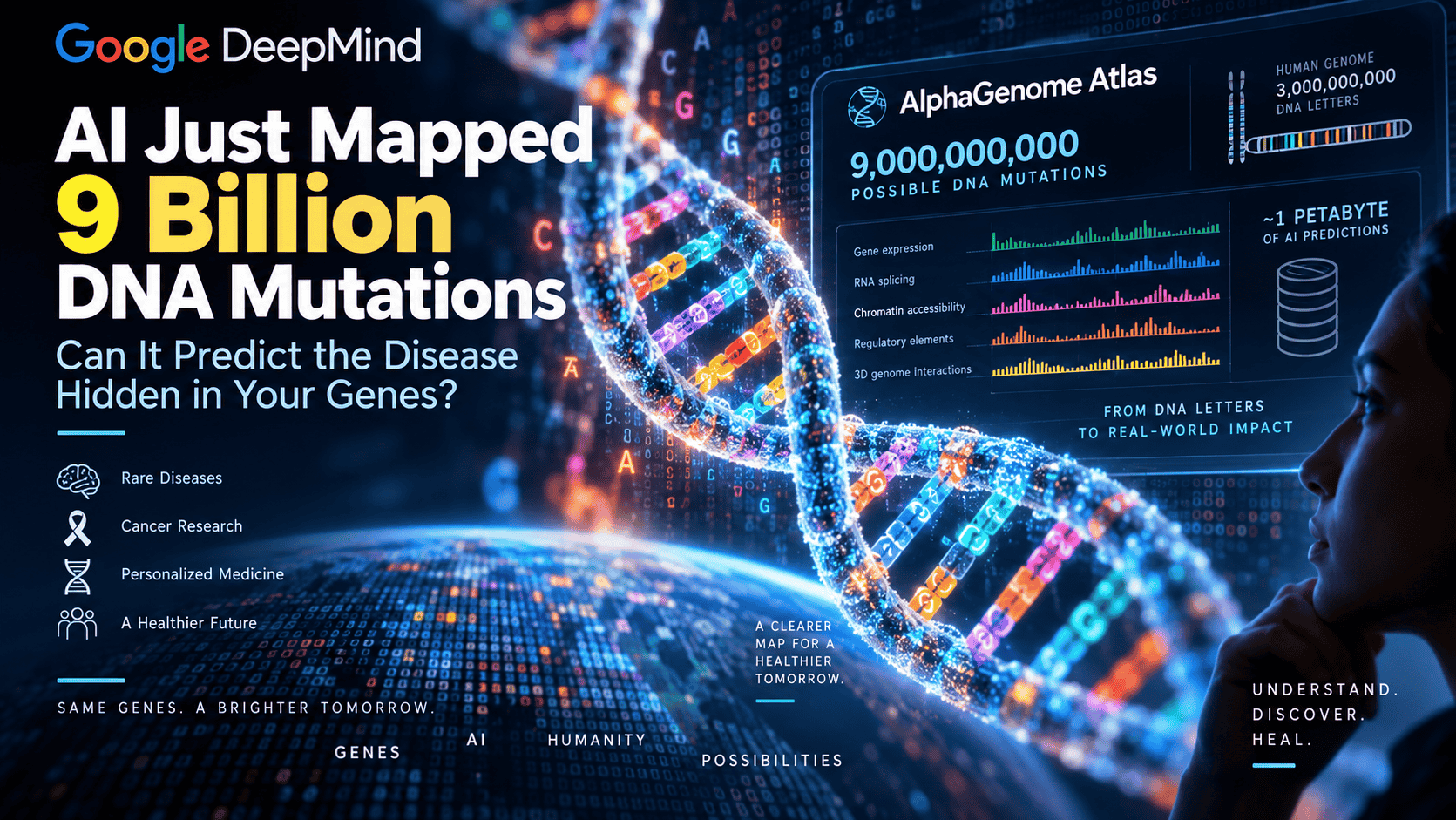
The human genome contains roughly three billion DNA letters, yet each position can potentially change into three alternatives. DeepMind has now precomputed AI predictions for nearly all nine billion possibilities. The result could dramatically accelerate rare-disease research—but it cannot tell an individual which disease they will develop.
AI Just Mapped 9 Billion DNA Mutations—Can It Predict the Disease Hidden in Your Genes?
Google DeepMind has created a one-petabyte “atlas” predicting the molecular effects of virtually every possible single-letter change in the human genome. It sounds like a map of our medical future. The reality is both more limited—and more scientifically extraordinary.
By History, Science & AI Desk | Wednesday, September 9, 2026
The human genome contains roughly three billion DNA letters.
Now imagine changing every one of those letters.
Not once.
Three different ways.
At every position where DNA contains an A, replace it individually with C, G or T.
Do the equivalent for every C, G and T across the genome.
The result is approximately:
nine billion possible single-letter genetic changes.
Testing nine billion mutations experimentally would be effectively impossible.
So Google DeepMind did something different.
It asked an artificial-intelligence model to predict what each one might do.
On September 8, DeepMind unveiled AlphaGenome Atlas, a roughly one-petabyte database containing predictions for more than nine billion possible single-nucleotide variants across the human genome.
It is an extraordinary number.
It is also easy to misunderstand.
DeepMind did not discover nine billion mutations inside human beings.
It generated predictions for almost every possible way a single DNA letter could be changed.
And it did not create a crystal ball capable of telling you:
“You will develop heart disease at 61.”
or:
“This mutation guarantees cancer.”
What it created is closer to a gigantic molecular consequence map.
For every possible DNA-letter change, AlphaGenome attempts to answer:
If this letter were different, what biological machinery might change?
That question sits at the heart of modern genetics.
And until now, it has been painfully difficult to answer at scale.
Why Are There 9 Billion Mutations if Humans Have Only 3 Billion DNA Letters?
This is probably the first question most readers will have.
DNA uses four chemical “letters”:
A, C, G and T.
At any position, the existing letter can theoretically be replaced by any of the other three.
So, very roughly:
3 billion genome positions × 3 possible substitutions = 9 billion possible single-letter variants.
These are known as single-nucleotide variants, or SNVs.
Some already exist naturally in human populations.
Many would be extremely rare.
Others may never have been observed in a person at all.
AlphaGenome Atlas tries to predict the molecular consequence of all of them in advance.
Nature reports that the Atlas also incorporates information involving more than 100 million short insertions and deletions observed in human genomes, although the headline nine-billion figure refers specifically to single-letter substitutions.
Think of it as asking:
What would happen if we changed every editable character in humanity's biological instruction manual, one at a time?
Not experimentally.
Computationally.
Why Scientists Still Don't Understand Most DNA Variants
Sequencing DNA has become dramatically easier.
Interpreting it has not.
A patient with a suspected genetic disease can have their genome sequenced and receive a list containing thousands or even millions of differences compared with a reference genome.
The difficulty is deciding which difference matters.
Most variants are harmless.
Some subtly influence traits.
A much smaller number can interfere with important biological functions.
And in rare diseases, researchers may be looking for one consequential change hidden among an enormous number of irrelevant ones.
It is the genomic equivalent of finding a defective line of code inside an operating system containing billions of characters.
Except biology is far more complicated than software.
The Hardest Part of the Genome Is the 98% That Doesn't Encode Proteins
One reason genetic interpretation remains difficult is that only about 2% of the human genome directly encodes proteins.
The remaining roughly 98% is non-coding DNA.
That does not mean it is useless.
Some non-coding regions help determine:
when genes turn on,
where they become active,
how strongly they are expressed,
how RNA is processed,
how DNA is physically packaged,
and which regulatory proteins can access particular sequences.
Nature describes this non-coding majority as especially difficult to decipher, even though many variants associated with human traits and disease occur there.
This is where AlphaGenome becomes particularly interesting.
Older genetic interpretation tools often performed much better when a mutation directly changed the structure of a protein.
A mutation in a regulatory region could be far harder to understand.
DeepMind is trying to decode both worlds.
AlphaGenome Is Not a DNA Chatbot
AlphaGenome is a specialized biological model.
The underlying system was introduced in 2025 and published in Nature in January 2026.
It takes DNA sequence as input—up to around one million DNA letters at a time—and predicts thousands of different molecular measurements.
These include effects involving:
gene expression,
RNA splicing,
transcription initiation,
chromatin accessibility,
transcription-factor binding,
histone modifications,
and three-dimensional interactions within DNA.
In the published evaluation, AlphaGenome matched or outperformed strong external models on 25 of 26 variant-effect prediction benchmarks.
The Atlas takes this model one enormous step further.
Instead of making a researcher request one prediction at a time, DeepMind has precomputed predictions across the genome.
The expensive computational work has already been done.
Researchers can now search the map.
The Dataset Is About One Petabyte
The scale is remarkable.
DeepMind says AlphaGenome Atlas contains about one petabyte of data.
That is roughly:
one million gigabytes.
The company says the dataset is more than 30 times larger than the AlphaFold Database, its influential resource containing predicted structures for more than 200 million proteins.
The comparison is deliberate.
AlphaFold helped make protein-structure predictions broadly accessible.
DeepMind wants AlphaGenome Atlas to do something similar for genetic variation.
Before the Atlas, researchers could already access AlphaGenome through an API.
Nature reports that around 9,000 researchers had used those predictions.
But using an API requires coding skills.
The new Atlas is designed to make the information much easier to explore directly.
That matters because scientific breakthroughs are not useful merely because a model can generate them.
Researchers need to be able to find them.
DeepMind Also Created a Single “How Much Should I Care?” Score
Thousands of molecular predictions for one DNA variant can create another problem:
information overload.
So DeepMind introduced the AlphaGenome Variant Impact score, or AVI.
The score combines information from AlphaGenome with AlphaMissense, another DeepMind system focused on predicting the effects of protein-changing variants.
The goal is to produce a single number that helps researchers rank variants according to their predicted biological impact.
A high score does not mean:
“This mutation definitely causes disease.”
It means something closer to:
“This variant looks biologically important enough that you may want to investigate it.”
Researchers can then examine why the model ranked it highly.
Was gene expression predicted to change?
Did the variant create a splicing problem?
Did chromatin accessibility change?
Could a protein itself be disrupted?
That interpretability is crucial.
A useful medical AI should not merely identify a suspicious variant.
Scientists need clues about how it might work.
And AlphaGenome Has Already Helped With a Real Rare-Disease Mystery
This is where the story moves beyond benchmarking.
DeepMind says researchers working with the GREGoR Consortium and Broad Institute used AlphaGenome Atlas to investigate unsolved rare-disease cases.
In one case involving severe epilepsy, researchers prioritized a previously overlooked non-coding variant affecting DNM1, a gene strongly associated with epileptic encephalopathy.
AlphaGenome predicted that the variant created an incorrect RNA splice site.
That changed how the genetic message would be assembled and was predicted to create an abnormal extension of the resulting protein.
Researchers then performed laboratory experiments.
The experiments supported the predicted mechanism.
This example is enormously important.
It demonstrates what AlphaGenome is actually designed to do.
Not:
diagnose somebody by pressing a button.
But:
shrink an enormous list of genetic possibilities into a smaller set that scientists can test.
That can potentially save months of investigation.
This Is Why Rare Diseases May Be the First Big Medical Opportunity
Rare diseases create a uniquely difficult genetic problem.
For some families, a child or adult may have:
developmental abnormalities,
neurological symptoms,
epilepsy,
metabolic disease,
or another severe condition.
Doctors sequence the genome.
Yet no known disease-causing mutation explains the symptoms.
These patients can spend years in what clinicians sometimes call a diagnostic odyssey.
One reason is that many diagnostic pipelines have historically been better at interpreting protein-coding mutations than regulatory mutations.
If the causative change sits inside non-coding DNA, it may be missed or classified as a variant of uncertain significance.
AlphaGenome could help investigators prioritize exactly these difficult cases.
DeepMind's underlying 2026 Nature paper explicitly identified rare-disease interpretation of non-coding variants as one promising application.
So Can AlphaGenome Predict the Disease Hidden in Your Genes?
Not in the way that headline suggests.
And this distinction is essential.
AlphaGenome primarily predicts molecular effects of genetic variants.
Disease prediction is a much larger problem.
Suppose AlphaGenome predicts that a variant reduces expression of a particular gene.
That does not automatically tell us:
whether a person will become ill,
at what age,
how severe the disease would be,
or whether another gene compensates for the effect.
Real disease depends on many layers.
These can include:
other genetic variants,
age,
sex,
environment,
diet,
infection,
medication,
lifestyle,
development,
and chance biological events.
Many common diseases are polygenic.
Thousands of variants may each contribute tiny amounts of risk.
Cancer adds another layer because many important mutations arise inside cells during life rather than being inherited from parents.
The Atlas predicts molecular consequences.
That is not the same as predicting an individual's medical future.
Nature's Warning Is Important
Independent experts quoted by Nature immediately emphasized this limitation.
Martin Kircher, a bioinformatician at the Max Delbrück Centre for Molecular Medicine, described the Atlas as a useful way to expand access to a strong model—but stressed that it will not replace:
laboratory experiments
or
the details of individual clinical cases.
That is exactly the right way to understand AlphaGenome.
AI can rank hypotheses.
It cannot magically convert every prediction into medical truth.
Can AlphaGenome Help With Cancer?
Potentially, yes.
But again, not by predicting exactly who will get cancer.
Cancer frequently involves mutations that alter:
gene activation,
gene suppression,
DNA repair,
cell growth,
and regulatory networks.
Some of the most important cancer mutations occur outside protein-coding regions.
AlphaGenome's original paper demonstrated that the model could reproduce known molecular mechanisms involving clinically relevant variants near the TAL1 oncogene, which is involved in certain leukemias.
That suggests researchers could use systems like AlphaGenome to investigate:
which non-coding cancer mutations matter,
which genes they regulate,
and which molecular pathways they disrupt.
Eventually, that could contribute to:
better biological classification,
drug-target discovery,
or more precise experimental design.
But an AlphaGenome score is not a cancer diagnosis.
The Atlas Could Change Population Genetics Too
DeepMind's collaborators have also used the Atlas on large population datasets.
At the University of Exeter, Gareth Hawkes applied AlphaGenome predictions to whole-genome information from more than 54,000 UK Biobank participants.
By grouping rare variants according to their predicted biological effects, researchers reported identifying 22% more non-coding genetic associations than conventional statistical analysis alone detected in that work.
In another analysis, the researchers examined non-coding variants potentially associated with body mass index.
By concentrating on the 1% of variants AlphaGenome predicted would have the greatest impact, they identified 19 genomic regions for further study.
Again, notice the pattern.
AI is not replacing science.
It is reducing the search space.
Imagine Looking for One Dangerous Needle in a Mountain of DNA
Consider the practical problem.
A genome contains billions of positions.
A person's sequence may differ from a reference genome at millions of locations.
Only a small fraction may matter for the disease being investigated.
Without prioritization, scientists potentially face an enormous list.
AlphaGenome tries to say:
Start here.
Ignore most of these for now.
These few variants are predicted to interfere strongly with:
splicing,
gene regulation,
protein function,
or another molecular process.
Scientists can then perform expensive laboratory experiments on the candidates that look most promising.
The value is not that AI eliminates experiments.
The value is that experiments become better targeted.
Why Scientists Cannot Simply Test All 9 Billion Mutations
Nine billion sounds manageable to computers.
It is absurdly large for wet-lab biology.
Imagine performing one experiment per variant.
Even if one experiment cost only $1, the bill would be $9 billion.
Real biological experiments often cost vastly more.
And one experiment is usually not enough.
A variant might behave differently in:
brain cells,
heart cells,
liver cells,
immune cells,
or embryonic tissue.
Its effect could depend on:
developmental stage,
neighboring DNA,
gene activity,
or environmental conditions.
The actual experimental space is therefore much larger than nine billion.
Computational prediction provides a filter.
AI asks:
Which experiments are most worth performing?
That may be the biggest practical contribution.
The “98% Junk DNA” Idea Is Becoming Increasingly Outdated
For decades, non-protein-coding DNA was sometimes casually described as junk DNA.
That phrase has become increasingly misleading.
Not every non-coding sequence necessarily has an important function.
But major parts of the non-coding genome contain regulatory information.
They include:
promoters,
enhancers,
splice-regulatory sequences,
transcription-factor binding sites,
and other elements controlling how genes operate.
DeepMind's collaborators used AlphaGenome Atlas to map more than 2,500 recurring DNA motifs—short sequence patterns that can act like elements of a regulatory vocabulary.
Researchers at the Stowers Institute then used these predictions to investigate which motifs:
open DNA,
activate genes,
suppress genes,
or behave differently across cell types.
One researcher described the work to Nature as creating something resembling a searchable dictionary of non-coding DNA.
That could be one of the Atlas's most profound long-term uses.
Not disease prediction.
Understanding the grammar of the genome itself.
Why One DNA Mutation Can Affect Different Tissues Differently
Every cell in your body largely contains the same genome.
Yet a neuron behaves nothing like a liver cell.
Why?
Because different genes are switched on and off in different cells.
AlphaGenome therefore does not merely ask whether a sequence changes.
It predicts consequences across many biological contexts.
The original model predicts thousands of genomic tracks across numerous cell types and tissues.
A variant might matter enormously in:
brain tissue
but have little predicted effect in:
skin.
That tissue specificity is one reason genetic medicine is difficult.
The DNA sequence alone is not the entire story.
What matters is how that sequence is used by a particular cell.
Could Your Doctor Use AlphaGenome Eventually?
Possibly.
But not yet as an approved clinical diagnostic tool.
DeepMind explicitly states that AlphaGenome has not been validated or approved for clinical use and that its information should not substitute for professional medical diagnosis or treatment.
Today, its most appropriate role is research.
A future clinical workflow might look something like this:
A patient has symptoms suggesting a genetic disorder.
Whole-genome sequencing identifies many candidate variants.
Clinical databases remove common harmless variants.
Inheritance information narrows the list.
AI systems rank the remaining variants.
Doctors compare those predictions with the patient's symptoms.
Laboratories perform functional tests.
Clinical geneticists interpret all the evidence.
Only then is a diagnosis considered.
AI becomes one component.
Not the final authority.
What Could AlphaGenome Get Wrong?
Plenty.
Like every predictive AI system, AlphaGenome learns patterns from existing data.
If biology is poorly represented in its training data, predictions can be weaker.
Rare cell types may be difficult.
Developmental biology may be difficult.
Interactions between multiple variants can be difficult.
Long-range genomic effects may extend beyond the model's context.
Environmental effects are outside the DNA sequence itself.
And molecular predictions can be correct while clinical interpretation is still wrong.
Benchmark superiority does not equal perfect biological understanding.
Even DeepMind's published paper frames AlphaGenome primarily as a tool for:
hypothesis generation,
variant prioritization,
and experimental investigation.
That is impressive enough.
There is no need to turn it into genetic fortune-telling.
The Real Breakthrough Is Search
The human genome was first broadly mapped more than two decades ago.
Since then, sequencing has become dramatically cheaper and faster.
But reading the letters was only the first challenge.
The second challenge is understanding them.
We now have an extraordinary paradox.
Humanity can sequence a genome relatively quickly.
But discovering which one of millions of differences explains a disease can still take years.
AlphaGenome Atlas attacks that interpretation bottleneck.
Instead of asking scientists to manually investigate billions of theoretical changes, the system creates a navigable landscape.
Some variants appear molecularly quiet.
Others create peaks.
Those peaks become places to investigate.
That is why the word Atlas is appropriate.
A map does not tell you where you must go.
It tells you where the mountains, rivers and roads might be.
Scientists still have to make the journey.
The Bigger AI Story Is Moving From Language to Biology
AI's most visible revolution happened through language models.
Chatbots write.
Answer questions.
Generate images.
Write software.
But some of the most consequential AI systems may ultimately be ones most people never interact with directly.
AlphaFold predicts protein structures.
AlphaMissense estimates consequences of protein-changing mutations.
AlphaGenome predicts how DNA variants may alter molecular biology.
The target is no longer merely human language.
It is the informational machinery of life.
The potential commercial and medical consequences are enormous:
drug discovery,
precision medicine,
rare-disease diagnosis,
genomic research,
cancer biology,
and synthetic biology.
But biological AI has a higher burden than a chatbot.
A wrong paragraph is inconvenient.
A wrong medical interpretation can matter enormously.
That is why prediction must remain connected to experiments.
Nine Billion Predictions Do Not Mean Nine Billion Answers
That may be the best way to summarize what happened this week.
DeepMind has generated an unprecedented map of possible human DNA variation.
Every possible single-letter substitution.
Across billions of positions.
Approximately one petabyte of predictions.
A new score to rank potentially important changes.
Molecular explanations for why some variants may matter.
And early evidence that the system can help researchers uncover variants previously missed in rare-disease investigations.
That is remarkable.
But AlphaGenome has not produced nine billion proven biological facts.
It has generated nine billion starting points for scientific investigation.
That distinction is what separates useful AI from hype.
Can AI Predict the Disease Hidden in Your DNA?
Today, the answer is:
not directly.
But it may increasingly help scientists identify which parts of your DNA deserve closer attention.
For a family that has spent years searching for the genetic cause of a child's unexplained condition, that difference could be profound.
For a cancer researcher trying to understand a mutation outside a protein-coding gene, it could eliminate months of uncertainty.
For population geneticists searching through hundreds of millions of variants, it can reduce statistical noise.
And for molecular biologists, the Atlas may become a new way of exploring the regulatory language controlling human cells.
Twenty years ago, one of biology's defining achievements was learning to read the human genome.
The challenge now is understanding what the letters mean.
DeepMind has not solved that problem.
But on September 8, 2026, it gave scientists the largest predictive map yet for exploring it.
The human genome contains roughly three billion letters.
AlphaGenome has now asked:
What happens if we change almost every one of them?
Nine billion predictions later, the far more important question begins:
Which ones are actually telling us something about human disease?
That is where the science starts.
Frequently Asked Questions
What is AlphaGenome Atlas?
AlphaGenome Atlas is a Google DeepMind resource containing AI-generated predictions for the molecular effects of more than nine billion possible single-letter variants across the human genome.
Why are there nine billion possible mutations if the human genome has three billion letters?
At each DNA position, the existing nucleotide can theoretically be changed into any of the other three DNA letters. Roughly three billion positions multiplied by three alternatives produces about nine billion possible single-letter substitutions.
Did DeepMind discover nine billion mutations in people?
No. The Atlas includes predictions for theoretically possible single-letter substitutions. It does not mean nine billion distinct mutations have been discovered in human patients.
How large is AlphaGenome Atlas?
DeepMind says the dataset is approximately one petabyte, more than 30 times the size of the AlphaFold Database.
Can AlphaGenome tell me which disease I will develop?
No. It predicts potential molecular effects of DNA variants. Disease risk depends on clinical circumstances, other genes, environment and many additional factors.
Can AlphaGenome diagnose rare diseases?
It is not an approved clinical diagnostic system. However, researchers have already used its predictions to prioritize candidate variants in unsolved rare-disease cases, including a DNM1-related variant investigated in severe epilepsy.
What is the AlphaGenome Variant Impact score?
The AVI score is a DeepMind metric designed to summarize the predicted biological importance of a genetic variant. It combines information from AlphaGenome and AlphaMissense to help researchers prioritize variants for deeper investigation.
Does AlphaGenome understand non-coding DNA?
That is one of its main strengths. AlphaGenome predicts effects involving gene expression, splicing, chromatin accessibility and other regulatory processes, helping researchers interpret variants outside protein-coding regions.
Is 98% of human DNA really “junk DNA”?
No. Although only around 2% directly codes for proteins, significant portions of non-coding DNA contain regulatory elements controlling when, where and how genes function. Not every non-coding sequence necessarily has a known function.
Could AlphaGenome help cancer research?
Potentially. The original AlphaGenome research demonstrated prediction of mechanisms involving clinically relevant regulatory variants near the TAL1 oncogene. This makes cancer genetics an important research application, but the system does not diagnose or predict individual cancer outcomes.
Has AlphaGenome been scientifically published?
Yes. The underlying AlphaGenome model was published in Nature in January 2026 after being introduced by DeepMind in 2025.
Is AlphaGenome Atlas free?
DeepMind says the Atlas is available to researchers through a web portal, with the resource described as available for academic/non-commercial research use.
Will AI replace geneticists?
There is no evidence that it will. Systems such as AlphaGenome are more likely to become tools that help geneticists prioritize variants and design experiments. Clinical interpretation still requires patient information, laboratory evidence and specialist judgment.
UrduPure Internal Topic Cluster
Primary cluster: AI + Genetics + Precision Medicine
Link this article naturally to existing UrduPure coverage on:
Quantum Computing and Cancer Drug Discovery — connect from the cancer-research section.
DNA Data Storage — connect when explaining DNA as an information system, while making clear biological DNA and synthetic storage are different applications.
Continuous Lactate Monitors — connect from the precision-medicine / biochemical wearables discussion if appropriate.
Best next cluster articles:
Why 98% of Your DNA Doesn't Make Proteins—and Why Scientists No Longer Ignore It
What Is a Variant of Uncertain Significance? Why a DNA Test Can Find a Mutation Without Giving You an Answer
Can AI Diagnose Rare Diseases Faster Than Doctors? What the Evidence Actually Shows
AlphaGenome vs AlphaMissense vs AlphaFold: What Each DeepMind Biology AI Actually Does
Editorial / Health Note: AlphaGenome Atlas is a research resource. DeepMind states that AlphaGenome has not been validated or approved for clinical use and should not substitute for professional medical advice, diagnosis or treatment. Predictions about molecular effects require experimental and clinical validation.
DeepMind AlphaGenome, 9 billion DNA mutations, AI genome 2026, AI genetic disease prediction, human genome AI, non-coding DNA, rare disease genetics, AlphaGenome disease prediction
genomic sequencing, genetic testing, precision medicine, AI healthcare, bioinformatics software, genomic analysis, rare disease diagnosis, clinical genomics
AlphaGenome, Google DeepMind, Human Genome, Genetics, DNA, Rare Disease, Artificial Intelligence, Precision Medicine, Cancer Research, Biotechnology