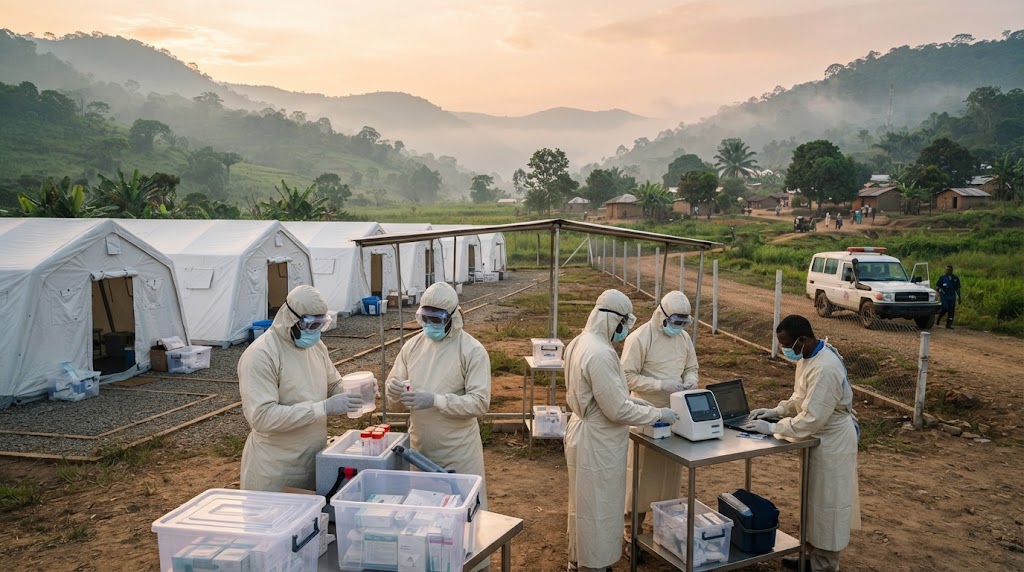
More than 7,200 confirmed Ebola cases and 3,500 deaths have now been reported in the Democratic Republic of Congo. The outbreak is showing tentative signs of slowing in some areas, but a difficult combination of virus biology, conflict, displacement and vaccine uncertainty is making it exceptionally hard to stop.
Updated: September 15, 2026
Congo’s Ebola Outbreak Is Now the Second Deadliest Ever—Why Is This One So Hard to Stop?
More than 7,200 people have been infected and over 3,500 have died. Cases may finally be slowing in parts of Congo—but health officials say it is far too early to declare victory.
By Headlines & Health Desk | September 15, 2026
An Ebola outbreak can begin with one sick person.
That person develops fever.
Perhaps weakness.
Vomiting.
Diarrhoea.
At first, the illness can look like malaria, typhoid or any number of infections common in the region.
Family members care for them.
Health workers examine them.
People travel.
By the time Ebola is recognized, a chain of transmission may already have begun.
That pattern is now playing out on a massive scale in the Democratic Republic of Congo.
As of September 15, Reuters reported more than 7,200 confirmed cases and 3,510 deaths, making the 2026 outbreak the second-deadliest Ebola epidemic ever recorded, behind only the catastrophic 2014–2016 West African epidemic.
The earlier West African outbreak ultimately infected more than 28,600 people and killed 11,325, according to the World Health Organization.
The current epidemic is smaller.
But it contains several features that make it unusually difficult.
It is spreading across a vast country.
Some affected areas are experiencing armed conflict and displacement.
Healthcare access is limited.
And perhaps most importantly:
this is not the Ebola virus for which the world already has a proven licensed vaccine.
The outbreak is being caused by Bundibugyo virus.
That single detail changes almost everything.
First: What Is Bundibugyo Ebola?
People often speak about “Ebola” as if it were one virus.
It is actually a group of related viruses.
Four are known to cause disease in humans:
Ebola virus
Bundibugyo virus
Sudan virus
and
Taï Forest virus.
The famous 2014–2016 West African epidemic was caused by Ebola virus, historically known as Zaire ebolavirus.
The current Congo epidemic is caused by Bundibugyo virus, or BDBV.
The illness it causes is formally called Bundibugyo virus disease.
The diseases look broadly similar.
Patients can develop:
fever,
severe weakness,
headache,
muscle pain,
vomiting,
diarrhoea,
abdominal pain,
and, in some cases, internal or external bleeding.
But biologically, the viruses are different enough that a vaccine developed for one cannot simply be assumed to work reliably against another.
That has become one of the central problems of the 2026 outbreak.
The Vaccine We Have Is Not Proven for This Virus
The world's best-known Ebola vaccine is Ervebo.
It is licensed and WHO-prequalified for disease caused by the Ebola virus species responsible for the West African epidemic.
It is not licensed specifically for Bundibugyo virus disease.
WHO says laboratory and animal evidence suggests Ervebo might provide some cross-protection.
But there is still not enough evidence to know whether it protects humans meaningfully against Bundibugyo infection.
For that reason, WHO currently recommends that Ervebo be used against this outbreak only within research protocols, rather than as a standard mass-vaccination programme.
That distinction is enormous.
During an outbreak of the better-studied Ebola virus, vaccination can become a proven tool for breaking transmission chains.
In this epidemic, health workers are simultaneously trying to:
control the outbreak
and
find out whether the available vaccine actually works well enough against this particular virus.
WHO says a randomized ring-vaccination trial is being used to generate that evidence.
Some Frontline Workers Are Being Vaccinated—But Under Research Conditions
Vaccination has not completely stopped.
WHO reported that by September 6, approximately 2,007 people had received Ervebo in several affected health zones as part of the research response.
The strategy focuses partly on healthcare and frontline workers.
That makes sense.
Healthcare workers face an unusually dangerous situation during Ebola outbreaks.
Patients often arrive before anyone knows they have Ebola.
Early symptoms resemble other common diseases.
Health workers may examine patients, draw blood, give injections or clean bodily fluids before infection-control precautions are fully activated.
If one healthcare worker becomes infected, the consequences can spread far beyond that individual.
They may have contact with:
patients,
colleagues,
family,
and the wider community.
Protecting healthcare workers therefore protects part of the outbreak-response system itself.
Why Is Ebola So Difficult to Stop Once It Begins Spreading?
Ebola does not spread as easily as measles or influenza.
It is primarily transmitted through direct contact with:
blood,
vomit,
diarrhoea,
saliva,
semen,
breast milk,
or other bodily fluids of an infected person.
Contaminated needles, surfaces and medical equipment can also spread infection.
This should theoretically make Ebola easier to contain than an airborne virus.
But several characteristics create major problems.
The first is that the early symptoms are nonspecific.
A person with:
fever,
weakness,
headache
and
body aches
does not immediately look like an Ebola patient.
In regions where malaria and other febrile illnesses are common, that ambiguity can delay diagnosis.
Every delayed diagnosis creates another opportunity for exposure.
The Disease Becomes Most Dangerous When Patients Need the Most Care
As Ebola progresses, some patients develop:
severe vomiting,
profuse diarrhoea,
dehydration,
organ dysfunction,
and bleeding.
That means the sickest patients often require the greatest amount of physical care precisely when their bodily fluids can pose the greatest infection risk.
Family members help them drink.
Relatives clean bedding.
Healthcare workers insert IV lines.
Caregivers wash patients.
Traditional burial practices can involve touching the body.
Each compassionate act can become a transmission opportunity if protective procedures are unavailable or misunderstood.
That is what makes Ebola socially brutal.
It turns care itself into a potential risk.
Congo’s Geography Makes the Problem Much Harder
The Democratic Republic of Congo is enormous.
It covers more than 2.3 million square kilometres.
Road networks are limited across large regions.
Some communities are reachable more easily by:
motorcycle,
boat,
or aircraft
than by conventional road.
That makes outbreak control enormously complicated.
A successful Ebola response requires:
laboratory testing,
rapid isolation,
contact tracing,
safe treatment,
protective equipment,
transport,
community outreach,
and surveillance.
All of those systems must reach the patient quickly.
If a blood sample takes too long to reach a laboratory, diagnosis is delayed.
If contact tracers cannot reach a village, infected people can disappear from surveillance.
If protective equipment cannot reach a clinic, healthcare workers become vulnerable.
Distance becomes part of the disease.
Conflict Makes the Map Even More Difficult
Some of the hardest-hit areas are also dealing with armed insecurity.
WHO reported in early September that ongoing insecurity and population displacement were restricting access to healthcare and limiting the ability of response teams to conduct:
surveillance,
case investigation,
contact tracing,
and treatment.
This is especially important in eastern Congo.
People may move repeatedly because of violence.
Families can cross between:
villages,
displacement camps,
mining areas,
cities,
and neighbouring regions.
That mobility makes contact tracing much harder.
Imagine trying to identify everyone who spent time with an infected person during the previous three weeks.
Now imagine half of them have moved.
Some do not have phones.
Some live in insecure territory.
Some distrust authorities.
Some cross provincial or international boundaries.
The virus does not need an army.
Human movement provides the network.
The Outbreak Has Continued Expanding Geographically
WHO reported 6,757 confirmed cases and 3,267 deaths in Congo as of September 7, affecting 61 health zones across six provinces.
Government data reported by Reuters several days later showed the total exceeding 7,000 cases, with spread into a seventh province, South Ubangi.
By September 15, Reuters reported more than:
7,200 cases
and
3,510 deaths.
These numbers may continue changing as:
new cases are confirmed,
records are reconciled,
patients die or recover,
and surveillance reaches previously undercounted areas.
That is normal in a fast-moving outbreak.
The trend matters more than any single day's total.
There Is Finally Some Good News
The latest evidence is not uniformly bad.
United Nations officials say the number of newly reported cases appears to be falling.
Reuters reported daily confirmed cases had dropped from approximately 120 at the mid-August peak to around 80.
Ten of the 62 affected health zones had also recorded no new case for more than 22 days.
That is encouraging.
It suggests outbreak-control measures may be working in some places.
Ituri province, which had been the main epicentre, has shown substantial improvement.
But health officials are being careful.
A declining daily case count does not automatically mean the epidemic has peaked.
Why?
Because the virus is behaving differently in different regions.
North Kivu Is Now the Biggest Concern
While some areas are improving, North Kivu remains alarming.
Reuters reported that the province recorded 555 new cases during the most recent 21-day period.
North Kivu is especially difficult because it combines several outbreak accelerators:
large population movements,
armed conflict,
displacement,
cross-border travel,
and strained health infrastructure.
That means the national epidemic can appear to improve while one region continues worsening.
This is why epidemiologists rarely ask only:
Are total cases falling?
They ask:
Where are cases falling—and where are they still growing?
A national average can hide a local emergency.
Why Is the Death Rate So High?
The numbers are devastating.
WHO's September 7 figures produced a crude case-fatality ratio of approximately 48.3% in Congo.
That means nearly half of confirmed patients had died.
But this number needs context.
It does not mean every person infected has exactly a 48% probability of dying.
Case-fatality estimates can be influenced by:
how quickly cases are detected,
how many mild infections are identified,
whether patients reach treatment early,
availability of supportive care,
and delays between diagnosis and outcome.
WHO specifically says rapid detection, testing and optimized supportive treatment can reduce mortality.
Ebola treatment has improved dramatically compared with the earliest outbreaks.
Good supportive care can include:
aggressive fluid replacement,
electrolyte management,
oxygen,
blood-pressure support,
treatment of secondary infections,
and management of organ complications.
Getting patients into treatment earlier can save lives.
The problem is getting there in time.
Are There Proven Ebola Medicines?
For Ebola caused by the better-known Ebola virus species, antibody treatments such as monoclonal-antibody therapies have substantially improved survival when given early.
But once again, Bundibugyo changes the equation.
Treatments proven against one Ebola species cannot automatically be assumed to work equally well against another.
WHO says the PARTNERS clinical trial began enrolling patients in July to test potential treatments specifically during the current Bundibugyo outbreak.
By early September, more than 300 confirmed patients had entered the study across treatment centres in Ituri.
So scientists are doing something unusual:
fighting an epidemic
while simultaneously generating the evidence needed for future epidemics.
Why Can't Scientists Simply Use the Vaccine Anyway?
This sounds reasonable.
If Ervebo is safe and works against another Ebola virus, why not vaccinate everybody at risk?
Because public-health decisions become difficult when effectiveness is unknown.
A vaccine with little or no protection could create false confidence.
People may believe they are protected when they are not.
Resources may be diverted away from measures that definitely work.
Scientists would also lose the opportunity to determine rigorously whether the vaccine actually provides cross-protection.
That is why WHO currently recommends use within controlled research protocols.
The aim is to answer the question while still protecting high-risk groups as carefully as possible.
The Outbreak Is Also a Race Against Trust
Medical technology alone does not stop Ebola.
People need to trust the response.
Families must report symptoms.
Contacts must agree to monitoring.
Patients must enter treatment centres.
Communities must accept safe burial practices.
Healthcare workers must be welcomed rather than viewed as outsiders.
Outbreak responses can fail when communities believe:
the disease is invented,
treatment centres are dangerous,
foreign teams are responsible,
or authorities are hiding information.
This is not simply irrationality.
Communities affected by war, poverty and political instability may have legitimate historical reasons to distrust institutions.
Successful Ebola control therefore depends heavily on local leaders, health workers and community engagement.
You cannot contact-trace a population that will not speak to you.
Why Funerals Can Become Transmission Events
Ebola remains infectious in the body after death.
Traditional funerals in many cultures involve:
washing,
touching,
dressing,
or embracing the deceased.
Those acts are emotionally and culturally important.
But during an Ebola epidemic, they can create very high-risk exposure.
Safe and dignified burial teams therefore have one of the most sensitive jobs in the outbreak response.
The goal is not simply:
remove the body safely.
It is:
keep families safe without stripping death of dignity.
If burial procedures ignore culture, communities may hide deaths or conduct funerals secretly.
That makes the epidemiological problem worse.
Could the Outbreak Spread Internationally?
It already has crossed borders.
WHO reported earlier in the epidemic that cases linked to Congo were detected in Uganda, while individual patients were also diagnosed or treated outside the region, including in Europe.
However, Ebola does not spread internationally as efficiently as respiratory viruses.
People generally must have direct contact with infectious bodily fluids.
That makes airport-style global spread less likely than with COVID-19 or influenza.
WHO nevertheless declared the 2026 Bundibugyo outbreak a Public Health Emergency of International Concern because of its severity and potential for further international spread.
Neighbouring countries therefore need:
surveillance,
laboratory capacity,
trained health workers,
and border preparedness.
The objective is not to close entire countries.
It is to identify cases quickly.
Should Travellers Panic?
No.
For most people outside affected communities, the risk remains very different from the risk faced by:
family caregivers,
health workers,
burial teams,
or people living in active transmission zones.
Ebola is not generally transmitted through casual contact in the same manner as measles or flu.
Public-health guidance should therefore focus on:
real exposure routes,
not fear.
Sensational claims that Ebola is simply “sweeping across the world” would misrepresent the current evidence.
The outbreak is extremely serious.
That does not make every person everywhere equally at risk.
Why This Outbreak Matters Beyond Congo
The current epidemic exposes a weakness in global outbreak preparedness.
Humanity has made extraordinary progress against Ebola.
We have:
vaccines,
better treatment,
rapid diagnostics,
specialized response teams,
and decades of outbreak experience.
But most of those tools are not equally effective against every member of the Ebola-virus family.
That means “we have an Ebola vaccine” is only partly true.
We have a highly valuable vaccine against one important Ebola virus.
We do not yet have a licensed vaccine specifically proven against Bundibugyo virus.
That gap matters.
Future outbreaks may involve:
Bundibugyo virus,
Sudan virus,
or another filovirus.
A truly robust global defence therefore requires broadly protective vaccines and treatments, not only tools designed around the virus that caused the last famous epidemic.
The 2014 Disaster Changed Ebola Science
The 2014–2016 epidemic in Guinea, Liberia and Sierra Leone was a catastrophe.
More than:
28,600 people were infected
and
11,325 died.
But the crisis also transformed research.
It accelerated:
vaccine development,
clinical trials,
diagnostics,
treatment-centre design,
and international coordination.
The tragedy helped produce the tools used during later outbreaks.
The current Bundibugyo epidemic may do something similar.
If vaccine and treatment trials succeed, the next Bundibugyo outbreak could be fought with weapons that simply did not exist in proven form in 2026.
That does not reduce today's suffering.
But it could change tomorrow's response.
Is the Outbreak Finally Peaking?
Maybe.
But that is not yet established.
The reduction from roughly 120 daily cases to around 80 is encouraging.
Health zones going weeks without new infections are encouraging.
Improvement in Ituri is encouraging.
But continuing transmission in North Kivu and geographic spread mean health authorities cannot safely treat the epidemic as finished.
Ebola outbreaks can appear to slow and then flare again.
One undetected chain of transmission can restart a cluster.
One infected traveller can carry the virus into a new area.
One unsafe funeral can expose multiple families.
Public health therefore has to continue after public attention begins disappearing.
What Has to Happen Next?
The basic tools are not mysterious.
Find cases faster.
Test quickly.
Isolate safely.
Treat aggressively.
Trace contacts.
Protect healthcare workers.
Conduct safe burials.
Work with communities.
Test vaccines and therapies properly.
And continue surveillance long after the daily headlines begin fading.
WHO emphasizes precisely these fundamentals:
early diagnosis,
contact tracing,
infection prevention,
clinical care,
community engagement,
and cross-border coordination.
They sound simple.
Implementing them across conflict-affected regions is anything but simple.
The Most Important Number May Not Be the Death Toll
The headline numbers deserve attention.
More than 7,200 infections.
More than 3,500 deaths.
Second-deadliest Ebola epidemic on record.
But another number may determine how this outbreak ends:
the number of transmission chains health workers fail to find.
If every infected person can be identified quickly and every high-risk contact monitored, Ebola eventually runs out of people to infect.
If invisible chains continue circulating through communities, the epidemic survives.
That is what makes outbreak control so different from fighting a conventional enemy.
There is no front line.
The battle happens:
inside homes,
inside clinics,
at funerals,
along roads,
in displacement camps,
and sometimes in a single unrecognized fever.
The good news is that transmission is falling in some parts of Congo.
The worrying news is that it continues growing elsewhere.
And because this epidemic involves a virus for which the world's licensed vaccine is not yet proven in humans, scientists are learning while they fight.
That is why this Ebola outbreak has become so difficult.
Not because humanity knows nothing about Ebola.
But because this epidemic has found the places where our knowledge, healthcare systems and political stability are still weakest.
Frequently Asked Questions
How many people have been infected in the 2026 Congo Ebola outbreak?
Reuters reported on September 15 that the outbreak had exceeded 7,200 confirmed cases. Numbers are changing rapidly as new cases are recorded and data are revised.
How many people have died?
More than 3,510 deaths had been reported by September 15.
Is this the worst Ebola outbreak ever?
No. It is currently the second-deadliest recorded Ebola epidemic. The 2014–2016 West African outbreak caused more than 28,600 cases and 11,325 deaths.
Which Ebola virus is causing the outbreak?
The epidemic is caused by Bundibugyo virus, which causes Bundibugyo virus disease.
Is there a vaccine?
There is no vaccine licensed specifically for Bundibugyo virus disease. Ervebo is licensed against Ebola virus disease caused by the Ebola virus species, and WHO says evidence is currently insufficient to know how well it protects humans against Bundibugyo virus.
Are people being vaccinated anyway?
Yes, but WHO recommends that Ervebo be used against Bundibugyo only within research protocols. More than 2,000 people had received vaccine through research-related efforts by early September.
Is the outbreak getting better?
There are encouraging signs. Daily cases have declined from around 120 at the August peak to about 80, and several health zones have gone weeks without new infections. However, transmission remains serious, particularly in North Kivu.
How does Ebola spread?
Ebola spreads mainly through direct contact with infected blood or other bodily fluids, contaminated objects, and infected bodies. It is not spread through ordinary casual airborne transmission like influenza.
Why is North Kivu especially concerning?
The region combines ongoing transmission with armed insecurity, displacement, population movement and difficult access for health teams. Reuters reported 555 new cases there during the latest 21-day period.
Can the outbreak spread outside Congo?
Cross-border cases have already occurred, and WHO considers further regional spread a risk. However, Ebola requires close contact with infectious bodily fluids and does not transmit as easily as common respiratory viruses.
Ebola outbreak 2026, DRC Ebola outbreak, Bundibugyo virus, Ebola deaths Congo, Ebola vaccine 2026, North Kivu Ebola, Ebola symptoms, Ebola treatment
Ebola, Democratic Republic of Congo, Bundibugyo Virus, WHO, Public Health, Outbreak, Africa, Vaccines, Infectious Disease