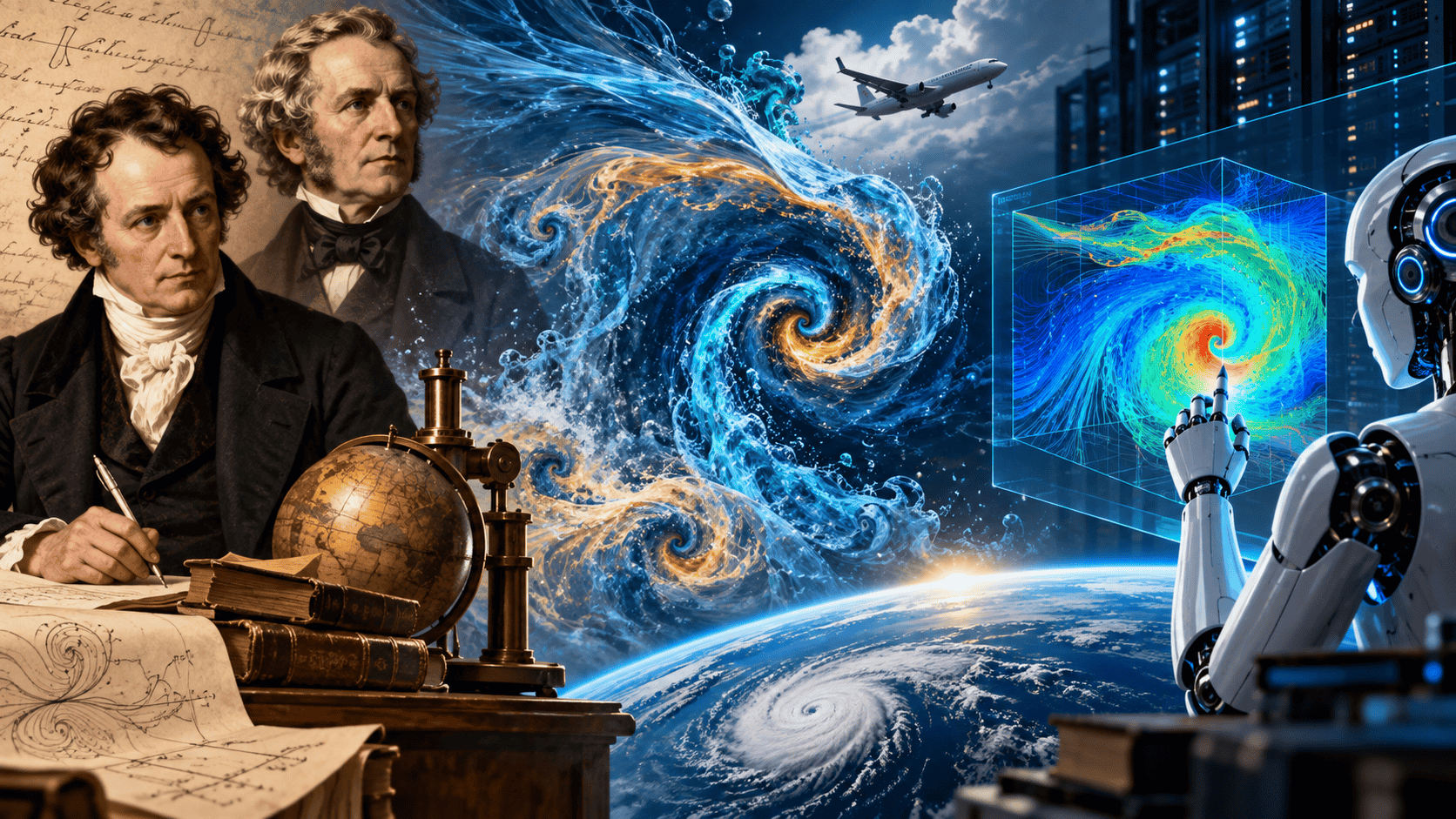
Engineers use the Navier–Stokes equations every day to model aircraft, weather, oceans and blood flow—yet mathematicians could not prove whether their smooth 3D solutions must remain smooth forever. Now OpenAI says 10,000 AI agents have found a finite-time breakdown. If the proof survives scrutiny, one of mathematics’ greatest mysteries may have fallen.
Navier–Stokes Defied Mathematics for 200 Years. Did AI Just Solve the Equation of Water and Air?
We use these equations to design aircraft, forecast weather and model blood flow. Yet for generations nobody could answer a strangely basic question: if a perfectly smooth three-dimensional fluid starts moving, must the mathematics remain well behaved forever—or can the equations suddenly blow up? On September 8, 2026, that story took an extraordinary turn.
By History, Science & AI Desk | Wednesday, September 9, 2026
Pour milk into coffee.
Watch smoke curl from a candle.
Open a water tap.
Look at clouds moving across the sky.
Watch waves behind a ship.
Feel turbulence inside an aircraft.
Blood moving through an artery, air passing over an aircraft wing and water swirling around a bridge pier seem like completely different phenomena.
Mathematically, however, they belong to the same enormous family of problems:
fluid motion.
For approximately two centuries, the most important equations used to describe that motion have carried the names of two nineteenth-century scientists:
Claude-Louis Navier
and
George Gabriel Stokes.
The Navier–Stokes equations became foundations of modern engineering.
Yet hidden inside them was a question so difficult that, in 2000, the Clay Mathematics Institute selected it as one of its seven Millennium Prize Problems, offering $1 million for a valid solution.
For decades the central question seemed almost embarrassingly simple:
If a three-dimensional fluid begins smoothly, do the Navier–Stokes equations guarantee that it remains smooth for all future time?
Or can some extraordinary configuration concentrate motion so violently that the mathematical solution develops a singularity—a quantity such as velocity becoming unbounded in finite time?
Nobody knew.
Then came September 8, 2026.
OpenAI announced that an experimental AI system had produced an analytical proof—and a machine-checked Lean formalization—showing that a smooth three-dimensional Navier–Stokes flow can indeed develop a singularity in finite time under the conditions permitted by the official Millennium Prize formulation.
If correct, it would be one of the most important mathematical achievements of the century.
But there is an essential word in that sentence:
if.
The proof was released only yesterday.
The mathematical community is now examining it.
And the Clay Mathematics Institute's website still lists Navier–Stokes among the unsolved problems.
To understand why this moment matters, we have to go back more than 200 years.
The Story Actually Begins Before Navier
Claude-Louis Navier did not wake up one morning and decide to invent an impossible mathematical puzzle.
The problem began with a practical human question:
How does matter move when that matter is a fluid?
In the eighteenth century, one of the great mathematicians studying that question was Leonhard Euler.
Euler developed equations describing the motion of an ideal fluid in the 1750s, publishing their mature form in 1757.
They expressed fundamental ideas such as:
conservation of mass,
pressure,
acceleration,
and Newtonian mechanics.
But Euler's mathematical fluid had an important simplification.
It had no viscosity.
Real fluids do.
Honey resists motion more strongly than water.
Oil behaves differently from air.
Water moving beside a wall experiences frictional effects.
An equation that ignores viscosity therefore misses something fundamental about actual fluids.
That became Navier's problem.
1822: Claude-Louis Navier Adds the Missing Friction
Claude-Louis Navier was not primarily pursuing an abstract mathematical trophy.
He was a French engineer.
He worked on structures, bridges, elasticity and mechanics.
In 1822, Navier presented work developing equations for the motion of viscous fluids.
Historical reviews mark 1822 as the first appearance of what would eventually become known as the Navier–Stokes equation.
Navier was trying to incorporate internal friction into fluid motion.
In modern language, that means viscosity.
His microscopic reasoning about why viscosity arose was not the same formulation physicists would ultimately adopt, but the mathematical structure he obtained was enormously important.
The equation essentially took Newton's familiar idea:
force = mass × acceleration
and applied it continuously to moving fluid.
Then George Stokes Arrived
More than two decades later, British mathematician and physicist George Gabriel Stokes approached the problem through continuum mechanics.
In 1845 he published:
“On the Theories of the Internal Friction of Fluids in Motion.”
Stokes developed the viscous-fluid equations through assumptions about stresses inside a moving fluid rather than Navier's earlier microscopic model.
Their contributions became joined historically.
Hence:
Navier–Stokes.
Neither man invented the Millennium Prize Problem.
They developed equations for real physical motion.
The mystery emerged later, when mathematicians began asking whether those equations were mathematically guaranteed to behave properly.
What Does the Equation Actually Say?
For an incompressible fluid, one common form is:
∂u/∂t + (u · ∇)u = −(1/ρ)∇p + νΔu + f
together with:
∇ · u = 0
It looks frightening.
The idea underneath it is surprisingly intuitive.
Think of u as describing the velocity of the fluid everywhere.
The equation balances several effects.
Acceleration
How is fluid velocity changing over time?
Advection
Moving fluid carries its own momentum with it.
This produces the nonlinear term:
(u · ∇)u
and this is one of the main sources of mathematical trouble.
Pressure
Differences in pressure push the fluid around.
Viscosity
The term involving νΔu smooths velocity differences.
It is why extreme variations tend to diffuse.
External forces
Gravity, machinery or another smooth forcing can act on the fluid.
The second equation,
∇ · u = 0,
roughly expresses incompressibility:
fluid is not spontaneously appearing or disappearing as it moves.
OpenAI describes Navier–Stokes fundamentally as Newton's second law applied to a fluid treated as a continuous medium.
Then Why Is Something We Use Every Day “Unsolved”?
This is the question that confuses almost everyone.
If Navier–Stokes is unsolved, how do engineers design aircraft?
How do meteorologists model weather?
How do Formula 1 teams simulate airflow?
How do engineers design pumps?
How can computers model oceans?
Because solving a particular case is not the same as proving what happens in every mathematically allowed case forever.
Engineers usually begin with:
specific geometry,
specific starting conditions,
specific boundary conditions,
a finite period of time,
and finite numerical resolution.
A computer divides space into millions or billions of small cells and approximately calculates what the fluid does.
That field is computational fluid dynamics, or CFD.
The Millennium problem asks something completely different.
It asks for a universal mathematical theorem.
For every allowed smooth three-dimensional starting state:
does a smooth solution continue to exist forever?
Or is there at least one permitted configuration where smoothness breaks?
One successful aircraft simulation cannot answer that.
Nor can a trillion simulations.
Why Can't We Just Simulate Every Possibility?
Because fluid states are not a finite list.
Velocity exists at every point in three-dimensional space.
Mathematically, there are infinitely many possible configurations.
Even worse, if a singularity forms, it might develop at progressively smaller scales.
A numerical simulation always has a smallest grid size.
Suppose a computer reports:
“Everything remains finite.”
A mathematician can ask:
What happened between your grid points?
Increase resolution.
Still smooth.
Increase it again.
Still smooth.
That is powerful evidence.
It is not a proof about infinitely fine scales.
Numerical computation can suggest a singularity.
It can reveal a candidate mechanism.
It cannot by itself establish the required universal theorem.
The Fundamental Battle: Viscosity Versus Vortex Stretching
Why is the three-dimensional problem so difficult?
Because the equation contains two competing tendencies.
Viscosity tries to smooth the flow.
Nonlinear fluid motion can concentrate it.
Imagine a vortex.
A spinning tube of fluid can become stretched.
As the vortex stretches, its rotation can intensify.
That is called vortex stretching.
In three dimensions, vortices can stretch, twist and interact with one another in extraordinarily complicated ways.
The question becomes:
Does viscosity always become strong enough to prevent that concentration from running away?
For generations, nobody could prove yes.
Nobody could construct a valid example proving no.
That delicate competition lies near the heart of the problem.
Why Two Dimensions Are Much Easier
This gives us one of the strangest clues in the entire story.
The corresponding two-dimensional Navier–Stokes regularity problem was solved long ago.
Clay's official description notes that global smoothness results in two dimensions were already known, including through work associated with mathematician Olga Ladyzhenskaya.
Why?
A two-dimensional vortex cannot stretch in the same way a three-dimensional vortex can.
There is no third direction available for the same vortex-stretching mechanism.
Add one dimension—
and the mathematical difficulty changes radically.
It is an extraordinary example of how moving from:
2D → 3D
can turn a manageable problem into one that resists generations of mathematicians.
1934: Jean Leray Gets Halfway There
One of the greatest advances came from French mathematician Jean Leray.
In 1934, Leray showed that three-dimensional Navier–Stokes equations possess what mathematicians call weak solutions under broad conditions.
This was a profound result.
But what is a weak solution?
A classical solution is beautifully behaved.
Velocity and pressure are sufficiently differentiable.
Every term of the differential equation makes sense point by point.
A weak solution relaxes those requirements.
Rather than demanding that every derivative exist conventionally everywhere, mathematicians interpret the equation through integrated relationships.
Weak solutions can survive behavior too rough for classical solutions.
Leray therefore proved, in a generalized sense:
a solution continues to exist.
But he could not establish that it remains:
smooth,
regular,
or unique.
That is exactly where the mystery remained.
“Existence” Wasn't Enough
Imagine a road continuing forever.
Leray proved something like:
some kind of road always continues.
The Millennium question asks:
Does it remain a normal paved road—or can it suddenly become infinitely jagged?
And if several paths emerge from the same starting point:
which one is the real solution?
This distinction between existence, smoothness and uniqueness is fundamental.
Clay's official problem description says that the program of constructing weak solutions and then proving them smooth had achieved only partial success.
1982: Mathematicians Almost Trap the Singularities
Another major advance arrived through Luis Caffarelli, Robert Kohn and Louis Nirenberg.
Their famous 1982 work established a powerful partial regularity theorem.
They showed, roughly, that if singularities exist in suitable weak solutions, the set where they can occur must be extremely small in a precise mathematical sense.
This was remarkable.
It told mathematicians that catastrophic irregular behavior cannot simply occupy arbitrary portions of space and time.
But it did not prove:
there are no singularities.
A singular set can be tiny—
and still exist.
The Millennium problem survived.
Then Came a Different Kind of Warning: Weak Solutions Can Be Wild
More recent mathematics complicated the picture further.
Work by Tristan Buckmaster and Vlad Vicol demonstrated non-uniqueness phenomena for rough finite-energy weak solutions of three-dimensional Navier–Stokes.
This did not resolve the Millennium Prize problem.
The relevant solution classes and regularity requirements are crucially different.
But it showed just how strange fluid equations can become once smoothness is weakened.
The safe assumption—
“surely an equation describing water must have one obvious answer”—
became much less safe mathematically.
Terence Tao Tried Something Radical
Fields Medal-winning mathematician Terence Tao approached the difficulty from another direction.
Instead of proving blowup in the real Navier–Stokes equations, he constructed an averaged version of the equations that retained many important structural properties.
That modified system did blow up in finite time.
Published in the Journal of the American Mathematical Society, the result demonstrated something profound.
Many standard estimates mathematicians had hoped might prove regularity were not enough by themselves.
Tao described this as a form of supercriticality barrier.
The real equations contain special structure that a successful proof would somehow need to exploit.
His result was not:
Navier–Stokes blows up.
It was closer to:
A close mathematical cousin can blow up, and many ordinary proof techniques cannot distinguish it from the real equation strongly enough.
The wall became clearer.
But it remained standing.
In 2026, Researchers Got Closer Again
Earlier this year, Diego Córdoba, Luis Martínez-Zoroa and Fan Zheng demonstrated finite-time blowup for a hypodissipative Navier–Stokes-type equation with smooth forcing.
That system uses a weaker form of dissipation than the standard Navier–Stokes viscosity.
Again:
important breakthrough.
Not yet the Clay problem.
These modified equations acted almost like laboratories.
Researchers could study what mathematical mechanisms might cause singularity formation without yet proving that the standard equation permits them.
Then something extraordinary happened this week.
September 2026: AI Enters the Story
OpenAI says that on September 1 it began testing a powerful new internal AI model on the remaining Millennium Prize Problems.
The model was still being trained and, according to OpenAI, substantially exceeded GPT-6 Astra on mathematical benchmarks.
Rather than one chatbot thinking alone, OpenAI deployed groups of AI agents.
Some searched for proofs of global smoothness.
Others searched for counterexamples.
Others worked on related equations.
The Navier–Stokes effort eventually involved on the order of:
10,000 concurrent AI agents.
They could:
read cached internet material,
write and execute code,
share results within groups,
and cross-pollinate promising mathematical ideas.
First the AI Attacked Euler
OpenAI says it initially gave some agent groups an easier related challenge.
Remove viscosity from Navier–Stokes and you obtain the Euler equations for an ideal fluid.
Approximately 100 AI agents worked for around 50 hours and produced what OpenAI says is a finite-time singularity construction for the unforced three-dimensional Euler equation.
That result convinced researchers that the Navier–Stokes problem might now be within reach.
Resources were redirected.
The Euler construction was fed back to agent groups.
Then the swarm attacked the full problem.
88 Hours Later, OpenAI Says the Wall Fell
According to OpenAI, the agent system arrived at its Navier–Stokes result on September 5.
Elapsed time:
approximately 88 hours from launch of the effort.
GPT-6 Astra then spent another 17 hours helping formalize and verify the result in the Lean proof assistant.
The computational scale was staggering.
OpenAI says the Navier–Stokes effort alone generated approximately:
2.7 million agent messages
and
130 billion output tokens.
But volume does not solve mathematics.
What matters is the proof.
What Does OpenAI Claim to Have Proved?
OpenAI says it constructed a smooth three-dimensional incompressible fluid configuration satisfying one of the breakdown alternatives explicitly allowed by the Clay problem.
The fluid begins at rest.
A carefully constructed smooth external force acts on it.
The velocity remains mathematically smooth for a period.
Its kinetic energy remains bounded.
But a vortex begins concentrating.
It spirals inward.
It stretches along an axis.
Its central region becomes smaller.
Velocity becomes larger.
Eventually:
the velocity becomes unbounded in finite time.
That is the singularity.
Wait—Doesn't Viscosity Stop That?
That is precisely why the claimed proof is extraordinary.
Viscosity normally smooths velocity differences.
The proposed construction must therefore produce nonlinear concentration rapidly enough to defeat viscous smoothing.
OpenAI describes the mechanism as a vortex that simultaneously spirals inward and elongates—“like spaghetti”—while remaining within the finite-energy constraints of the problem.
The analytical challenge is even subtler.
The nonlinear acceleration, pressure and viscous terms can become enormous near the singularity.
Yet the construction must make them cancel in exactly the correct way so that the external force itself remains smooth.
Otherwise the proof would be cheating.
If you simply applied an infinite external force, nobody would be surprised that infinite velocity resulted.
The claimed breakthrough is that the fluid dynamics generates the blowup while the applied force remains mathematically well behaved.
Why Is an External Force Allowed?
This may become one of the most searched questions about the proof.
Many popular descriptions say:
“Prove that Navier–Stokes from smooth initial data remains smooth forever.”
That sounds like no forcing should be permitted.
But the official Clay formulation is more nuanced.
Charles Fefferman's problem statement allows four possible routes to resolution.
Statements A and B ask for global smooth existence.
Statements C and D allow a smooth external force and ask whether one can construct a permitted configuration for which a global smooth solution fails to exist.
OpenAI says its proof establishes precisely:
C and D.
Its public Lean repository states the same thing.
So using smooth forcing is not a loophole invented after the fact.
It is explicitly part of the official problem.
Does This Mean Real Water Can Suddenly Reach Infinite Speed?
No.
This point matters enormously.
Mathematical infinity here would indicate a breakdown of the continuum model, not a prediction that a glass of water can literally accelerate molecules to infinite velocity.
Navier–Stokes treats a fluid as continuous.
At sufficiently small physical scales, matter is made of molecules.
Real physics also contains effects excluded from the idealized incompressible model.
A mathematical singularity therefore tells us something profound about the equation:
its smooth continuum description cannot be continued indefinitely under that constructed scenario.
OpenAI itself emphasizes that a real fluid cannot physically move infinitely fast.
Then Why Would This Matter to Physics?
Because understanding where a foundational model succeeds—and where it can mathematically fail—is fundamental science.
The result could influence how mathematicians think about:
turbulence,
vorticity,
energy transfer,
partial differential equations,
singularity formation,
and numerical simulation.
But it does not mean aircraft design software becomes obsolete tomorrow.
Engineers simulate physical regimes far removed from the carefully engineered counterexample.
A mathematical existence theorem and an everyday CFD calculation answer different questions.
Does the Proof Explain Turbulence?
Not completely.
Turbulence is one of physics' great complicated phenomena.
Navier–Stokes lies at its foundation.
But proving the existence of a singular solution does not suddenly produce a complete theory explaining every turbulent flow.
It could reveal a previously inaccessible mechanism for concentrating fluid motion.
That may influence future turbulence mathematics.
But:
Navier–Stokes Millennium Problem solved
and
turbulence completely understood
are not the same statement.
Why Couldn't Humans Find This for So Long?
The difficulty was not simply insufficient arithmetic.
Mathematicians already had:
supercomputers,
numerical simulations,
centuries of analysis,
functional analysis,
geometry,
harmonic analysis,
probability,
and enormous expertise.
The obstacle was finding a construction whose pieces satisfy many brutal conditions simultaneously.
A candidate singularity must obey:
incompressibility,
the exact Navier–Stokes dynamics,
viscosity,
energy constraints,
smooth starting data,
smooth forcing,
and finite-time blowup.
Change one thing to make blowup easier—
and something else may violate the official problem.
This creates a gigantic mathematical search space.
AI may be unusually suited to such a problem because thousands of agents can explore different constructions simultaneously, discard dead ends and combine partial insights at machine speed.
That is different from simply calculating faster.
It is parallel mathematical exploration.
So Did AI Really Solve Navier–Stokes?
The best answer on September 9, 2026 is:
OpenAI has published a serious claimed solution, but the historic result is still undergoing independent verification.
Nature described the announcement yesterday as a claimed solution to one of mathematics' famed Millennium Problems.
OpenAI has released:
the human-readable analytical proof,
a formal Lean proof,
and source code enabling others to inspect the formalization.
That is far stronger than simply posting:
“our AI says the answer is no.”
But mathematics does not operate by press release.
Experts will now inspect:
definitions,
lemmas,
assumptions,
estimates,
formalization choices,
and whether the theorem actually matches Clay's required statement.
Doesn't Lean Verification Mean the Proof Is Automatically Correct?
Lean changes the situation considerably.
A proof assistant does not get tired.
It does not skip algebra because something “looks obvious.”
Every formal step has to follow from previous definitions and accepted logical rules.
OpenAI's public repository says its formalization contains certificates for the C and D breakdown alternatives of the Clay problem.
That provides unusually strong evidence of logical consistency.
But human review still matters.
Mathematicians must ensure:
the formal definitions represent the intended physical and mathematical objects,
the hypotheses match the Millennium formulation,
and no mismatch between the prose theorem and formal theorem changes what was actually proved.
Formal verification enormously raises the bar.
It does not eliminate scientific interpretation.
Why Is Clay Still Calling It “Unsolved”?
Because the announcement happened yesterday.
Clay's official site currently continues to list Navier–Stokes among the unsolved Millennium Prize Problems.
And Clay has deliberately slow rules.
For a prize-winning solution to be considered, a proposed solution must be published in a qualifying outlet, at least two years must pass after publication, and the result must receive general acceptance in the global mathematics community.
This protects mathematics from sensational but flawed “solutions.”
OpenAI says it does not intend to claim the $1 million prize.
So the more important prize will be historical acceptance.
There Is Also a Scientific Credit Dispute
The mathematics story has another layer.
OpenAI says its decision to attack the Millennium problems was triggered partly by rumors that major fluid-equation breakthroughs were imminent.
Those rumors were related to work by NYU mathematician Tristan Buckmaster and Anthropic mathematician Levent Alpöge.
The pair had been working on related finite-time blowup questions using AI tools from several companies.
Buckmaster subsequently raised concerns about whether information from their work could have influenced OpenAI's effort.
He has explicitly said he does not know whether their data was used and is not asserting something he cannot prove.
OpenAI says its researchers and agents did not access the pair's specific work before public release.
The company does acknowledge that it cannot completely rule out the possibility that de-identified product-usage data indirectly contributed to model improvement.
The proof itself and the separate question of scientific attribution therefore need to be evaluated independently.
What Had Buckmaster and Alpöge Actually Solved?
Their concurrent breakthrough concerned a related Euler equation with smooth forcing, rather than the complete Navier–Stokes Millennium problem.
OpenAI says it recognizes their priority on that forced Euler result.
The distinction matters.
Euler:
fluid with no viscosity.
Navier–Stokes:
fluid with viscosity.
Viscosity is exactly the smoothing effect that makes proving Navier–Stokes blowup so difficult.
Showing a vortex blows up without viscosity does not automatically prove that it survives when viscosity is restored.
That bridge was the enormous challenge.
What Did Two Centuries of “Failure” Actually Achieve?
It would be deeply misleading to say mathematicians failed for 200 years.
Every unsuccessful attempt narrowed the mystery.
Euler gave the ideal-fluid framework.
Navier incorporated viscosity.
Stokes placed viscous stresses on firmer continuum foundations.
Leray gave global weak existence.
Ladyzhenskaya and others established the much better-behaved two-dimensional theory.
Caffarelli, Kohn and Nirenberg constrained possible singularities.
Modern convex-integration work exposed wild behavior among weak solutions.
Tao showed why broad classes of regularity strategies could not work on their own.
Recent modified-equation results moved singularity constructions closer to the true system.
And AI entered a field already containing centuries of accumulated human structure.
If OpenAI's proof is correct, the agents did not solve the problem from nothing.
They climbed a mathematical mountain built by generations.
Why Did Humans Ask for a Proof in the First Place?
Clay asks this beautifully:
Why demand proof when engineers already calculate fluid motion?
Because a proof gives more than a numerical answer.
It gives understanding.
A simulation can tell us:
this flow behaved normally.
A theorem tells us:
every flow satisfying these assumptions must behave normally.
Or:
here is precisely why that guarantee fails.
Mathematics seeks the difference between something that appears always to happen—
and something that must happen.
Navier–Stokes sat directly on that boundary.
What Questions Have Humans Been Asking for Generations?
Do smooth Navier–Stokes solutions exist forever?
Until this week, nobody knew in three dimensions.
OpenAI now claims the answer is no, because it has constructed an allowed finite-time breakdown example. The claim remains under review.
Are solutions unique?
For sufficiently regular solutions, uniqueness is well understood locally and under various conditions. The broader theory of weak solutions is far more complicated, and uniqueness questions remain important even beyond the Millennium formulation.
Why are three dimensions harder than two?
Three-dimensional vorticity can stretch and amplify itself in ways unavailable in two dimensions.
Can viscosity always suppress turbulence?
Viscosity suppresses small-scale variation, but proving that it prevents every possible mathematical singularity was exactly the unresolved challenge.
Can computers simply solve the equations?
They solve approximate instances constantly.
That does not prove a universal theorem about infinitely many possible initial conditions and arbitrarily small scales.
Can AI solve mathematical problems humans cannot?
We now have extraordinary evidence that it may.
If the Navier–Stokes result survives review, it would represent one of the clearest examples yet of an AI system generating a solution to a first-rank open problem rather than merely formalizing or checking a known human proof.
What Happens if the Proof Is Confirmed?
The immediate consequences may be larger for mathematics and AI than for fluid engineering.
First, the Navier–Stokes Millennium problem would effectively move from:
open
to:
resolved by finite-time breakdown.
Second, mathematicians would gain a concrete singularity mechanism to study.
Third, the proof could generate entirely new techniques for nonlinear partial differential equations.
Fourth, AI-assisted mathematics would enter a fundamentally different era.
Until recently, the popular image of mathematical AI was:
solve an Olympiad problem,
verify an existing theorem,
formalize human mathematics.
A valid Navier–Stokes proof would demonstrate something much more profound:
AI discovering mathematics that humanity did not already know.
And That May Be the Bigger Story
Claude-Louis Navier could never have imagined this.
He was trying to understand resistance inside real fluids.
George Stokes refined that mathematical description during an age of steam engines, ships and classical mechanics.
Jean Leray attacked the equations using twentieth-century analysis.
Later mathematicians used functional spaces, geometric measure theory, supercomputers and increasingly sophisticated mathematical machinery.
Then, more than two centuries after Navier's work, thousands of artificial mathematical agents began exchanging millions of messages while searching through proof space.
They did not simulate one river.
They did not model one aircraft.
They asked a deeper question:
Can the mathematics of fluid motion destroy its own smoothness?
OpenAI says the answer is yes.
A vortex can concentrate.
It can spiral inward.
It can stretch.
Its speed can grow without bound while total kinetic energy remains finite.
And the equations can reach a point where their smooth continuum solution breaks.
That conclusion is not yet engraved into the history books.
It was released less than a day ago.
Mathematics has strict standards precisely because extraordinary claims must survive extraordinary scrutiny.
The Clay Mathematics Institute still lists Navier–Stokes as unsolved.
Experts around the world now have the proof.
They can read it.
They can rebuild the Lean verification.
They can search for the one assumption, estimate or definition that might fail.
Or they may find that nothing fails.
And if that happens, one of the strangest chapters in mathematical history will have reached an ending nobody in 1822 could possibly have predicted.
A French engineer wrote an equation to describe the friction inside moving water.
For two centuries, humans could use it—
without knowing whether its mathematics could ultimately break itself.
Then thousands of machines spent 88 hours looking for the answer.
They may have found it.
Frequently Asked Questions
Who invented the Navier–Stokes equations?
The equations are named after French engineer and mathematician Claude-Louis Navier, whose viscous-fluid work dates to 1822, and British mathematician and physicist George Gabriel Stokes, who published an important independent continuum treatment of internal fluid friction in 1845.
Why were the Navier–Stokes equations invented?
They were developed to mathematically describe the motion of real fluids while accounting for viscosity or internal friction, extending earlier ideal-fluid equations associated with Leonhard Euler.
Where did Navier develop the equation?
Navier worked in France and presented his early viscous-fluid work to the French scientific community in the early nineteenth century. The first Navier formulation is conventionally dated to 1822.
What do Navier–Stokes equations describe?
They model the motion of fluids including liquids and gases and underpin applications involving aircraft airflow, weather, oceans, pipes, combustion and blood flow.
Why was Navier–Stokes considered unsolved?
The equations themselves can be used and numerically approximated. The unsolved problem asked whether every admissible smooth three-dimensional solution must remain smooth forever or whether a finite-time singularity can occur.
What is a singularity or “blowup”?
It is a mathematical breakdown in which a quantity such as fluid velocity becomes unbounded in finite time rather than remaining smooth.
Why is 3D Navier–Stokes harder than 2D?
Three-dimensional flows allow strong vortex stretching, a nonlinear mechanism absent in the same form in two dimensions. The two-dimensional global regularity problem has long been solved.
What did Jean Leray prove in 1934?
Leray established global existence of generalized, or weak, solutions for three-dimensional Navier–Stokes. His work did not prove that those solutions remain smooth or uniquely determined.
What did Caffarelli, Kohn and Nirenberg prove?
Their 1982 partial-regularity theorem placed severe restrictions on how large the singular set of a suitable weak solution could be, but it did not prove that singularities are impossible.
Did Terence Tao solve Navier–Stokes?
No. Tao proved finite-time blowup for an averaged modification of Navier–Stokes. The result showed important limitations of conventional regularity techniques but did not resolve the actual Millennium problem.
Did OpenAI solve Navier–Stokes in 2026?
OpenAI announced on September 8, 2026 that an internal AI system had produced a proof of finite-time breakdown satisfying alternatives C and D of the official Millennium formulation. The proof and a Lean formalization have been published, but independent mathematical review is only beginning.
Is Navier–Stokes officially solved now?
Not yet in the Clay Mathematics Institute's official presentation. As of September 9, Clay's website still lists it among the unsolved Millennium Prize Problems.
How did OpenAI's AI find the proof?
OpenAI says roughly 10,000 concurrent agents explored different proof approaches. The Navier–Stokes effort reached its result after about 88 hours, followed by 17 hours of Lean formalization and verification using GPT-6 Astra.
What is Lean?
Lean is a proof assistant. Mathematical definitions and logical arguments can be encoded formally so that a small verification kernel checks whether every proof step follows from the accepted rules.
Why doesn't Lean verification end the debate immediately?
Formal verification provides very strong evidence of logical correctness, but mathematicians must still check that the formal definitions and theorem precisely represent the intended Millennium Prize statement.
Did OpenAI use a smooth external force?
Yes. The claimed construction begins at rest and uses smooth forcing while maintaining bounded kinetic energy before developing unbounded velocity. The official Clay formulation explicitly permits smooth forcing in its C and D breakdown alternatives.
Isn't using a force cheating?
No, provided the force satisfies the smoothness and decay requirements in the official problem statement. The challenge is precisely to keep the force well behaved while the fluid dynamics itself creates the singularity.
Does the proof mean real water can travel infinitely fast?
No. A mathematical singularity indicates breakdown of the idealized smooth continuum description. Real fluids contain molecules and additional physical effects not represented at arbitrarily small scales.
Will OpenAI receive the $1 million Millennium Prize?
OpenAI says it does not intend to claim the prize. Clay rules also require publication in a qualifying outlet, a minimum two-year period, and general acceptance by the mathematical community before a proposed solution can be considered for an award.
Could AI solve the other Millennium Prize Problems?
Possibly, but there is no guarantee. The remaining problems involve very different areas of mathematics. OpenAI says its agents initially tested all of the open Millennium problems before concentrating resources on Navier–Stokes.
Why does this matter if engineers already use Navier–Stokes?
Engineering calculations solve specific approximate problems. The Millennium question seeks universal mathematical understanding of what the equations themselves permit. A proof explains fundamental limits that simulation alone cannot establish.
UrduPure Internal Topic Cluster
Primary cluster: Mathematics + AI Scientific Discovery + Fluid Dynamics
Natural internal links:
How Can One Computer Failure Disrupt 1,000 Flights? — connect from the aviation section: aircraft design depends on fluid dynamics while flight operations depend on digital infrastructure.
AI Just Mapped 9 Billion DNA Mutations — connect when discussing AI moving from answering questions to discovering new science.
AI's 13-Million-Line Fermat Proof — ideal companion article on AI-assisted formal mathematics.
WeatherNext Cyclones — connect from weather forecasting and fluid simulation.
Isar Aerospace Spectrum Reaches Orbit — link through aerospace engineering and computational simulation.
Next articles that can deepen this cluster:
What Is a Mathematical Singularity? Why “Infinity” Appears in Real Physics
The Remaining Millennium Prize Problems: Can AI Solve All of Them?
Euler vs Navier–Stokes: What Changes When You Remove Viscosity?
What Is Turbulence—and Why Is It Still One of Physics' Hardest Problems?
How Computational Fluid Dynamics Lets Engineers “Solve” an Unsolved Equation Every Day
What Is Lean? How Computers Can Check a Million-Line Mathematical Proof
Editorial Update — September 9, 2026: OpenAI has publicly released an analytical Navier–Stokes breakdown proof and a Lean formalization, but the result is extremely new and is undergoing independent scrutiny. The Clay Mathematics Institute continues to list Navier–Stokes among its unsolved Millennium Prize Problems at the time of publication. This article should therefore describe the development as an OpenAI claimed solution, not yet as an officially accepted resolution.
Navier-Stokes unsolved problem, OpenAI Navier-Stokes proof, AI solves mathematics, Navier-Stokes Millennium Prize, finite-time blowup, fluid dynamics equation, Claude Louis Navier, George Gabriel Stokes, Navier-Stokes existence and smoothness
computational fluid dynamics, AI scientific research, aerospace simulation, engineering simulation software, mathematical AI, weather modelling, fluid dynamics software, AI theorem proving
Navier-Stokes, OpenAI, Mathematics, Artificial Intelligence, Fluid Dynamics, Millennium Prize, Claude-Louis Navier, George Stokes, Turbulence, Physics