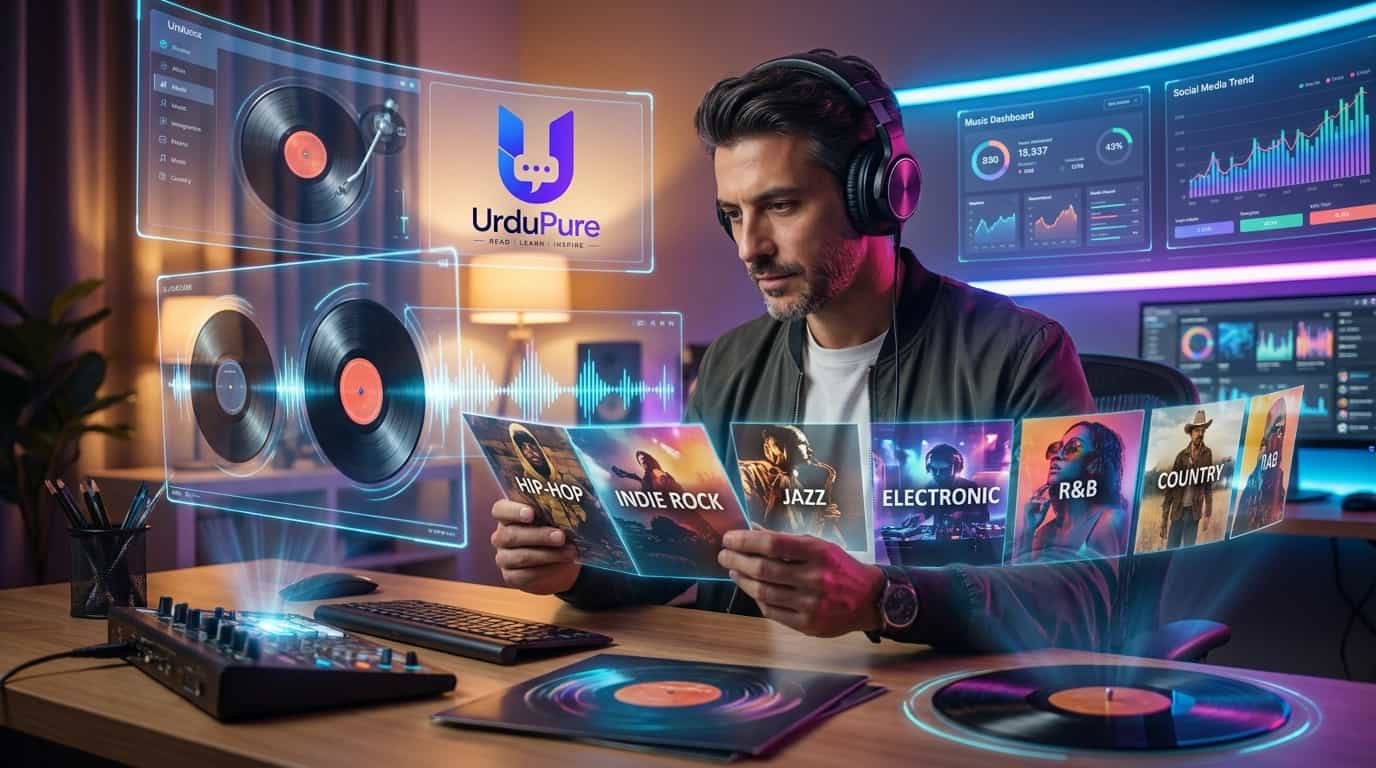
Best Albums of 2026 So Far: The Mid-Year Critical Review
Music in 2026: The Context Before the Records
Understanding which albums matter in 2026 requires understanding the market they are entering. Spotify reported that over 100,000 songs are uploaded to the platform daily — a figure that has grown with the mainstreaming of AI-assisted music production tools. The democratisation of production has produced genuine creative abundance; it has also produced extraordinary competition for listener attention. The albums that break through do so through a combination of artistic quality, pre-release narrative, cultural timing, and social media momentum.
The clearest trend of 2026 is genre fluidity. The most compelling records of the year so far do not fit cleanly into a single category — they draw from hip-hop rhythmic vocabulary, Latin melodic sensibility, R&B emotional directness, and indie sonic experimentation simultaneously. The genre as an organising principle is increasingly inadequate for describing what interesting artists are actually doing.
A secondary trend: the artist's personal narrative has become more important than ever as a frame for the music itself. In an era of algorithmic discovery, the story of who made something and why — the context, the struggle, the journey — is often what gets a record heard in the first place. The best albums of 2026 all have a compelling story attached to their creation.
The Critical Consensus: What Is Being Called the Year's Best
The Dominant Conversations in Pop and R&B
The pop and R&B landscape in mid-2026 is shaped by several artists who have released or are imminently releasing major projects. The release cycle of 2025-2026 has been particularly rich for Black American music — R&B, rap, and their hybrids — with multiple releases generating significant critical and commercial attention simultaneously. The specific critical rankings shift weekly, but the common thread in the most praised records is lyrical specificity (not abstraction), sonic cohesion (a record that sounds designed as a whole rather than assembled from singles), and emotional honesty that makes the listener feel rather than simply process.
Hip-Hop: The Continuing Conversation
Hip-hop's critical landscape in mid-2026 has been significantly shaped by two converging forces: the aftermath of the Drake-Kendrick Lamar conflict of 2024, which produced one of the most commercially and culturally significant "beef" moments in the genre's history, and the continued commercial dominance of streaming-optimised rap that prioritises melodic hooks over lyrical density.
The critical community has increasingly valorised artists who operate outside the streaming-optimisation formula: longer-form albums with deliberate sequencing, producers with distinctive sonic identities, and rappers whose word-per-bar density and conceptual ambition prioritise the art form over commercial calculation. These records rarely top streaming charts; they tend to dominate year-end critical lists and to be the albums that receive recommendations from people whose musical taste you trust most.
The Indie and Alternative Landscape
The indie sector continues to produce some of the year's most critically acclaimed records — a consistent pattern of recent years in which smaller releases outperform major-label output in Metacritic average scores. The British indie ecosystem, energised by the global attention that acts like Wet Leg, Yard Act, and the Fontaines D.C. have generated, continues to produce inventive guitar music. US indie is more fragmented, with the most interesting work coming from artists who have consciously resisted the genre's post-2010 calcification into a recognisable aesthetic.
Electronic Music and the AI Production Question
Electronic music in 2026 faces the most direct creative challenge from AI production tools of any genre. AI composition and sound design tools have lowered the barrier to producing technically competent electronic music to near-zero, creating a paradox: there is more electronic music available than ever, and the average quality of the most widely distributed work has declined as quantity has exploded. The artists distinguishing themselves are those whose human creative perspective — their specific cultural context, their live performance dimension, their willingness to be strange rather than optimised — cannot be replicated by a prompt.
Jazz: The London Renaissance
The most genuinely exciting musical movement in the UK and arguably globally is the London jazz renaissance that has been building since approximately 2018 and shows no signs of peaking. Artists including Ezra Collective, Nubya Garcia, Moses Boyd, and their extended creative community have developed a distinctive sound that draws on jazz tradition while integrating grime, afrobeat, reggae, and electronic music influences in ways that feel organic rather than calculated.
The commercial success of this scene — with Ezra Collective winning the Mercury Prize and achieving mainstream chart positions that jazz has not seen in decades — has created institutional support and commercial infrastructure for jazz-adjacent music in the UK that is producing a second generation of artists with resources their predecessors lacked. The records coming from this community in 2026 are among the most musically literate and emotionally direct available anywhere in contemporary music.
Country's Continued Crossover
The country music crossover trajectory that Beyoncé's Cowboy Carter era and Morgan Wallen's sustained mainstream dominance established in 2024 continues into 2026. The genre's traditional sonic markers — pedal steel, twang, rural thematic content — are being blended with pop production, hip-hop rhythms, and Americana aesthetics in ways that are generating both significant commercial success and significant controversy within the country music establishment.
The most interesting country music of 2026 is being made by artists who approach the genre as a tradition worth engaging with honestly rather than either abandoning (for generic pop) or calcifying (for purist nostalgia). Artists who can write a song that would have made sense in 1975 country Nashville while sounding entirely current in 2026 are the ones generating the most sustained critical and commercial attention.
How to Discover 2026's Best Music
Algorithmic discovery platforms — Spotify's Discover Weekly, Apple Music's algorithms — are adequate for mainstream discovery but poorly calibrated for the records that tend to age best. For music with genuine longevity: Pitchfork remains the most influential critical voice despite its algorithmically driven decline, particularly for the 7.5+ rated records; The Wire for experimental and jazz-adjacent music; NME for UK guitar music; and Bandcamp for discovering independent music before it reaches mainstream attention. RateYourMusic is the most useful community-driven resource for tracking what the engaged music listening community has settled on as the year's best, usually months after release.
The most underrated discovery strategy: follow music journalists whose taste you respect on social media rather than reading their formal reviews. A three-sentence Instagram post from a trusted writer about a record they are excited about is often more reliable signal than a 500-word formal review shaped by editorial considerations.
Frequently Asked Questions
What is the best way to find new music in 2026?
The most reliable combination: algorithmic playlists for volume discovery, trusted critical voices (Pitchfork, The Wire, Bandcamp editors) for quality filtering, and word-of-mouth recommendation from specific friends or social media accounts whose taste you genuinely respect. The last source — specific human recommendation from someone who knows your taste — consistently outperforms algorithms for finding music you will love rather than music you will merely engage with momentarily.
Are music streaming platforms still the best way to listen in 2026?
For discovery and convenience: yes. For audio quality: hi-res audio options including Apple Music Lossless, Tidal HiFi Plus, and Qobuz offer significantly better audio quality than standard streaming for listeners with capable playback equipment. For supporting artists financially: Bandcamp remains the platform that returns the highest percentage of revenue to artists — important for the independent music ecosystem that produces much of the most critically acclaimed work.
What is the impact of AI on music in 2026?
AI music generation tools can produce technically competent music in any style. They cannot produce the specific cultural context, biographical specificity, and live performance dimension that makes the music that endures. The impact is concentrated at the bottom of the market — replacing stock music and generic background audio — and has not yet significantly displaced the top of the market, where artist identity and narrative drive value. The debate about copyright, attribution, and artist compensation for AI training data trained on copyrighted recordings.
best albums 2026, new music 2026, best songs 2026, best hip hop albums 2026, best pop albums 2026, best indie albums 2026, music review 2026, top albums June 2026, critically acclaimed music 2026

Discussion
Comments
Approved comments are published after moderation to keep discussion useful and spam-free.
No comments yet. Start the discussion below.