The Problem With Most Resin Starter Kit Guides
Resin art looks simple on social media.
A creator pours clear resin into a mold, adds gold flakes, moves a few colors around, waits for the cure, and suddenly there is a glossy coaster, tray, bookmark, pendant or art panel.
But beginners quickly discover the truth.
The hard part is not only pouring resin. The hard part is knowing what to buy, how to use it safely, how to avoid sticky results, and which starter kits are actually useful instead of just looking impressive in product photos.
Many resin starter guides recommend kits based on affiliate commission, not beginner value. They focus on the biggest box, the most glitter, or the cheapest price, while ignoring the things that matter most:
Is the resin beginner-friendly?
Does the kit include useful molds?
Are the pigments easy to use?
Is the safety equipment adequate?
Is the resin suitable for coasters, jewelry or art coating?
Will the finished work stay clear or yellow quickly?
Is the kit good for learning, gifting or selling?
This guide takes a practical beginner-first approach.
The best resin art starter kit is not always the most expensive one. It is the kit that helps you learn the fundamentals without wasting money or creating unsafe habits.
Quick Recommendation: Best Resin Kit for Most Beginners
For most beginners, the best starting point is an all-in-one epoxy resin kit from a beginner-focused brand such as Let’s Resin.
Why?
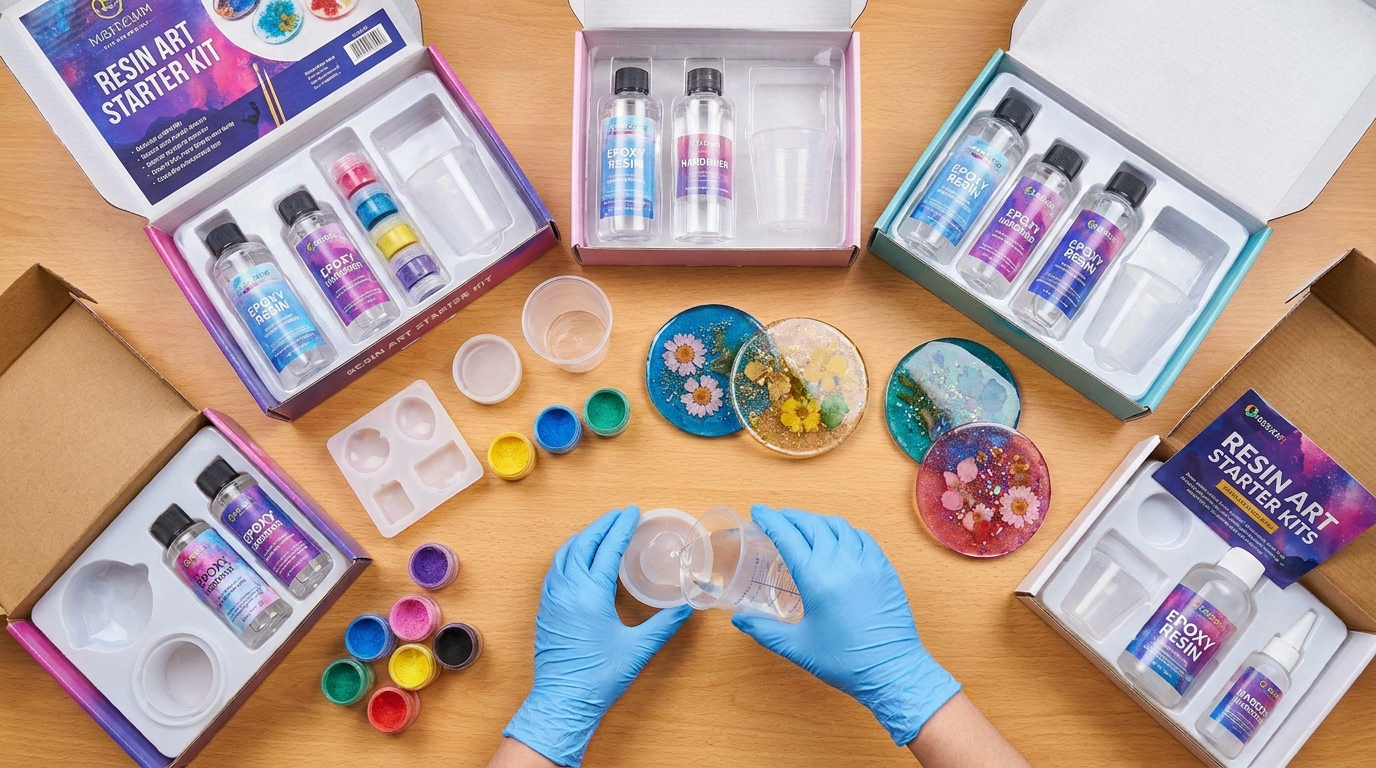
Because a good all-in-one kit usually includes resin, hardener, mixing cups, sticks, gloves, molds, pigments and small decorative extras. That means you can make your first project without buying ten separate items.
But even with an all-in-one kit, you should still buy proper safety gear separately, especially nitrile gloves, eye protection and a suitable mask or respirator if you are working indoors.
Epoxy Resin vs UV Resin: Which Should Beginners Choose?
Before buying a kit, you need to understand the difference between epoxy resin and UV resin.
They are not the same, and they are not equally good for every project.
Epoxy Resin: Best for Most Beginners
Epoxy resin is a two-part system. You mix resin and hardener together, usually in a 1:1 or 2:1 ratio depending on the brand.
Once mixed, epoxy gives you a working time of around 30 to 60 minutes, depending on the formula. It then cures over 24 to 72 hours.
Epoxy resin is best for:
Coasters
Trays
Small art panels
Jewelry
Keychains
Decorative objects
Tabletop coatings
Bookmark molds
First beginner projects
The big advantage of epoxy is time. You do not have to rush. You can mix colors, remove bubbles, arrange flowers or glitter, and correct small mistakes before the resin starts curing.
That makes epoxy more forgiving for beginners.
UV Resin: Fast but More Limited
UV resin is a one-part resin that cures under a UV lamp or strong sunlight.
It can cure in minutes, which sounds amazing. But it is usually better for very small projects, especially jewelry and tiny charms.
UV resin is best for:
Small pendants
Earrings
Charms
Tiny inclusions
Quick experiments
Layered jewelry pieces
The limitation is that UV resin is not ideal for large pours. It can yellow faster than good epoxy resin, and it requires a UV lamp for consistent results.
Beginner Verdict: Start With Epoxy
If you are new to resin art, start with epoxy resin.
It gives you more time, more flexibility, and a better foundation. Once you understand mixing, bubbles, curing and demolding, you can try UV resin for smaller jewelry projects.
Safety First: What Every Resin Beginner Must Know
Resin art is beautiful, but uncured resin is not harmless.
You should treat resin like a chemical craft, not like ordinary paint or glue.
At minimum, you need:
Nitrile gloves
Eye protection
A well-ventilated workspace
A mask or respirator when working indoors or for longer sessions
A protected work surface
A dust cover for curing pieces
A child-free and pet-free work area
Why Nitrile Gloves Matter
Do not rely on latex gloves.
Nitrile gloves are stronger and better suited for resin work. They help protect your skin from uncured resin and reduce the risk of irritation or sensitization.
Resin sensitization is serious. Some people develop an allergic reaction after repeated exposure to uncured resin. Once that happens, working with resin can become very difficult or impossible.
Gloves are not optional.
Ventilation Matters Too
Work in a well-ventilated room or outdoors. A closed bedroom or small kitchen is not ideal.
If you are working indoors, open windows, use airflow, and consider a respirator rated for the type of resin and additives you are using.
Also remember that pigments, alcohol inks, mica powders, sanding dust and heat tools can create additional exposure risks.
Keep Children and Pets Away
Do not let children or pets touch uncured resin.
Even if the finished piece looks harmless, the resin is not fully safe until it has cured properly. Most epoxy projects need 24 to 72 hours to cure, depending on the product and environment.
Keep your curing pieces covered and out of reach.
Best Resin Art Starter Kits 2026: Ranked for Beginners
1. Let’s Resin All-in-One Starter Kit
Best for: Absolute beginners who want one box to start
Typical Price Range: Around $25–$40 depending on kit size, retailer and offer
Best Projects: Coasters, small molds, jewelry, keychains, bookmarks, decorative pieces
Beginner Rating: 9/10
Let’s Resin is one of the most beginner-friendly resin brands because it offers all-in-one kits designed for first-time users.
A typical Let’s Resin beginner kit may include epoxy resin, hardener, silicone molds, pigments, mixing tools, gloves and decorative materials. Exact contents vary by kit, so always check the product listing before buying.
Why It Is Good for Beginners
The biggest advantage is convenience.
Beginners often do not know what they need. Let’s Resin solves that by packaging the basics together. You can make your first coaster, small tray or decorative piece without building a full supply list from scratch.
It is also affordable enough that mistakes do not feel too expensive.
What It Does Well
Good beginner value
Easy first-pour experience
Often includes molds and pigments
Suitable for simple projects
Good gift option
Easy to find online
Honest Limitation
The included molds and pigments are usually starter-grade. They are fine for learning, but not always professional quality.
The included safety items may also be basic. You should still buy your own nitrile gloves, eye protection and proper mask or respirator if needed.
Verdict
This is the best default choice for most beginners. Buy this if you want to start resin art without overthinking every supply item.
2. ArtResin Epoxy Resin Kit
Best for: Artists who want a high-gloss coating resin
Typical Price Range: Higher than basic beginner kits; price varies by size and retailer
Best Projects: Artwork coating, canvas art, photography coating, wood panels, professional-looking finishes
Beginner Rating: 8/10
ArtResin is a premium epoxy resin known for clear, glossy coatings.
The 32 oz ArtResin kit includes two bottles: resin and hardener. It is designed for artwork, coatings and high-gloss finishes rather than being a complete craft box with molds and decorations.
Why It Is Good
ArtResin is a better choice when you care about clarity, gloss and long-term finish quality.
It is especially useful for:
Painters
Mixed-media artists
Photographers
Wood artists
Canvas coating
Professional-looking resin finishes
What It Does Well
Excellent glossy finish
Good clarity
Self-leveling behavior
Strong artwork coating use case
Better long-term presentation than many cheap resins
Honest Limitation
ArtResin is not an all-in-one beginner craft kit.
It usually does not include molds, pigments, flowers, glitter or decorative extras. If you want to make coasters or jewelry, you will need to buy molds and pigments separately.
It is also more expensive than many beginner kits.
Verdict
Choose ArtResin if you want to coat artwork or create polished, professional-looking pieces. Do not choose it as your first kit if you want a complete beginner box with molds and colors included.
3. DR. Resin Large Epoxy Resin Kit
Best for: Beginners who already tried resin and want more material
Typical Price Range: Mid-range, depending on size
Best Projects: Coaster batches, small trays, practice pours, larger beginner projects
Beginner Rating: 8/10
A larger epoxy resin kit is useful once you know you enjoy resin art.
Starter kits run out quickly. After a few coasters or molds, many beginners realize they need more resin than expected.
That is where a larger resin-only kit becomes practical.
Why It Is Useful
A larger kit gives better value per ounce. It is ideal if you already have:
Molds
Pigments
Mixing cups
Stir sticks
Gloves
Decorative inclusions
Instead of paying again for accessories, you can buy more resin and keep practicing.
What It Does Well
Better value for repeated projects
Useful for coaster sets
Good for practice
Helps beginners improve technique
Less need for frequent reordering
Honest Limitation
This type of kit may not include enough accessories for a true beginner.
If you have never made resin art before, start with an all-in-one kit first. Then buy a larger resin refill kit later.
Verdict
Best as your second resin purchase, not your first.
4. UV Resin Starter Kit With Lamp
Best for: Jewelry beginners who want fast results
Typical Price Range: Around $25–$50 depending on lamp and included accessories
Best Projects: Earrings, pendants, charms, keychains, tiny molds
Beginner Rating: 7.5/10
A UV resin starter kit is perfect if your main goal is small jewelry.
Unlike epoxy resin, UV resin cures quickly under a UV lamp. This means you can finish small pieces in minutes instead of waiting a full day.
Why It Is Good
UV resin is satisfying for beginners because results are fast.
You can pour, cure, demold and adjust quickly. That makes it good for learning color combinations and small design details.
What It Does Well
Fast curing
Great for jewelry
Good for tiny details
Less waiting time
Useful for layered pieces
Honest Limitation
UV resin is not ideal for larger projects. It can yellow faster than high-quality epoxy, and it requires good UV light exposure to cure properly.
Thick pieces may not cure evenly.
Verdict
Choose UV resin if you want to make small jewelry. Choose epoxy if you want coasters, trays or larger art pieces.
5. Alumilite Amazing Epoxy Starter Kit
Best for: Small casting and jewelry practice
Typical Price Range: Budget to mid-range depending on size and retailer
Best Projects: Jewelry, small molds, mica effects, small decorative pieces
Beginner Rating: 7.5/10
Alumilite is a known brand in resin and casting communities.
Its small starter kits can be useful for beginners who want to experiment with jewelry, mica powders and small molds.
Why It Is Good
Alumilite kits are often simple and focused. They are useful if you want to understand resin behavior without buying a huge amount of material.
They can be especially good for:
Pendants
Charms
Small molds
Mica powder effects
Decorative pieces
What It Does Well
Good for small-scale learning
Suitable for jewelry and casting
Often available through craft retailers
Helpful for controlled practice
Honest Limitation
Some small kits do not include much resin, so you may run out quickly.
Also check the gloves included. If the kit includes latex gloves, replace them with nitrile gloves before working.
Verdict
A good small-project kit, especially for jewelry and casting practice.
6. Budget Crystal Clear Epoxy Resin Kit
Best for: Cost-conscious beginners
Typical Price Range: Budget-friendly
Best Projects: Practice coasters, bookmarks, small molds, clear effects
Beginner Rating: 7/10
Budget clear epoxy resin kits can be useful if you want to practice without spending much.
Many of these kits promise a crystal-clear finish, low odor and easy mixing. Some perform well, while others yellow faster or cure less consistently.
Why It Can Be Worth Buying
A budget resin kit is fine for learning basic techniques:
Mixing
Pouring
Bubble removal
Demolding
Pigment blending
Layering
You do not need premium resin for every practice project.
What to Check Before Buying
Before buying a budget resin kit, check:
Mixing ratio
Cure time
Reviews mentioning yellowing
Whether it includes molds
Whether gloves are nitrile
Whether instructions are clear
Whether the resin is suitable for your project type
Honest Limitation
Cheap resin can be inconsistent. Some formulas may yellow faster or cure with more bubbles.
Do not use the cheapest resin for important gifts, commissions or pieces you want to last for years.
Verdict
Good for practice, but upgrade when making serious pieces.
Best Resin Kit by Use Case
Best Overall Beginner Kit
Let’s Resin All-in-One Starter Kit.
It offers the easiest start for most beginners because it usually includes resin, tools, molds and decorative items.
Best Resin for Artwork Coating
ArtResin.
Choose it when you want a clear, glossy finish over paintings, photographs, wood panels or mixed-media art.
Best Resin for Jewelry
UV resin starter kit with lamp.
Choose it for earrings, pendants and small charms where fast curing matters.
Best Value After Your First Kit
A larger epoxy resin refill kit.
Once you already own molds and tools, buying more resin gives better value.
Best Budget Option
A well-reviewed crystal clear epoxy resin kit.
Choose this for practice, not for professional work.
What Should Be Inside a Good Resin Starter Kit?
A proper beginner kit should include:
Epoxy resin
Hardener
Clear mixing instructions
Measuring cups
Mixing sticks
Silicone molds
Pigments or mica powders
Gloves
Droppers or pipettes
Small decorative inclusions
Basic project guide
But remember: even if gloves are included, you should confirm they are nitrile. If not, buy nitrile gloves separately.
What You Still Need to Buy Separately
Most beginner kits do not include everything you need for safe resin work.
You may still need:
Extra nitrile gloves
Safety goggles
Mask or respirator
Silicone work mat
Apron
Dust cover or cardboard box
Heat gun or lighter for bubbles
Toothpicks
Baby wipes or paper towels
Isopropyl alcohol for tool cleanup
Storage containers
Extra molds
Do not spend all your budget on resin and forget safety.
First Resin Project: Make a Simple Coaster
The best first resin project is a coaster.
A coaster is small enough that mistakes are not expensive, but large enough to teach you the important basics.
You will learn:
Measuring
Mixing
Coloring
Pouring
Bubble removal
Curing
Demolding
Step-by-Step Beginner Coaster Pour
Step 1: Prepare Your Workspace
Cover your table with a silicone mat or parchment paper.
Work in a ventilated space. Keep children and pets away.
The room should not be too cold. Resin cures best in a stable, warm environment. A very cold room can slow curing and cause sticky results.
Step 2: Wear Safety Gear
Put on nitrile gloves before opening resin bottles.
Use eye protection, especially when mixing or pouring.
If working indoors for longer sessions, use a suitable mask or respirator and maintain airflow.
Step 3: Measure Carefully
Follow your resin kit’s exact mixing ratio.
Many beginner kits use a 1:1 ratio, but not all do. Never guess.
Measure resin and hardener accurately. Wrong ratios are one of the biggest causes of sticky, uncured projects.
Step 4: Mix Slowly
Stir slowly for the full recommended time, often around 3 minutes.
Scrape the sides and bottom of the mixing cup.
Do not whip the mixture. Fast stirring creates bubbles.
Step 5: Add Color
Divide the resin into smaller cups if using multiple colors.
Add pigment slowly. Too much pigment can interfere with curing.
Start with a small amount and build up.
Step 6: Pour Into the Mold
Pour slowly and close to the mold surface.
Use a toothpick or stick to move colors gently.
Do not overfill the mold.
Step 7: Remove Bubbles
Let the resin sit briefly so bubbles rise.
You can use a small heat gun or quick lighter pass above the surface, but do not overheat the resin or silicone mold.
Beginners should be careful with flame.
Step 8: Cover and Cure
Cover the mold with a cardboard box or dust cover.
This prevents dust, hair and insects from landing in the resin.
Leave it alone until the recommended cure time.
Step 9: Demold Slowly
Do not demold too early.
Even if the resin feels hard after 24 hours, many epoxy projects need up to 72 hours for full cure.
Flex the mold gently from the edges and remove the piece slowly.
Common Resin Mistakes Beginners Make
Mistake 1: Guessing the Ratio
Resin chemistry depends on accurate measurement.
If the ratio is wrong, the resin may stay sticky forever.
Mistake 2: Mixing Too Fast
Fast mixing creates bubbles.
Slow, steady mixing is better.
Mistake 3: Not Mixing Long Enough
Under-mixed resin causes soft spots, streaks and sticky patches.
Mix for the full recommended time.
Mistake 4: Using Too Much Pigment
Too much pigment can stop resin from curing properly.
Use small amounts.
Mistake 5: Working in a Cold Room
Cold temperatures slow curing.
Keep your workspace warm and stable.
Mistake 6: Not Covering the Project
Dust, hair and lint can ruin a glossy surface.
Always cover curing pieces.
Mistake 7: Demolding Too Early
Early demolding can bend, scratch or warp the piece.
Wait for the full cure.
Mistake 8: Ignoring Safety
Do not touch uncured resin with bare hands.
Do not work in a closed room.
Do not let children handle uncured resin.
Where to Buy Resin Starter Kits
United States
Good places to check include:
Amazon
Michaels
Walmart
Hobby Lobby
ArtResin official store
Let’s Resin official store
Resin specialty websites
United Kingdom
Good places to check include:
Amazon UK
Hobbycraft
The Range
ArtResin retailers
Let’s Resin official store
Resin craft suppliers
International Buyers
If you are outside the US or UK, check:
Amazon international shipping
Local craft stores
Regional marketplaces
Specialist resin suppliers
Direct brand websites
Always compare shipping costs, delivery times and return policies before buying.
Buying Checklist Before You Order
Before buying any resin starter kit, check:
Is it epoxy or UV resin?
Does it include both resin and hardener?
What is the mixing ratio?
Does it include molds?
Are the gloves nitrile?
Does it include pigments?
Is it suitable for your project?
What is the cure time?
Are reviews positive for clarity and curing?
Does the seller provide safety instructions?
Is the price reasonable for the resin quantity?
Best Beginner Resin Kit Setup
For the smoothest start, buy:
One all-in-one epoxy starter kit
Extra nitrile gloves
Safety goggles
Mask or respirator
Silicone work mat
Small heat gun or bubble remover
Dust cover
Extra coaster mold
This gives you enough to make your first few projects safely.
Final Verdict
The best resin art starter kit for most beginners in 2026 is a good all-in-one epoxy resin kit, especially from a beginner-focused brand like Let’s Resin.
It gives you the easiest first experience because you get resin, tools, molds and decorative items in one box.
If you are an artist coating finished work, choose ArtResin instead.
If you want to make small jewelry quickly, choose a UV resin starter kit with a lamp.
If you have already made your first few pieces, buy a larger epoxy refill kit and upgrade your molds and pigments separately.
The most important rule is simple:
Do not buy resin without also preparing for safety.
A beautiful coaster is not worth skin irritation, breathing discomfort or poor working habits.
Start small, work safely, measure carefully and let your first project teach you the basics.
Once you understand resin, the creative possibilities open quickly.
FAQ
What is the best resin art starter kit for beginners in 2026?
For most beginners, a Let’s Resin all-in-one epoxy starter kit is the best starting point because it usually includes resin, tools, molds, pigments and beginner accessories.
Should beginners use epoxy resin or UV resin?
Most beginners should start with epoxy resin because it gives more working time and is better for coasters, trays and art pieces. UV resin is better for small jewelry and fast curing.
Is resin art safe for beginners?
Resin art can be safe when handled correctly. Beginners should use nitrile gloves, eye protection, ventilation and a suitable mask or respirator when needed. Keep children and pets away from uncured resin.
Why did my resin stay sticky?
Sticky resin is usually caused by incorrect mixing ratio, under-mixing, cold temperature, too much pigment or demolding too early.
Can I make resin art indoors?
Yes, but only with good ventilation and proper safety gear. Avoid small closed rooms. Use gloves, eye protection and a suitable mask or respirator when needed.
What is the easiest first resin project?
A coaster is the easiest first project because it is small, useful and teaches the basic skills of measuring, mixing, pouring, curing and demolding.
Does UV resin need a lamp?
Yes, UV resin usually needs a UV lamp for consistent curing. Sunlight can work, but a lamp gives more reliable results.
Is ArtResin good for beginners?
ArtResin is good for beginners who want to coat artwork, but it is not a complete starter craft kit. You will need to buy molds, pigments and accessories separately.
Featured Image Prompt
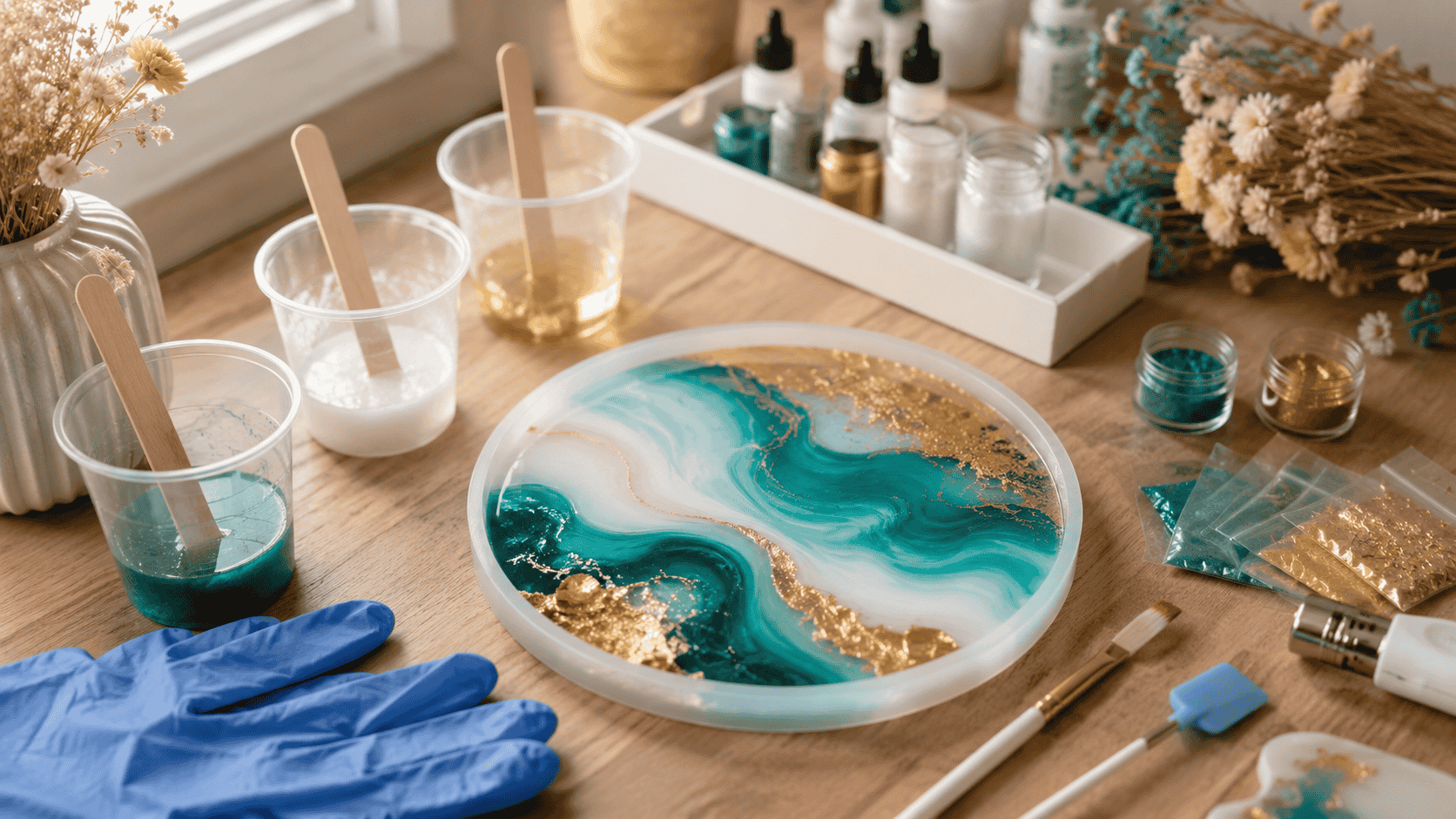
Lifestyle craft photography of a clean wooden worktable with a beginner resin art project in progress. A silicone coaster mold contains glossy teal, white and gold resin swirls. Nearby are clear mixing cups, wooden stir sticks, nitrile gloves, small pigment jars and dried flowers. Warm natural window light from the left, cozy creative studio atmosphere, no visible brand logos, no text overlay, no watermark, high-resolution feature image for a crafts and hobbies article.
Resin art is beautiful, but beginners often waste money on the wrong kits. This guide compares the best resin art starter kits for 2026, explains epoxy vs UV resin, covers safety essentials and shows how to complete your first beginner pour.
resin art, resin starter kit, epoxy resin, UV resin, resin art for beginners, craft kits, DIY crafts, coaster making, jewelry making, resin safety, crafts and hobbies
Sources
Let’s Resin official all-in-one kit information
ArtResin official 32 oz epoxy resin kit information
ArtResin resin safety guidance
Resin Pro resin protective gear guidance
Steve McDonald Crafts resin safety information
Resin Obsession beginner resin resources
Michaels, Walmart and Amazon retailer listings for availability and pricing checks
UrduPure editorial product comparison notes



Discussion
Comments
Approved comments are published after moderation to keep discussion useful and spam-free.
No comments yet. Start the discussion below.