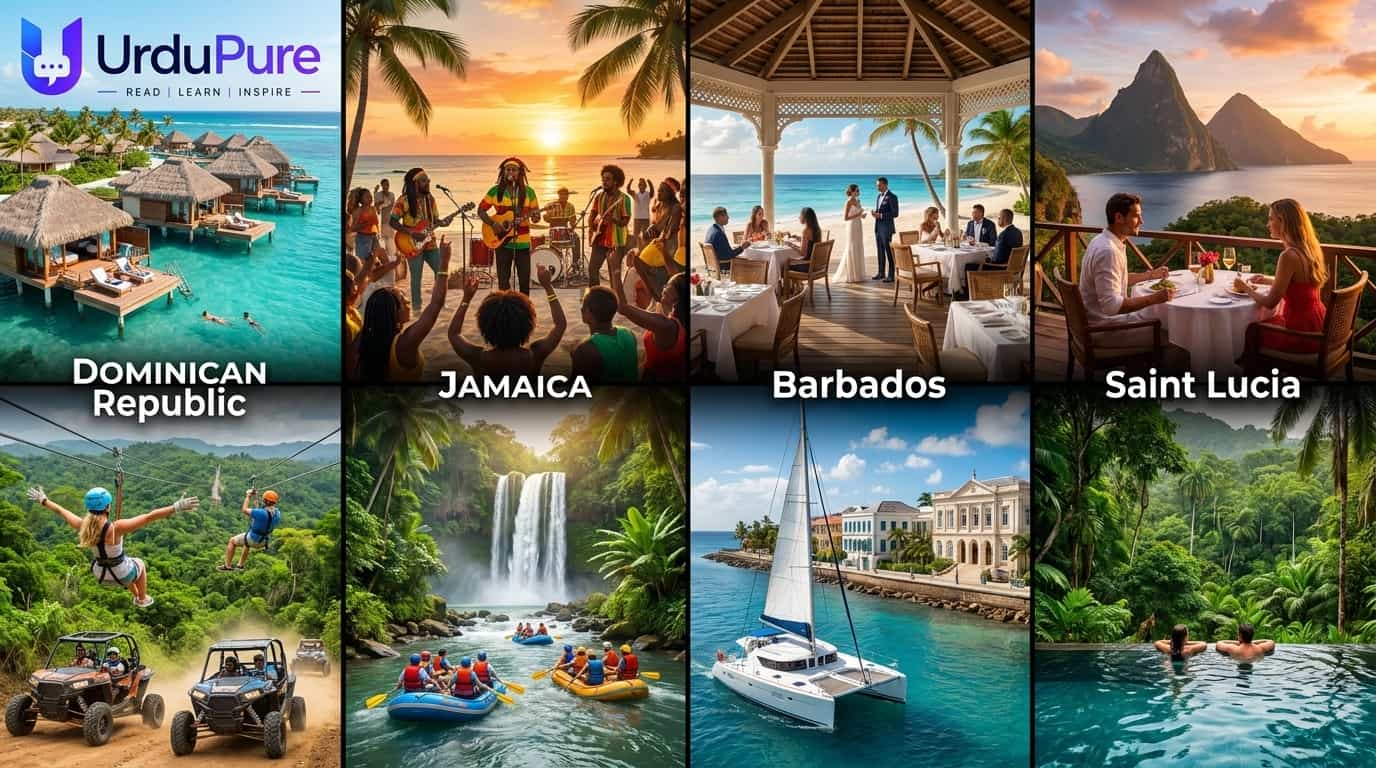
Caribbean Island Comparison 2026: Dominican Republic vs Jamaica vs Barbados vs St Lucia — An Honest Side-by-Side
Every travel article about the Caribbean will eventually tell you it is all a matter of personal preference. That is true — and it is also a way of avoiding the more useful answer. Because these four islands are not interchangeable variations on the same theme. They have radically different price points, different safety profiles, different beach personalities, different food cultures, and different soul. Picking the wrong one for your travel style will not ruin your holiday — the Caribbean's baseline is spectacular — but picking the right one will make it the trip you describe to people for a decade.
This comparison is built on the most current data available in 2026: real daily budget figures from Budget Your Trip's live Caribbean rankings, the US State Department's January 2026 travel advisory updates, TripAdvisor's 2026 Best of the Best Caribbean rankings, and independent beach assessments from the region's most authoritative travel sources. No sponsored content. No softened conclusions. Here is the honest side-by-side.
1. Cost Comparison: Full Daily Budget for Real Travellers
The cost gap between these four islands is larger than most travellers expect — and the data from Budget Your Trip's 2026 Caribbean rankings makes it unambiguous.
The Numbers, Head to Head
Jamaica: Average daily tourist spend of $141.78, making it the second-most affordable destination in this group. Jamaica's all-inclusive infrastructure means costs are predictable — once you are inside the resort, the daily spend is controlled. Independent travellers who engage with local markets, jerk stands, and guesthouses can get this figure considerably lower. Budget travellers in Jamaica can manage comfortably on $80–100 per day including accommodation.
Dominican Republic: Average daily tourist spend of $169.27 — slightly higher than Jamaica but for good reason. The DR's infrastructure is more developed, the resort corridor of Punta Cana offers a wider range of quality tiers, and the country's combination of luxury all-inclusive options with genuinely affordable local alternatives gives it a broader spending spectrum than any other island in this group. A mid-range Punta Cana all-inclusive typically runs $150–$250 per person per day including meals and drinks. Santo Domingo's merengue neighbourhood bars and local comida criolla restaurants bring independent daily budgets to $70–110.
St Lucia: Average daily tourist spend sits in the mid-range for the Caribbean, around $200–$250 per person per day at a decent resort standard. The island lacks the mass all-inclusive infrastructure of Jamaica and the DR, which tends to push costs upward — fewer properties competing for mid-budget travellers means prices hold higher. Rodney Bay's restaurant strip offers mid-range dining at $20–40 per main, while Soufrière's jungle lodges command premium pricing for their extraordinary positioning.
Barbados: The most expensive island in this comparison by a significant margin. Budget Your Trip's live rankings place Barbados at $437.88 per day — three times the cost of Jamaica. The HelloSafe March 2025 global tourism spending report places Barbados at $331 per day even on a conservative measure, versus Jamaica at under $100. A mid-range hotel in Holetown or St James on the Platinum Coast runs $350–$700 per night in high season. The Sandy Lane resort — Barbados's most iconic property and one of the world's most celebrated — starts at over $1,500 per night. Even at the budget end of Barbados, you are paying more per night than at the top of Jamaica or the DR's mid-range.
Breaking Down the Budget by Category
For a couple travelling for one week in high season (December–April), here is the realistic all-in budget including accommodation, meals, local transport, and two to three paid activities:
Jamaica (Negril or Montego Bay, mid-range all-inclusive): £2,800–£4,200 / $3,500–$5,500 per couple, excluding flights. Independent travel can be done for £1,800–£2,500.
Dominican Republic (Punta Cana, mid-range all-inclusive): £2,400–£3,800 / $3,000–$4,800 per couple. Value leader for the all-inclusive segment — competitive resorts have driven prices down while maintaining quality. TripAdvisor's 2026 Best of Best Caribbean rankings place the DR at the top of the region.
St Lucia (Rodney Bay or Soufrière, boutique resort): £4,000–£6,500 / $5,000–$8,200 per couple. Luxury options extend significantly above this range.
Barbados (St James or Christ Church, mid-range): £5,500–£9,000+ / $7,000–$11,500+ per couple. The Platinum Coast is one of the most expensive stretches of beach property in the Caribbean, and it sets the pricing tone for the island.
"The Dominican Republic ranks 47th globally for daily tourism spending at $132 per day — more than Jamaica and Mexico, but dramatically less than Barbados at $331. For value-conscious travellers who want high quality, the DR's combination of infrastructure and pricing is unmatched in the Caribbean."
— HelloSafe Global Tourism Cost Report, March 2025
Best for Budget: Dominican Republic and Jamaica
Best for Luxury Exclusivity: Barbados, then St Lucia
2. Beach Quality: The Honest Ranking for Sand, Water and Crowding
All four islands have outstanding beaches. The differences are in character, consistency, crowding, and what kind of beach experience each island prioritises — not in whether the beaches are beautiful. They all are.
Dominican Republic: Volume and Variety
The DR's undisputed headline beach is Bávaro Beach in Punta Cana — a single, continuous stretch of fine white sand running for 30 miles, making it one of the longest unbroken beaches in the entire Caribbean. The sand is genuinely powder-soft, the water is calm and turquoise, and the density of resort amenities means that everything from jet skis to beachside massage to fresh coconut vendors is always within reach. US News Travel lists Bávaro among its top Caribbean beaches.
The honest caveat: the Punta Cana-Bávaro strip is developed. Heavily. Fourteen miles of continuous resort wall means the beach itself can feel like a corridor of hotel frontage rather than a natural escape. Sargassum seaweed — a regional issue affecting the Dominican Republic's Atlantic-facing east coast — periodically affects beach conditions from spring to summer, though resort staff work continuously to clear it. The north coast (Cabarete, Playa Grande) and the southwest (Pedernales, Bahía de las Águilas) offer wilder, emptier, more authentic beaches for travellers willing to go beyond the all-inclusive corridor.
Beach verdict: Best for volume, best for all-inclusive amenities, best for families with young children. Bahía de las Águilas on the southwest coast is a genuinely world-class unspoiled beach. Punta Cana is spectacular but busy and developed.
Jamaica: Character Over Perfection
Jamaica's best beaches — Seven Mile Beach in Negril, Doctor's Cave Beach in Montego Bay, Frenchman's Cove in Port Antonio — are defined by personality rather than pristine uniformity. Seven Mile Beach is genuinely magnificent: calm aquamarine water, soft golden-white sand, and a long, relatively open stretch that feels accessible rather than annexed by a single resort. Doctor's Cave was historically considered one of the finest cove beaches in the Caribbean, with famously clear, mineral-rich water.
Jamaica's beach experience is shaped partly by Hurricane Melissa, which made landfall on October 28, 2025 and caused widespread damage to the western part of the island. Some beach facilities in the Montego Bay area are still in recovery. Negril was less affected, but travellers visiting in 2026 should confirm current conditions at specific beaches and resorts before booking, particularly at western properties.
Away from the resort areas, Jamaica has a rawer beach culture — vendors are persistent, beach access disputes are more common, and the experience requires more navigation than the other three islands. This authenticity is part of Jamaica's charm for travellers who want engagement with the island's culture. It is a complication for those who want a seamless sunbathing experience.
Beach verdict: Best character and personality. Seven Mile Beach is genuinely world-class. Less consistent across the island than Barbados; some 2026 hurricane recovery ongoing.
Barbados: The Quality Standard-Setter
Barbados is frequently cited as the Caribbean's gold standard for beach quality — and for sand and water clarity, the ranking holds up. The island's western Platinum Coast (Paynes Bay, Brighton Beach, Brandons Beach) offers calm, turquoise, reef-protected Caribbean water with fine white sand in a reliably clean, maintained condition. The eastern Atlantic coast gives Barbados its beach range: Crane Beach, with its dramatic pink-tinged sand enclosed in rough limestone cliffs and coconut groves, is among the most visually striking individual beaches in the entire Caribbean. Bathsheba Beach on the east coast, where Atlantic swells create conditions for surfing and rock pool exploration, is nothing like the standard Caribbean resort beach — it is wild, spectacular, and memorable.
All beaches in Barbados are legally public. This is not true everywhere in the Caribbean — and it means that even the most expensive stretch of the Platinum Coast is accessible to any visitor regardless of where they are staying. Beach quality in Barbados is consistently maintained, sargassum impact is lower than the DR's Atlantic coast, and crowding — while present in the most popular spots — is nowhere near the resort-wall density of Punta Cana.
Beach verdict: Highest average quality and consistency across the island. Crane Beach is the most photographically spectacular beach in this comparison. Best water clarity in the group. Premium pricing, but all beaches are publicly accessible.
St Lucia: Drama Over Expanse
St Lucia's beaches are not its primary visual identity — its twin volcanic Pitons, its dense jungle, and its dramatic coastline are. The beaches are good to excellent, but the island's topography means they are smaller and more intimate than the other three. Reduit Beach in Rodney Bay is St Lucia's most accessible and popular beach — a crescent of soft golden sand facing west for spectacular sunsets, calm enough for swimming, with the bonus of yachts and catamarans anchored offshore. Anse Chastanet near Soufrière is widely considered St Lucia's most beautiful beach — volcanic black and grey sand, extraordinary snorkelling on the adjacent reef, and the Pitons rising directly behind the treeline.
St Lucia's beaches are not for travellers who want 30-mile stretches of white sand and resort amenities. They are for travellers who want their beach to be one element of a richer, more varied landscape experience. The water on the western (Caribbean) side is calm and excellent for snorkelling and diving. The Atlantic east coast is wilder and less swimmable.
Beach verdict: Most dramatic scenery of the four islands. Anse Chastanet is a genuine bucket-list beach. Fewer and smaller beaches than the other three. Best for travellers who see the beach as part of an experience rather than the entirety of it.
3. Food Culture: Where Caribbean Cuisine Is Most Authentic and Diverse
Caribbean food is one of travel's great underdiscussed pleasures — and the four islands in this comparison represent four genuinely different culinary traditions.
Jamaica: The Undisputed Food Culture Champion
Jamaica has the strongest and most globally recognised indigenous food culture of any Caribbean island. Jerk seasoning — a blend of Scotch bonnet peppers, allspice, thyme, garlic, and ginger that has become one of the world's great marinades — originated in Jamaica and is applied with varying degrees of heat and complexity to chicken, pork, fish, and increasingly vegetables across the island. A proper Jamaican jerk experience requires eating from a roadside stand or open-air jerk pit, not a resort restaurant. The difference is significant.
Beyond jerk, Jamaica's food culture encompasses ackee and saltfish (the national breakfast dish, with the ackee fruit's creamy, egg-like texture unique in Caribbean cuisine), escovitch fish, oxtail braised in butter beans, curried goat (reflecting the island's substantial South Asian community from indentured labour history), festival dumplings, bammy (cassava flatbread), and the extraordinary range of fresh tropical juices — soursop, June plum, sorrel, tamarind — that make Jamaican beverages a category of their own.
Rum is Appleton Estate. Blue Mountain coffee is among the finest in the world. The food culture is deep, proud, and best experienced at local establishments — not in all-inclusive resort buffets, where its complexity is inevitably smoothed and standardised.
Dominican Republic: Hearty, Generous, and Underrated
Dominican food is a rich synthesis of African, indigenous Taíno, and Spanish culinary traditions — and it is consistently underrated in Caribbean food discussions because the country's all-inclusive resort culture has historically obscured it from international visitors. La Bandera (the flag) — white rice, stewed beans, and stewed meat — is the Dominican national daily meal and the benchmark against which all Dominican cooking is measured. Sancocho, a rich stew of multiple meats and root vegetables, is the celebratory dish. Mangú — mashed plantains topped with sautéed onions and accompanied by fried cheese, salami, and egg — is the definitive Dominican breakfast.
The DR's food culture is best experienced in Santo Domingo — specifically in the colonial city and the neighbourhood of Naco — where a generation of Dominican chefs are creating a serious restaurant scene that draws on the island's flavours with modern technique. Punta Cana's all-inclusive corridor represents the least authentic expression of Dominican food; Santo Domingo's markets and neighbourhood restaurants represent its best.
Barbados: The Rising Culinary Destination
Barbados has quietly built the most sophisticated restaurant scene of the four islands over the last decade. The combination of a historically English-influenced culinary tradition, a prosperous local economy, and a global-luxury visitor base has produced a restaurant culture that ranges from exceptional local fish fry events (Oistins Friday Night Fish Fry is an institution) to genuine fine dining restaurants that would hold their own in London or New York.
Bajan food itself centres on fresh flying fish — Barbados's national symbol — prepared as a sandwich, fried, or in Cou-Cou (the national dish, made from cornmeal and okra). Pudding and souse (pickled pork with sweet potato pudding), cutters (the Barbadian sandwich tradition), and Bajan black cake (a dark rum-soaked Christmas cake available year-round) are the cultural touchstones. Mount Gay — the world's oldest rum brand, founded 1703 — is Barbados's liquid identity. The rum punch recipe, the fish cakes, the pepperpot: Bajan food is proudly specific.
St Lucia: French-Creole Sophistication
St Lucia's food culture carries the influence of centuries of French colonial history alongside its English and African roots, producing a Creole cuisine that is more herb-forward and complex in its seasonings than most English-speaking Caribbean islands. Green fig and saltfish (the national dish, using unripe banana rather than the fruit) is a morning staple. Bouyon — a rich broth of ground provisions, meat, and dumplings — is the comfort food. The breadfruit dishes, the callaloo soup, and the distinctive use of herbs including fresh bay leaves, thyme, and chive create a flavour profile that feels distinctly French-Caribbean.
St Lucia also has a small but excellent restaurant scene in Rodney Bay, and the cocoa production in the island's interior supports a growing chocolate culture that produces some of the finest single-origin chocolate in the Caribbean.
Food culture verdict: Jamaica for raw authenticity and cultural depth. Barbados for restaurant quality and culinary sophistication. Dominican Republic for generous, satisfying local eating away from the resort corridor. St Lucia for French-Creole distinctiveness.
4. Safety: The Realistic Picture for Tourists in Each Destination
Safety is the topic that generates the most anxiety among Caribbean travellers and the most inaccurate information in travel media. Here is the accurate, current picture.
Barbados: Safest of the Four
Barbados holds the strongest safety record in this group — and one of the strongest in the entire Caribbean. It carries a US State Department Level 1 advisory (exercise normal precautions), the only island in this comparison at that designation. Numbeo places Barbados third in the Caribbean for lowest Crime Index and third-highest Safety Index. The local community is described universally by visitors as welcoming. Petty crime exists — pickpocketing in crowded areas of Bridgetown — but violent crime targeting tourists is extremely rare. St Lucia's lower murder rate than Jamaica means both smaller islands feel considerably safer than the Caribbean's headline safety stories.
St Lucia: Second Safest
St Lucia also carries a US State Department Level 1 advisory as of 2025–2026 — the safest possible designation. The island has lower crime rates than Jamaica and significantly lower than the Dominican Republic's tourist-area petty crime environment. St Lucia's compact size, strong community culture, and lower tourist volume compared to Jamaica and the DR contribute to its safety profile. Independent travellers report greater freedom to explore without the persistent hassle experienced in some tourist zones of the other islands.
Dominican Republic: Level 2, but Context Required
The Dominican Republic carries a US State Department Level 2 advisory (exercise increased caution). This designation primarily reflects the reality of petty crime in some urban areas, particularly outside tourist zones. The resort corridors of Punta Cana, Casa de Campo, and Puerto Plata are well-secured, heavily patrolled by tourist police (POLITUR), and do not reflect the conditions generating the Level 2 advisory. Tens of millions of visitors travel to the DR annually from the US, UK, and Europe without incident. Specific safety practices apply: use hotel or pre-arranged transport rather than unlicensed taxis, avoid ATMs at night, keep valuables secured at the beach. The advisory language "exercise increased caution" is appropriate for a country at this scale — not a reason for avoidance.
Jamaica: Level 2, With Important Local Variation
Jamaica's safety situation is the most complex of the four islands and warrants careful context rather than either dismissal or alarm. The US State Department reduced Jamaica's advisory from Level 3 to Level 2 on January 17, 2026 — a genuine improvement reflecting targeted policing strategies and community programmes that reduced violent crime rates by over 40% in 2025 compared to 2024. Jamaica's overall murder rate is among the highest in the world, but this statistic is driven by gang violence concentrated in specific urban districts — Kingston's inner-city communities, parts of Montego Bay — that are entirely separate from the tourist experience in Negril, Ocho Rios, Port Antonio, and resort Montego Bay.
US government employees are restricted from using public buses or driving between cities at night — and the same precautions apply to visitors. Staying within resort areas, using organised transfers, and avoiding unlit streets after dark are the practical measures that reduce exposure to the risks driving Jamaica's national statistics. Hurricane Melissa's 2025 landfall has additionally affected infrastructure in the western part of the island; verify current conditions at specific destinations before booking for 2026. The western resort corridor, including Negril and some Montego Bay areas, is still recovering from storm damage.
Safety verdict by designation: Barbados (Level 1) → St Lucia (Level 1) → Dominican Republic (Level 2) → Jamaica (Level 2, improving). All four are safe for informed, precaution-taking tourists in their primary tourism zones.
5. Who Each Island Is Actually Best For
The most useful question is not "which island is best" but "which island is best for you." Here is the definitive matching matrix.
Dominican Republic: Best For...
Families with young children. Punta Cana's all-inclusive infrastructure is uniquely well-suited to family travel: enormous resort complexes with dedicated kids' clubs, multiple pools, water parks, supervised activities, and a staffing model that anticipates every family need. The beach is calm, warm, and shallow. The logistical simplicity of an all-inclusive reduces the friction of travelling with children significantly.
Budget-conscious travellers who don't want to compromise on quality. The DR's competitive all-inclusive market has produced genuine value — five-star food, service, and facilities at three-star European prices. TripAdvisor's 2026 Best of Best Caribbean rankings place the DR at the top of the region precisely because travellers are receiving more quality per dollar than anywhere else in the Caribbean.
First-time Caribbean visitors from the US and UK. More direct flights from North America and Europe than any other island in this group. Familiar resort infrastructure. English widely spoken in tourist areas. Straightforward logistics. The DR is the Caribbean's clearest entry point.
Cultural explorers willing to venture beyond Punta Cana. Santo Domingo's Colonial City is a UNESCO World Heritage Site — the oldest continuously inhabited European settlement in the Americas — with a genuine urban culture, art scene, and restaurant scene that rewards those who leave the resort corridor.
Jamaica: Best For...
Music lovers, culture seekers, and travellers who want an island with a soul they can feel. No other Caribbean island has contributed more to global culture than Jamaica — reggae, dancehall, Rastafarianism, jerk cuisine, rum culture, athletics — and that cultural density is palpable in every town, every market, every roadside sound system. Jamaica gives you something to take home beyond a tan.
Adventure travellers. Blue Mountain hiking (including the pre-dawn summit hike to see the sunrise over the island), Dunn's River Falls climbing, river tubing, kayaking in the Black River Great Morass, and some of the Caribbean's best scuba diving and snorkelling all make Jamaica the most activity-rich destination in this comparison.
Repeat Caribbean visitors who want authenticity. Jamaica rewards travellers who go beyond the resort — who rent a car and drive to local markets, who eat at jerk pits rather than buffets, who hire a local guide to Port Antonio's fringe beaches. For the traveller who has done the Dominican Republic all-inclusive experience and wants something rawer, Jamaica is the natural next chapter.
Barbados: Best For...
Couples seeking a romantic, sophisticated beach holiday with exceptional food and wine. Barbados's combination of Platinum Coast luxury, outstanding restaurants, the Friday Night Fish Fry at Oistins, and consistently beautiful beaches makes it the Caribbean's premium romantic destination. The island is small enough to feel knowable, with enough quality to justify the price for travellers who make the splurge.
British travellers specifically. Barbados has a deep historical and cultural connection to the UK — cricket is essentially the national religion, driving is on the left, the legal system is English common law, and British cultural references are everywhere. UK visitors consistently report feeling more at home in Barbados than on any other Caribbean island. There are also more direct flights from London and other UK cities to Bridgetown than to any other island in this group.
Those who prioritise safety and tranquillity above all else. Barbados's Level 1 safety designation, welcoming local culture, and well-organised tourist infrastructure make it the most hassle-free experience of the four islands. If you want to spend your holiday genuinely relaxed rather than exercising street awareness, Barbados is your island.
St Lucia: Best For...
Honeymoon and anniversary couples seeking scenery and seclusion. St Lucia is the Caribbean's premium honeymoon island for a reason. The Pitons at sunset from the deck of a Soufrière hillside resort is one of the world's most spectacular natural settings. The seclusion of its smaller resorts, the intimacy of its beaches, and the drama of its landscape produce a honeymoon atmosphere that the mass-resort islands simply cannot replicate.
Nature and adventure travellers. Sulphur Springs volcano, the rainforest zip-line, the Tet Paul Nature Trail with its 360-degree Piton views, waterfall hikes, and world-class diving at Anse Chastanet reef make St Lucia the most nature-engaged of the four islands. It is the rare Caribbean destination where the land is as compelling as the sea.
Travellers who want a quieter, less commercialised Caribbean experience at a premium quality level. St Lucia lacks the mass tourism infrastructure of Jamaica and the DR — which is either a drawback or an advantage depending on your orientation. If you want fewer tourists, smaller resorts, less vendor pressure, and a more genuinely natural environment, St Lucia's relative quietness is exactly what you are looking for.
The Final Comparison Matrix
For travellers who process information in summary form, here is the definitive at-a-glance comparison:
Cheapest island: Jamaica, then Dominican Republic
Most expensive island: Barbados, by a wide margin
Best beaches overall: Barbados for consistency and quality; Dominican Republic for volume; St Lucia for drama; Jamaica for character
Best food culture: Jamaica for authenticity; Barbados for restaurant sophistication
Safest for tourists: Barbados (Level 1), then St Lucia (Level 1)
Best for families: Dominican Republic
Best for honeymooners: St Lucia
Best for UK travellers: Barbados (cultural affinity, direct flights, safety)
Best for US travellers on a budget: Dominican Republic or Jamaica
Best for cultural immersion: Jamaica
Best for adventure and nature: St Lucia, then Jamaica
TripAdvisor 2026 Best of Best Caribbean: Dominican Republic ranked number one overall
"Jamaica is unmatched for culture and energy. The Dominican Republic offers value and variety. St Lucia combines drama with adventure. Barbados delivers quiet luxury and the safest, most polished Caribbean experience. Your ideal island depends on what you value — figure out what matters most, and you'll find your perfect match."
— The Chica Travelista, Caribbean island-hopping assessment, January 2026
Practical Planning Notes for 2026
When to Travel
All four islands share the same peak season (December to April — dry season, lower humidity, clearest water) and the same hurricane season exposure (June to November, with September the most active month). Jamaica is still recovering from Hurricane Melissa (October 2025) in some western areas — confirm resort conditions before booking. Barbados's southern positioning gives it slightly better hurricane avoidance than Jamaica or the DR's northern coast. St Lucia's southern position is similar to Barbados in hurricane risk profile — lower than average for the region.
Flights from the US and UK
Dominican Republic: The most direct flight options from both the US and UK, with Punta Cana (PUJ) and Santo Domingo (SDQ) both well-served. Average flight time from London: 9.5 hours. From New York: 3.5 hours.
Jamaica: Montego Bay (MBJ) is one of the Caribbean's busiest airports with excellent US and UK connectivity. Average flight time from London: 10 hours. From New York: 3.5 hours.
Barbados: Grantley Adams International (BGI) has the most direct flights from the UK of any Caribbean island. British Airways, Virgin Atlantic, TUI, and Jet2 all fly direct from multiple UK airports. Average flight time from London: 8.5 hours. From New York: 4.5 hours.
St Lucia: Hewanorra International (UVF) in the south is the primary gateway. Fewer direct UK and US services than Barbados or Jamaica — some routing via Barbados or Antigua may be required. Average flight time from London: 9 hours.
Key Takeaways
Jamaica ($141/day) and Dominican Republic ($169/day) are the budget leaders; Barbados ($437/day) is the most expensive Caribbean island in this comparison.
Barbados and St Lucia hold US State Department Level 1 (safest) travel advisories; Jamaica was downgraded from Level 3 to Level 2 in January 2026 following 40%+ violent crime reductions in 2025; the Dominican Republic is Level 2.
TripAdvisor's 2026 Best of Best Caribbean rankings place the Dominican Republic first overall. Eden Roc Cap Cana is the Caribbean's highest-rated resort.
Barbados has the most consistent beach quality and the Caribbean's most sophisticated restaurant scene. All beaches are legally public.
Jamaica has the deepest food culture (jerk, ackee, Blue Mountain coffee), most vibrant music culture, and most adventure activities. Hurricane Melissa recovery ongoing in western areas for 2026.
St Lucia is the Caribbean's premiere honeymoon and nature destination — best for drama, seclusion, diving, and the Pitons. Higher cost than Jamaica or DR.
British travellers will feel most at home in Barbados; US budget travellers get best value in the Dominican Republic; cultural seekers belong in Jamaica; nature romantics belong in St Lucia.
This article draws on Budget Your Trip's 2026 Caribbean Islands Travel Cost Rankings (live data), the HelloSafe Global Tourism Cost Report (March 2025), US State Department travel advisories current as of January 2026, TripAdvisor's 2026 Best of the Best Caribbean Destinations rankings, Numbeo's 2026 Safety Index for Caribbean nations, Expatriate Healthcare's 2026 Caribbean safety rankings, Villa Paradiso Jamaica's 2026 safety assessment, and independent beach quality assessments from US News Travel, Seaspiration, and Touropia. All pricing and advisory information is current at time of writing and subject to change. Travellers should verify current conditions, particularly for Jamaica (hurricane recovery) and all destinations during hurricane season (June–November).




Discussion
Comments
Approved comments are published after moderation to keep discussion useful and spam-free.
No comments yet. Start the discussion below.