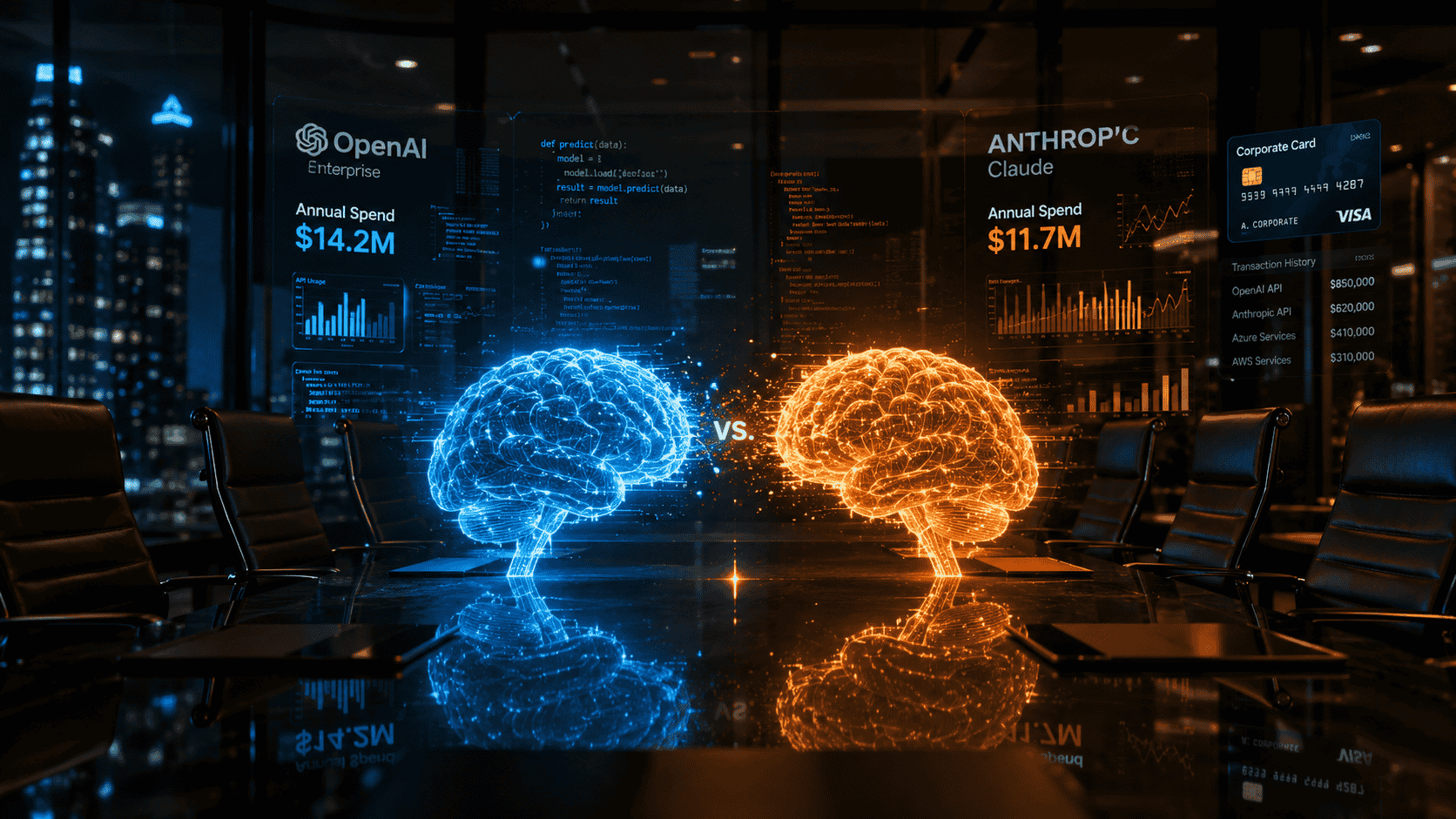
Enterprise demand and corporate card spending push Anthropic’s model past OpenAI, highlighting a massive shift in how businesses buy AI.
By Javaid Ahmed Solangi | July 20, 2026
The battle for artificial intelligence dominance is no longer about who can generate the most viral poetry or pass a bar exam. The real war is for the corporate credit card—and the spending has reached staggering new heights.
Consider this: South Koreans are now paying nearly 1 trillion won, or roughly $6.8 billion, a year for subscriptions to generative artificial intelligence services. To put that immense figure into perspective, the region is now spending more money on AI subscriptions than it does on Netflix. Generative AI is no longer a fascinating experiment or a novelty; it has fundamentally cemented itself as a core, non-negotiable professional utility.
But here is the real plot twist. While OpenAI's ChatGPT remains massive in overall global consumer volume, it is no longer the undisputed king of the premium workplace. In a major industry milestone reported today, Anthropic’s Claude has officially overtaken ChatGPT in South Korea’s highly lucrative paid generative AI market.
How did Anthropic manage to dethrone the most famous chatbot in the world where it matters most? The answer lies in enterprise demand, structural billing shifts, and an AI ecosystem that has evolved from basic chat to complex workflow automation. Let's break down the data.
1. The Enterprise Spending Shift
The changing of the guard in the paid AI sector is being driven entirely by a shift in how companies allocate their software budgets.
According to alternative market data from South Korea, Claude managed to pull ahead of ChatGPT precisely because the industry's center of gravity is moving away from casual mass adoption and toward deeper, premium use by existing enterprise customers.
The Power of the Corporate Card: Corporate card spending and investments in premium workplace tools are what ultimately pushed Anthropic's model past ChatGPT. Analysis of card transaction data from Hankyung Aicel revealed that corporate cards accounted for a massive 61% of Claude's payments, sitting a full 16 percentage points higher than ChatGPT's corporate card ratio.
Quality Over Quantity: Remarkably, Claude achieved this market-share milestone despite having fewer total paid transactions than its competitors. The data shows two very different stories: Claude's average transaction exceeded 100,000 won—roughly double the industry average. This indicates that while it may have fewer casual users, a much higher percentage of Anthropic's user base finds the tool valuable enough to pay a heavy premium for it.
The Public Rebuttal: This surge even ignited a rare public dispute. OpenAI’s Korea chief publicly argued that card data structurally undercounts large enterprise contracts because major ChatGPT Enterprise clients shift to invoice billing when upgrading. However, whether by invoice or corporate card, the underlying reality remains: Anthropic is rapidly capturing high-value enterprise use, maintaining a massive foothold in the global enterprise LLM API market.
2. A $6.8 Billion Subscription Economy
The willingness to pay for premium AI access highlights just how critical these tools have become for modern workflows. The South Korean market—often a bellwether for global tech adoption trends—is proving that the subscription model is wildly successful, and incredibly expensive.
The Indispensable Expense: Generative AI services are fast becoming an indispensable expense, lifting monthly subscription payments to a record $58.3 million in South Korea alone. Workers, particularly those in their 20s and 30s, are aggressively integrating AI into their everyday tasks to remain competitive.
The Cascading Dollar Outflow: The spending data indicates a sharp shift toward higher-tier software plans. Developers are flocking to top pricing tiers like "Claude Max," which can cost between $100 and $200 per month. This is up to ten times more expensive than standard $20-per-month consumer AI plans. Because software engineers rapidly burn through basic token limits when building applications, monthly expenditures can easily exceed 1 million won for heavy users.
The Revenue Milestone: The fact that consumers and businesses are collectively spending $6.8 billion annually clearly indicates that the market has transitioned from free experimentation to a robust, recurring revenue model. The financial weight of this transition is staggering. Counterpoint Research projects global consumer spending on Generative AI will nearly triple by 2030, meaning this subscription economy is just the opening act.
3. Why Claude is Winning the Professional Desk
So, why are developers and executives reaching for Claude over ChatGPT when it comes time to expense a premium subscription? It comes down to specialization and architectural trust.
By mid-2026, the flagship models from Anthropic and OpenAI are essentially at parity regarding raw intelligence. However, the market is choosing Claude for specific, highly complex workflows. Anthropic designed Claude from the ground up with a constitutional AI framework that heavily prioritizes safety, steerability, and, most importantly for businesses, a drastically reduced hallucination rate.
Claude is widely favored for understanding massive codebases, performing complex architectural refactoring, and maintaining rigorous reliability. When a senior software engineer is tasked with migrating a legacy database architecture, they cannot afford a chatbot that confidently invents non-existent software libraries. Claude’s massive context window allows professionals to upload dozens of interconnected technical documents and execute multi-step reasoning tasks without losing the thread of the prompt.
Interestingly, this isn't necessarily a zero-sum game. Data shows that a significant portion of the professional market refuses to bet on just one winner. While Claude may be taking the lion's share of new corporate card spending, many enterprise customers maintain dual subscriptions, utilizing OpenAI for broad, creative agentic workflows and Anthropic for highly technical, specialized analytical tasks. But the momentum is undeniable: for the high-end professional desk, Claude is increasingly viewed as the standard operating system.
4. The Local Competitor Uprising and the Global Push
While Silicon Valley giants like Anthropic and OpenAI are currently battling for the top spot, the lucrative nature of this $6.8 billion subscription economy has triggered massive local investments. Governments and domestic tech titans are waking up to a harsh economic reality: relying entirely on foreign AI APIs creates a massive capital drain.
Because ChatGPT, Gemini, and Claude are all American services paid for in U.S. dollars, the explosion in AI adoption is directly leading to a long-term outflow of domestic currency. To combat this, South Korean technology companies, both large conglomerates and agile startups, are rushing to advance their own domestic large language models (LLMs) to fend off the pioneering American services.
Furthermore, the South Korean government recently unveiled a sweeping, $1 trillion medium- to long-term investment plan to secure the infrastructure of the AI era. This aggressive strategy, led by President Lee Jae Myung and supported by memory chip titans like Samsung Electronics and SK Hynix, aims to build new AI semiconductor fabs, massive data centers, and advanced physical robotics hubs.
By heavily subsidizing local hardware and software ecosystems, the region hopes to capture a slice of the rapidly growing demand at home before expanding abroad. The ultimate goal is to build an integrated innovation ecosystem that can challenge the dominance of Western API providers and keep that $6.8 billion circulating within the domestic economy.
The Bottom Line
The era of the "everything chatbot" is fracturing into specialized utilities. The fact that a single regional market is spending nearly $7 billion annually on AI tools proves that generative intelligence is the new electricity of the digital workspace. As Anthropic's Claude captures the highly lucrative enterprise sector through premium corporate subscriptions, the AI arms race is moving into a new, incredibly profitable phase. Workflow integration, reliability, and enterprise trust now dictate market leadership, proving that building the smartest AI is only half the battle; getting businesses to swipe their corporate cards for it is the ultimate victory.




Discussion
Comments
Approved comments are published after moderation to keep discussion useful and spam-free.
No comments yet. Start the discussion below.