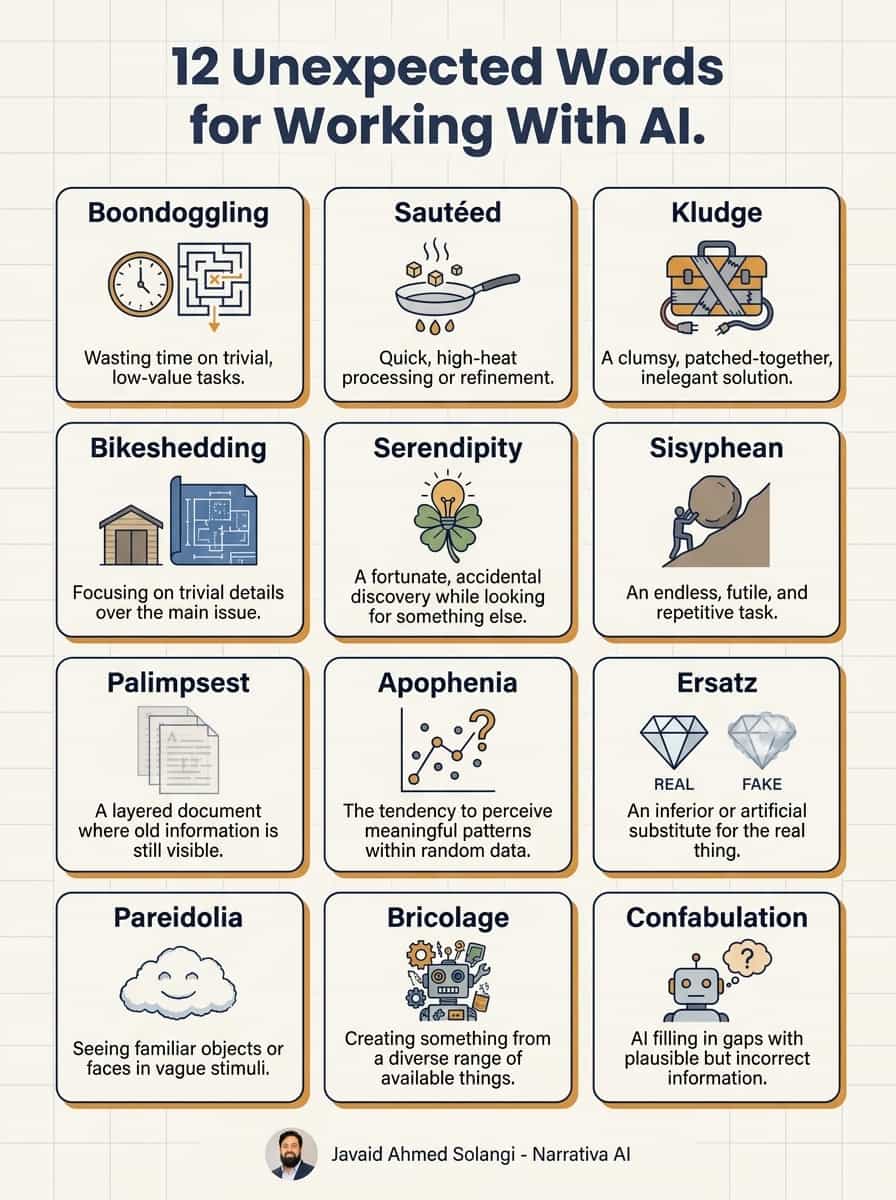
Words You Didn't Expect to Need When Working With AI: A Vocabulary Field Guide
Most guides to working with AI hand you the same dozen terms — prompt, token, context window, hallucination. Useful, but thin. The more interesting vocabulary shows up in the texture of actually working with a tool like Claude day to day: the false starts, the odd tangents, the moments a model does something genuinely delightful or genuinely off. Below are a dozen words — some formal, some borrowed from completely unrelated fields — that turn out to describe those moments better than the standard AI lexicon does.
Boondoggling
(noun/verb) — work that looks productive but produces little of real value; effort spent for its own sake rather than toward a genuine goal.
Every AI workflow has a boondoggling failure mode: the fifteenth prompt refinement that changes nothing, the elaborate multi-agent pipeline built to solve a problem a single well-worded request would have handled in one pass. If you find yourself iterating on formatting for the third time while the actual content still isn't right, you're boondoggling — and the fix is usually to step back and ask Claude directly for what you actually need, rather than circling it.
Sautéed
(verb, past tense) — cooked quickly in a small amount of fat over relatively high heat, usually while stirring or tossing.
Not every AI vocabulary word needs to be about AI. Ask Claude to walk you through why garlic goes bitter when it's sautéed too long at too high a heat, and you'll get a genuinely good answer about Maillard reactions and burnt allicin — a small reminder that a language model's usefulness doesn't stop at the edge of "tech" topics. Half of what makes these tools worth using is that the vocabulary of cooking, medicine, law, and code all sit in the same conversation without switching gears.
Kludge
(noun) — an inelegant, patched-together solution that works despite (not because of) its design.
Anyone who's stitched together a working pipeline out of three tools that were never meant to talk to each other knows a kludge when they see one. AI-assisted development produces fewer of these than it used to — agents increasingly flag brittle glue code before it ships — but the instinct to reach for duct tape under deadline pressure is a human one, and no amount of tooling fully cures it.
Bikeshedding
(verb) — spending disproportionate time debating a trivial, easy-to-understand detail while a larger, more complex decision goes unexamined.
Named for the idea that a committee will argue for hours about the color of a bike shed but wave through a nuclear reactor design without comment, because the shed is something everyone feels qualified to have an opinion on. It happens constantly in prompt engineering — teams will spend a week debating exact wording while the actual system architecture, the part that determines whether the thing works at all, gets a five-minute nod.
Serendipity
(noun) — a fortunate discovery made by accident, while looking for something else entirely.
The best moments working with an AI system are rarely the ones you planned. You ask for a summary and get a reframing of the problem that's better than the summary would have been. Serendipity like that isn't something you can prompt for directly — it's more likely to show up when you leave a request slightly open-ended instead of over-specifying every constraint.
Sisyphean
(adjective) — endless and seemingly futile, after the Greek myth of Sisyphus, condemned to roll a boulder uphill forever.
Debugging a flaky test suite can feel Sisyphean — fix one failure and two more appear, seemingly at random. It's one of the genuinely useful places for an AI collaborator: patient, systematic bisection of a problem that would wear a human down through sheer repetition long before it found the root cause.
Palimpsest
(noun) — a manuscript or document that's been reused, with earlier writing still faintly visible beneath the newer layer.
A long, heavily-edited conversation with an AI assistant behaves a bit like a palimpsest — earlier framings and false starts leave faint traces that shape how later turns get interpreted, even after you've explicitly moved on. It's part of why starting a genuinely fresh conversation sometimes gets a cleaner result than trying to correct course six messages deep into one that's drifted.
Apophenia
(noun) — the tendency to perceive meaningful patterns or connections in random or unrelated data.
Worth knowing precisely because it's a risk on both sides of the keyboard. A model can produce a coincidental-sounding correlation that isn't real; a person reading model output can also read intention or insight into something that was closer to statistical noise. Naming the tendency is the first step toward not falling for it.
Ersatz
(adjective) — a substitute, typically an inferior one, standing in for the real thing.
Not every AI-generated draft is ersatz — plenty hold up on their own — but it's a useful word for the version that technically checks every box and still feels hollow: correct facts, right length, no actual voice. Usually the fix is more specific instruction about tone and intent, not a longer prompt.
Pareidolia
(noun) — the perception of a specific, familiar pattern (often a face) where none was intentionally created.
The visual cousin of apophenia. People report seeing faces in generated images, meaning in noise-based art, intention in outputs that were, technically, just the most statistically likely next tokens. It's harmless most of the time and worth remembering when a result feels eerily on-point — sometimes it's genuine capability, and sometimes it's pareidolia doing the heavy lifting.
Bricolage
(noun) — construction or creation using whatever materials happen to be available, rather than purpose-built ones.
A lot of real-world AI tooling is bricolage in the best sense: a spreadsheet macro, a scraped API, a model call, and a Slack webhook, none of them designed to work together, all pressed into service because they were on hand and the deadline wasn't moving. It's not elegant, but it's often how genuinely useful internal tools get built the first time, before anyone has the bandwidth to do it properly.
Confabulation
(noun) — filling a gap in memory or knowledge with a fabricated but confidently stated answer, without intent to deceive.
The more precise cousin of "hallucination" for describing what happens when a model states something false with total fluency. The word comes from neurology, where confabulation describes patients with certain memory conditions doing exactly this — not lying, just confidently filling a gap. It's a useful reminder that the failure mode isn't malicious; it's structural, and it's why checking claims that matter is still worth the extra step.
None of these words started life anywhere near a server rack. That's rather the point — the vocabulary that actually describes working with AI well tends to come from wherever precise language already exists for a particular kind of mess, insight, or failure. Cooking, mythology, neurology, committee politics — borrow freely. The right word, however unexpected its origin, usually explains the moment better than any AI-specific jargon would.






Discussion
Comments
Approved comments are published after moderation to keep discussion useful and spam-free.
No comments yet. Start the discussion below.