A Model Can Pass the Exam—and Still Fail on Monday Morning
About the Author: Javaid Ahmed Solangi is an AI strategist and researcher at Narrativa AI, focused on transforming advanced AI research into practical, reliable and scalable real-world solutions.
Imagine a university student who has built an impressive artificial-intelligence project.
The model achieves 92% accuracy on a clean academic dataset. The training loss falls smoothly. The architecture is modern. The final presentation contains colourful graphs, benchmark comparisons and a confident conclusion:
The model works.
Then the graduate joins a bank, hospital, retailer, factory or government department.
The real data arrives.
Names are misspelled. Urdu and English appear in the same sentence. Documents are scanned at different angles. Customer records are incomplete. APIs fail. Users submit questions the developers never expected. Predictions become slower during peak hours. Cloud costs rise. Regulators ask where the training data came from. Management asks whether the system is improving revenue, reducing risk or saving time.
Suddenly, model architecture is no longer the main problem.
The real problems are:
Data quality
Evaluation
Deployment
Monitoring
Security
Cost
Compliance
Human behaviour
Business integration
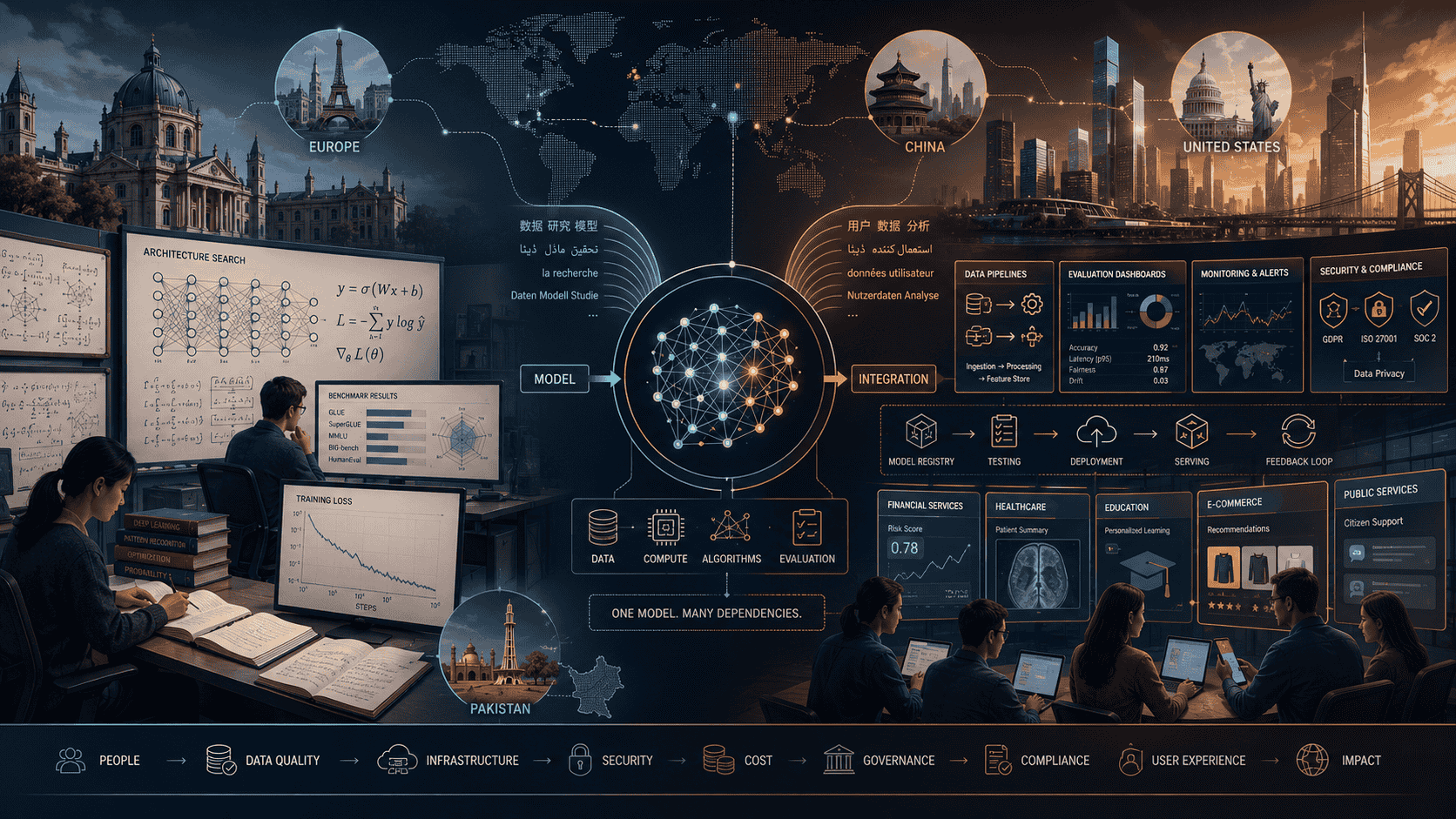
The image accompanying this article captures that tension brilliantly.
Academic attention is often concentrated on architecture and the training algorithm or loss function.
Industry, meanwhile, succeeds or fails because of data, evaluation and systems.
It should not be interpreted as proof that universities completely ignore data or production systems. They do not.
But its central argument is directionally correct:
A model is only one component of an artificial-intelligence product—and often not the component that determines whether the product survives.
The Academic Question and the Industrial Question Are Different
Academia frequently asks:
Can this method improve model performance?
Industry asks:
Can this system deliver a reliable outcome repeatedly, affordably, safely and at scale?
Both questions matter.
Without academic work on neural architectures, optimisation, representation learning, transformers and reinforcement learning, modern artificial intelligence would not exist.
Academia remains a major source of highly cited research, while industry increasingly dominates the development of frontier models because companies possess greater computing capacity, proprietary data, engineering teams and capital. Stanford’s 2026 AI Index reports that industry produced more than 90% of notable frontier models in 2025.
This does not mean academic research has become less important.
It means that the frontier has become so expensive and operationally complex that universities can rarely compete directly with the largest technology companies in training the biggest models.
The better question is therefore not:
Should universities stop teaching architecture and algorithms?
The better question is:
How much of the curriculum should remain focused on model invention, and how much should prepare students to build dependable AI systems around existing models?
Why Academia Naturally Focuses on Architecture and Loss Functions
Universities are not irrational. Their focus reflects the incentive system under which academic research operates.
Novelty Is Easier to Publish Than Reliability
A new architecture, optimisation method or benchmark result can be described clearly in a research paper.
The researcher can state:
The proposed method
The experimental setup
The dataset
The baseline
The accuracy improvement
The statistical result
Production reliability is harder to package.
A company may spend six months improving data validation, reducing latency, eliminating hallucinations, redesigning user workflows and building monitoring tools—yet none of those improvements may produce a new academic algorithm.
The work is valuable.
It simply looks less novel on paper.
Academic Experiments Need Controlled Conditions
Research depends on reproducibility.
Controlled datasets and standard benchmarks allow different researchers to compare methods fairly.
Industry rarely enjoys controlled conditions.
A production system receives changing data from unpredictable users through unreliable networks while business rules, regulations and product requirements continue to evolve.
The conditions that make an experiment scientifically clean can make it commercially unrealistic.
Universities Have Limited Access to Production Environments
A student can download a dataset and train a model.
It is much harder for that student to access:
Millions of real customer interactions
Internal enterprise databases
Sensitive medical or financial records
Large-scale cloud infrastructure
Production incident histories
Compliance teams
Real user feedback
The result is an understandable imbalance.
Students learn how to optimise the visible model because they cannot easily experience the invisible system surrounding it.
The Model Is the Centre of the Diagram—but Not the Whole Product
One of the most important industrial machine-learning papers described model development as a source of potentially massive technical debt.
Google researchers warned that machine-learning systems accumulate hidden costs through data dependencies, feedback loops, configuration problems, changes in the external world and interactions with surrounding software.
A second Google production-readiness paper proposed 28 tests covering data, models, infrastructure and monitoring.
Its central lesson was straightforward:
A model that performs well in an offline experiment is not automatically ready for production.
This is where many university projects stop too early.
They demonstrate that the model can make a prediction.
Industry must answer everything that comes afterward:
What happens when the data changes?
What happens when the model is wrong?
Who is alerted?
Can the prediction be explained?
Can the organisation reproduce the result?
Can the system be rolled back?
What happens when an external model provider changes its API?
How much does each request cost?
Which users are harmed when performance degrades?
Can an auditor trace the decision six months later?
A successful AI product is not merely a trained model.
It is a governed, monitored and continuously evaluated decision system.
What Industry Actually Needs
1. Data Engineering Before Model Engineering
Artificial intelligence consumes data, but industrial data rarely arrives ready for use.
Companies need people who can:
Design data pipelines
Integrate databases and APIs
Handle missing and duplicated records
Create reliable labelling processes
Track data lineage
Detect distribution changes
Protect sensitive information
Build retrieval systems
Manage multilingual and multimodal data
Document where datasets came from
The proposal known as Datasheets for Datasets argues that datasets should include structured documentation about their motivation, composition, collection process, intended use and limitations.
The authors emphasise that a model may fail in the real world when the deployment environment does not match the data used for training and evaluation.
For Pakistan, this point is critical.
Models trained predominantly on American or European data will not automatically understand:
Urdu written in Roman script
Mixed Urdu-English communication
Sindhi, Pashto, Punjabi or Balochi content
Local addresses and identity formats
Pakistani legal and administrative terminology
Regional accents
Informal business records
Low-quality scanned government documents
Pakistan does not merely need more models.
It needs better national and sector-specific data foundations.
The country’s 2026 Data Governance Policy recognises the importance of managing public-sector data across its full lifecycle, including collection, use, sharing, retention, privacy and lawful disposal.
That is not a side issue.
It is the foundation on which serious public-sector AI must be built.
2. Evaluation That Reflects Real Work
Academic evaluation often asks whether a model performs well on a benchmark.
Industrial evaluation asks whether the model performs well for this organisation, this user and this decision.
A customer-service system should not be judged only on linguistic quality.
It should be evaluated on whether it:
Solves the customer’s problem
Uses the correct company policy
Avoids inventing information
Escalates high-risk cases
Responds within an acceptable time
Reduces support workload
Maintains customer satisfaction
Performs consistently across languages
A medical assistant may need evaluation by clinicians.
A banking model may require fairness, fraud, explainability and regulatory testing.
An Urdu educational assistant may need teachers to assess cultural appropriateness, curriculum alignment and language clarity.
Model cards were proposed to document intended use, performance conditions, evaluation procedures and limitations across relevant demographic and deployment contexts.
This is closer to what industry needs.
A benchmark score without deployment context can create false confidence.
An industrial evaluation system should combine:
Automated tests
Human expert review
Adversarial testing
Safety testing
Business indicators
User feedback
Production monitoring
The strongest AI teams do not ask only, “How intelligent is the model?”
They ask:
Where does it fail, how often does it fail, how serious is the failure, and how quickly will we detect it?
3. Systems Engineering and MLOps
Once a model enters production, it becomes part of a software system.
That means AI graduates increasingly need knowledge of:
Software architecture
Cloud infrastructure
Containers
APIs
Databases
Version control
Automated testing
Continuous deployment
Logging
Monitoring
Cybersecurity
Access control
Backup and recovery
Cost optimisation
A research notebook may work on one computer.
A production service may need to handle thousands or millions of requests while remaining available, secure and affordable.
For large language models, the systems challenge becomes even more demanding.
Teams must manage:
Prompt and version changes
Retrieval pipelines
Vector databases
Context limits
Hallucination detection
Tool permissions
Agent behaviour
Token costs
Response latency
Model-provider outages
Guardrails
Human approval points
Google’s recent guidance on production AI agents argues for moving beyond informal “vibe testing” toward measurable key performance indicators, engineering discipline and controlled deployment.
That lesson should be taught before graduates enter the workplace—not after the first production failure.
4. Risk, Governance and Compliance
Modern AI engineers increasingly need to understand regulation as well as code.
The NIST AI Risk Management Framework organises practical AI risk work around four functions:
Govern, Map, Measure and Manage.
The European Union’s AI Act adds legal requirements according to the risk level and purpose of an AI system.
Organisations operating in Europe must increasingly consider documentation, transparency, human oversight, data quality, monitoring and accountability during development—not as paperwork added after deployment.
This changes the definition of a qualified AI professional.
A strong engineer can no longer say:
“My job ends when the model reaches acceptable accuracy.”
The engineer must understand how the model will be used, who may be affected, what evidence should be retained and which risks require human control.
5. Business and Domain Understanding
The technically strongest model is not always the most valuable model.
Industry rewards systems that solve specific problems.
A slightly less accurate model may be commercially superior when it is:
Faster
Cheaper
Easier to explain
Easier to integrate
More reliable
Available on local infrastructure
Safer for users
Better aligned with the workflow
An AI engineer working in agriculture should understand farming processes.
An engineer working in healthcare should understand clinical workflows.
An engineer working in banking should understand risk, fraud and compliance.
An engineer working in education should understand teaching and assessment.
Industry does not merely need people who know artificial intelligence.
It needs people who can combine artificial intelligence with another field.
The United States: Frontier Research Meets Production Scale
The United States leads the world in private AI investment and frontier-model development.
Stanford’s 2026 AI Index reports that US private AI investment reached approximately $285.9 billion in 2025 and that the country produced more notable AI models than any other nation.
But employment demand is not limited to frontier researchers.
The US Bureau of Labor Statistics projects that data-scientist employment will grow by 34% between 2024 and 2034.
It also expects strong demand for software developers, database architects and workers who build and maintain AI-enabled systems and data infrastructure.
This reveals an important reality.
The American market may celebrate model breakthroughs, but most organisations need people who can apply, integrate, secure and maintain AI—not people who can train a frontier model from the beginning.
For American universities, the challenge is to preserve world-class theoretical research while giving more students exposure to production engineering, evaluation, product development and real organisational data.
Europe: Regulation and Industrial AI Create a Different Talent Profile
Europe’s opportunity is not simply to imitate Silicon Valley.
Its strengths lie in industrial manufacturing, healthcare, automotive engineering, energy, scientific research and regulated enterprise systems.
In 2025, almost 20% of EU enterprises reported using AI, rising to approximately 55% among large companies.
At the same time, European employers face persistent digital-skills shortages.
Among EU enterprises that attempted to recruit ICT specialists, 57.5% reported difficulty filling vacancies. In Germany, the figure exceeded 72%.
Europe therefore needs AI professionals who can combine:
Industrial knowledge
Data engineering
Safety
Compliance
Edge computing
Multilingual evaluation
Enterprise integration
Energy efficiency
The European Commission is responding through an AI Skills Academy intended to offer modular training, apprenticeships, sector laboratories, micro-credentials and generative-AI programmes.
That direction is significant.
Europe is recognising that a traditional degree alone cannot respond quickly enough to technological change.
Universities, employers and vocational institutions must form a continuous learning system.
China: Linking AI Education With Industrial Transformation
China’s approach is increasingly system-wide.
A 2026 government plan calls for universities to introduce AI as a basic public course, build interdisciplinary programmes and align new majors with AI-driven industrial change.
The plan also promotes integrating AI into vocational and traditional industry-related programmes.
This is important because China’s advantage is not only AI research.
It is the ability to connect AI with:
Manufacturing
Robotics
Logistics
Electric vehicles
Electronics
Smart cities
Industrial automation
Large consumer platforms
Stanford’s 2026 AI Index reports that China leads in AI research publication volume, citations and patent grants, while the United States remains ahead in notable-model development.
China’s education model increasingly treats AI as a capability that should enter engineering, manufacturing and vocational training—not remain confined to computer-science departments.
Other emerging markets should study that integration carefully.
The goal should not be to copy China’s institutional model.
The lesson is that AI education becomes economically powerful when it is linked directly to national industries.
Pakistan: The Opportunity Is Larger Than the Current Curriculum
Pakistan has a rapidly growing digital-services economy.
PSEB reported that ICT exports reached $1.86 billion during the first half of fiscal year 2024–25, representing year-on-year growth of 28%.
The National AI Policy was approved in July 2025, while HEC has revised computing curricula and introduced AI learning across higher education. HEC has also announced a mandatory three-credit-hour AI course for undergraduate programmes.
These are valuable steps.
But Pakistan should avoid interpreting AI education as simply adding one course about neural networks or generative AI.
The country’s most immediate market opportunity is unlikely to come from training a model larger than those created by American or Chinese laboratories.
Pakistan’s opportunity lies in solving local and regional problems more effectively.
These include:
Urdu and regional-language technologies
Education platforms
Agricultural advisory systems
Healthcare administration
Government-document processing
Financial inclusion
Fraud detection
Call-centre intelligence
Export-oriented software services
Logistics
Manufacturing quality control
Small-business automation
Islamic finance and legal-document systems
A Pakistani graduate who can deploy a reliable bilingual customer-support system may create more economic value than a graduate who reproduces another image-classification research paper.
The country needs researchers.
But it also urgently needs:
AI application engineers
Data engineers
Evaluation engineers
MLOps professionals
AI security specialists
Product managers
Domain experts
AI auditors
Local-language data specialists
What Pakistani Universities Should Change
Stop Treating the Final-Year Project as a Demonstration
A final-year AI project should not end when the model produces an output.
Students should be required to:
Deploy it
Expose it through an API
Test it with real users
Measure failure rates
Monitor performance
Estimate operating cost
Document the dataset
Define limitations
Create a rollback plan
Present a business or public-service case
The final examination should ask:
Can another team operate this system after the students leave?
If the answer is no, the project is a prototype—not a production-ready solution.
Teach Data Before Students Become Obsessed With Models
Students should learn:
SQL
Data cleaning
Data contracts
Labelling
ETL pipelines
Data quality testing
Privacy
Governance
Dataset documentation
Local-language data preparation
A weak dataset with a sophisticated model remains a weak system.
Make Evaluation a Full Course
Evaluation should not be one lecture at the end of machine learning.
Students should practise:
Benchmark design
Human evaluation
Error analysis
Bias testing
Red teaming
A/B testing
Business metrics
Safety evaluation
Regression testing
Multilingual evaluation
Pakistan should also build national benchmarks for Urdu and regional languages rather than relying only on English datasets.
Combine AI With Software Engineering
Every AI student should understand professional software development:
Git
Code review
Testing
APIs
Containers
Cloud deployment
Security
Monitoring
Documentation
Likewise, software-engineering students should understand modern AI integration.
The labour market increasingly needs the combination.
Build Industry-Led Laboratories
Universities should invite banks, hospitals, telecom companies, exporters, manufacturers, government departments and software firms to contribute anonymised problems and datasets.
A laboratory should not be measured only by papers.
It should also be measured by:
Systems deployed
Organisations supported
Datasets created
Students employed
Open-source tools released
Measurable local impact
A Better AI Degree for the Next Five Years
A practical artificial-intelligence degree should balance four pillars.
Foundation and Theory
Students still need mathematics, probability, optimisation, algorithms, machine learning, deep learning and model architecture.
Without foundations, they become dependent on tools they do not understand.
Data and Systems
Students need databases, distributed systems, data engineering, APIs, cloud computing, MLOps, security and infrastructure.
This is what turns an experiment into a service.
Evaluation and Responsible AI
Students need model evaluation, risk management, privacy, explainability, fairness, governance, documentation and compliance.
This is what turns a service into a trustworthy system.
Product and Domain Application
Students need user research, workflow design, economics, communication and a domain specialisation.
This is what turns a trustworthy system into something people will actually use.
A sensible curriculum would give each of these pillars substantial weight rather than allowing architecture and training algorithms to dominate nearly the entire degree.
Industry Must Also Change
Universities are not solely responsible for the skills gap.
Many companies demand “five years of AI experience” for technologies that have existed in their current form for barely a few years.
Others expect one employee to be simultaneously:
A data scientist
A software developer
A cloud engineer
A researcher
A security expert
A product manager
A compliance officer
Companies should build structured entry pathways.
They should provide:
Paid internships
Real capstone projects
Technical mentorship
Access to non-sensitive data
Clear junior roles
Internal training
Time for experimentation
Cross-functional teams
Industry complains that graduates lack production experience while refusing to give graduates access to production environments.
That contradiction must end.
The Benchmark Is Not the Business
The next generation of AI professionals will enter a world where powerful models are increasingly available through APIs, open weights and commercial platforms.
As leading models become closer in capability, competition shifts toward reliability, price, domain performance and user experience. Stanford’s 2026 AI Index notes that several top models are now clustered closely together, increasing pressure on cost and application-specific performance.
That means the competitive advantage will often not come from choosing a model that scores one percentage point higher.
It will come from:
Owning better data
Designing better evaluations
Building stronger systems
Understanding users
Integrating the technology into real work
The model may be the most visible component.
But the surrounding system is where most organisations will win or lose.
Final Word
Academia teaches students how intelligence is created.
Industry needs people who know how intelligence is delivered.
Those are not opposing missions.
They are incomplete halves of the same profession.
Pakistan, Europe, China and the United States all face different AI opportunities, but they share one educational challenge:
They must stop treating artificial intelligence as a model sitting alone inside a diagram.
A real AI system lives inside data pipelines, organisations, laws, budgets, user behaviour, infrastructure and consequences.
A model can be trained in weeks.
A dependable AI system may require years of engineering, evaluation and institutional learning.
That is the skill gap.
And that is where the next generation of AI careers will be built.
Frequently Asked Questions
Does academia ignore data and AI systems?
No. Universities conduct important research in data quality, evaluation, safety, fairness and systems. The problem is one of emphasis, access and incentives: many degree programmes still devote more attention to model development than production deployment.
Do most companies need to train their own LLM?
No. Most organisations are more likely to use commercial APIs, open models, retrieval systems or targeted fine-tuning. Their difficult work lies in integration, data, evaluation, security, cost and workflow redesign.
What is the most important skill for an AI graduate?
There is no single skill, but the most employable graduates combine machine-learning foundations with software engineering, data handling, evaluation and domain knowledge.
What should Pakistan prioritise in AI education?
Pakistan should prioritise local-language datasets, applied AI, data governance, production engineering, MLOps, evaluation, cybersecurity and partnerships between universities and local industries.
Is model architecture still important?
Yes. Architecture and optimisation remain essential for research and for organisations building frontier or specialised models. The argument is not to remove theory, but to balance theory with the skills required to operate real systems.
What is the difference between MLOps and model training?
Model training creates or adapts the predictive model. MLOps covers the processes and infrastructure used to deploy, version, monitor, update, secure and maintain the model in production.
AI education often emphasises architecture and training algorithms, while industry depends on data, evaluation, deployment and systems. Here is how global education must close the gap.
Tags
AI education, AI industry skills, machine learning, LLM training, MLOps, data engineering, AI evaluation, responsible AI, Pakistan technology, Europe AI, China AI, United States AI, future of work
References
Stanford HAI — 2026 AI Index Report.
Google Research — Machine Learning: The High-Interest Credit Card of Technical Debt.
Google Research — The ML Test Score: A Rubric for ML Production Readiness.
NIST — Artificial Intelligence Risk Management Framework.
European Union — Artificial Intelligence Act.
European Commission and Eurostat — AI adoption and digital-skills data.
Government of Pakistan — National AI Policy and Data Governance Policy.
Higher Education Commission of Pakistan — Revised Computer Science Curriculum.
Government of China — AI literacy and education integration plan.
US Bureau of Labor Statistics — AI-related employment projections.





Discussion
Comments
Approved comments are published after moderation to keep discussion useful and spam-free.
No comments yet. Start the discussion below.