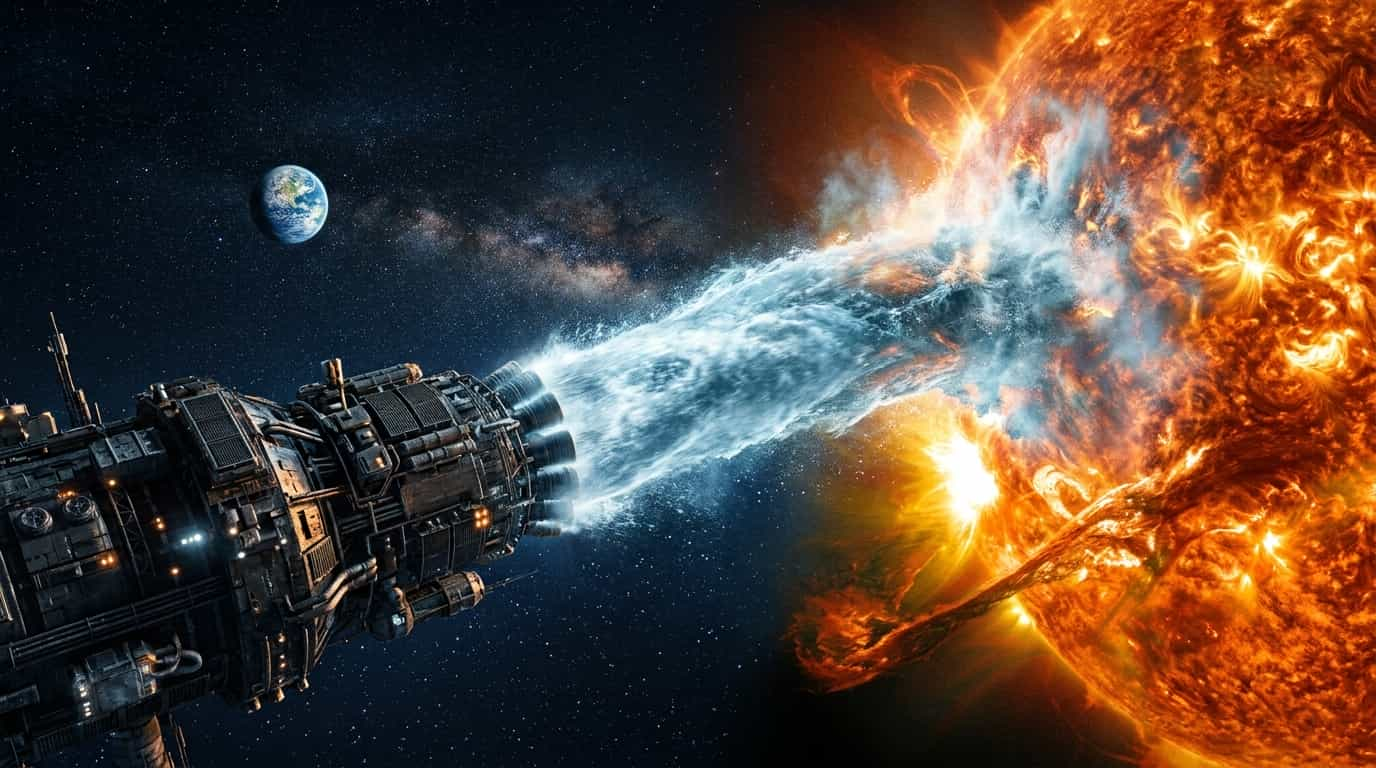
Could Water Extinguish the Sun?
Imagine this.
Humanity builds the biggest bucket ever made. Not a swimming pool. Not an ocean. Not even all the water on Earth.
A bucket so absurdly huge that it makes planets look like marbles.
Then, with the confidence of someone trying to put out a campfire, we aim it at the Sun and pour.
For one second, it feels logical.
Fire plus water equals no fire.
That is how it works on Earth. A burning match dies when water cools it. A kitchen flame disappears when fuel and oxygen are cut off. Forest fires are fought with water because ordinary fire needs heat, fuel, and oxygen to survive.
So the question sounds simple:
Could we extinguish the Sun with enough water?
The answer is much stranger than “no.”
Because if you poured enough water onto the Sun, you would not put it out.
You might accidentally feed it.
And if you used enough water, Earth would not freeze in darkness.
Earth would be cooked.
The First Mistake: The Sun Is Not Fire
The reason this question feels so interesting is that our brains see the Sun as a giant ball of fire.
It looks like fire.
It gives heat like fire.
It glows like fire.
It can burn your skin from 150 million kilometers away.
But the Sun is not burning in the way wood, coal, oil, or gas burns.
A normal flame is a chemical reaction. It needs oxygen. It releases energy because atoms rearrange themselves into new molecules. That is why water works so well against many fires. It cools the fuel and blocks oxygen from reaching the flame.
The Sun does not care about oxygen.
Deep inside the Sun, the real engine is nuclear fusion. Hydrogen nuclei are forced together under unbelievable pressure and temperature until they fuse into helium, releasing energy. NASA explains that the Sun’s energy is produced by hydrogen fusing into helium in the core, and that energy eventually travels outward and reaches space as light and heat.
That means the Sun is not a bonfire.
It is a nuclear furnace.
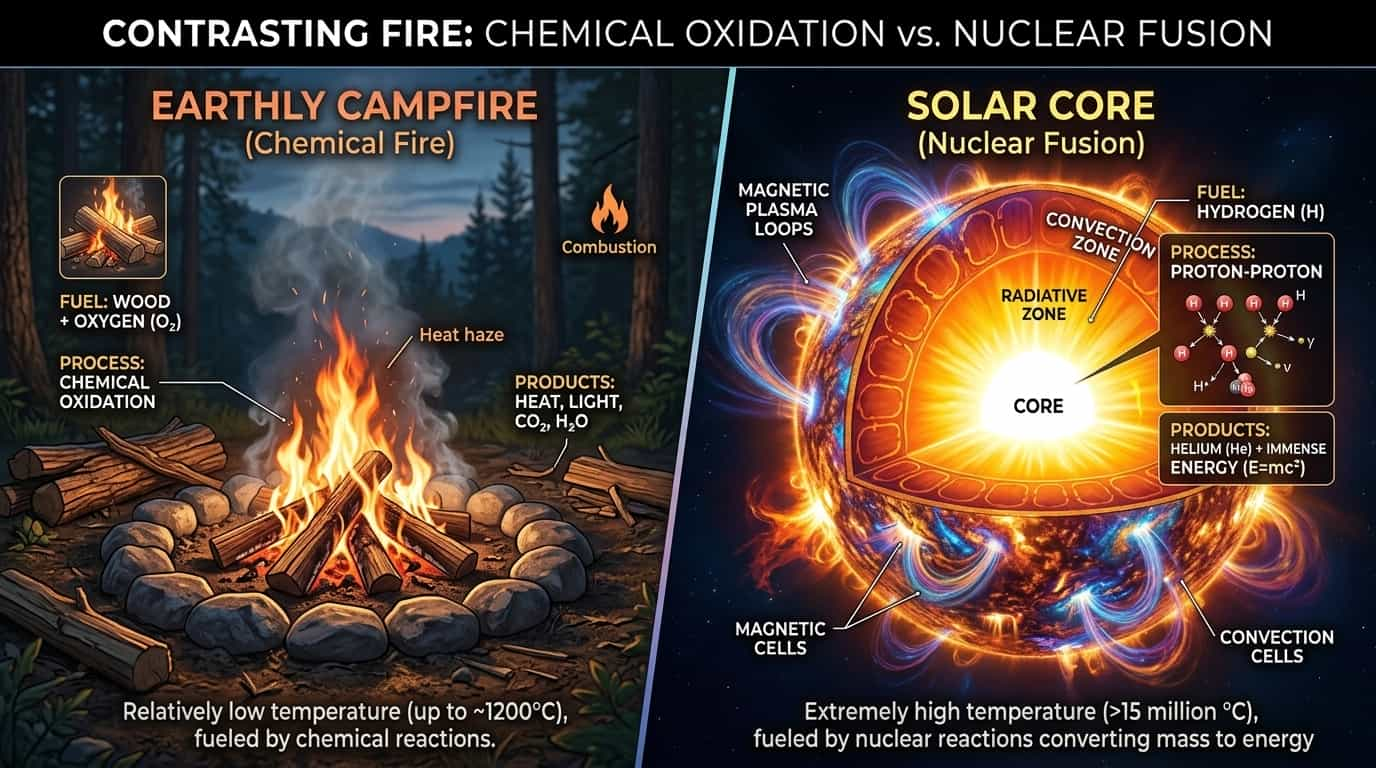
And trying to put it out with water is like trying to stop a lion by throwing meat into its mouth.
What Happens When Water Hits the Sun?
Water is made of hydrogen and oxygen.
That innocent fact changes everything.
On Earth, water is the thing that defeats fire. But near the Sun, water would not remain water for long. The heat and energy would tear the molecules apart. The hydrogen and oxygen would become part of the Sun’s hot plasma environment.

And hydrogen is exactly what the Sun uses as fuel.
The Sun’s core is the region where hydrogen is consumed to form helium, releasing the energy that powers sunlight.
So instead of “drowning” the Sun, you would be adding more material to it.
Not instantly into the core. That part matters. Fusion happens in the Sun’s center, not casually at the outer edge. If you dumped water onto the outside, the material would first mix into the outer layers. It would not immediately race into the core and become fresh fuel overnight.
But on a cosmic timescale, adding a ridiculous amount of mass to the Sun is not harmless.
It changes pressure.
It changes gravity.
It changes the balance of the solar system.
And that is where the nightmare begins.
The Sun Would Get Heavier
Let’s say we do not pour a bucket.
Let’s say we pour something impossible.
An ocean larger than Earth.
Then a thousand oceans.
Then enough water to seriously increase the Sun’s mass.
Now the Sun becomes heavier.
That sounds boring until you remember one rule:
Gravity increases with mass.
NASA describes the Sun’s gravity as the force that holds the solar system together, keeping planets, moons, asteroids, and dust in orbit.
So if the Sun suddenly gained enough mass, its gravitational pull would become stronger.
Earth’s orbit depends on a careful balance between forward motion and the Sun’s gravity. Increase the Sun’s pull dramatically, and Earth’s path changes. It could be pulled into a tighter orbit.
That means Earth moves closer to the Sun.
And if Earth moves closer while the Sun also becomes brighter and more energetic, the result is not a peaceful sunset.
It is a planetary oven.
The Terrifying Part: More Mass Can Mean More Fusion
The Sun is stable because gravity pushes inward while energy from fusion pushes outward.
It is a balance.
Gravity compresses the core.
Fusion releases energy.
That energy resists collapse.
But if the Sun gains a massive amount of new material, gravity presses harder. More pressure in the core can increase fusion activity. More fusion means more energy. More energy means more heat and light.
The Sun’s core already reaches temperatures of about 15 million degrees Celsius, according to NASA’s Sun facts page.
Now imagine changing the conditions inside that core.
Not by a little.
By dumping enough material onto the Sun to change its mass.
The Sun would not scream. It would not explode like a bomb just because you poured water on it. Stars are more complicated than that. But over time, a heavier Sun could become more luminous.
In simple words:
Trying to extinguish the Sun could make it shine harder.
That is the kind of cosmic irony that feels almost rude.
Would the Oxygen Help Put It Out?
This is another trap in the question.
Water contains oxygen, and ordinary fires need oxygen. So maybe adding oxygen would change something?
No.
The Sun already contains oxygen and many other elements in small amounts. But oxygen is not what controls the Sun’s “burning,” because the Sun is not burning chemically. It is powered mainly by nuclear fusion.
In a campfire, oxygen is essential.
In the Sun, oxygen is just another ingredient floating inside a star.
Adding oxygen would not smother the Sun. It would become ionized, mixed into plasma, and absorbed into the Sun’s mass.
So the classic firefighting logic fails twice.
Water does not cool the Sun enough.
And oxygen does not matter in the way it matters for flames.
Could Enough Water Cool the Sun?
This is where the idea becomes tempting again.
What if we used so much water that it cooled the Sun faster than the Sun could heat it?
The problem is scale.
The Sun is not just hot. It is enormous.
Its mass is about 333,000 times Earth’s mass, and it contains almost all the mass in the solar system. NASA notes that the Sun is the dominant object holding our solar system together.
Even if you threw Earth’s oceans at it, that would be a laughably tiny amount compared with the Sun.
It would be like trying to cool a volcano with a teardrop.
The water would not stay liquid. It would vaporize, split apart, ionize, and become plasma. It would join the solar material instead of defeating it.
To truly cool the Sun, you would need to remove energy from the core or stop fusion.
Water does neither.
It adds mass.
And mass is exactly what stars know how to use.
The Hidden Horror: Earth Does Not Freeze — It Burns
Most people imagine the scary version like this:
We extinguish the Sun.
The sky goes black.
Earth freezes.
Everyone waits in darkness.
That would be terrifying.
But the water scenario is scarier because it moves in the opposite direction.
The Sun survives.
The Sun gets heavier.
Its gravity changes.
Earth’s orbit may shrink.
Solar heat increases.
The planet becomes unlivable.
Oceans would start evaporating faster. Weather systems would become violent. Ecosystems would collapse. Eventually, the surface could become too hot for life as we know it.
The cruel twist is that the mission meant to save or control the Sun could destroy Earth faster than doing nothing.
It is not a story about darkness.
It is a story about too much light.
Why This Question Is So Addictive
The beauty of this thought experiment is that it exposes how human intuition breaks in space.
On Earth, we learn rules from everyday life:
Water puts out fire.
Heavy things fall down.
The sky is up.
Heat rises.
Then space arrives and says:
Not always.
In space, the Sun is not a flame.
Water is not always a rescue tool.
Fuel is not always something black and smoky.
And adding the “solution” can make the problem bigger.
That is why science stories like this work so well. They begin with a childlike question, then open a door into something massive.
The question is not silly.
It is the perfect trap.
Because the moment you ask it, you discover that the Sun is stranger, stronger, and more terrifying than the campfire our eyes pretend it is.
So, Could We Extinguish the Sun?
No.
Not with water.
Not even close.
If you poured water onto the Sun, the water would be destroyed almost immediately as water. Its hydrogen and oxygen would become part of the Sun’s plasma. The hydrogen could eventually contribute to the Sun’s fuel supply, while the added mass could increase gravity and affect the solar system.
The Sun would not go out.
It would absorb the attack.
And if the amount of water were impossibly huge, the real danger would not be a frozen Earth.
It would be a hotter Sun, a stronger gravitational pull, and a planet dragged into a future where the sky does not go dark.
It gets brighter.
Too bright.
Final Thought
The Sun is not a candle waiting to be blown out.
It is a star.
A nuclear engine so large that our oceans, our storms, our machines, and our imagination all feel tiny beside it.
So the next time someone says, “What if we just poured water on the Sun?” the answer is simple:
You would not extinguish it.
You would become part of its meal.
References
NASA — How the Sun makes energy through fusion
NASA — Sun facts and solar core explanation
NASA — Overview of the Sun and its gravity
Uploaded curated longform article source provided by Javaid Ahmed






Discussion
Comments
Approved comments are published after moderation to keep discussion useful and spam-free.
No comments yet. Start the discussion below.