
Imagine If Humans Tried to Land on Kepler-69c: The Super-Earth That Became a Super-Venus
Imagine if you could close your eyes tonight, slip into a state of suspended animation, and wake up not tomorrow morning, but hundreds of thousands of years in the future. Imagine if, when you finally opened your eyes, the light filtering through the window of your spacecraft did not come from our familiar yellow Sun, but from a completely alien star deep within the Cygnus constellation.
You have just arrived at Kepler-69c.
For decades, astronomers back on Earth whispered about this distant world. Discovered thousands of light-years away from the pale blue dot we call home, Kepler-69c was hailed in early astronomical catalogs as a "Super-Earth." It is roughly 1.7 times larger than our home planet, boasting a planetary mass that could be up to 3.5 times greater. It was the dream of generations—a rocky exoplanet where humanity might one day build a second genesis.
And now, you are about to become the very first human being to travel to this alien world and see it with your own eyes. You are about to answer the ultimate question: What would it be like to make this epic journey across the unforgiving abyss of the Universe? What kind of planet is actually waiting for you upon arrival? And if you did discover extraterrestrial life hiding in this distant solar system, what would it look, feel, and even smell like?
Strap in. The reality of Kepler-69c is far more brutal, awe-inspiring, and terrifying than anything you could ever prepare for.
The Abyss of Deep Time: A Journey Beyond Human Comprehension

Before you even begin to worry about atmospheric pressures or alien microbes, there is one monumental, crushing hurdle you must overcome: the sheer, unimaginable distance.
Kepler-69c is located approximately 2,383 light-years from Earth. To the human brain, which evolved to calculate the distance to the nearest watering hole or the next town over, a "light-year" is an abstract mathematical concept. But out here in the dark, it is a physical barrier. A single light-year is roughly 5.88 trillion miles. Multiply that by 2,383, and you are looking at a void so vast it makes our entire solar system look like a single grain of sand in the Sahara.
It is almost 600 times further away than Proxima Centauri, our closest neighboring star.
Imagine if human engineering had reached a pinnacle where we could build a starship capable of traveling at 1% of the speed of light. By our current standards, this is a mind-bending velocity. At 1% of the speed of light, you could whip around the entire circumference of the Earth in just over 13 seconds. You could reach the Moon in a matter of minutes. But out here, in the interstellar deep?
At that incredible speed, your journey to Kepler-69c would still take about 238,000 years.
To even make this trip possible, you would need to be sealed inside a super-advanced hibernation pod. You can't just pack a really long playlist and enough freeze-dried ice cream to pass the time. You don’t want to grow too old, wither, and die before your ship has even cleared the Oort Cloud, right? Well, hibernation technology that can seamlessly suspend human biological aging for over 200,000 years without turning your cells into mush doesn't exist yet.
But hey, this is Imagine If. Anything is possible. We will assume the engineers back home figured it out.
As the icy frost thaws from the glass of your pod and the automated revival sequences pump warm, oxygen-rich blood back into your veins, a profound psychological weight settles over you. Look back at the coordinates of the planet you left behind. Who knows what has happened to human civilization during your trip?
Think about the scale of time you just slept through. Three hundred thousand years ago, humans on Earth were just beginning to bang rocks together to create the very first crude stone tools and spears. Now, 238,000 years have passed since you launched. The Earth you left behind is gone. The nations, the cities, the languages—they may have evolved into something entirely unrecognizable, or they may have turned to dust.
No matter what has happened back home, it’s way too late to turn around now. You are a ghost from antiquity, arriving at the shores of a new world.
The Grand Celestial Bait-and-Switch

As your starship begins its deceleration burns, correcting its trajectory to enter the planetary orbit of Kepler-69c, the massive sphere looms in your viewing window. But something is immediately wrong. This does not look like a Super-Earth. There are no swirling blue oceans, no emerald green continents, and no white, fluffy cumulus clouds.
Instead, you are looking at an opaque, churning marble of thick, golden-yellow haze.
The initial excitement about Kepler-69c was based on incomplete data. Astronomers knew it was a rocky planet, but the crucial determining factor for a world's habitability is its location within its host star's "Goldilocks Zone"—the precise orbital distance where it is neither too hot nor too cold for liquid water to pool on the surface.
If a planet is too close to its sun, it is subjected to a stellar bombardment that makes it too hot for liquid water to exist; the oceans simply boil away into space. If it’s too far from its sun, the water freezes solid, leaving nothing but a frigid, icy wasteland.
What the navigation computers now confirm is that Kepler-69c orbits its star about 40% closer than the Earth orbits the Sun. This puts it dangerously close to the inner edge of the habitable zone, perhaps even crossing the boundary entirely. The host star is pumping immense amounts of solar radiation directly into the planet's atmosphere.
You haven't traveled across the galaxy to find a Super-Earth. You have arrived at a Super-Venus.
Based on the planet’s distance from its star, Kepler-69c receives a similar, scorching amount of sunlight as the second planet in our own solar system. And here is where the physics get truly hostile. Despite being 3.5 times more massive than Earth, Kepler-69c has a relatively low overall density. What this means to a planetary geologist is that, instead of having a massive, dense core made of heavy metals like iron and nickel, this rocky planet is composed heavily of silicate and carbonate minerals.
That specific mineral composition is the recipe for a planetary nightmare.
The Descent: Falling Into the Global Kiln
You see, with all these carbonate minerals baked into the planet's crust, the intense heat from the nearby star has caused a relentless, planet-wide chemical reaction over billions of years. The heat literally bakes the carbon directly out of the rocks, releasing it into the sky.
Because of this, Kepler-69c possesses a breathtakingly thick, heavy atmosphere. To make things worse for a fragile, oxygen-breathing human like yourself, this atmosphere is composed almost entirely of carbon dioxide.
Uh oh. Did you choose the wrong Super-Earth to travel to?
As your landing module detaches from the main ship and begins its descent into the atmosphere, the friction outside your heat shields spikes exponentially. If Kepler-69c is anything like Venus, its thick carbon dioxide clouds act as a flawless thermal blanket. They trap the incoming heat from the star but refuse to let any of it radiate back out into space, creating an extreme, runaway greenhouse effect.
Kepler-69c’s atmosphere has been caught in an endless, vicious cycle of getting thicker, trapping more heat, baking more carbon out of the crust, and getting even thicker and hotter.
Nobody ever promised that this world would be a hospitable paradise for you. Oh no. The moment your landing craft touches down on the dry, jagged surface, the sensors begin screaming. If you were foolish enough to cycle the airlock and take off your helmet, you wouldn't just be unable to breathe. You would instantly melt and suffocate simultaneously.
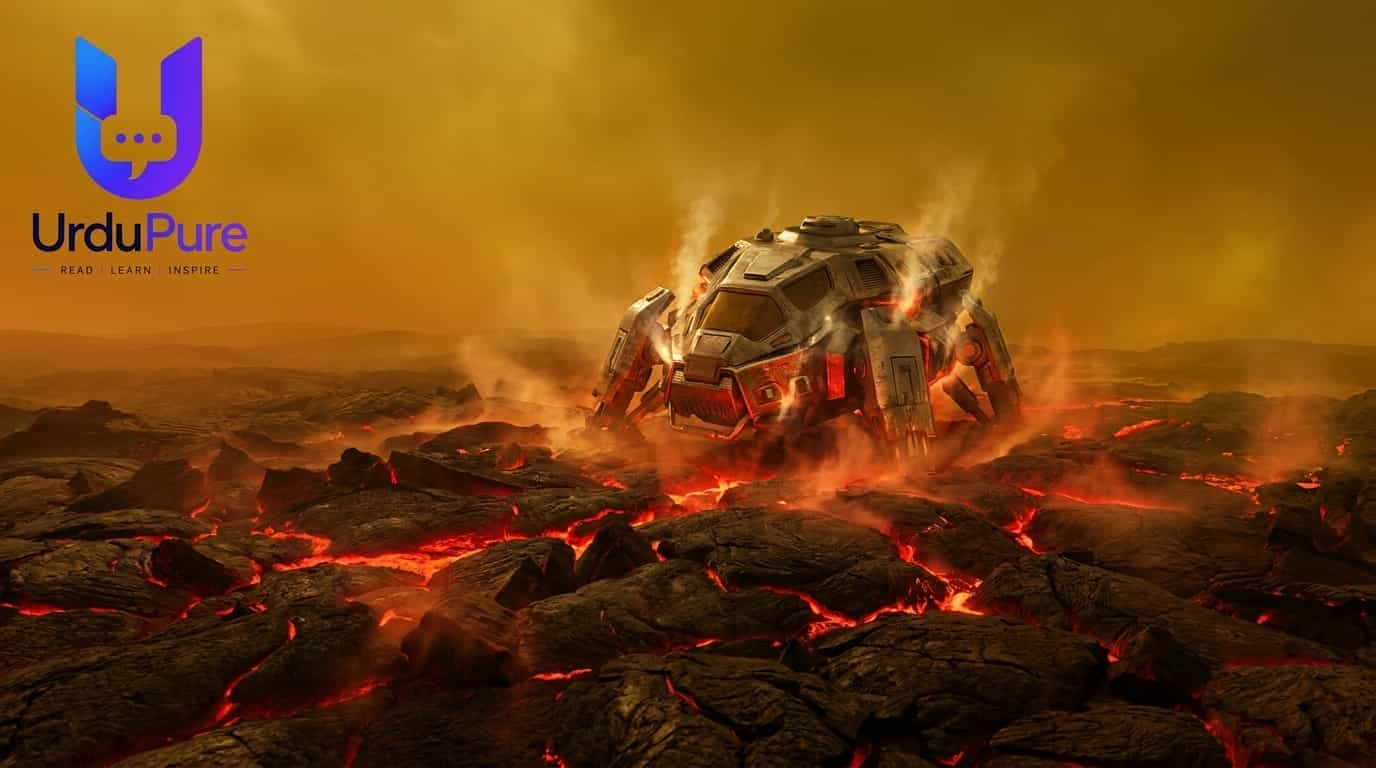
As you peer through the reinforced, thermally treated quartz windows of your lander, you realize the true horror of the surface. The temperature outside is a staggering 475 °C (900 °F). That is more than double the temperature required to cook a Thanksgiving turkey, and it is hot enough to melt solid lead into a liquid puddle.
And then there is the pressure. The atmosphere of carbon dioxide is so dense, so unbelievably heavy, that the atmospheric pressure on the surface is over 90 times that of Earth at sea level.
Imagine stepping outside and feeling the weight of the sky pressing down on you. It would be the exact physical equivalent of being 900 meters (about 3,000 feet) deep in the Earth's oceans, with thousands of tons of water crushing you from all sides. Except here, you wouldn't be underwater. You would be standing on dry, glowing-hot silicate land. Your spacesuit would crumple like an empty soda can, and your lander would groan and buckle under the immense, unseen weight of the sky.
With conditions like this, you will definitely not find anything even remotely resembling an ocean here. The high temperatures boiled away all the surface water eons ago, leaving behind a barren, scorched desert of cracked rock and eternal gloom, lit only by the dull, orange glow of the sun struggling to pierce the miles of toxic clouds.
The Cloud Sanctuary: A Strange Twist of Gravity
If life exists on Kepler-69c, it cannot exist on the ground. Whatever biology you could potentially encounter on this planet would either need to be built from exotic, heat-resistant chemistry completely unknown to human science, or it would have to exist somewhere else entirely. It would have to flee the surface.
To find the alien life you spent 238,000 years traveling to see, you have to look up.
You fire the emergency thrusters, lifting your craft away from the crushing, molten surface and ascending high into the thick cloud deck. About 50 kilometers (30 miles) up in the atmosphere, a miraculous transformation occurs.
The altimeter climbs, the external pressure gauges drop back down to a manageable, Earth-like 1 atmosphere, and the thermal alarms finally silence themselves. Here, suspended high above the planetary kiln, temperatures are much, much cooler. They range from a highly tolerable 30 °C to a balmy 70 °C (86 to 158 °F).
It is here that the planet's relatively low density comes to your advantage. Because Kepler-69c is made of lighter silicates rather than heavy iron, its surface gravity is actually quite forgiving. Despite being a massive "Super-Earth," the gravity pulling you down is just over 70% of what you are used to on Earth. You feel light, buoyant, almost as if you could float.
This weaker gravity, combined with the incredibly thick, dense atmosphere below, creates a unique aerodynamic environment. It could allow lifeforms to thrive perfectly in the sky. In this 50-kilometer-high sweet spot, Kepler-69c is incredibly hospitable.
Imagine looking out your window and seeing not birds, but entire ecosystems of alien life floating freely in the atmosphere. They wouldn't need a solid ground to walk on; they could ride the massive thermal currents generated by the heat below, hovering in the temperate zone of the clouds.
The Stench of Success: A Phosphine Revelation
This high-altitude biological haven is another way in which this exoplanet has far more in common with Venus than with Earth. Back in our own solar system, probes scanning the upper atmosphere of Venus have occasionally picked up traces of a highly specific gas—a chemical that astronomers consider a potential biosignature, a sign of life.
That gas is called phosphine.
Phosphine is an incredibly stubborn molecule. On rocky planets, it takes immense amounts of energy to force phosphorus and hydrogen atoms together without them instantly breaking apart. Generally, there are only two ways to make phosphine in these quantities: you either manufacture it in a highly controlled industrial chemical plant, or it is produced as a byproduct by living, breathing organisms.
If your ship's atmospheric scoops open up in the clouds of Kepler-69c and the chemical analyzers suddenly spike with the detection of phosphine, a chill would run down your spine. You have done it. You have discovered extraterrestrial life.

But it might not be the glorious, highly advanced alien civilization sci-fi movies promised you.
If phosphine is present in the clouds of Kepler-69c, it is almost certainly the result of massive colonies of alien bacteria—specifically, anaerobic bacteria that do not require oxygen to survive. They would float in the golden haze, feeding off the chemical soup of the atmosphere, metabolizing the trace elements, and exhaling phosphine gas into the sky.
But if you ever managed to bring a sample of this air inside your ship, be ready to hold your nose. Phosphine is a notoriously smelly gas. It carries an incredibly pungent, foul odor that is almost identical to the smell of decaying, rotting fish.
On Earth, the anaerobic bacteria that produce phosphine are generally found hiding in the most unglamorous places imaginable: the muck of stagnant swamps, deep wetlands, and even the intestinal tracts of animals. But on a Super-Venus like Kepler-69c, these microbes wouldn't be hiding in the mud. They would be the dominant lifeform, existing in vast, floating swarms within the thick, oxygen-less atmosphere itself.
Onward to the Next Horizon
So, in the end, you may have just traveled 2,383 light-years, slept through the rise and fall of human civilization, and crossed the deepest, darkest voids of the galaxy... only to find the smallest, strangest, and absolute stinkiest of lifeforms. A planet of floating, fish-smelling bacteria suspended high above a molten, crushing desert.
It is a harsh, brutal reminder of how rare and precious the fragile balance of our own Earth truly was.
But on the upside, you have just definitively proved that humanity is not alone. You have just discovered extraterrestrial life. You have confirmed that biology finds a way, even in the clouds of a planetary furnace.
As you sit in your command chair, looking out at the endless golden sky of Kepler-69c, you realize your journey isn't over. Your hibernation pod still works. Your fusion drives still have fuel. You are already thousands of light-years deep into the Cygnus constellation.
Why not see if there are any other hospitable planets in this cosmic neighborhood? Perhaps a world where the conditions allowed for the evolution of far more advanced lifeforms. You bring up the navigation charts, tracing a line through the stars toward another legendary exoplanet.
You set the coordinates for Kepler-22b. The pod door hisses open, the frost begins to form, and you close your eyes once more, ready to imagine what comes next.
kepler-69c, super-earth, exoplanet habitability, interstellar travel, what if humans landed on kepler-69c, cygnus constellation, super-venus, runaway greenhouse effect, astrobiology phosphine, alien cloud life, imagine if, what if





Discussion
Comments
Approved comments are published after moderation to keep discussion useful and spam-free.
No comments yet. Start the discussion below.