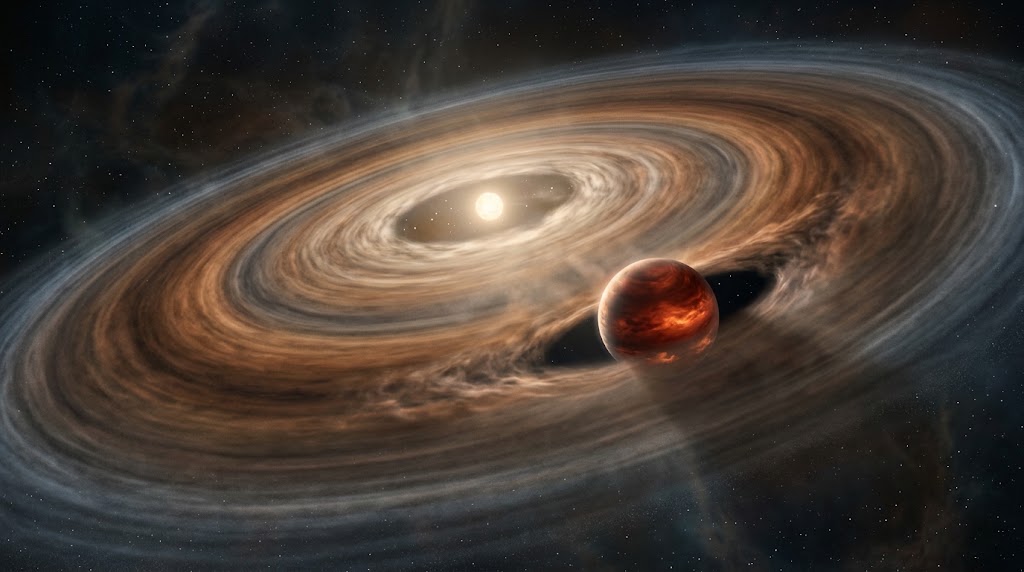
Elias 2-24 b: Youngest Planet Ever Confirmed
There is something extraordinary about looking into space and seeing not simply another world, but a world that may still be under construction.
Astronomers have confirmed Elias 2-24 b, a giant planet less than one million years old orbiting a young star about 450 light-years from Earth. It is now considered the youngest confirmed planet known to science.
For comparison, Earth is about 4.5 billion years old.
If Earth's entire history were compressed into a single year, Elias 2-24 b would be younger than the first few hours of January 1.
And that is what makes this discovery so important.
Astronomers are not merely studying the finished product of planetary evolution. They appear to be witnessing one of its earliest chapters.
Elias 2-24 b is still surrounded by the same enormous disk of gas and dust from which planets are born. It sits inside a prominent gap in that disk, exactly where scientists suspected a forming planet might be hiding.
The discovery gives researchers a rare opportunity to investigate a question that sounds simple but remains surprisingly difficult:
How does a planet actually become a planet?
A Planet Younger Than Anything We Have Confirmed Before
Until now, some of the youngest directly observed planets were found around stars such as PDS 70 and WISPIT 2.
Those systems are already remarkable because astronomers can see planets associated with planet-forming disks around very young stars.
But those worlds are more than five million years old.
Elias 2-24 b is dramatically younger.
Scientists estimate that its system is less than one million years old, meaning the planet appeared extremely early in the life of its star.
The planet itself is approximately as massive as Jupiter, making its rapid formation particularly difficult to explain using some conventional models of giant-planet formation.
It is also very far from its star.
Elias 2-24 b lies approximately 55 times farther from its host star than Earth is from the Sun.
That combination creates the puzzle:
A very young system.
A Jupiter-mass planet.
And a huge orbital distance.
Current models have difficulty producing such a massive planet so quickly, especially at such a large distance from its star.
The Mystery Began Years Ago
Elias 2-24 did not suddenly appear in astronomers' telescopes in 2026.
Scientists have been studying this young system for years.
Earlier observations from the Atacama Large Millimeter/submillimeter Array, better known as ALMA, revealed something intriguing in the disk surrounding Elias 2-24.
The disk contained several distinct gaps.
ALMA observations published in 2017 identified major structures at roughly 20, 52 and 87 astronomical units from the star.
An astronomical unit, or AU, is approximately the average distance between Earth and the Sun.
Planet-forming disks often contain rings, gaps and other structures. Some can be produced by physical or chemical processes within the disk.
But gaps can also be created by planets.
A sufficiently massive young planet moving through a disk interacts gravitationally with surrounding material, gradually clearing a path through the gas and dust.
That possibility immediately made Elias 2-24 interesting.
Scientists wondered whether an unseen planet might be responsible for one of its most obvious gaps.
Then Astronomers Saw a Tiny Point of Light
Later observations from the European Southern Observatory's Very Large Telescope detected a faint source inside the disk.
Even more interestingly, the source appeared inside the same gap where a forming planet might logically exist.
But detecting a faint point of light near a young star is not enough to declare the discovery of a planet.
Astronomers have to eliminate other possibilities.
The signal could be caused by an imaging artifact.
It could be a distant background object that only happens to appear near the star.
Or the observations could be influenced by the complex material surrounding the young stellar system.
The suspected planet therefore remained uncertain.
For years, astronomers had a tantalizing clue but not enough evidence to confidently call it a confirmed world.
The Answer Was Hiding in Old Telescope Data
The breakthrough came from an increasingly powerful form of astronomy: looking again at observations that already exist.
A research team led by Andrea Bernardi of Universidad Diego Portales examined archived observations from the W. M. Keck Observatory in Hawaii.
The team found Elias 2-24 in observations taken in 2018 and 2020.
By comparing observations collected over time, the astronomers could determine whether the faint source moved as expected for an object physically associated with Elias 2-24.
It did.
The evidence showed that the object behaved like a planet orbiting the young star rather than a stationary background source or an imaging error.
That allowed astronomers to confirm it as Elias 2-24 b.
Why Finding Baby Planets Is So Difficult
Astronomers have now confirmed thousands of planets beyond our Solar System.
Yet extremely young planets remain rare.
The reason is almost ironic.
The material that creates planets also hides them.
Young stars are surrounded by enormous quantities of gas, dust, ice and rocky material.
Inside these chaotic disks, planets gradually emerge.
But the same thick material can obscure the planets from our telescopes.
Most known exoplanets were discovered using techniques that work especially well for more mature planetary systems.
One of the most successful is the transit method.
When a planet passes between its star and Earth, it blocks a tiny fraction of the star's light. By measuring repeated dips in brightness, astronomers can infer the presence of an orbiting planet.
This method has revolutionized astronomy.
But it is much less useful when a planet is deeply embedded inside a thick dusty disk or orbiting very far from its star.
Young planets therefore occupy something of an observational blind spot.
We know planet formation is happening throughout the galaxy.
We can see young stars.
We can see disks around those stars.
We can often see gaps and rings inside those disks.
But directly identifying the planet responsible for those structures is much harder.
Elias 2-24 b helps bridge that gap.
A Problem for Planet-Formation Models
The discovery is particularly valuable because Elias 2-24 b appears to have formed faster than many models would comfortably predict.
One widely discussed mechanism for building giant planets is known as core accretion.
In a simplified version of the process, tiny pieces of solid material inside a protoplanetary disk gradually collide and stick together.
They become larger objects.
Those objects become planetary embryos.
Eventually, a sufficiently massive solid core can attract enormous quantities of surrounding hydrogen and helium, creating a gas giant such as Jupiter.
The process takes time.
NASA notes that some current models require roughly five million years to create a Jupiter-sized planet at approximately Jupiter's distance from a Sun-like star.
But Elias 2-24 b appears to have reached roughly Jupiter's mass in less than one million years.
And it is located much farther from its star than Jupiter is from our Sun.
Something therefore does not fit neatly.
The planet may indicate that giant planets can form more quickly than expected.
The conditions inside some young disks may be different from what current simulations assume.
Material may accumulate in ways models do not yet fully represent.
Alternative planet-formation mechanisms may also play a larger role in some systems.
The important point is not that modern theories of planet formation are useless.
Quite the opposite.
Discoveries such as Elias 2-24 b are valuable precisely because they expose where otherwise successful theories still need improvement.
We May Be Looking at Our Own Ancient Past
Elias 2-24 is obviously not our Solar System.
Its planets, star, disk and environment may be very different from the conditions that existed around the young Sun.
But systems like this function almost like natural time machines.
Our Solar System formed around 4.6 billion years ago.
The gas and dust that once surrounded the young Sun disappeared long before humans existed.
There is no telescope we can build that will literally photograph our own Solar System as it looked during its first million years.
Instead, astronomers look elsewhere.
Because stars are continuously being born throughout the galaxy, the universe contains stellar systems at many different stages of development.
Some are ancient.
Some resemble middle-aged stars such as the Sun.
And some have barely begun their lives.
By observing young systems such as Elias 2-24, researchers can study processes that may resemble events that once occurred in our own cosmic neighborhood.
The Gap Around the Planet May Be Telling Us a Story
One of the most fascinating aspects of Elias 2-24 b is its location inside a visible gap in the surrounding disk.
Imagine an enormous rotating construction site around a young star.
Dust, gas and larger particles orbit the center.
Now place a growing planet inside that disk.
The planet's gravity interacts with the surrounding material.
Over time, it can push, pull, gather and redistribute that material.
A lane begins to form around its orbit.
From hundreds of light-years away, astronomers may not initially see the planet itself.
But they can see the lane.
That means the architecture of a protoplanetary disk can sometimes act as indirect evidence for hidden planets.
Elias 2-24 provided an unusually satisfying example.
Astronomers saw the gap.
They suspected a planet.
They later saw a possible object inside it.
And years of observations finally helped establish that the object was real.
An Important Lesson About Old Data
There is another part of this discovery worth appreciating.
It demonstrates why astronomical archives are becoming almost as important as new observations.
The Keck observations used to confirm Elias 2-24 b were not all taken in 2026.
They came from earlier years.
Scientists were able to return to those observations, combine them with information from other observatories and examine how the suspected planet behaved over time.
Modern astronomy therefore does not advance only by building bigger telescopes.
It also advances by connecting data gathered by different instruments, at different wavelengths and during different years.
ALMA helped reveal the structure of the disk.
The Very Large Telescope helped identify a possible source inside the gap.
Keck archival observations helped establish its motion and confirm the planet.
Each observatory contributed a different piece of the puzzle.
The Next Generation Could Find Many More
Elias 2-24 b sits close to the limit of what current instruments can detect.
That makes the discovery exciting for another reason.
The tools available to astronomers are improving.
NASA's Nancy Grace Roman Space Telescope, launched on August 30, 2026, carries advanced coronagraph technology designed to suppress the overwhelming glare of stars and reveal much fainter nearby objects.
A coronagraph effectively masks much of a star's light so astronomers can search the surrounding region for planets.
This technique is particularly valuable for directly imaging worlds that would otherwise disappear in their star's brightness.
NASA researchers expect future instruments to make it possible to detect planets closer to their stars and potentially reveal many more young planetary systems.
Elias 2-24 b may therefore be less an isolated curiosity than the beginning of a new population waiting to be discovered.
What Elias 2-24 b Does Not Tell Us Yet
As exciting as the discovery is, one planet cannot rewrite everything we know about planetary formation.
Astronomers still need many more examples.
Researchers will want to understand Elias 2-24 b's atmosphere, temperature, composition, rate of growth and interaction with the surrounding disk.
They will also want to determine whether other planets are forming elsewhere in the Elias 2-24 system.
The disk contains multiple structures that have attracted scientific attention.
Some gaps may be associated with planets.
Others may have different causes.
Future observations will help distinguish between them.
That is how science moves forward: not through one spectacular observation alone, but by repeatedly testing what that observation appears to tell us.
We Are Beginning to Watch Planets Being Made
For most of human history, the planets in the night sky appeared permanent.
They moved, but they seemed essentially unchanging.
Modern astronomy has given us a radically different picture.
Planetary systems have beginnings.
They grow.
They collide.
They migrate.
They reshape the disks around their stars.
Some worlds survive for billions of years.
Others may disappear.
And somewhere inside a dusty stellar nursery about 450 light-years away, Elias 2-24 b appears to be living through the earliest moments of that story.
It is difficult to think of a more direct connection between observation and one of humanity's oldest questions:
How did worlds like ours come to exist?
Elias 2-24 b does not provide the complete answer.
But for the first time, astronomers have confirmed a planet so young that the construction site around it is still clearly visible.
We are not simply finding another distant planet.
We are beginning to watch planets being made.
Elias 2-24 b, youngest planet, youngest exoplanet, planet formation, baby planet, protoplanetary disk, Keck Observatory, ALMA telescope, exoplanet discovery 2026, Jupiter mass planet, forming planets, astronomy discovery, space news 2026, Beyond the World