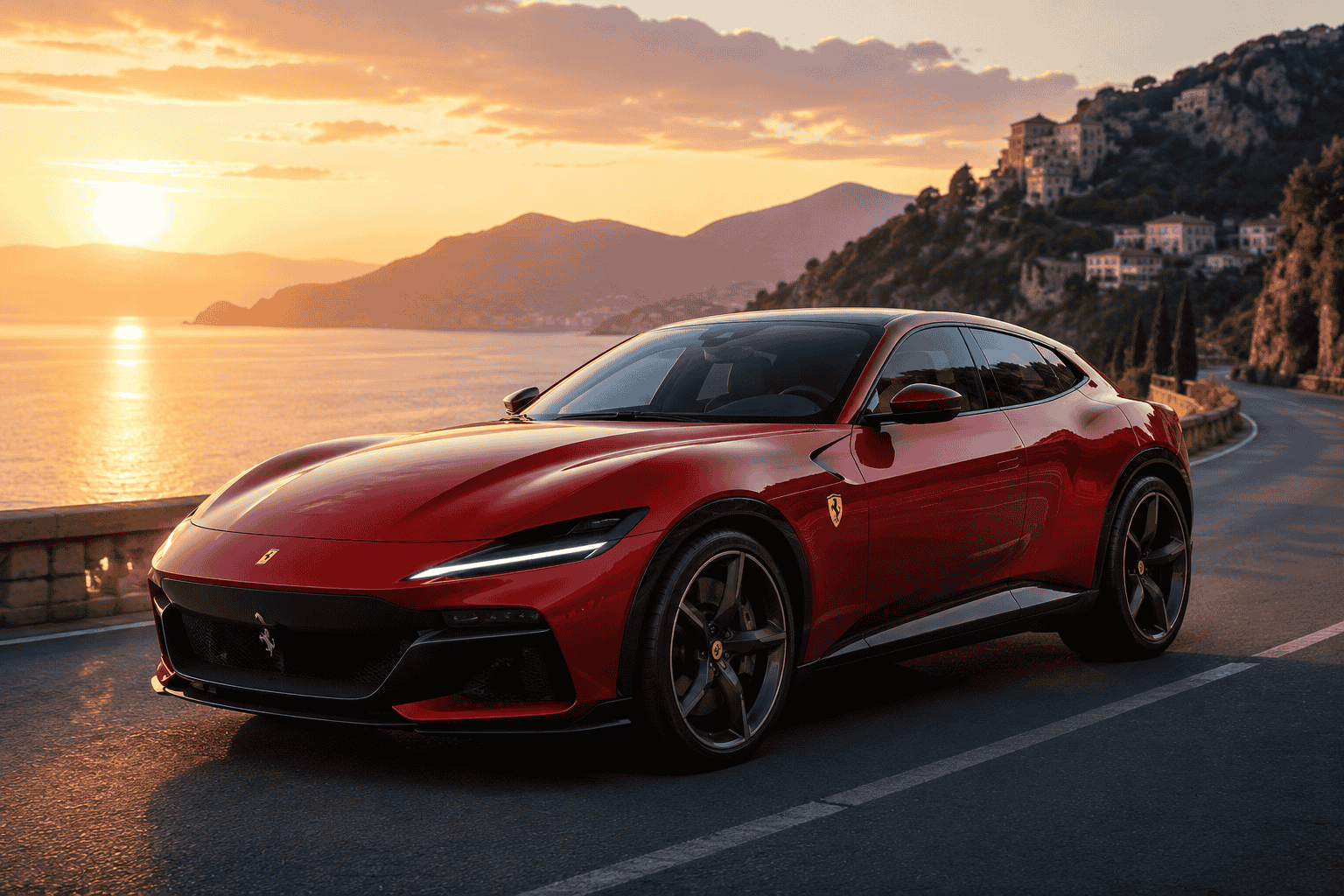
The Most Controversial Ferrari in 77 Years Has Arrived
On May 25, 2026, Ferrari unveiled the Luce at the Vela di Calatrava sports complex in Rome. It was not just another new model. It was Ferrari’s first fully electric production car, and almost immediately, it became one of the most debated vehicles in the world.
The Luce arrived with four electric motors, a five-seat layout, a four-door body, an advanced 800-volt architecture, and design input from LoveFrom, the creative collective led by former Apple design chief Jony Ive and Marc Newson.
For Ferrari, this was a historic move into the fully electric era.
For purists, it was a shock.
The reaction was immediate. Critics questioned the car’s appearance. Some Ferrari loyalists argued that the Luce looked too large, too quiet, too restrained, and too far removed from the emotional aggression traditionally associated with the brand. Reuters reported that Ferrari’s Milan-listed shares closed down 8.4% after the reveal, while the company’s New York-listed shares also fell sharply.
Former Ferrari chairman Luca Cordero di Montezemolo openly criticised the model. Italian Deputy Prime Minister Matteo Salvini also questioned whether the car remained true to Ferrari’s heritage.
And yet, the Luce is not a simple failure story. Ferrari says the car is not a replacement for combustion and hybrid Ferraris. It is an addition to the lineup. It is also aimed at a new generation of ultra-wealthy buyers who want Ferrari performance, electric usability, and everyday practicality in one dramatic package.
That tension is exactly why the Ferrari Luce matters.
It is not only a car. It is a test of what the Ferrari name means in the electric age.
What Is the Ferrari Luce?
The Ferrari Luce is the company’s first fully electric production vehicle. The name “Luce” means “light” in Italian, a symbolic choice for a car designed to represent a new chapter in Ferrari’s history.
Unlike traditional two-seat Ferraris, the Luce is a four-door, five-seat electric grand tourer. It is only the second four-door Ferrari after the Purosangue and the first Ferrari production model designed to seat five people.
This makes the Luce one of the most unusual Ferraris ever built.
It is not a replacement for the 296, SF90, 12Cilindri, or Purosangue. Ferrari is positioning it as a new kind of product: a luxury electric performance car that combines speed, space, technology, and exclusivity.
That is also why it has divided opinion so sharply.
To some buyers, the Luce is Ferrari evolving.
To others, it is Ferrari stepping too far away from its traditional identity.
Ferrari Luce Price
The Ferrari Luce starts at approximately €550,000, which is roughly $640,000 depending on exchange rates. UK pricing is expected to be around £470,000, although final pricing can vary by market, taxes, options, and delivery timing.
That price puts the Luce above many existing Ferrari road cars and far above mainstream luxury EVs.
It is not trying to compete with a Tesla Model S Plaid, Porsche Taycan Turbo GT, Lucid Air Sapphire, or Lotus Eletre R on value. Ferrari is playing a different game. The Luce is priced as a Ferrari first and an EV second.
For the target buyer, the badge, exclusivity, engineering story, and allocation access matter as much as the raw numbers.
Full Technical Specifications
Powertrain: Four Electric Motors
The Ferrari Luce uses four electric motors, one for each wheel. This allows advanced torque vectoring and all-wheel-drive control at a level that would be difficult to achieve with a traditional combustion layout.
Ferrari developed the electric motors in-house. The company says the system draws on knowledge from Formula 1 and endurance racing.
The car’s output is reported at 772 kW, which Ferrari describes as 1,050 cv. In horsepower terms, that is approximately 1,036 hp.
The result is one of the most powerful road-going Ferraris ever produced.
Performance
The Ferrari Luce is expected to deliver brutal straight-line performance despite weighing more than two tonnes.
Key performance figures:
Power: 772 kW / 1,050 cv / approximately 1,036 hp
0 to 100 km/h: about 2.5 seconds
Top speed: more than 310 km/h / 193 mph
Drive system: all-wheel drive
Motor layout: four electric motors, one per wheel
The Luce is not lightweight by Ferrari standards, but its instant electric torque and advanced chassis systems are designed to compensate for that mass.
Battery, Charging and Range
The Ferrari Luce uses a large 122 kWh battery pack. The battery is structurally integrated into the chassis, helping improve rigidity and packaging.
The car uses an 800-volt architecture and supports fast DC charging at up to 350 kW under ideal conditions.
Battery and charging highlights:
Battery capacity: 122 kWh
Architecture: 800V
DC fast charging: up to 350 kW
Estimated range: more than 500 km
Charging target: 10% to 80% in under 25 minutes under optimal conditions
The estimated range is strong for a high-performance luxury EV, though real-world results will depend heavily on driving style, wheel choice, weather, and road conditions.
Practicality: The Most Usable Ferrari Ever?
One of the most important things about the Luce is not its power. It is its usability.
This is the first Ferrari with five genuine seats. It also offers the largest luggage space Ferrari has ever put into a production car.
Practicality details:
Seating: five seats
Doors: four doors
Cargo space: around 21 cubic feet
Body style: electric grand tourer / luxury fastback
Purpose: performance, long-distance comfort, and everyday usability
This is where the Luce becomes strategically interesting.
Ferrari is not simply building an electric supercar. It is building a car that can be used by wealthy families, tech entrepreneurs, collectors, and luxury buyers who want the Ferrari badge without giving up comfort or practicality.
That decision may upset purists, but it also opens Ferrari to buyers who might never have considered a traditional two-seat Ferrari.
Why the Design Divided the World
The Luce’s exterior design is the centre of the controversy.
Ferrari fans are used to low, muscular, emotional machines. Think of the F40, 458 Italia, LaFerrari, 812 Superfast, or SF90 Stradale. These cars look aggressive before they even move.
The Luce does not follow that formula.
It is larger, cleaner, more restrained, and more architectural. Its design language is influenced by Ferrari’s own Style Centre and LoveFrom’s minimalist approach. Instead of visual drama from sharp vents and muscular surfaces, the Luce uses smoother forms, glass-led proportions, and a more controlled shape.
That is exactly what made it controversial.
To some observers, it looks modern and bold.
To others, it does not look enough like a Ferrari.
The debate is not really about whether the car is ugly or beautiful. It is about whether Ferrari is allowed to look this different.
Jony Ive and LoveFrom’s Role
One reason the Luce attracted so much attention is the involvement of LoveFrom, the design collective led by Jony Ive and Marc Newson.
Jony Ive is best known for his work at Apple, including the iPhone, iMac, iPad, and Apple Watch. His design language is associated with restraint, simplicity, premium materials, and the removal of unnecessary visual noise.
That approach is visible in the Luce.
The car does not scream for attention in the traditional Ferrari way. It feels more like a luxury object shaped by industrial design thinking.
This has created a fascinating clash.
Ferrari’s traditional design identity is emotional, loud, and sculptural. LoveFrom’s influence is quieter, more reduced, and more product-like.
That contrast is one reason the Luce became an internet talking point almost immediately.
The Interior: Where the Luce Makes Its Strongest Case
While the exterior divided people, the interior has received more positive attention.
Ferrari avoided the common EV mistake of turning the cabin into a giant touchscreen. Instead, the Luce blends digital displays with physical controls, switches, rotary elements, and tactile surfaces.
That matters because Ferrari is a driver-focused brand. In a Ferrari, the interior cannot simply look futuristic. It must support the act of driving.
The Luce cabin uses premium materials including leather, glass, and anodised aluminium. The displays are OLED, but Ferrari has preserved important physical controls for the driver.
This is one of the smartest parts of the car.
In an age where many EV interiors are becoming flat, screen-heavy, and generic, Ferrari has tried to create something more tactile and more emotional.
Torque Shift Engagement: Ferrari’s Answer to the EV Gearbox Problem
Electric cars do not have traditional gearboxes in the same emotional sense as combustion sports cars. There is no rising engine note, no clutch, no mechanical shift, no stepped delivery of power.
That is a major problem for Ferrari.
A Ferrari is not supposed to be only fast. It is supposed to feel alive.
Ferrari’s answer is a system that uses the steering-wheel paddles in a new way. Instead of changing gears, the paddles adjust torque delivery and regenerative braking.
The right paddle changes how aggressively power is delivered.
The left paddle adjusts regenerative braking.
This gives the driver more control when entering and exiting corners. On corner entry, the driver can increase regeneration to simulate some of the braking and weight-transfer feeling of downshifting. On exit, the driver can control how torque arrives at the wheels.
It is not a fake gearbox. It is Ferrari’s attempt to create a new kind of electric driving interaction.
Whether it fully satisfies traditional Ferrari drivers remains to be seen, but the idea is genuinely interesting.
Sound: Amplified Mechanical Reality, Not Fake Engine Noise
Sound is another major challenge for an electric Ferrari.
Ferrari could have played artificial V8 or V12 sounds through the speakers. Instead, the company chose a more authentic route.
The Luce captures real mechanical vibrations from the electric drivetrain, processes them, and amplifies them. Ferrari has compared the idea to an electric guitar: the sound begins as a real mechanical signal, then is shaped and amplified.
This distinction matters.
Many car enthusiasts dislike fake EV engine sounds because they feel dishonest. Ferrari’s approach is different because it starts with real drivetrain noise.
The result may not satisfy everyone who loves Ferrari’s naturally aspirated engines, but it is a more serious answer than simply playing a synthetic engine soundtrack.
Ferrari Stock Reaction: Why Investors Were Nervous
Ferrari’s stock reaction after the Luce reveal showed how sensitive the market is to brand identity.
Reuters reported that Ferrari’s Milan-listed shares closed down 8.4% after the reveal, while New York-listed shares also declined.
The concern was not simply that people disliked the design.
The bigger concern was brand risk.
Ferrari is one of the most valuable luxury brands in the world because it controls scarcity, emotion, heritage, and desire better than almost any other carmaker. If investors believe a new product weakens that formula, the market reacts.
The Luce raised several questions:
Can Ferrari make an EV without weakening its identity?
Will traditional Ferrari buyers accept a five-seat electric model?
Can the car attract new buyers without alienating loyal ones?
Is the ultra-luxury EV market deep enough to support a €550,000 Ferrari?
Does the design create excitement or confusion?
These are serious questions. The Luce is not just another model launch. It is a brand test.
China: Reported Sellout, But the Claim Is Disputed
One of the most viral claims after the China launch was that Ferrari sold out all 88 Luce units allocated to China immediately.
Several automotive outlets reported that the initial China allocation had sold out quickly. The number 88 also attracted attention because eight is considered lucky in Chinese culture and is associated with prosperity.
However, this claim should be treated carefully.
CnEVPost later reported that several authorised Ferrari dealers in China said the Luce was still available to order and that Ferrari itself had not officially confirmed the 88-unit sellout.
That means the safest publishing position is this:
The Luce appears to have generated strong interest in China, and several outlets reported an 88-unit sellout, but the claim has been disputed by dealer checks and has not been officially confirmed by Ferrari.
This is important because repeating the sellout claim as confirmed fact could weaken the article’s credibility.
Delivery Timeline
Ferrari expects deliveries of the Luce to begin in Europe in late 2026. U.S. deliveries are expected later, with Car and Driver reporting that the car will not arrive in the United States until the second quarter of 2027.
Expected delivery timeline:
Italy and Europe: late 2026
United States: expected in 2027
United Kingdom: expected around early 2027
China: order situation remains closely watched
Broader global availability: likely limited by allocation and market demand
As with most high-end Ferraris, availability will depend on allocation, customer profile, market, and dealer relationships.
What You Can Order
The Luce will likely offer extensive personalisation options through Ferrari’s configuration and Tailor Made programmes.
Expected options include:
Exterior paint colours
Interior leather specifications
Wheel designs
Trim materials
Contrast stitching
Interior colour combinations
Driver interface preferences
Exterior carbon or aero details
Market-specific equipment packages
For a car at this price point, options can significantly increase the final cost.
A Luce advertised around €550,000 will likely become much more expensive once personalised.
Who Is the Ferrari Luce Really For?
The Ferrari Luce is not aimed at the traditional poster-on-the-bedroom-wall Ferrari fan.
It is aimed at a very specific modern luxury customer.
That buyer may already own several Ferraris. They may live in a city where electric driving is becoming more practical or politically preferred. They may want the Ferrari badge but also want five seats, luggage space, quiet refinement, and advanced technology.
The Luce buyer may be:
A Ferrari collector
A technology entrepreneur
A luxury EV buyer
A wealthy family buyer
A China-focused luxury customer
A buyer who wants Ferrari prestige without sacrificing practicality
This explains why the Luce looks so different from a traditional Ferrari supercar.
Ferrari is not trying to please everyone. It is trying to expand what a Ferrari can be.
The Case Against the Luce
The criticism of the Luce is not irrational. Ferrari has built its identity on emotion, sound, racing heritage, beauty, and mechanical drama.
The Luce challenges all of that.
Critics argue that:
A five-seat electric fastback does not feel like a true Ferrari.
The design lacks traditional Ferrari aggression.
The car is too heavy.
The price is extremely high for an EV.
Electric performance is no longer rare.
The sound will never replace a Ferrari V8 or V12.
The car may dilute the brand’s emotional identity.
These are fair concerns.
Ferrari is asking buyers and fans to accept a major change. Not everyone will.
The Case for the Luce
The argument in favour of the Luce is equally strong.
Ferrari has always evolved with technology. The company moved from front-engine race cars to mid-engine supercars, from naturally aspirated engines to turbocharging, from manual gearboxes to paddles, and from pure combustion to hybrids.
Each change created resistance.
Many Ferrari fans disliked turbocharging. Many disliked hybrid systems. Many disliked the idea of an SUV-like Ferrari before the Purosangue. Yet Ferrari continued to grow because it managed scarcity, performance, and brand desire carefully.
The Luce could be another step in that evolution.
Supporters argue that:
Ferrari must enter the EV era on its own terms.
The Luce offers performance no combustion grand tourer can easily match.
The interior shows Ferrari can avoid generic EV design.
The torque and regen paddle system is a serious innovation.
The car may attract younger ultra-wealthy buyers.
The model expands Ferrari without replacing combustion and hybrid cars.
The controversy itself keeps Ferrari at the centre of global attention.
In luxury, attention matters.
And the Luce has certainly captured attention.
Ferrari Luce vs Other Luxury EVs
The Luce does not have a direct competitor, but buyers may compare it with several high-performance electric cars.
Porsche Taycan Turbo GT
The Taycan Turbo GT is much cheaper, extremely fast, and more conventional as a performance EV. It is the logical driver’s EV comparison, but it does not carry Ferrari-level exclusivity.
Lucid Air Sapphire
The Lucid Air Sapphire offers huge power and impressive range. It is a technology showcase, but it does not have Ferrari’s heritage or collector appeal.
Lotus Eletre R
The Lotus Eletre R is powerful, luxurious, and practical, but it is positioned more like a performance SUV than a Ferrari-grade collector car.
Rimac Nevera
The Rimac Nevera is far more expensive and far more extreme. It is a hypercar, not a five-seat grand tourer.
The Luce sits in its own unusual space: more exclusive than typical luxury EVs, more usable than electric hypercars, and more controversial than almost anything else on sale.
Model: Ferrari Luce
Type: Fully electric luxury grand tourer
Brand milestone: Ferrari’s first fully electric production car
Seats: Five
Doors: Four
Power: 772 kW / 1,050 cv / approximately 1,036 hp
Battery: 122 kWh
Architecture: 800V
Charging: Up to 350 kW DC fast charging
Range: More than 500 km estimated
Top speed: More than 310 km/h / 193 mph
Price: Around €550,000 / approximately $640,000
Deliveries: Expected from late 2026 in Europe, 2027 in the U.S.
Design collaboration: Ferrari Style Centre with LoveFrom, led by Jony Ive and Marc Newson
Verdict: Heresy or Evolution?
The Ferrari Luce will be debated for years.
For some people, it is the moment Ferrari compromised too much. It is electric, heavy, quiet, expensive, and shaped in a way that does not immediately match the traditional Ferrari fantasy.
For others, it is exactly what Ferrari needed to build: a serious electric grand tourer that does not copy Tesla, Porsche, or Chinese EV brands, but instead tries to create a new Ferrari language for a new era.
Both views can be true.
The Luce is not the Ferrari many people expected. That is why it became controversial. But it is also not a lazy EV badge exercise. Ferrari has clearly tried to solve real electric-car problems: driver engagement, sound, tactile controls, torque delivery, and brand emotion.
The real judgment will not come from social media comments.
It will come from buyers, deliveries, resale values, and whether the Luce still feels desirable after the first wave of controversy passes.
For now, one thing is clear.
Ferrari has entered the electric era, and it did not do it quietly.
Ferrari Luce 2026, Ferrari electric car price, Ferrari Luce specs, Ferrari first EV, Ferrari Luce horsepower, Ferrari Luce Jony Ive, Ferrari Luce release date, Ferrari Luce range, Ferrari Luce review, Ferrari EV 2026
Sources
Ferrari official Luce product and engineering pages
Ferrari corporate launch materials
Reuters coverage of Ferrari Luce reveal, market reaction, pricing and criticism
Car and Driver Ferrari Luce reveal and specifications coverage
CarNewsChina report on China launch allocation
CnEVPost report disputing the China sellout claim
Electrive coverage of Ferrari Luce price and EV platform
Ferrari electric car, Ferrari Luce price, Ferrari first EV, Ferrari Luce specs, Ferrari Luce range, Ferrari Luce Jony Ive, Ferrari Luce horsepower, Ferrari EV review, Ferrari Luce delivery date


Discussion
Comments
Approved comments are published after moderation to keep discussion useful and spam-free.
No comments yet. Start the discussion below.