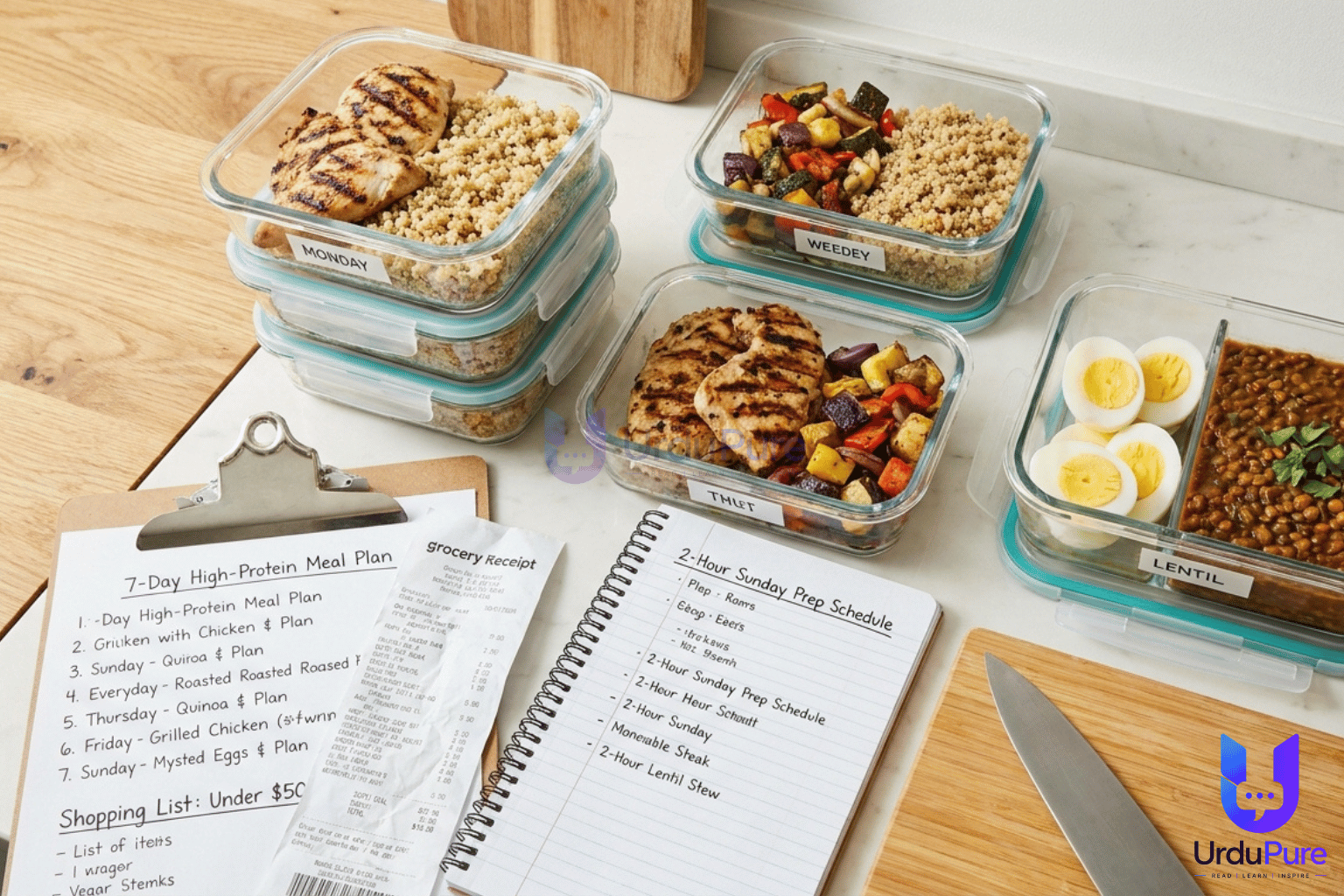
High-Protein Meal Prep for the Week: 7-Day Plan Under $50 / £40
Eat well, hit your protein goals, and spend under $50 or £40 for the entire week. A nutritionist-informed meal prep plan with full recipes, a complete shopping list, and a prep schedule that takes just two hours on Sunday.
Why High-Protein Meal Prep Is the Smartest Food Habit of 2026
The combination of rising food costs and increasingly mainstream awareness of protein's role in satiety, muscle preservation, and metabolic health has made high-protein meal prep the most searched and most discussed food topic of 2026. And the logic is simple: when you've prepared filling, protein-rich meals in advance, you make better food choices by default rather than by willpower.
Most people significantly underestimate how much protein they eat — and significantly overestimate how difficult it is to hit higher protein targets on a modest budget. This plan solves both problems at once: a full seven-day high-protein eating plan, complete with quantities, macros, a shopping list, and a step-by-step Sunday prep guide that gets everything ready in under two hours.
Target protein: 120–150g per day (adjustable based on your bodyweight and goals). Target spend: under $50 in the US or £40 in the UK for the full week's food.
The Nutritional Case for Higher Protein
Before the plan, a brief case for why protein deserves its current cultural prominence — because understanding the why makes the effort worthwhile.
Protein has the highest thermic effect of any macronutrient: your body burns approximately 20–30% of the calories in protein just digesting it, compared to 5–10% for carbohydrates and 0–3% for fat. This makes protein the most metabolically active macronutrient for body composition.
Protein is also the most satiating macronutrient. Multiple studies confirm that higher protein intake reduces hunger hormones and increases satiety hormones, leading to naturally lower overall calorie consumption without deliberate restriction. Put simply: eating more protein tends to make you eat less of everything else.
For anyone exercising — particularly resistance training — adequate protein is non-negotiable for muscle repair and growth. The current research consensus suggests 1.6–2.2g per kg of bodyweight as the optimal range for most active people.
The Shopping List
Everything below is available at mainstream supermarkets in both the US and UK. Prices are approximate and based on standard supermarket pricing in 2026.
Proteins
Chicken breasts — 1.5kg / 3.3 lbs (~$9 / £7)
Eggs — 18 pack (~$5 / £3.50)
Tinned tuna in spring water — 4 × 145g tins (~$5 / £4)
Greek yoghurt (0% or full fat) — 1kg tub (~$5 / £3.50)
Cottage cheese — 500g (~$4 / £2.50)
Frozen edamame — 500g bag (~$3 / £2)
Red lentils — 500g bag (~$2 / £1.20)
Carbohydrates
Brown rice — 1kg bag (~$3 / £1.80)
Sweet potatoes — 1kg (~$3 / £2)
Oats (rolled) — 1kg (~$3 / £1.50)
Wholegrain bread — 1 loaf (~$3.50 / £1.80)
Vegetables and Fruit
Broccoli — 2 heads (~$3 / £1.80)
Spinach — 200g bag (~$2.50 / £1.50)
Cherry tomatoes — 250g punnet (~$2.50 / £1.50)
Cucumber — 1 (~$1 / £0.70)
Frozen mixed vegetables — 1kg bag (~$2.50 / £1.50)
Bananas — 6 pack (~$2 / £1)
Fats and Flavour
Olive oil — use existing or ~$4 / £3 for a small bottle
Soy sauce (low sodium) — use existing or ~$2 / £1.20
Garlic — 1 bulb (~$0.80 / £0.50)
Smoked paprika, cumin, mixed herbs — use existing pantry staples
Total estimated cost: $47–$53 / £37–£43 depending on location and specific brands chosen.
The Prep Guide: Two Hours on Sunday
The following sequence is designed to run multiple components simultaneously, cutting total hands-on time to under two hours.
Step 1 (0:00–0:10): Start the Rice and Lentils
Rinse 500g of brown rice and start it in your largest saucepan with 1 litre of water. In a separate pot, rinse 250g of red lentils and cover with 500ml water. Bring both to the boil, then reduce to a simmer. The rice will take 30–35 minutes; the lentils will take 20–25 minutes.
Step 2 (0:10–0:20): Prep and Season the Chicken
Cut the 1.5kg of chicken breasts in half lengthways to create thinner pieces that cook faster and more evenly. Season one half (750g) with olive oil, smoked paprika, garlic powder, and salt. Season the other half with olive oil, cumin, soy sauce, and a little honey for variety across the week. Place on a lined baking tray.
Step 3 (0:20–0:25): Prep the Sweet Potatoes and Broccoli
Peel and cube the sweet potatoes into roughly 2cm pieces. Cut the broccoli into florets. Toss the sweet potato with olive oil and smoked paprika; toss the broccoli with olive oil and a pinch of salt. Place on a second lined baking tray.
Step 4 (0:25–0:50): Oven Time
Preheat oven to 200°C / 400°F. Place the chicken tray and the vegetable tray in simultaneously. Chicken will take 20–25 minutes (until internal temperature reaches 74°C / 165°F); vegetables will take 25–30 minutes (until sweet potato is tender and broccoli edges are slightly caramelised). Check rice and lentils — stir and reduce heat if needed.
Step 5 (0:50–1:10): Portion and Pack
Drain and cool rice and lentils. Slice or shred the cooked chicken. Begin filling your meal prep containers:
5 lunch containers: One portion chicken + one portion rice + broccoli or mixed frozen veg (steamed in microwave while portioning)
5 dinner containers: Lentils (seasoned with cumin, lemon juice, and olive oil) + sweet potato + a handful of spinach
Step 6 (1:10–1:30): Prep Breakfasts and Snacks
Overnight oats (5 jars): 60g oats + 200ml milk or water + 120g Greek yoghurt per jar. Add banana slices on serving day. These keep 5 days refrigerated.
Hard-boiled eggs (8 eggs): Cover with cold water, bring to boil, simmer 10 minutes, cool in ice water. Store in the shell in the fridge — they keep for 7 days.
Snack pots (5): 150g cottage cheese + cherry tomatoes + cucumber slices per pot.
The Full 7-Day Meal Plan
Every Day: Breakfast
Overnight oats (prepared Sunday) + 2 hard-boiled eggs. Approximate macros: 45g protein, 55g carbs, 12g fat, 510 calories.
Every Weekday: Lunch
Prepped chicken + brown rice + broccoli container. Approximate macros: 48g protein, 52g carbs, 9g fat, 480 calories.
Every Weekday: Afternoon Snack
Cottage cheese snack pot + 1 banana. Approximate macros: 20g protein, 32g carbs, 4g fat, 240 calories.
Every Weekday: Dinner
Lentil and sweet potato container + 120g Greek yoghurt (dessert). Approximate macros: 30g protein, 65g carbs, 8g fat, 450 calories.
Weekend Breakfasts (Days 6–7): Scrambled Eggs
3 eggs scrambled with spinach and cherry tomatoes, served on wholegrain toast. 10 minutes, entirely fresh. Approximate macros: 28g protein, 30g carbs, 16g fat, 370 calories.
Weekend Lunches: Tuna and Salad
1 tin tuna drained + cucumber + cherry tomatoes + spinach + olive oil and lemon dressing, served with 2 slices wholegrain toast. Quick, no-heat option. Approximate macros: 38g protein, 32g carbs, 10g fat, 370 calories.
Weekend Dinners: Flexible
Use remaining prepped chicken or lentils with whatever additional ingredients you have. Or treat yourself — a full week of disciplined eating earns one relaxed meal.
Daily Protein Totals
Weekday total: approximately 143g protein, 234g carbs, 43g fat — roughly 1,900 calories. This is calculated for a moderately active person. Scale portions up or down based on your specific caloric needs.
For anyone doing regular resistance training, add one additional protein source at any meal — an extra egg, a second tin of tuna, or an additional 100g of Greek yoghurt — to reach the 160–170g range.
Storage, Shelf Life, and Food Safety
Cooked chicken: Refrigerate, consume within 4 days. Freeze any portions intended for days 5–7 and defrost overnight in the fridge.
Cooked rice: Refrigerate immediately after cooling, consume within 3–4 days. Never reheat rice more than once.
Cooked lentils: Refrigerate, consume within 5 days.
Overnight oats: Refrigerate, consume within 5 days.
Hard-boiled eggs: Refrigerate in the shell, consume within 7 days.
Cottage cheese pots: Consume within 3–4 days of opening the original tub.
If your working week is unpredictable and you know you'll eat out on some days, prep only 3–4 days of lunches and dinners rather than a full five. Half-prep is infinitely better than no prep.
Scaling the Plan: More Protein, More Budget
The plan above delivers around 140g protein per day at a weekday cost of approximately $7 / £5.50 per day — well under the budget ceiling. If you want to push protein higher, the most cost-effective additions are:
Frozen edamame (500g bag, $3 / £2): 25g protein per 200g serving, takes 4 minutes to microwave from frozen
Whey protein powder (1kg, ~$30 / £22): Roughly $0.50 / £0.40 per 25g protein serving — the cheapest protein source per gram available
Tinned sardines (4 × 120g, $5 / £3.50): 22g protein per tin, high in omega-3, requires no cooking
The Mindset Shift That Makes Meal Prep Stick
The practical mechanics of meal prep are simple. The reason most people start and stop after two or three weeks is not practical — it's psychological. Here's the reframe that makes the difference: meal prep is not about restriction. It's about having good options available when you're tired, busy, or hungry. When a high-protein, genuinely tasty meal is sitting in your fridge ready to eat, the default choice is the right choice. You remove the need for decision-making at the moments when your decision-making is worst.
Start with one prep session. See how it changes your week. Most people who try it once continue doing it indefinitely — not because they have to, but because the alternative starts to feel unnecessarily hard.
high protein meal prep 2026, weekly meal prep guide, meal prep under $50, high protein meals budget, 7 day meal plan high protein, healthy meal prep beginners, protein meal prep ideas, cheap high protein food, meal prep for weight loss, Sunday meal prep guide



Discussion
Comments
Approved comments are published after moderation to keep discussion useful and spam-free.
No comments yet. Start the discussion below.