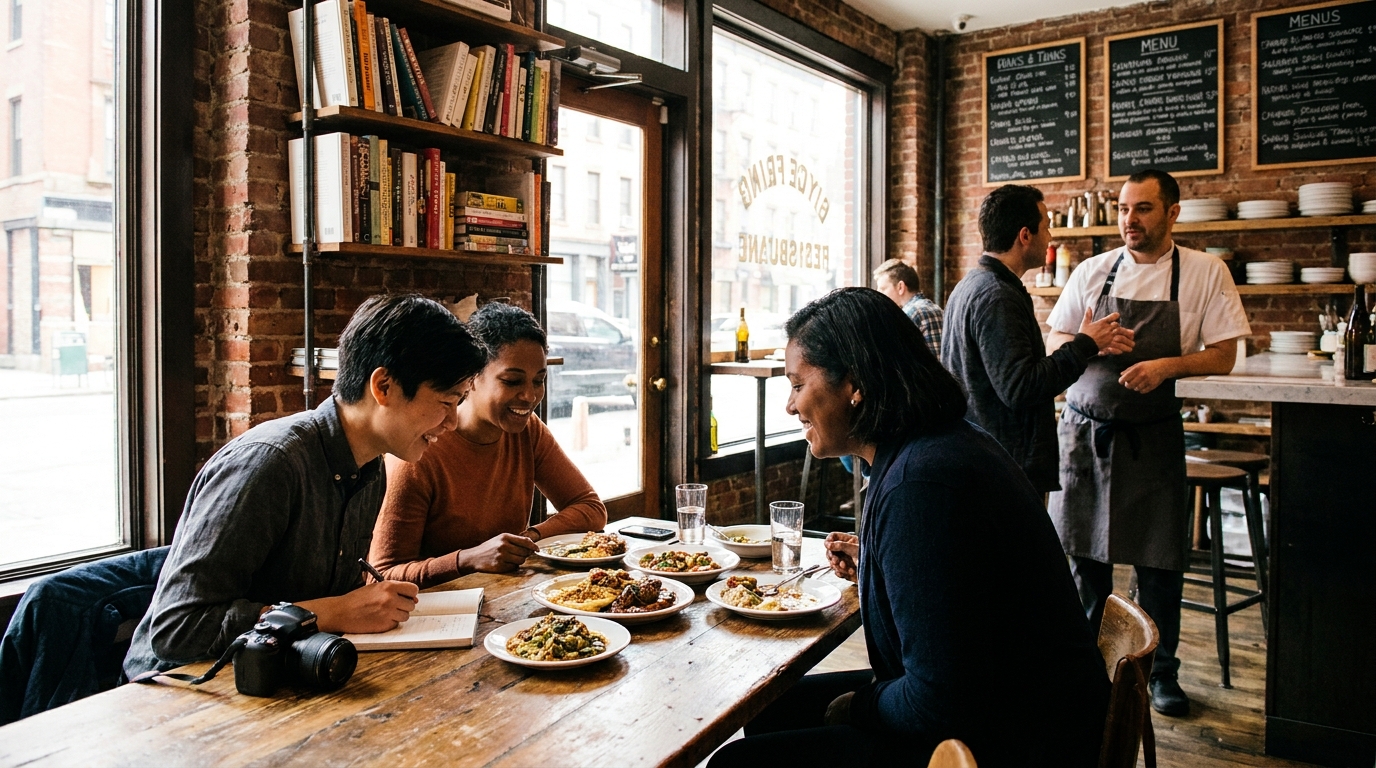
How to Find Hidden Gem Restaurants in Any City (Beyond Google Reviews)
The best restaurants aren't always the ones with the most Google reviews. Here's how locals, food journalists, and serious eaters actually discover extraordinary food in any city — methods that work every time.
Why Google Reviews Fail Food Discovery
Google Reviews is the default tool for finding restaurants and it produces systematically mediocre results for anyone who cares seriously about food. The algorithm rewards volume of reviews and recency, not quality of food. Restaurants that are easy to find, heavily marketed, and convenient for tourists accumulate reviews faster than the small, family-run place three streets away that has been feeding the neighbourhood for twenty years. The result is that the most-reviewed restaurant in any given area is rarely the best one.
The problem compounds in unfamiliar cities. Without local knowledge, visitors default to platforms that surface the most visible options — which are usually the most commercial, most tourist-optimised, and least interesting. The extraordinary hole-in-the-wall Ethiopian place, the unmarked basement ramen shop, the taqueria operating out of a petrol station — these almost never appear in the first page of Google results.
This guide gives you the methods that food journalists, serious travellers, and passionate local eaters use to find genuinely excellent food wherever they are.
Method 1: Find the Food Media That Covers That City Specifically
Every significant city in the UK and US has food writers, bloggers, and media outlets that cover its restaurant scene with genuine depth and local knowledge. Finding these voices before you visit — or using them to rediscover your own city — produces dramatically better restaurant leads than any algorithm.
How to find them
Search "[city name] food blog" or "[city name] restaurant critic" — find the local voices rather than national outlets covering the city from a distance
Look for local alt-weeklies and city magazines: The Infatuation has excellent city-specific coverage in major US cities. Eater's city editions (Eater NY, Eater LA, Eater Chicago) provide genuinely informed local restaurant journalism. In the UK, publications like Manchester Confidential, Leeds List, and Birmingham-specific food media serve the same function.
Find the local James Beard Foundation finalists: The James Beard Awards (US) and the National Restaurant Awards (UK) publish long nomination lists that include regional finalists — these are among the most reliable signals of genuine quality available
Follow local food Instagram accounts: Search "[city] food" on Instagram and find accounts that post original photography and genuine local knowledge rather than reposts and sponsored content
The key is finding voices with genuine local expertise and a track record you can assess — not national aggregators applying generic criteria.
Method 2: The Ethnic Grocery Store Signal
One of the most reliable signals for genuine, non-tourist-facing ethnic cuisine in any city is proximity to the grocery stores that supply it. Authentic Vietnamese cooking requires specific ingredients available at Vietnamese grocery stores. Genuine West African cuisine requires ingredients available at African grocery stores. The restaurants that use these ingredients are almost always near the stores that supply them.
How to use it
Search Google Maps for the cuisine type's grocery store ("Korean grocery," "Halal butcher," "Indian grocery") in the city you're visiting
Look at the restaurants within a half-mile radius of the store — particularly any that appear to be patronised primarily by members of that community
Cross-reference with any food media coverage from step 1
This method consistently produces the most authentic and best-value food finds in any city with meaningful immigrant communities. The restaurant feeding the community it emerged from has fundamentally different incentives from the restaurant optimised for tourist approval — and those different incentives almost always produce better food.
Method 3: Ask the Right People the Right Questions
The most reliable restaurant recommendation in any city comes from a local who shares your food preferences and cares about eating well. The challenge is finding that person and asking the right question.
Who to ask
Your Airbnb or hotel host: If they're a genuine local rather than a commercial operation, ask specifically: "Where do you personally go when you want a really good [specific type of food]?" Not "what restaurants would you recommend" — that produces generic tourist answers. The personal framing produces personal knowledge.
The staff at a good coffee shop or bar: People who work in food and drink are usually plugged into the local food scene. Ask your barista where they eat on their days off.
A market vendor: Farmers market vendors often know the local food community deeply — they supply ingredients to local restaurants and have strong opinions about who uses them well.
The taxi or rideshare driver — but only with the right question: "Where's the best [specific thing] you've eaten in this city?" produces genuinely useful answers. "What restaurants would you recommend?" does not.
The question that always works
"If you were taking someone you wanted to impress out to dinner tonight — not necessarily the fanciest place, just the best food — where would you take them?"
This framing cuts through generic recommendations and surfaces genuine personal favourites every time.
Method 4: The Platforms Better Than Google for Food
The Infatuation
The best food discovery platform in the US for major cities. Reviews are written by people who actually know and care about the cities they cover, are genuinely opinionated (they tell you who a restaurant is NOT for, as well as who it is), and are updated regularly. The EEEEEATS app (The Infatuation's recommendation tool) is particularly useful for specific cuisine and occasion searches.
Eater
Eater's city-specific editions (available for most major US and some UK cities) provide restaurant journalism rather than aggregated reviews — informed writers with genuine local knowledge covering openings, closings, and the context around the restaurant scene. The "Heatmap" feature on each city edition shows the most recommended new and established restaurants from local critics.
Reddit's Local Food Subreddits
Every major city has a Reddit community, and the food threads within those communities consistently produce the most honest, unfiltered local recommendations available anywhere online. Search r/[cityname] + "best [food type]" or "hidden gem restaurants" and read the threads rather than the top results. Locals correcting each other's recommendations and arguing about specific dishes at specific places is exactly the information you want.
Substack Food Writers
The migration of food writing to Substack has produced a wave of genuinely independent, local food journalism unbeholden to advertisers. Search Substack for your city — the writers you find there are typically serious, opinionated, and covering the food scene with more depth than any commercial platform.
Yelp — But Used Differently
Yelp's aggregate ratings are as susceptible to the same gaming and tourist-review bias as Google. But Yelp's filtering function — sorting by "review count: low to high" rather than highest rated — surfaces newer, less-discovered restaurants that may have ten excellent reviews from genuine customers rather than hundreds of mediocre ones from casual visitors. This reverse-sort technique consistently surfaces genuine discoveries.
Method 5: Read the Physical Environment
The physical signals of a genuinely good restaurant — particularly in communities without strong English-language food media coverage — are readable if you know what to look for.
A menu in the language of the cuisine's origin: A Vietnamese restaurant with a Vietnamese-language menu (or a menu where English is clearly the translation rather than the original) is almost always more authentic than one where English is primary
Full tables at off-peak hours: A restaurant busy at 3pm on a Tuesday is busy because local people are eating there by choice, not because it was recommended to tourists
No photographs on the menu: Photo menus are almost exclusively for audiences unfamiliar with the food. The absence of photos usually indicates a restaurant expecting customers who know what they're ordering.
The queue of people who look like they're from that community: If the customers at a Thai restaurant are primarily Thai, at a Chinese restaurant primarily Chinese, the food has passed the most important quality test
Hand-written daily specials: A sign showing today's specials, handwritten in any language, indicates a kitchen engaged with what's fresh and seasonal rather than executing a static menu
Method 6: Build Your Own Local Knowledge System
For your own city — the one you live in rather than visit — the best food discovery system is a long-term, deliberate practice of neighbourhood exploration. Most people who live in cities have deeply explored perhaps 20% of their city's food landscape, concentrated around their home and commute route. The other 80% contains extraordinary things.
A practical approach: once a month, pick a neighbourhood you don't usually visit, spend a Saturday afternoon walking its main commercial streets, look for the physical signals above, and eat one meal there at a place you've never heard of. Over two or three years, this practice produces a personal food map of your city that no platform can replicate.
How to Read Reviews for Accuracy
When you do use review platforms, these signals help identify trustworthy reviews from unreliable ones:
Specific dishes named: "The khao soi was extraordinary — the coconut broth had real depth and the crispy noodles on top were perfect" is a review from someone who ate and paid attention. "Great food, great service, will return!!" is not.
Negative reviews that are specific: A one-star review describing exactly what went wrong is more credible than a five-star review that could apply to any restaurant anywhere
Reviewer history: A reviewer who has reviewed dozens of restaurants in the same city over several years is significantly more credible than someone whose only review is the one you're reading
Reviews that mention being a regular: "I've been coming here for years" is a strong signal — people don't return out of inertia to mediocre food
how to find hidden gem restaurants, best local restaurants near me, food discovery tips, beyond Google reviews restaurants, find authentic ethnic food, best food apps 2026, local restaurant guide, how to find good food travelling, food discovery methods, restaurant finding tips




Discussion
Comments
Approved comments are published after moderation to keep discussion useful and spam-free.
No comments yet. Start the discussion below.