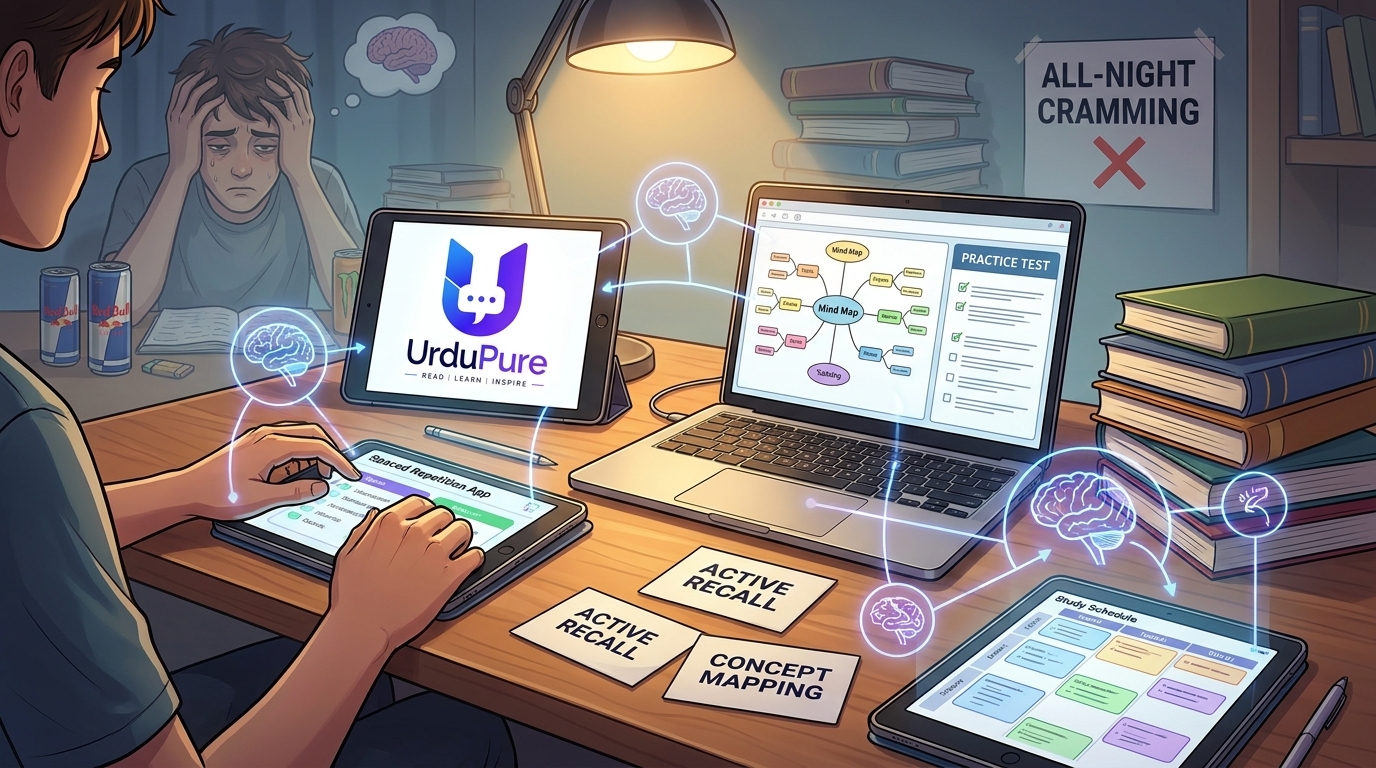
How to Study Smarter, Not Harder: The Science-Backed Method
Most study techniques people use are proven ineffective. These methods are backed by cognitive science — and will genuinely change how much you retain, how quickly you learn, and how confident you feel going into any exam or assessment.
Why Most Students Study Wrong
If you were to survey what studying techniques are most commonly used by students — at every level from secondary school through postgraduate education — you would find a consistent list: re-reading notes, highlighting text, reviewing material shortly before the exam, and studying for marathon sessions the night before an assessment. These techniques feel productive. They are largely ineffective.
Cognitive science has produced a clear and consistent picture of how human memory actually works — and the gap between that picture and standard student practice is significant. The techniques that feel like studying (passive re-reading, highlighting, reviewing material you already recognise) engage shallow processing that produces familiarity without durable retention. The techniques that feel harder, less comfortable, and more effortful are the ones that actually produce lasting learning.
This isn't a guide to studying more hours. It's a guide to studying differently — using approaches that the research demonstrates produce dramatically better retention, comprehension, and performance with equivalent or lower time investment.
The Six Techniques With the Strongest Evidence
1. Active Recall (The Most Powerful Single Technique)
Active recall — also called retrieval practice or the testing effect — is the practice of actively attempting to retrieve information from memory rather than passively reviewing it. Instead of re-reading a chapter, closing the book and attempting to write down everything you can remember from it. Instead of reviewing notes, turning the notes face-down and attempting to reconstruct their content. Instead of reading a flashcard, seeing the question and generating the answer before revealing it.
The research supporting active recall is among the most robust in all of educational psychology. A landmark 2006 study by Roediger and Karpicke found that students who studied by repeated retrieval practice retained 65% of material after a week, compared to 42% for students who studied by repeated reading — a significant gap produced without any additional study time. The retrieval attempt itself, even when unsuccessful, dramatically enhances subsequent learning of the material.
How to implement:
After reading any section of material, close the book and write or type everything you can recall — then check what you missed
Use flashcards (Anki or Quizlet) and always attempt to generate the answer before revealing it — never review a card without first testing yourself
After a lecture, spend 10 minutes writing down everything you remember without looking at notes — this is the highest-return use of post-lecture time
Practice with past papers and practice questions from day one of studying, not just the week before an exam
2. Spaced Repetition (The Most Powerful System)
Spaced repetition is the practice of reviewing material at increasing intervals — reviewing it shortly after first learning it, then again after a longer gap, then again after a longer gap still. This exploits the "spacing effect" — the robust finding that memory is stronger when learning is distributed across time than when it is massed into a single session.
The forgetting curve — first described by Hermann Ebbinghaus in 1885 and replicated hundreds of times since — shows that newly learned information decays rapidly at first and then more slowly. Reviewing material just before it would otherwise be forgotten (the optimal interval) requires the least review time to maintain retention at any given level.
Spaced repetition combined with active recall (as implemented in Anki and similar software) is the most evidence-based system for building durable long-term memory of any factual or conceptual material. Medical students, law students, and language learners who use Anki consistently produce the most dramatic self-reported learning efficiency improvements of any study technique.
How to implement:
Download Anki (free desktop application, £24.99 / $29.99 iOS, free Android) and use it for any factual material — definitions, formulas, vocabulary, concepts, dates, processes
Review your Anki deck every day — the daily review is the mechanism through which the spacing effect operates
Make your own cards rather than downloading pre-made decks — the act of creating flashcards is itself a form of active recall and encoding
Distribute study sessions across weeks and months rather than concentrating them before assessments — this is the hardest behavioural change and the most impactful one
3. Elaborative Interrogation
Elaborative interrogation is the practice of asking "why" and "how" about the material you're studying — generating explanations for facts rather than simply recording them. Why is this the case? How does this connect to what I already know? What would happen if this were different?
The research shows that generating explanations activates deeper semantic processing than memorisation — connecting new information to existing knowledge structures in ways that both strengthen retention and build the kind of flexible understanding that transfers to novel problems and exam questions framed differently from how material was originally learned.
How to implement: After encountering any new fact or concept, habitually ask yourself "why is this true?" and attempt to generate the explanation before looking it up. When reviewing material, for each point ask "how does this connect to what I already know about this topic?" The elaborative interrogation habit takes deliberate practice to build but produces significant comprehension improvements once established.
4. Interleaving
Interleaving is the practice of mixing different subjects or problem types within a single study session, rather than "blocking" — studying all of one topic before moving to another. Massed practice on a single topic feels productive because performance improves rapidly within a session. Interleaved practice produces slower within-session progress but significantly better long-term retention and the ability to discriminate between problem types — the skill that exams actually test.
A 2010 study by Rohrer and Taylor found that interleaved mathematics practice produced 43% higher test performance than blocked practice, despite blocked practice appearing to produce better immediate performance during the practice sessions themselves. The feeling that interleaved practice is going worse than blocked practice is characteristic of the technique — and it's precisely why most students don't use it.
How to implement: When practising maths problems, mix problem types within practice sets rather than completing all problems of one type before moving to another. When studying for multiple subjects, switch between them within a session rather than devoting separate sessions to each. Work on different chapters' problems in the same session.
5. Concrete Examples and Self-Explanation
Abstract concepts are learned better when they're anchored to concrete, specific examples — and when learners generate their own examples rather than passively receiving those provided. For every abstract principle encountered in studying, the habit of immediately generating a concrete example produces significantly better understanding and retention than processing the abstract statement alone.
Self-explanation — explaining to yourself (or to an imagined other) how a worked example was solved step-by-step — is similarly effective. The generation of an explanation requires retrieving and organising knowledge in ways that passive observation does not.
6. Dual Coding
Dual coding — representing information in both verbal and visual form — exploits the separate cognitive channels for verbal and visual processing. Creating diagrams, concept maps, and visual representations of relationships between ideas alongside verbal notes encodes information through two channels rather than one, producing stronger retention.
The most practically accessible form: after reading or listening to material, draw a diagram or concept map representing the key relationships — without looking at original materials. The act of constructing the visual representation is an active recall exercise, and the visual format produces a complementary memory trace to the verbal one.
The Techniques That Don't Work (Despite Feeling Productive)
The 2013 Dunlosky et al. meta-analysis in Psychological Science in the Public Interest — the most comprehensive review of study technique effectiveness — rated these techniques as having "low utility" despite their popularity:
Re-reading: Produces familiarity, not learning. Feels good because recognised material is processed more fluently — but fluency of processing is not the same as depth of encoding. Minimal benefit over a single reading.
Highlighting and underlining: Even more passive than re-reading. The act of highlighting a passage processes it no more deeply than reading without highlighting. The marked passages are then re-read — returning to the re-reading technique's limitations.
Summarising: Not entirely useless, but significantly lower effectiveness than retrieval practice and spaced repetition. Writing a summary is a mild active recall exercise, but the summary is then often re-read (returning to re-reading).
Keyword mnemonics: Useful for very specific memorisation tasks (vocabulary in a foreign language, for example) but poorly generalised to most academic content.
The Study Environment: What the Research Shows
Several environmental factors have clear evidence for effects on learning:
Sleep: Memory consolidation occurs primarily during slow-wave sleep. Studying before sleeping (with adequate sleep) produces stronger retention than studying at other times of day. All-night studying before exams actively impairs the consolidation of recently learned material — one of the most clearly documented counterproductive strategies in education.
Exercise: Acute aerobic exercise before learning tasks increases hippocampal blood flow and BDNF (brain-derived neurotrophic factor) production, both associated with improved memory formation. A 20-minute walk before a study session is a low-cost, high-evidence enhancement.
Distraction elimination: The research on multitasking and learning is unambiguous. Studying with social media, messaging, or television available is dramatically less effective than studying without these distractions. The effort required for task-switching between studying and distracting stimuli is substantial and invisible — students consistently overestimate how well they learn while distracted.
The Pomodoro Technique: 25 minutes of focused work followed by a 5-minute break — repeated across a study session — produces better sustained attention and encoding than continuous work for most learners. The break allows working memory to consolidate and prevents the cognitive fatigue that degrades processing quality during sustained effort.
how to study effectively 2026, best study techniques science, active recall studying, spaced repetition guide, Anki flashcards study, study smarter not harder, retrieval practice learning, interleaving study technique, cognitive science studying, how to improve memory studying






Discussion
Comments
Approved comments are published after moderation to keep discussion useful and spam-free.
No comments yet. Start the discussion below.