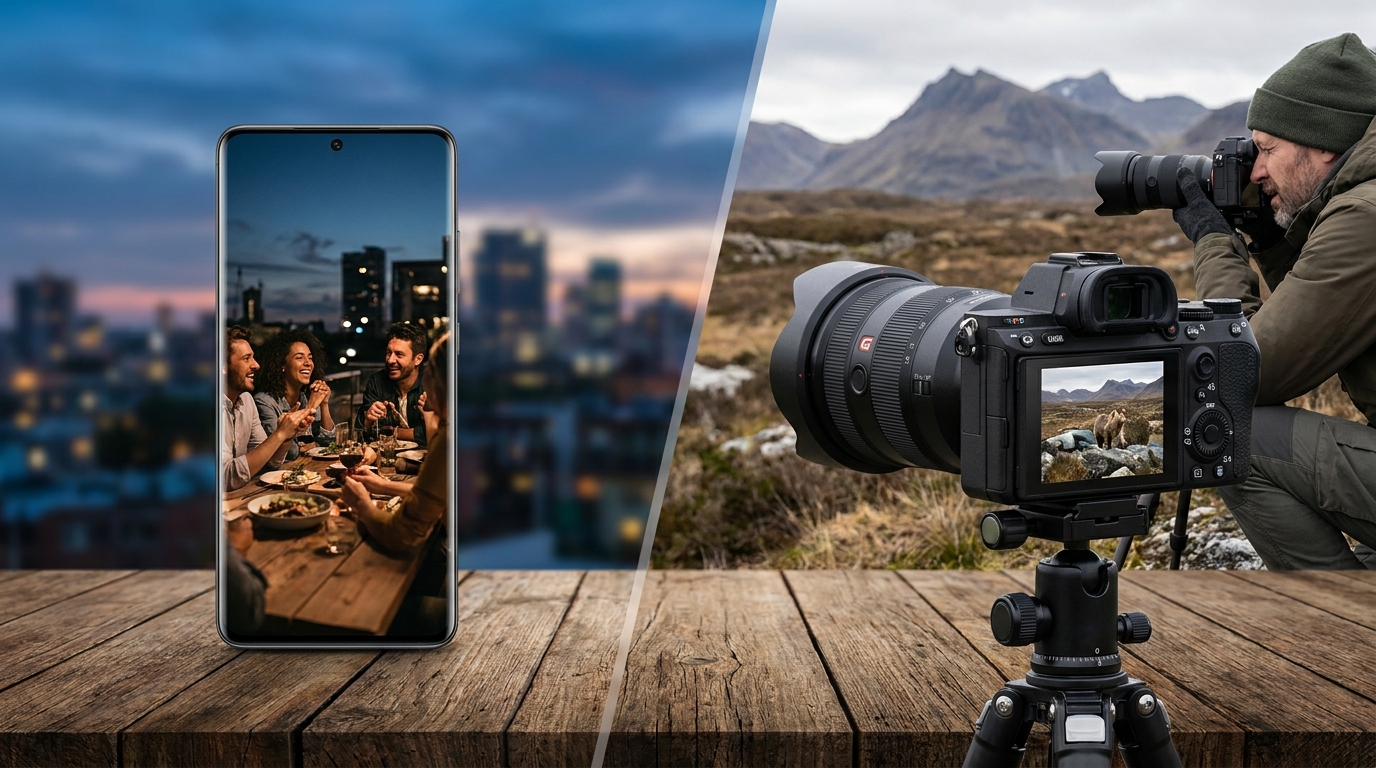
iPhone 17 vs Sony vs Fujifilm vs Canon: Which Camera Should You Choose in 2026?
The smartphone-vs-camera debate has a clearer answer than ever in 2026 — but it depends entirely on what and how you shoot. Here's an honest head-to-head with real sample scenario comparisons.
The Debate Has Changed
Five years ago, the smartphone-vs-dedicated camera debate had a reasonably clear answer: smartphones were excellent for casual photography but dedicated cameras were decisively better for anyone who cared about image quality. That is no longer straightforwardly true. The iPhone 17 Pro's camera system — and equivalents from Samsung, Google, and other flagship Android manufacturers — has closed the gap to dedicated cameras in ways that were not predictable even three years ago.
Computational photography — the use of AI and software processing to enhance images — has allowed smartphones to partially compensate for their fundamental physical limitation: small sensors. Portrait modes simulate the depth-of-field effect of large-aperture lenses. Night modes stack multiple exposures to produce usable low-light images. Apple's photographic styles and AI-enhanced processing produce JPEGs that for many users are preferable to the straight-from-camera output of dedicated cameras.
And yet: dedicated cameras still win in specific, important ways. The gap is smaller than it was, but it is real. This guide maps exactly where each option is genuinely superior — without the tribal loyalty that distorts most comparisons.
The Contenders
iPhone 17 Pro — £999 / $999 (48MP main, 48MP ultrawide, 48MP 5x telephoto)
Apple's current flagship camera phone. The triple-camera system features 48MP sensors across all three focal lengths — a significant upgrade from the 12MP ultrawide and telephoto of previous generations. Apple Intelligence camera features, improved ProRAW capture, and Action Button customisation for camera functions make it the most capable iPhone camera system ever produced. The 5x optical zoom (equivalent to approximately 120mm on a full-frame camera) is genuinely useful for everyday photography.
Sony A6700 + 16-50mm kit lens — £1,299 / $1,399
Sony's APS-C mirrorless flagship. AI-powered autofocus, 4K/120fps video, 26MP sensor, and the comprehensive Sony E-mount lens ecosystem. The most technologically advanced APS-C camera available at any price in 2026.
Fujifilm X100VI — £1,499 / $1,599
Fujifilm's fixed-lens premium compact. 40MP APS-C sensor, 23mm f/2 (35mm equivalent) fixed lens, in-body image stabilisation, and Fujifilm's celebrated film simulations. Demand has significantly exceeded supply since launch — the camera's combination of aesthetic results, tactile controls, and compact form factor has made it one of the most discussed cameras in years.
Canon EOS R8 + 24-50mm kit lens — £1,299 / $1,299
Canon's entry-level full-frame mirrorless. 24MP full-frame sensor, Canon's excellent Dual Pixel CMOS AF II autofocus system, and the growing RF mount lens ecosystem. The most affordable path to full-frame photography in Canon's lineup.
Head-to-Head: Where Each Option Wins
Convenience and Always-With-You Photography
Winner: iPhone 17 Pro — by a landslide
The best camera is the one you have with you. No dedicated camera — not even the compact Fujifilm X100VI — is as consistently available as the phone already in your pocket. For street photography, spontaneous moments, travel documentation, and any photography where being ready immediately matters more than ultimate image quality, the iPhone wins unconditionally. The computational photography pipeline has made the iPhone's JPEGs excellent enough that for social media, web use, and most casual printing, the quality difference between iPhone and dedicated camera output is invisible to most viewers.
Low Light Photography
Winner: Dedicated cameras — clearly at extreme low light
The iPhone's Night Mode is genuinely excellent for a small-sensor device. In moderately low light — dim restaurants, evening street photography — it produces usable images. In very low light — unlit rooms, concerts, night photography — the physical reality of sensor size becomes decisive. The Sony A6700's large APS-C sensor, combined with fast prime lenses (the Sony 35mm f/1.8 captures approximately 9x more light than the iPhone's equivalent focal length), produces images that are simply not comparable in very low light conditions. The Canon R8's full-frame sensor extends this advantage further.
Portrait Photography (Shallow Depth of Field)
Winner: Dedicated cameras — but the gap is narrowing
The "bokeh" effect — the blurred background that separates subjects from their environment — is a function of aperture and sensor size. A dedicated camera with a fast portrait lens (the Canon RF 85mm f/1.8, for example) produces a quality of background separation that the iPhone's computational portrait mode can approximate but not replicate. For portrait photography where the aesthetic of genuine optical blur is important — professional portraits, wedding photography, product photography — dedicated cameras produce distinctly superior results. For casual portrait photography where viewers won't examine the output critically, the iPhone's portrait mode is impressive.
Sports and Action Photography
Winner: Sony A6700 — decisively
Tracking moving subjects — particularly fast-moving, unpredictable ones — remains a domain where dedicated cameras with large, fast sensors and sophisticated autofocus systems outperform smartphones significantly. The Sony A6700's AI subject tracking at 11fps burst rate produces images of moving subjects that are simply beyond the iPhone's current capability. For anyone photographing sports, wildlife, or children in motion, a dedicated camera with a telephoto lens remains the appropriate tool.
Video
Winner: Broadly tied — depends on use case
The iPhone 17 Pro shoots 4K/60fps with Log profiles, ProRes video (on models with sufficient storage), and excellent computational video stabilisation. The Sony A6700 shoots 4K/120fps, allows lens flexibility, and produces video with superior depth-of-field characteristics when fast lenses are used. For run-and-gun, vlog-style, or social media video content, the iPhone's combination of capability, stabilisation, and convenience makes it genuinely competitive. For narrative filmmaking, commercial video production, or any application where lens control and depth-of-field matter, the Sony is superior.
Telephoto Reach
Winner: Dedicated cameras with appropriate lenses — significantly
The iPhone 17 Pro's 5x optical zoom (120mm equivalent) is useful for moderate telephoto work. For wildlife photography, sports from a distance, or any situation requiring significant reach (200mm, 300mm, 400mm equivalent or more), a dedicated camera with a telephoto lens is necessary. The iPhone's digital zoom beyond 5x degrades image quality rapidly. A mirrorless camera with a 70-350mm lens covers distances the iPhone simply cannot.
Optical Quality and Resolving Power
Winner: Fujifilm X100VI and Canon R8 — for large prints
For images intended for large prints (A2 / 24x16" and above), the resolution and optical quality of dedicated cameras producing 24–40MP images with high-quality lenses exceeds what the iPhone's computational processing, however sophisticated, can match. For screen display and prints below A3 / 16x12", the difference is negligible for most viewers.
The Scenarios: Which to Buy
You are a casual photographer who wants the best possible photos without learning photography
Recommendation: iPhone 17 Pro (or equivalent flagship Android)
The computational photography pipeline, the always-available convenience, and the excellent results without any technical knowledge make the smartphone the right tool. A dedicated camera will only produce better results if you invest in learning to use it.
You want to learn photography as a craft and skill
Recommendation: Sony ZV-E10 II or Fujifilm X-S20
The Fujifilm especially, with its physical controls, teaches the craft of photography in a way that no smartphone — with its automated computational pipeline — can. Learning manual exposure on a dedicated camera with physical dials builds skills that transfer to any camera.
You are a content creator whose primary output is video for social media and YouTube
Recommendation: Sony ZV-E10 II
Excellent autofocus for self-filming, good stabilisation, interchangeable lenses for versatility, and 4K video in a compact, affordable package.
You want the best image quality in the most portable package and are willing to pay for it
Recommendation: Fujifilm X100VI
The best camera for this specific brief — but be prepared for supply constraints and a premium price.
You want to shoot portraits, events, or weddings with professional results
Recommendation: Canon EOS R8 with 85mm f/1.8
Full-frame sensor, excellent autofocus, and a portrait lens that produces genuinely beautiful results. The most capable professional portrait system at an accessible entry price.
Keywords: iPhone 17 vs mirrorless camera, smartphone vs dedicated camera 2026, Sony A6700 review, Fujifilm X100VI review, Canon R8 review, should I buy a camera 2026, best camera vs iPhone, camera comparison 2026, photography gear guide, mirrorless camera worth it 2026



Discussion
Comments
Approved comments are published after moderation to keep discussion useful and spam-free.
No comments yet. Start the discussion below.