The 15 Biggest Food Trends of 2026 You'll Be Eating All Year
From mushroom coffee to fermented everything — the food movements taking over restaurant menus, supermarket shelves, and home kitchens in 2026. Here's what's actually worth your attention.
How We Eat Is Changing Faster Than Ever
The way the world eats has never evolved more rapidly. In the past two years alone, the combination of climate anxiety, post-pandemic wellness awareness, the explosion of global food content on social media, and a genuine shift in how people think about their relationship with food has produced a wave of trends that feel genuinely different from the fleeting viral moments of years past.
These aren't all passing fads. Several of 2026's biggest food trends reflect deep cultural and economic shifts that will shape menus, supermarket aisles, and home cooking for years to come. Others are brilliant, flavour-driven discoveries that deserve a permanent spot in your weekly rotation.
Here are the 15 most significant food trends of 2026 — with the origins, the science, and the practical guide to trying each one at home.
1. Functional Mushrooms: The Wellness Ingredient of the Year
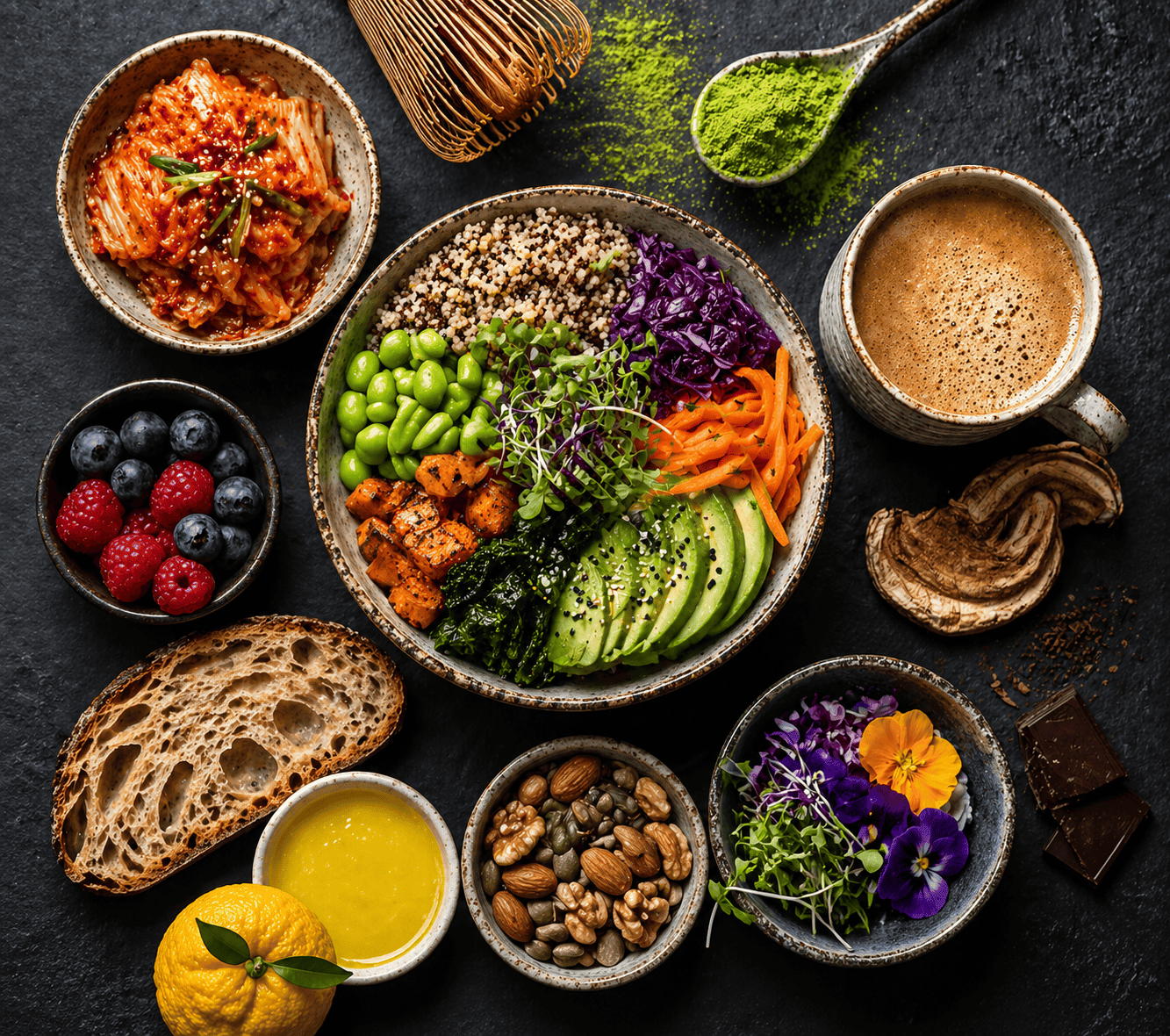
Lion's mane, reishi, chaga, and cordyceps have crossed over from health food shops into mainstream menus and supermarkets in a big way. The appeal is twofold: the flavour profiles are genuinely interesting, and the emerging science around cognitive function, immune support, and anti-inflammatory properties is generating serious research interest.
You'll find functional mushrooms in coffee blends, protein powders, pasta sauces, chocolate bars, and dedicated elixir drinks. Mushroom coffee — typically a blend of arabica and lion's mane or chaga — has gone from niche to mainstream, with brands like Ryze, Four Sigmatic, and own-brand supermarket versions now widely available in the UK and US.
How to try it: Start with a mushroom coffee blend in the morning, or add lion's mane powder to a smoothie. For cooking, dried shiitake and oyster mushrooms added to any stock or sauce add deep umami complexity.
2. The Fermentation Renaissance
Fermented foods have been a global staple for centuries — but 2026 marks the moment they became a fully mainstream Western obsession. Gut health awareness, driven by an explosion of microbiome research and the mainstreaming of terms like "gut-brain axis," has pushed fermented foods from the health aisle to the centre of every food conversation.
Kimchi, miso, kefir, tempeh, kombucha, and sourdough remain the anchors — but 2026 has introduced a wave of more adventurous options: fermented hot sauces, lacto-fermented vegetables of every kind, drinking vinegars, and jun (a honey-based kombucha variant).
How to try it: Add a spoonful of kimchi to scrambled eggs, use miso paste as the base for salad dressings and marinades, or swap your afternoon soft drink for a good-quality raw kombucha.
3. Protein Maximalism
The macro obsession of 2026 is unambiguously protein. Driven partly by the explosion of resistance training culture, partly by research into satiety and metabolic health, and partly by the influence of high-protein diet advocates across social media, consumers are actively seeking out protein density in everything from yoghurt to pasta to ice cream.
High-protein versions of everyday staples — Greek yoghurt, cottage cheese, legume-based pasta, protein-enriched bread — have become the fastest-growing segment in multiple grocery categories. Cottage cheese, in particular, has had its most dramatic cultural rehabilitation in decades, appearing in everything from viral pasta sauces to cheesecake recipes.
How to try it: Swap regular pasta for chickpea or lentil pasta. Use full-fat Greek yoghurt or cottage cheese as the base for dips, sauces, and dressings. Add hemp seeds or edamame to salads for a whole-protein boost.
4. Yuzu and Japanese Citrus Take Over
Yuzu — the Japanese citrus fruit with a flavour profile somewhere between lemon, grapefruit, and mandarin — has completed its journey from specialist Asian grocery item to mainstream ingredient of the year. Its intensely fragrant zest and juice bring a brightness to both sweet and savoury dishes that is entirely unlike any Western citrus fruit.
In 2026, yuzu is appearing in everything: curd and marmalade, salad dressings, cocktail syrups, chocolate ganache, ramen broth, and premium crisp flavours. Other Japanese citrus varieties — sudachi, kabosu, and citrus junos — are following in its wake.
How to try it: A small amount of yuzu juice in a vinaigrette transforms a simple salad. Yuzu curd on toast is exceptional. Look for yuzu kosho — a fermented chilli and yuzu condiment — as an extraordinary addition to grilled fish, noodles, and roasted vegetables.
5. The "Ugly" Produce Movement
Driven by both economics and sustainability consciousness, the movement to celebrate imperfect, misshapen, and surplus produce has reached a tipping point in 2026. Supermarkets including major UK and US chains now offer dedicated "imperfect" ranges at 20–40% below standard prices. Subscription boxes delivering cosmetically challenged but nutritionally identical produce have grown significantly.
Beyond the ethics, there's a genuine culinary argument: heirloom and irregular varieties are often more flavourful than their uniform counterparts, bred for shelf-life and appearance rather than taste.
How to try it: Sign up for an imperfect produce subscription box. Visit a farmers market where irregular varieties are the norm. Try heirloom tomatoes in a simple caprese — the flavour difference versus standard supermarket tomatoes is revelatory.
6. Hyper-Local and Hyper-Seasonal Eating
Localism in food has been a theme for years, but 2026 has seen it intensify into something more like a genuine culinary philosophy rather than a marketing angle. Driven partly by supply chain anxiety, partly by environmental consciousness, and partly by a backlash against the homogenisation of food culture, restaurants and home cooks alike are embracing radical locality.
Some restaurants are now publishing their suppliers' postcodes on menus. Weekly veg box subscriptions from local farms have seen sustained growth since 2020 and continue to expand. The "100-mile diet" — eating exclusively from within a 100-mile radius — has attracted a new generation of adherents.
How to try it: Visit your nearest farmers market. Subscribe to a local veg box. When cooking, ask the question: where was this grown? The seasonal constraints this imposes are a creative challenge that consistently produces more interesting cooking.
7. South and Southeast Asian Flavours Go Mainstream
The long overdue mainstream recognition of South and Southeast Asian cuisines continues to accelerate in 2026. Filipino food, in particular, has had a breakthrough moment — adobo, sinigang, and ube (purple yam) are now common sightings on upscale restaurant menus and in supermarket aisles. Vietnamese, Thai, and Sri Lankan flavours have similarly escaped their niche status.
Ingredients like pandan, tamarind, gochujang, fish sauce, coconut aminos, and banana blossom are now stocked in mainstream supermarkets rather than reserved for specialist shops. The result is a genuine broadening of the everyday Western flavour palette.
How to try it: Add fish sauce to pasta sauces and stews for deep umami complexity (it doesn't make anything taste fishy). Use gochujang as a base for marinades and dipping sauces. Make an ube latte at home using ube extract and oat milk.
8. The Alcohol-Free Revolution Matures
The "sober curious" movement has moved decisively beyond its early awkward phase. In 2026, non-alcoholic spirits, wines, and beers have matured into genuinely excellent products rather than pale imitations of their alcoholic counterparts. Brands like Seedlip, Lyre's, and Oddbird have been joined by dozens of high-quality regional producers.
Dry January has become Dry Year for a growing segment, particularly among people under 35. UK and US data both show a sustained decline in alcohol consumption among younger adults, and the hospitality industry has responded with dedicated zero-alcohol menus and cocktail programmes at premium venues.
How to try it: Try a non-alcoholic Negroni made with Lyre's or a similar brand before dismissing the category. Seedlip Spice 94 with tonic and a burnt orange peel is genuinely excellent. The quality gap between the best non-alcoholic wines and entry-level alcoholic wines has largely closed.
9. Tinned Fish — Seriously
The tinned fish renaissance, which began quietly in 2023 and picked up momentum through 2024 and 2025, has fully arrived in 2026. Premium tinned sardines, anchovies, mackerel, mussels, and octopus from Spain and Portugal have become a genuine culinary trend — part sustainability story, part pantry-staple revival, part aesthetic object.
The health case is compelling: oily tinned fish is among the most nutritionally dense foods available, rich in omega-3 fatty acids, protein, calcium, and vitamin D. The sustainability case is equally strong — small pelagic fish like sardines and mackerel are among the most responsibly farmed seafood options.
How to try it: Try Spanish brand Ortiz anchovies on sourdough toast with butter and pickled peppers. Serve premium tinned sardines as a sharing plate with good crackers, dijon mustard, and cornichons. Add tinned mackerel to a grain bowl with pickled cucumber and miso dressing.
10. Flour Power: Alternative Grains Take Centre Stage
Wheat flour's dominance is being challenged like never before. Spelt, einkorn, emmer, teff, sorghum, tigernut, and cassava flours are finding their way into mainstream baking, driven by a combination of digestive health interest, nutritional curiosity, and a genuine desire for flavour complexity beyond what standard wheat delivers.
The sourdough boom accelerated interest in heritage grain varieties, and that curiosity has spread into everyday cooking. Teff, the Ethiopian grain with a rich malty flavour, is particularly having a moment in pancakes, porridge, and baked goods. Cassava flour, virtually grain-free, has become a staple in gluten-free baking.
How to try it: Substitute 20–30% of plain flour with spelt or einkorn in standard recipes for a nuttier, more complex flavour. Make teff porridge with coconut milk and honey. Use cassava flour tortillas — the texture is remarkably close to wheat flour versions.
11. Butter Is Back (And Fancier Than Ever)
After decades of being vilified, butter has completed its rehabilitation and entered a new premium phase. Cultured butters, compound butters, European-style high-fat butters, and small-batch artisan varieties have become gift items, restaurant showpieces, and social media stars.
The viral "butter board" trend of recent years has evolved into genuine appreciation for butter as a flavour-carrying ingredient. Top restaurants are now presenting house-made cultured butters with bread service as a signature element, and supermarkets carry an expanding range of European and artisan varieties.
How to try it: Make a simple compound butter by mixing softened butter with roasted garlic, fresh herbs, and sea salt. Keep cultured butter on your counter for bread — the difference in flavour over standard refrigerator butter is significant. Try Breton or Normandy-style salted butter for a revelatory experience.
12. Climate Cuisine: Eating for the Planet
Food choices and climate impact have become inseparable in 2026. But where earlier versions of this trend felt preachy or restrictive, climate cuisine in 2026 is reframing sustainability as a source of culinary richness rather than sacrifice. Chefs and food writers are celebrating the ingredients that happen to be low-impact: legumes, shellfish, small fish, foraged plants, and the full use of the whole animal or vegetable.
Nose-to-tail and root-to-leaf cooking — using every part of an ingredient rather than only the premium cuts — is gaining mainstream traction, driven as much by economics as ethics.
How to try it: Use the tops of beetroot, carrot, and fennel in pestos and salads. Make stock from vegetable scraps and meat bones. Replace one meat-based meal per week with a lentil or bean-based dish. The environmental impact is significant, and the flavour payoff is equally so.
13. Breakfast Gets Serious
Breakfast is having its most significant cultural moment in years. The combination of high-protein diet culture, a growing rejection of ultra-processed cereal and toast, and the influence of global breakfast traditions is producing the most interesting morning meal landscape in recent memory.
Savoury breakfasts are increasingly normalised: miso soup, congee, shakshuka, Turkish-style eggs, and leftover dinner for breakfast are all gaining ground. On the sweet side, bircher muesli, overnight oats, and protein pancakes have displaced sugary cereal for a significant portion of the health-conscious market.
How to try it: Make bircher muesli the night before — rolled oats soaked in apple juice with grated apple, yoghurt, and honey. Try a savoury breakfast bowl with soft-boiled eggs, avocado, miso-glazed sweet potato, and a tahini drizzle. The investment in a good breakfast pays dividends in energy and satiety through the morning.
14. Edible Flowers Move Beyond Decoration
Edible flowers have been a restaurant plating tool for years — but 2026 sees them transition from purely visual garnish to genuinely flavour-forward ingredient. Nasturtiums (peppery, bright), elderflower (floral and sweet), calendula (mildly spicy), borage (cucumber-like), and lavender (used carefully in savoury dishes) are all being used with intentionality and flavour purpose.
The home growing angle is accelerating adoption: edible flowers are among the easiest things to grow on a windowsill or balcony, and the flavour-to-effort ratio is exceptional.
How to try it: Toss nasturtium petals through a green salad — the peppery bite is excellent with a creamy dressing. Infuse elderflower into a simple syrup for cocktails, lemonade, or cake soaking. Freeze borage flowers in ice cubes for an effortlessly stunning drinks presentation.
15. The Return of Slow Cooking
In an era of 15-minute meals and air fryer convenience, slow cooking is having a meaningful counter-cultural moment. Braises, stews, confit, ragu, and overnight slow-roasted meats and vegetables are being celebrated for exactly what they are: food that improves with time, technique, and patience.
The economic factor is significant: slow-cooking methods are uniquely suited to cheaper, tougher cuts of meat — beef cheeks, lamb shanks, oxtail — which reward long cooking with extraordinary flavour and tenderness. In a cost-of-living environment where food budgets are under pressure, this aligns economy and quality in a compelling way.
How to try it: A beef shin or lamb shoulder braise in red wine, aromatics, and stock needs only 10 minutes of preparation and 4–6 hours in a low oven. The result is restaurant-quality depth of flavour at a fraction of the cost. Invest in a good Dutch oven or slow cooker — it will last decades and pay for itself immediately.
Which Trends Are Here to Stay?
Not every trend has the same longevity. Based on the economic, cultural, and scientific drivers behind each one, the trends most likely to become permanent fixtures rather than passing moments are: the fermentation renaissance (backed by serious gut health science), protein maximalism (driven by demographic shifts in fitness culture), hyper-local eating (driven by environmental and supply chain concerns), and the alcohol-free revolution (driven by structural shifts in younger generations' relationship with alcohol).
The trends most likely to fade or moderate: edible flowers (niche appeal), tinned fish premium positioning (may normalise back to everyday staple status), and alternative flour complexity (likely to consolidate around two or three dominant options rather than the current breadth).
The most exciting thing about food in 2026 is not any single trend, but the underlying direction: towards more flavour, more diversity, more intentionality about sourcing and impact, and more genuine curiosity about the vast range of ingredients and techniques the world has to offer. That direction feels permanent.
food trends 2026, biggest food trends 2026, trending foods to try, what's popular food 2026, mushroom coffee trend, fermented foods gut health, high protein diet 2026, sustainable eating trends, yuzu trend 2026, tinned fish trend



Discussion
Comments
Approved comments are published after moderation to keep discussion useful and spam-free.
No comments yet. Start the discussion below.