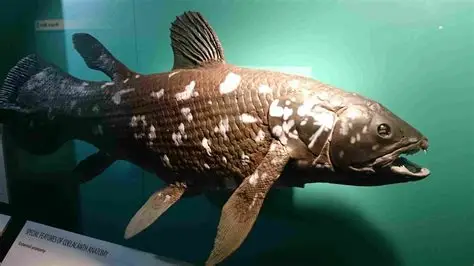
The Ghost Fish Story: Believed Lost to Time
Imagine a creature so ancient, so utterly prehistoric, that scientists were convinced it had vanished from the face of the Earth alongside the mighty dinosaurs. We're talking about a fish that was thought to have waved its final fin about 66 million years ago. Its fossil record ended abruptly with the Cretaceous-Paleogene extinction event – the very same cataclysm that wiped out T-Rex and Triceratops. For millions of years, the coelacanth was nothing more than a magnificent footnote in the textbooks of paleontology, a prime example of evolutionary history laid to rest. Scientists marvelled at its unique structure, particularly its intriguing, lobe-like fins, but never expected to see one alive. It was a ghost, a legend, a creature consigned to the annals of deep time. Until one fateful day, that is, when the seemingly impossible happened.
The Unbelievable Comeback: A Tale from 1938
Fast forward to December 22, 1938. The setting: a fishing trawler off the coast of East London, South Africa. The protagonist: Marjorie Courtenay-Latimer, curator of the local museum. She received a call about an unusual catch, a 'beautiful blue fish' unlike anything ever seen. Intrigued, she rushed down to the docks. What she found was a five-foot-long, steel-blue fish with iridescent scales, startling eyes, and those strange, limb-like fins. It was utterly baffling. After sketches and careful preservation (in challenging circumstances, mind you!), she contacted Professor J.L.B. Smith, a renowned ichthyologist. When Smith finally saw the specimen, his jaw must have hit the floor. He famously exclaimed, "I would not have been more surprised if I had encountered a dinosaur on the street!" This wasn't just a new species; it was a living coelacanth, a fish thought extinct for 66 million years! The scientific world erupted. It was like finding a living saber-toothed tiger!
Why So Special? Unpacking the "Living Fossil" Label
The term "living fossil" is often tossed around, but for the coelacanth, it fits like a glove made of ancient scales. This isn't just an old fish; it's a direct descendant of a lineage that peaked during the Devonian Period, over 400 million years ago! That's before dinosaurs even existed! Its body plan has remained remarkably unchanged over geological epochs. Why is this a big deal? Because it provides an unparalleled window into the past, offering clues about evolutionary processes, adaptation, and even the very origins of land vertebrates. Its discovery wasn't just a biological curiosity; it was like opening a time capsule to a crucial moment in life's history on Earth.
Coelacanth Superpowers: What Makes It Tick?
Beyond its incredible history, the coelacanth boasts some truly fascinating features:
- Lobed Fins: The Precursor? Unlike most fish with ray fins, the coelacanth possesses fleshy, limb-like fins supported by bone. These are strikingly similar to the ancestral limbs of tetrapods (four-limbed vertebrates). While coelacanths themselves didn't crawl onto land, they represent a close relative of the fish that did, giving us an exciting glimpse into that pivotal evolutionary moment. They use these fins to 'walk' along the seabed, not just swim!
- The Rostral Organ: Nature's Radar. Located in its snout, the coelacanth has a unique electroreceptive organ called the rostral organ. This allows it to detect weak electrical fields, helping it find prey in the pitch-black depths where light barely penetrates. It's like having built-in sonar!
- Unique Scales: Armored & Ancient. Its large, rough, and plate-like cosmoid scales are another ancient feature, forming a protective armor. These are very different from the scales of most modern fish.
- Slow Living: A Prehistoric Pace. Coelacanths are slow-motion masters. They have an incredibly slow metabolism, leading to a long lifespan – possibly up to 100 years! This leisurely pace of life is well-suited to their deep-sea environment where food can be scarce.
- Live Birth: A Deep-Sea Nursery. Unlike most fish that lay eggs, coelacanths are ovoviviparous. Females carry their young internally for a gestation period estimated to be up to five years – one of the longest of any vertebrate! The pups hatch inside the mother and are born fully formed, miniature versions of the adults, ready to face the deep.
A Deep Dive into Its Mysterious World
So, where do these majestic time-travelers hang out? Coelacanths are true denizens of the deep. They prefer cold, dark waters between 100 to 500 meters (330-1,600 feet) down, often near volcanic islands or rocky slopes. They spend their days lurking in caves or crevices, using their unique fins to maintain position or slowly drift. At night, they become active hunters, ambushing smaller fish, squid, and other cephalopods. Their large eyes are adapted for low light, and that rostral organ is crucial for sensing prey in the absolute blackness. Observing them in their natural habitat is incredibly challenging, making every snippet of information about their behavior precious.
A Second Splash: The Indonesian Twist
For decades after 1938, only one species of coelacanth was known, Latimeria chalumnae. But in 1997, another incredible discovery was made! A second, distinct species, Latimeria menadoensis, was found in the waters off Sulawesi, Indonesia. This new coelacanth was brownish-gray, differing in color and some genetic markers from its African cousin. This find demonstrated that the coelacanth's survival wasn't a one-off miracle but perhaps a testament to its incredible adaptability and the vast, unexplored mysteries of our oceans. Two species, living on opposite sides of the Indian Ocean, quietly defying extinction for millions of years – talk about a plot twist!
What Can This Ancient Mariner Teach Us?
The coelacanth isn't just a cool fish; it's a living textbook. It challenges our understanding of evolution, adaptation, and even extinction. Its existence proves that the fossil record isn't always complete and that nature holds countless surprises. Scientists continue to study its unique physiology, genetics, and behavior, hoping to unlock secrets about ancient life, the transition from water to land, and how some species manage to survive radical environmental shifts largely unchanged. Every observation, every sample, brings us closer to understanding one of Earth's most enduring biological enigmas.
Swimming Against the Tide: Conservation Challenges
Despite its incredible resilience, the coelacanth is far from out of the woods. Both species are listed as Critically Endangered (L. chalumnae) or Vulnerable (L. menadoensis) by the IUCN. They face threats primarily from accidental capture by deep-sea fishing trawlers and long-lines, as well as habitat degradation and pollution. Their slow reproductive rate and long gestation period make them particularly susceptible to population decline, as they cannot recover quickly from losses. Conservation efforts are crucial, focusing on raising awareness, establishing marine protected areas, and implementing sustainable fishing practices to ensure this magnificent "living fossil" continues its prehistoric journey for millions more years.
The Enduring Enigma of the Deep
The coelacanth's story is a powerful reminder that our world is full of wonders, many of them still hidden beneath the waves. From a creature believed lost with the dinosaurs to a vibrant, living testament to the tenacity of life, its journey is nothing short of epic. It challenges our assumptions, sparks our imagination, and compels us to protect the precious biodiversity that still thrives in the farthest reaches of our planet. So, next time you hear about a fish, remember the coelacanth – the ancient mariner that truly refused to die, and continues to swim against the currents of time, a true marvel of evolution!






Discussion
Comments
Approved comments are published after moderation to keep discussion useful and spam-free.
No comments yet. Start the discussion below.