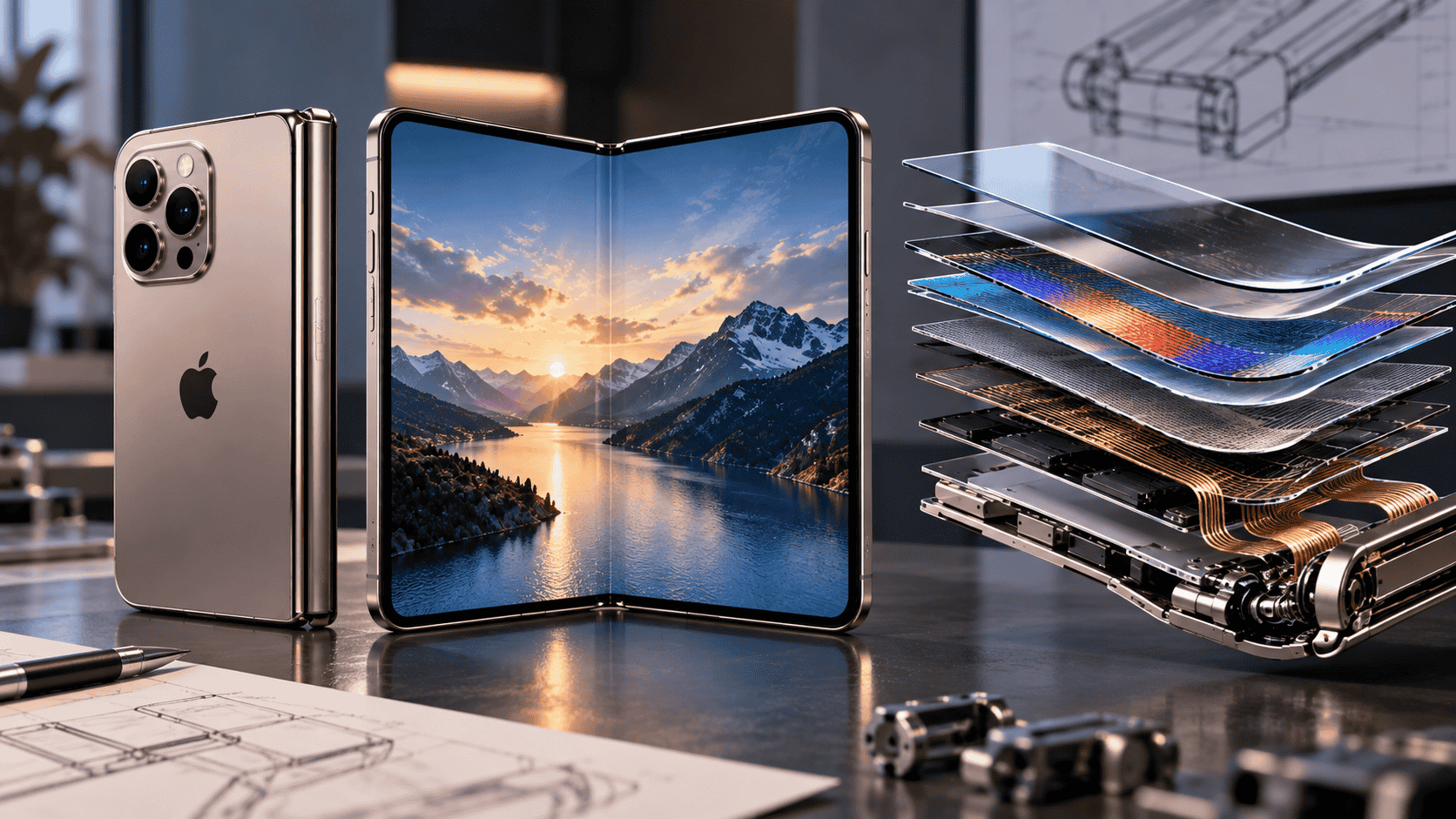
Glass normally cracks when you bend it. Yet modern foldable phones repeatedly bend displays containing ultrathin glass, OLED electronics and touch sensors. The secret is not one magical flexible material—it is an engineered stack in which every layer, adhesive and hinge works to keep destructive strain away from the most fragile components.
How Can Glass Fold Without Breaking? Inside the Engineering of Foldable Phone Screens
Apple’s first foldable iPhone has reopened one of the strangest questions in consumer technology: if glass is brittle, how can a phone screen fold in half again and again? The answer involves glass thinner than a human hair, carefully positioned “neutral planes,” adhesives that slide microscopically, and a hinge whose real job is protecting the screen from physics.
By Design & Technology Desk | Thursday, September 10, 2026
Take the glass from an ordinary window.
Try to bend it.
You already know what happens.
It cracks.
Now look at a modern foldable smartphone.
Close it.
Open it.
Close it again.
A display filled with microscopic electronic components bends through the same region over and over.
Some manufacturers design these systems to withstand hundreds of thousands of folding cycles.
That seems to violate everything we intuitively understand about glass.
It doesn't.
The trick is that a folding screen is not simply a flexible piece of glass.
It is a carefully engineered sandwich containing multiple materials, each doing a different job.
And the most important engineering achievement may be something you cannot see:
controlling exactly where mechanical stress goes when the phone bends.
Apple's newly announced iPhone Duo provides a particularly timely example. Apple says its folding display uses high-strength glass around the display panel, specialized adhesives that allow layers to move relative to one another, a protective polymer surface, a titanium support plate and a hinge built from more than 100 components.
To understand why all of that is necessary, we need to begin with a surprisingly simple question.
Why Does Glass Break When You Bend It?
Glass is strong in some ways and vulnerable in others.
It can resist considerable compression.
But it is brittle.
When ordinary thick glass is bent, one surface is compressed while the opposite surface is stretched.
That tensile strain is dangerous.
Tiny microscopic defects in the glass can act as starting points for cracks.
Once a crack begins propagating through brittle glass, failure can happen suddenly.
Now change one thing:
make the glass extremely thin.
The thinner a sheet becomes, the less its outer surface has to stretch for a given bending radius.
That is why a thin strip can bend much farther than a thick slab made of broadly similar material.
Samsung Display describes ultra-thin glass used in foldables as less than 100 micrometres thick; one of its established UTG implementations was about 30 micrometres, compared with roughly 0.5 millimetres for a conventional rigid OLED cover window.
Thirty micrometres is:
0.03 millimetres.
For comparison, a typical human hair is often somewhere around several tens of micrometres thick.
Foldable glass can therefore approach hair-like dimensions.
At that scale, something we normally think of as rigid begins behaving very differently.
The Glass Isn't Doing the Folding Alone
Calling these devices “folding glass screens” creates another misconception.
The display is a multilayer system.
A modern foldable OLED can contain layers for:
a protective surface,
ultrathin glass,
optically clear adhesive,
touch sensing,
polarization or optical management,
OLED emitters,
thin-film transistors,
encapsulation,
support films,
and structural reinforcement.
Research reviews of deformable displays emphasize that engineering these interacting layers—and controlling their mechanical neutral planes—is fundamental to making repeated folding possible.
If manufacturers simply glued a stack of rigid materials together and folded it sharply down the center, something would eventually:
crack,
peel,
delaminate,
or permanently deform.
The secret is allowing the stack to behave as a coordinated mechanical system.
OLED Is Important Because It Doesn't Need a Rigid Backlight
Traditional LCD screens rely on a backlight behind the image-forming layers.
OLED works differently.
Each OLED pixel emits its own light.
That architecture makes it possible to fabricate extremely thin displays on flexible substrates.
But “OLED is flexible” does not mean every material inside an OLED panel is naturally happy being folded.
Some transparent electrodes and encapsulation materials can be relatively brittle.
A recent Nature Communications review notes that certain oxide and nitride encapsulation layers used in OLEDs can crack at comparatively small strain levels.
So engineers cannot simply make the screen thinner and hope for the best.
They have to hide fragile layers from the worst mechanical forces.
That leads us to one of the most important concepts in foldable-display engineering.
Meet the “Neutral Plane”
Take a stack of paper.
Bend it gently.
The outside pages have to travel farther around the curve.
They stretch relative to the center.
The inner pages travel a shorter path.
They experience compression.
Somewhere between them is a region that barely changes length at all.
Engineers call this the neutral plane.
In a simplified bending structure:
material outside the neutral plane stretches,
material inside it compresses,
and material near the neutral plane experiences much less longitudinal strain.
So if you have a fragile electronic layer that hates stretching, where would you place it?
As close as possible to the neutral plane.
Research on flexible electronics has repeatedly shown that positioning delicate components near a neutral bending plane can dramatically improve their ability to survive tight curvature.
This is one of the hidden superpowers of foldable displays.
The screen does not defeat mechanical stress.
Engineers redirect it.
A Foldable Screen Can Have More Than One Neutral Plane
Now things get even stranger.
A smartphone display is not one homogeneous sheet.
It is a stack of materials with different stiffnesses.
Some layers are hard.
Some are soft.
Some adhesives behave almost like transparent rubber.
Because those layers can slide and deform relative to each other, researchers have shown that a foldable AMOLED stack can effectively develop multiple neutral planes rather than behaving like one solid block.
That is extremely useful.
It means designers can reduce strain across several fragile parts of the display simultaneously.
And the material that helps enable this is something most buyers never think about:
glue.
The Glue May Be as Important as the Glass
Inside a foldable display are layers of optically clear adhesive, usually abbreviated OCA.
The adhesive must do several contradictory things.
It must:
remain completely transparent,
hold layers securely together,
survive heat and cold,
avoid bubbles,
resist peeling,
and still deform repeatedly when the phone folds.
Make it too rigid and the stack cannot relieve stress.
Make it too soft and layers can shift excessively or delaminate.
Research published in 2026 continues to focus specifically on this problem. One study developed a gradient adhesive structure intended to redistribute stress and suppress crease formation while maintaining adhesion.
Another 2026 study notes that as foldable devices become thinner and bending radii approach roughly one millimetre, deformation inside adhesive layers rises rapidly, increasing the challenge of maintaining reliable interfaces.
So one of the most advanced materials inside a $2,000 foldable phone may effectively be:
invisible transparent glue.
Apple Says Its Display Layers Actually Slide
This is where Apple's iPhone Duo design becomes particularly interesting.
Apple says high-strength glass sits above and below the folding display panel.
Between layers are custom adhesives designed so the individual layers can move slightly relative to each other during bending.
Apple compares the movement to pages sliding past one another in a book.
That is a beautiful mechanical analogy.
Imagine trying to bend a 500-page book if every page were permanently bonded into one rigid brick.
Much harder.
Allow each page a tiny amount of relative movement and the stack curves naturally.
Foldable displays exploit a sophisticated version of the same principle.
The objective is to reduce peak strain on the most vulnerable layers.
The Hinge Is Really a Display Protection System
When people see a foldable-phone hinge, they tend to think its purpose is:
make phone open and close.
That is only half the story.
The hinge determines the shape of the bend.
And bend shape directly determines screen stress.
Imagine folding a sheet sharply around the edge of a ruler.
Now bend the same sheet around a marker pen.
The second curve has a larger radius.
It is gentler.
Modern foldable hinges increasingly use curved or “waterdrop”-style paths that allow the display to form a broader loop inside the hinge rather than being crushed into one extremely sharp fold.
Corning notes that modern foldable designs increasingly use tighter waterdrop hinges and that bendable glass has to withstand hundreds of thousands of repeated bending cycles.
Samsung Display advertises foldable OLED configurations with a minimum curvature around 1.4R, while using staggered display layers to reduce folding stress.
The hinge therefore acts almost like suspension on a car.
You may notice the metal hardware.
Its deeper purpose is controlling the forces experienced by something more fragile.
Apple's Hinge Has More Than 100 Components
Apple says iPhone Duo's precision hinge contains more than 100 components.
It is designed not only to control opening and closing but also to support the center of the display when completely unfolded.
Magnets help create a secure closed position.
Internal structural ribs reinforce the chassis, and Apple uses Grade 5 titanium in the body and hinge cover.
Why support the display when open?
Because a flexible screen cannot simply float unsupported over an empty cavity.
When someone:
taps,
swipes,
writes with Apple Pencil,
or presses the center of the display,
the structure beneath it must distribute that force.
A foldable screen has to be flexible while folding—
and feel rigid while being used.
Those requirements fight each other.
The hinge helps reconcile them.
Then Why Do Foldable Phones Still Have a Crease?
If all this engineering is so sophisticated, why can you often still see a line running down the middle?
Because materials remember stress.
Repeated bending creates a localized region where:
glass,
polymers,
adhesives,
OLED layers,
and support materials
experience cyclic deformation.
Even if nothing breaks, microscopic changes in geometry can alter how the surface reflects light.
Adhesives are especially important because they are viscoelastic.
That means their behavior contains aspects of both:
an elastic solid
and
a slowly deforming viscous material.
Repeated folding can therefore create residual deformation.
Research into foldable-panel mechanics specifically identifies OCA behavior, strain distribution and interlayer mechanics as contributors to crease formation and delamination risk.
A crease is therefore not simply a cosmetic manufacturing mistake.
It is partly the visible signature of repeatedly bending a complex multilayer structure.
Why Does a Waterdrop Hinge Reduce the Crease?
Return to the ruler-versus-marker example.
A larger bend radius generally spreads deformation across a wider area.
Instead of concentrating all mechanical strain along one narrow line, the structure distributes it.
That can:
reduce peak strain,
reduce material fatigue,
and make the resulting crease less severe.
But a larger internal loop requires space.
So manufacturers must balance:
phone thickness,
hinge dimensions,
screen flatness,
crease visibility,
and mechanical durability.
There is no free solution.
A tighter fold makes the device compact.
A gentler fold can protect the screen.
The hinge negotiates between them.
Why Doesn't Apple Claim the Crease Is Gone?
Apple says the iPhone Duo's nano-texture surface reduces glare and minimizes crease visibility.
That wording matters.
Apple does not say:
“There is no crease.”
The device has not yet reached customers, so we also do not know how the fold will appear after:
10,000 folds,
50,000 folds,
a year of pocket lint,
hot summer temperatures,
winter mornings,
or repeated stylus use.
The engineering may be excellent.
Long-term durability still needs real-world evidence.
That gives buyers a useful rule:
Never confuse launch-day durability claims with long-term durability data.
Why Put Polymer Over Expensive Glass?
Another common misunderstanding is that the surface you touch must simply be bare ultrathin glass.
Foldable screens often use additional protective layers because ultrathin glass alone faces a difficult compromise.
Make glass thinner:
it bends more easily.
But it also provides less resistance to concentrated impact.
Apple says the Duo's inner screen uses a scratch-resistant coating and a nano-textured cover layer made from a custom polymer. The company claims that polymer is up to 40% stiffer than comparable materials used in the industry.
Again, that 40% figure is Apple's test claim, not independent long-term evidence.
But the architecture illustrates the underlying principle.
You do not ask one miraculous material to provide:
flexibility,
scratch resistance,
impact protection,
clarity,
touch feel,
and structural support.
You build a stack where different layers specialize.
Is Ultrathin Glass Actually “Glass”?
Yes.
This sometimes surprises people because we associate glass with rigidity.
Corning describes its bendable material explicitly as real ultra-thin glass engineered to flex repeatedly.
Samsung likewise describes UTG as chemically strengthened glass processed thin enough to bend while retaining glass-like optical and scratch-resistance characteristics.
The physics is not magic.
Thickness changes mechanical behavior dramatically.
A thick tree branch feels rigid.
A very thin wooden shaving bends.
A thick metal bar resists curvature.
Metal foil flexes easily.
Material identity stays the same.
Geometry changes what the material can tolerate.
But Why Doesn't the OLED Pixel Break?
OLED pixels themselves are fabricated as extremely thin films.
Thin structures can accommodate much greater bending than thick ones.
The real challenge lies not only in the light-emitting organic layers but in:
electrodes,
thin-film transistors,
encapsulation,
wiring,
and interfaces.
Moisture is particularly dangerous to OLED materials.
So the display needs barrier layers that keep oxygen and water out while still surviving bending.
That creates another contradiction:
excellent moisture barriers are often made using inorganic materials that can themselves be brittle.
Research therefore uses multilayer encapsulation combining organic and inorganic materials so the structure can maintain barrier performance without cracking during repeated folding.
This is why flexible display engineering is fundamentally a materials science problem.
What Happens When One Layer Fails?
A folding screen does not need to shatter dramatically to fail.
Several quieter failure modes exist.
The adhesive can separate.
That is delamination.
A barrier layer can crack.
Moisture may then damage OLED material.
A conductive trace can fatigue.
Pixels may fail.
The cover material can develop surface damage.
The hinge can introduce uneven pressure.
A foreign particle can press upward underneath the panel.
Research analyzing OLED panels bonded with optically clear adhesives finds that the highest debonding risks can appear around transitions between folding and non-folding regions, where mechanical stress concentrates.
So when engineers perform thousands of fold cycles, they are not merely testing whether the phone still opens.
They are looking for slow mechanical damage accumulating inside invisible interfaces.
Why Was the First Galaxy Fold Such an Important Failure?
When Samsung's original Galaxy Fold reached reviewers in 2019, several early devices experienced display failures.
Some reviewers removed what looked like an ordinary screen protector but was actually part of the display structure.
Other problems involved debris entering around the hinge region.
Samsung delayed the launch and redesigned aspects of the device.
That episode was embarrassing.
It was also enormously important for the industry.
It showed manufacturers that a foldable device needed to survive not just laboratory bending machines but human behavior.
Users:
pick at films,
drop phones,
carry them in dusty pockets,
press screens,
and misunderstand unfamiliar hardware.
A technically successful flexible display is not automatically a successful consumer product.
Industrial design has to anticipate misuse.
Why Are Manufacturers Still Improving Foldables Seven Years Later?
Because there is no single “foldable screen problem.”
There are dozens.
Make the hinge thinner and structural rigidity may suffer.
Make the screen harder and flexibility may fall.
Make the adhesive softer and layers can shift.
Make it stronger and folding stress may increase.
Reduce the bending radius and the phone becomes thinner.
But strain increases.
Increase protective layers and durability improves.
But thickness and weight rise.
Samsung Display's 2026 panels, for example, incorporate titanium reinforcement and refined support structures intended to improve impact distribution while also reducing crease visibility.
Apple's newly announced Duo uses its own combination of titanium support, custom adhesives and polymer protection.
Different companies are solving the same physics through different engineering compromises.
Will Foldable Screens Ever Feel Exactly Like Normal Glass?
Possibly—but that remains one of the industry's most difficult goals.
Conventional smartphone cover glass offers a combination users now take for granted:
hardness,
clarity,
scratch resistance,
smooth touch,
impact resistance,
and rigidity.
A folding display asks for all of those—
plus repeated bending.
That last requirement changes everything.
A material optimized for maximum hardness usually does not naturally want to behave like a flexible film.
Future improvements could come from:
better ultrathin glass,
advanced polymers,
new protective coatings,
stronger transparent electrodes,
improved encapsulation,
more sophisticated adhesives,
and hinges that distribute strain more effectively.
The long-term objective is a folding screen whose unusual mechanics disappear from the user's awareness.
When people stop thinking about the fold—
the technology has matured.
Could We Eventually Fold a Phone More Than Once?
Already, yes.
Manufacturers have demonstrated tri-fold concepts and commercial devices with more than one folding region.
But every additional fold multiplies the engineering challenge.
Now there are:
two hinges,
multiple crease zones,
more variable bending states,
larger moving display areas,
and more locations where stress can accumulate.
Corning explicitly describes bendable-glass development as moving toward tighter waterdrop hinges and tri-fold form factors.
The future may therefore extend beyond:
phone → tablet.
We could eventually see displays that transform:
phone → tablet → small desktop canvas.
But only if materials can survive the choreography.
The Future May Be Rollable Instead
There is another route.
Instead of folding sharply at one location, a display could roll gradually around a cylinder.
A rollable screen distributes curvature differently and can avoid one permanent central crease.
Prototype rollable OLED devices already demonstrate the concept.
But they introduce their own problems:
motorized mechanisms,
dust protection,
moving chassis sections,
variable structural support,
and large areas of flexible material.
Foldable, rollable and stretchable screens are therefore different answers to the same design problem:
How do we make screen size independent of device size?
That question may define the next decade of display engineering.
So How Many Times Can a Foldable Screen Bend?
There is no universal number.
It depends on:
the display,
hinge,
temperature,
bending radius,
test methodology,
and manufacturer.
Samsung Display has advertised UTG systems verified for more than 200,000 folding cycles under particular laboratory conditions.
Corning says its ultra-thin bendable glass is engineered for hundreds of thousands of folds over a device's lifetime.
Apple has announced extensive durability engineering for iPhone Duo but its current public materials do not provide the kind of long-term independent consumer evidence that will exist after the device reaches users.
A fold-count number should therefore never be interpreted as:
“Your phone will definitely survive exactly this many folds.”
Laboratory cycles and daily life are different.
Temperature Matters More Than Most Buyers Realize
Polymers and adhesives change behavior with temperature.
A material that flexes comfortably at room temperature may become:
stiffer in cold conditions,
or softer when hot.
Repeated folding at extreme temperatures can therefore create different mechanical stresses.
This is another reason durability testing uses multiple environmental conditions rather than simply opening and closing a phone in an office laboratory.
The challenge is especially important because a foldable display combines materials with different coefficients of thermal expansion.
Heat one layer and it may expand more than its neighbor.
Cool it and the relationship changes again.
The adhesive interfaces have to absorb those differences without losing optical clarity or mechanical integrity.
Why the iPhone Duo Is Such a Good Materials-Science Story
Apple's first foldable arrived years after the category itself.
That delay gives us a useful way to understand the technology.
The company was not waiting for somebody to invent “flexible pixels.”
Those have existed for years.
The harder challenge was building an entire consumer device around them.
Apple's public design reveals that the solution requires:
100+ hinge components
to control motion,
Grade 5 titanium
for structural strength,
high-strength glass
around the folding panel,
custom sliding adhesives
to relieve bending stress,
a titanium support plate,
and a special polymer cover
protecting the surface.
None of those alone is the breakthrough.
The breakthrough is making all of them work together.
The Foldable Screen Is a Machine Disguised as a Surface
That may be the best way to understand the technology.
Look at an ordinary smartphone screen.
It appears passive.
Flat glass.
Pixels underneath.
A folding display is different.
Its surface is part of a mechanical system.
Every time you close the phone:
the hinge rotates,
the bend radius changes,
glass flexes,
adhesive layers shear,
polymers stretch,
other layers compress,
the neutral planes shift,
and support structures reposition.
Then everything has to return almost exactly to where it started.
Again.
And again.
And again.
The user sees:
a screen folding.
The engineer sees:
a controlled redistribution of strain through a multilayer composite structure.
So Why Doesn't the Glass Break?
Because designers never ask ordinary thick glass to perform an impossible sharp fold.
They:
make glass extraordinarily thin,
use OLED structures capable of bending,
place vulnerable electronics near low-strain regions,
separate layers with carefully engineered adhesives,
allow microscopic sliding between materials,
control the curvature using the hinge,
support the panel mechanically,
and protect the outer surface using additional coatings and polymers.
The screen does not break the laws of physics.
It is designed around them.
That is what makes the technology so impressive.
Seven years after the first mainstream book-style foldables arrived, the industry is still refining:
crease,
thickness,
durability,
weight,
and touch feel.
Apple's iPhone Duo will now put those problems in front of an entirely new group of consumers.
Its $1,999 price gets attention.
But underneath that price is a more fascinating story.
A piece of glass can now bend because engineers have reduced its thickness to almost unbelievable dimensions.
OLED electronics can fold because their most fragile layers are deliberately protected from strain.
A hinge can preserve a display because it controls not merely whether the phone closes—
but exactly how every microscopic layer bends while it does.
The next time you unfold a phone, look at the crease.
That small line across the center is where:
physics,
chemistry,
mechanical engineering,
materials science,
and industrial design
have spent years negotiating with one another.
The remarkable thing is not that the crease still exists.
The remarkable thing is that the screen survives at all.
Frequently Asked Questions
How can glass bend without breaking?
Glass becomes much more bendable when made extremely thin because the outer surfaces experience less strain at a given bend radius. Foldable devices use specially engineered ultra-thin glass rather than conventional thick smartphone cover glass.
How thin is ultra-thin glass in foldable phones?
UTG is generally below 100 micrometres thick. Samsung Display has described one of its established foldable UTG structures as approximately 30 micrometres thick.
Are foldable phone screens made entirely from glass?
No. They are multilayer structures containing OLED electronics, adhesives, protective materials, touch and optical layers, thin glass or other cover materials, encapsulation and structural support.
What is the neutral plane in a folding screen?
It is a region within a bending structure that experiences relatively little stretching or compression. Fragile electronic layers can be positioned near neutral planes to reduce damaging strain.
Why do foldable screens have creases?
Repeated bending produces localized mechanical deformation across glass, polymer and adhesive layers. Viscoelastic adhesive behavior and stress distribution within the display stack contribute to visible crease formation.
Can manufacturers completely eliminate the crease?
They can reduce its visibility through larger-radius hinge designs, improved support structures, adhesives and optical treatments, but current manufacturers generally speak of reducing or minimizing the crease rather than proving it is completely absent.
What does the foldable-phone hinge do?
Besides opening and closing the device, it controls the radius and geometry of the folding display, supports the screen when open and helps distribute mechanical stress.
How many components are in the iPhone Duo hinge?
Apple says its precision hinge contains more than 100 components.
What protects the iPhone Duo's inner screen?
Apple describes high-strength glass around the folding panel, custom adhesives, a titanium support plate, scratch-resistant coating and a nano-textured polymer cover layer.
Does the iPhone Duo use ordinary glass?
No. Apple's folding display uses an engineered multilayer structure specifically designed to accommodate bending. The company distinguishes it from the rigid Ceramic Shield protecting the external surfaces.
How many times can a folding screen be folded?
There is no universal number. Samsung Display has publicized laboratory verification exceeding 200,000 folds for certain UTG systems, while Corning says its bendable glass is engineered for hundreds of thousands of bends.
Why is OLED used in foldable phones instead of LCD?
OLED can be fabricated as an extremely thin self-emissive display without a conventional rigid backlight, making flexible and folding architectures more practical.
Can a foldable screen still crack?
Yes. Flexibility does not make the display indestructible. Impact, debris, excessive pressure, damaged hinges, extreme conditions or accumulated material fatigue can still cause failure.
Why are foldable phones expensive?
Beyond conventional smartphone components, they require flexible OLED panels, specialized cover materials, precision hinges, complex adhesives, structural reinforcement and demanding manufacturing and durability testing.
Are rollable screens better than foldable screens?
They solve some mechanical problems differently, potentially avoiding one sharp permanent crease, but they introduce other challenges involving moving chassis structures, motors, dust protection and screen support.
Why Does Apple's First Foldable iPhone Cost $1,999?
Editorial Note: Apple announced iPhone Duo on September 9, 2026 and says its folding display uses custom adhesives, high-strength glass, a polymer protection layer and structural support designed to reduce bending stress. The device has not yet accumulated independent long-term consumer durability data, so manufacturer durability and material-performance claims should be identified as such until production devices have undergone extensive independent testing.
Foldable phones contain glass, OLED pixels and fragile electronics—yet bend repeatedly. Here’s how ultrathin glass, hinges and adhesives make it possible.
foldable OLED screen, ultra thin glass, foldable phone crease, how folding screens bend, iPhone Duo display, flexible OLED, foldable phone hinge, UTG glass
foldable phone durability, best foldable phone 2026, foldable screen repair, foldable OLED display, iPhone Duo durability, Samsung Fold durability
Foldable Phones, OLED, Ultra Thin Glass, iPhone Duo, Apple, Samsung Display, Materials Science, Smartphone Design, Flexible Displays, Industrial Design