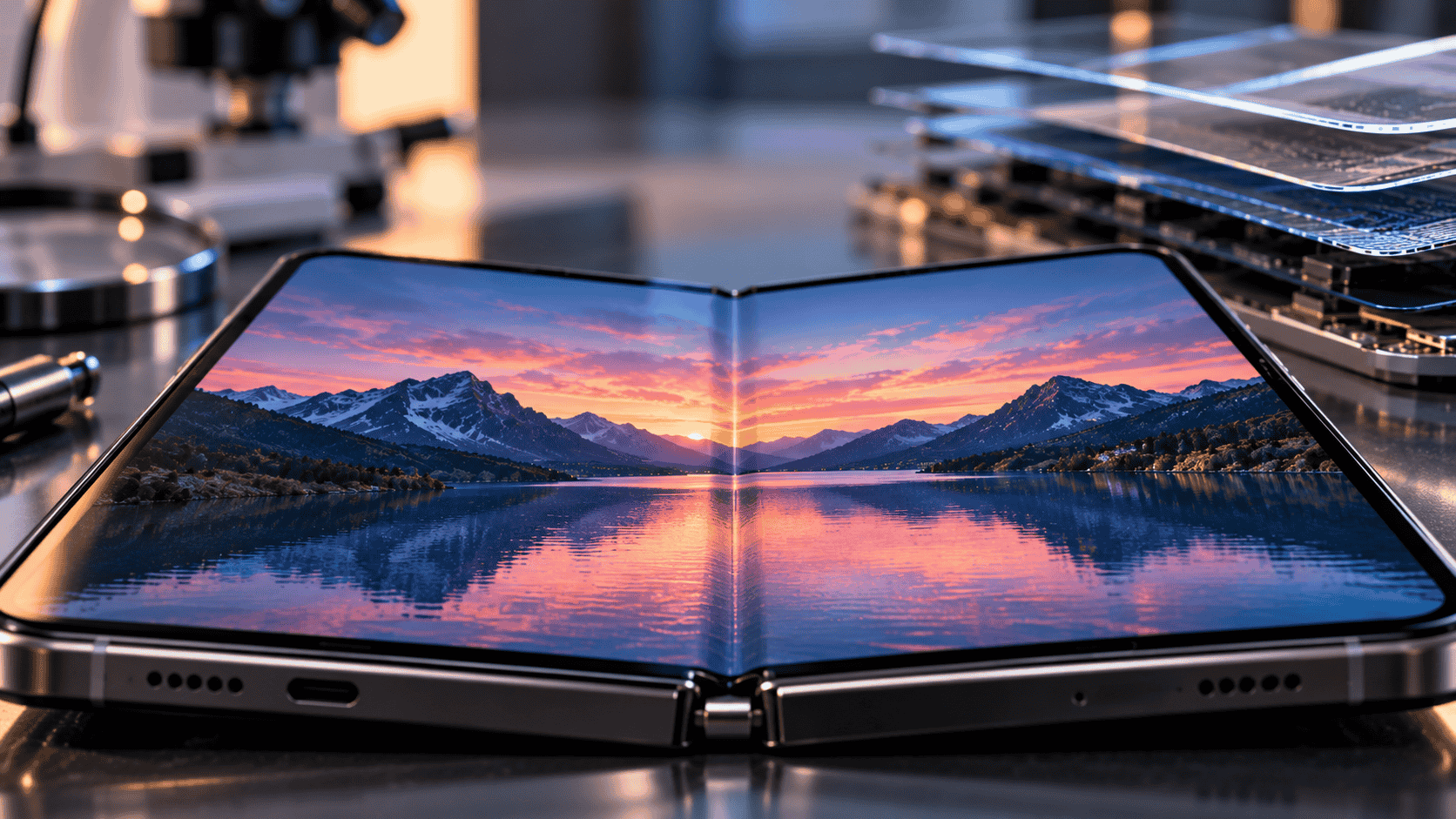
Foldable phones can now survive hundreds of thousands of bends, yet most still show a line where the screen folds. The reason is not simply weak glass. The crease emerges from the entire display stack—glass, polymers, OLED layers, adhesives and the hinge—all deforming differently every time the phone closes.
Why Do Foldable Phone Screens Still Have a Crease—and Can Engineers Ever Remove It?
Samsung has spent years fighting it. Apple says its new iPhone Duo minimizes it. Materials scientists are now redesigning even the invisible glue beneath the screen to suppress it. So why, after billions of dollars of display engineering, does the foldable-phone crease refuse to disappear?
By Design & Materials Science Desk | Thursday, September 10, 2026
Open a modern foldable phone under the right light.
Tilt it slightly.
There it is.
A faint valley running vertically through the center of the display.
Sometimes you barely notice it while watching a movie.
Sometimes sunlight catches it perfectly and the fold becomes impossible to ignore.
For years, manufacturers have improved almost everything around that line.
Foldable phones have become:
thinner,
lighter,
more water-resistant,
better sealed,
more powerful,
and mechanically stronger.
Hinges have evolved from bulky mechanical joints into extraordinarily compact systems.
Ultra-thin glass can survive enormous numbers of bending cycles.
OLED panels themselves can flex repeatedly.
Yet the crease remains.
Apple's newly announced iPhone Duo provides the latest example.
Apple says its folding display uses a special nano-textured surface and an elaborate multilayer structure designed to minimize crease visibility. Notice the word Apple chose:
minimize.
Not eliminate.
That wording points toward an uncomfortable truth about foldable displays.
The crease is not one defective component waiting to be fixed.
It is the visible result of a much deeper mechanical problem:
how do you repeatedly bend a stack of materials that all deform differently—and then make the stack return perfectly flat?
That is much harder than making something flexible.
A Foldable Screen Is Not One Flexible Sheet
When you touch a foldable display, it looks like one surface.
Mechanically, it is anything but.
A modern foldable OLED is constructed from a stack containing multiple functional layers.
Depending on the design, these can include:
ultrathin glass,
protective polymer,
optically clear adhesive,
touch-sensing layers,
OLED electronics,
thin-film encapsulation,
support films,
and structural plates.
Research into deformable displays describes the management of these multiple layers and their neutral planes as one of the fundamental challenges of foldable-display engineering.
When the phone folds, every one of those layers follows a slightly different path around the bend.
The material on the outside of the curve has to travel farther.
It stretches.
The material toward the inside is compressed.
Somewhere between them is a region that experiences relatively little strain.
But because the display contains many materials with very different mechanical properties, it does not behave like a single sheet of paper.
It behaves more like an incredibly thin laminated machine.
And every fold asks those layers to negotiate with one another.
The Crease Is What Happens When the Materials Remember
Imagine repeatedly bending a plastic ruler in exactly the same place.
You may never actually snap it.
But eventually you may see a faint whitening or deformation where the material has been stressed.
Foldable displays experience a vastly more sophisticated version of this effect.
The materials inside them are designed to remain within safe strain limits.
But some of those materials are viscoelastic.
They behave partly like elastic solids and partly like materials that slowly flow under stress.
That matters particularly for the transparent adhesives bonding the display together.
After thousands of folding cycles, those layers may not return to precisely their original geometry immediately.
Tiny differences accumulate.
The surface may develop microscopic curvature.
Light reflecting from that region changes.
Your eye sees:
a crease.
So the crease does not necessarily mean the screen is about to fail.
It can instead be the optical signature of repeated mechanical deformation.
The Invisible Glue Is One of the Main Suspects
This may be the strangest part of the entire story.
One of the most important materials controlling the appearance of a $2,000 foldable screen is:
transparent glue.
Manufacturers use optically clear adhesives, or OCAs, to bond layers together.
These adhesives must be:
transparent enough not to damage display quality,
strong enough to prevent layers separating,
soft enough to accommodate repeated bending,
stable in heat,
stable in cold,
and durable through thousands of mechanical cycles.
Those properties conflict.
A very stiff adhesive holds layers firmly.
But it can transfer more bending stress into fragile display components.
A very soft adhesive allows layers to move.
But too much movement can produce:
warping,
delamination,
or residual deformation.
This is why materials scientists are still publishing major research specifically about foldable-display glue.
In 2026, Researchers Redesigned the Glue to Fight the Crease
One of the most interesting new developments appeared in Polymer in April 2026.
Researchers created what they call a Janus optically clear adhesive.
“Janus” refers to the Roman god with two faces.
The material effectively has different mechanical characteristics through its thickness.
One side can accommodate deformation more easily.
The other provides greater structural strength.
According to the study, this gradient in crosslinking density helps redistribute stress during folding and suppress crease formation while preserving adhesion.
That is an important conceptual shift.
Instead of asking one material to be equally soft everywhere, engineers can design an adhesive whose mechanical behavior changes depending on where the stress occurs.
The folding screen itself becomes a deliberately engineered gradient.
That is materials science operating almost invisibly beneath your finger.
Why Can't Manufacturers Just Make the Glue Even Softer?
Because then another problem appears.
Layers may start separating.
This is called delamination.
If the OLED stack begins peeling internally, the result can be far worse than a cosmetic crease.
You can get:
bubbles,
dead pixels,
display failure,
or contamination entering between layers.
Mechanical simulations of foldable AMOLED panels have shown that strain inside optically clear adhesive can concentrate around the transition between the folded and flat regions, while careful adjustment of adhesive thickness can help reduce peeling risk.
That means the screen designer is balancing at least two objectives:
reduce crease
while simultaneously
preventing layers from separating.
Solve one too aggressively and you can worsen the other.
Cold Weather Makes the Problem Harder
Foldable displays do not operate only inside comfortable laboratories.
People carry them into winter.
And polymers behave differently when cold.
A 2026 Microelectronics Reliability study examined seven commercial protective-film systems during repeated folding at −20°C.
The researchers focused specifically on how cold temperatures accelerate delamination and adhesion problems in foldable displays.
Why?
At low temperature, many polymer chains become less mobile.
Materials that are flexible at room temperature can become stiffer.
Now bend them repeatedly.
Stress rises.
Interfaces become more vulnerable.
So manufacturers cannot simply optimize a folding display for:
22°C in a laboratory.
It needs to survive:
freezing mornings,
hot cars,
humid summers,
pockets,
dust,
and years of repeated folding.
The crease you see is produced by a structure designed to survive all of those conditions simultaneously.
Why Does the Hinge Affect the Crease?
Because the hinge determines how sharply the screen bends.
Imagine wrapping a sheet around a pencil.
Now wrap another around a large bottle.
The pencil creates a much tighter radius.
The outer surface must stretch more sharply.
A larger bend radius reduces peak strain.
This is why modern foldables increasingly use so-called waterdrop hinges.
Instead of forcing the display into one extremely sharp V-shaped fold, the screen forms a broader teardrop-shaped loop inside the chassis.
Corning describes the industry's direction as moving toward tighter-profile waterdrop hinges while still requiring ultra-thin glass to survive hundreds of thousands of bends.
The engineering paradox is obvious.
Consumers want:
a thinner closed phone.
Display engineers want:
a gentler, larger bend radius.
Both cannot increase indefinitely.
Every millimetre becomes a negotiation between pocketability and display stress.
So Why Not Make the Fold Extremely Wide?
Because the hinge would become enormous.
Suppose you allowed the screen to bend around a large circular arc.
Mechanical strain would decrease significantly.
But the folded phone might have a thick, hollow spine.
Nobody wants a smartphone shaped like a binder.
So hinge engineers compress the folding geometry into an extraordinarily small volume.
The challenge becomes:
make the bend as gentle as possible while keeping the phone thin enough to sell.
That is one reason the central crease has proved so persistent.
The physical design consumers prefer creates the very stress engineers are trying to remove.
Apple's Approach: Let the Layers Slide
The iPhone Duo provides a particularly interesting solution.
Apple says the folding display uses high-strength glass above and below the folding panel, along with custom adhesives designed so the layers can move relative to one another during bending.
Apple compares the movement to the pages of a book sliding past each other.
Think about that carefully.
When you bend a thick book, the outside pages need to move farther than the inside ones.
If every page were permanently bonded into a rigid block, bending would be much harder.
Allow tiny amounts of sliding between pages and the structure accommodates the curve.
Apple is applying a microscopic version of the same idea inside the display stack.
That helps reduce stress.
But reducing stress does not necessarily mean the surface returns to perfectly flat geometry after unlimited folding cycles.
Hence:
minimized crease
rather than
no crease.
Apple Is Also Attacking the Optical Problem
A crease has two components.
One is physical:
the surface is not perfectly flat.
The other is optical:
light makes that imperfection visible.
Apple's inner Duo screen uses a nano-texture finish designed to reduce glare and reflections. The company specifically says it helps minimize the visibility of the crease.
How Can Glass Fold Without Breaking? Inside the Engineering of Foldable Phone Screens
This is clever because completely removing physical deformation may be far harder than making the deformation less visible.
If reflections are diffused, your eye receives fewer sharp highlights from the depressed region.
The crease can still physically exist while becoming less visually distracting.
In other words, one path to solving the crease problem is:
don't eliminate every micron of deformation.
Hide it from light.
Why Do You Notice a Crease More With the Screen Off?
This explains something many foldable owners have already experienced.
When the OLED is displaying a bright image, the light coming from the pixels can overwhelm subtle surface reflections.
Turn the screen off.
Now the dark surface behaves much more like a mirror.
Overhead lights reflect directly from the curved center region.
The crease becomes obvious.
Tilt the phone.
The reflection moves.
Suddenly the center line appears deeper than it looked seconds earlier.
That means crease visibility depends on:
viewing angle,
ambient lighting,
screen content,
surface coating,
and physical depth.
Two reviewers can therefore look at the same foldable and disagree completely about how noticeable its crease is.
Both may be telling the truth.
Is a Crease the Same Thing as Screen Damage?
No.
This distinction matters for buyers.
A normal crease is a predictable deformation associated with the folding region.
Actual display damage can include:
cracking,
dead pixels,
lifting layers,
bubbles,
flickering,
black lines,
or touch failure.
A visible center line alone does not mean the OLED has broken.
Corning explicitly describes ultra-thin bendable glass as being engineered to bend hundreds of thousands of times while helping reduce creasing in organic display layers.
The objective is controlled deformation.
The material is expected to bend.
The challenge is preventing that bending from crossing into irreversible failure.
Does More Crease Mean Less Durability?
Not necessarily.
This is another trap.
A manufacturer could make a screen appear flatter by increasing stiffness.
But increasing stiffness might raise stress somewhere else.
A slightly more visible crease could theoretically coexist with a mechanically safer folding geometry.
Conversely, a visually beautiful screen on day one might age poorly.
This is why consumers should be cautious about judging durability from launch photographs.
What matters is how the structure behaves after:
months of folding,
temperature changes,
surface pressure,
dust exposure,
and everyday accidental abuse.
Appearance and structural reliability are related.
They are not identical.
Why Manufacturers Test Hundreds of Thousands of Folds
Fold testing is essentially accelerated aging.
A machine repeatedly opens and closes the device.
Again.
Again.
Again.
Hundreds of thousands of times.
Corning says modern bendable glass is engineered to withstand this kind of repeated mechanical cycling throughout a device's useful life.
But a folding robot cannot perfectly reproduce a human.
People:
open phones at strange angles,
press on screens,
drop them,
leave them in cars,
carry grit in pockets,
fold them while cold,
and sometimes close them with foreign objects inside.
Laboratory fold counts therefore answer:
Can the mechanism survive controlled repetitive bending?
They do not guarantee:
this particular phone will survive your particular life.
Could a Harder Surface Eliminate the Crease?
Not by itself.
A harder surface can improve resistance to:
scratches,
nails,
pens,
and minor impacts.
But hardness and bendability frequently pull materials in opposite directions.
Make a cover thicker or significantly more rigid and it becomes harder to bend at a tight radius.
Make it extremely flexible and surface protection becomes more challenging.
Corning itself acknowledges that foldable glass must simultaneously provide bending ability and protect the OLED against impact and daily stress.
So display makers are not pursuing one maximum property.
They are optimizing a compromise among:
hardness,
toughness,
thickness,
bend radius,
optical quality,
and fatigue resistance.
Why the Crease Is Really a Geometry Problem
Strip away all the product branding and the underlying physics becomes surprisingly simple.
The inner display must travel from:
flat
to:
strongly curved
and then back to:
flat.
If the phone always remained curved, designing the screen would be easier.
If it always remained flat, conventional glass would work.
The challenge is the transition.
That transition repeatedly loads the same narrow area.
Engineers can spread the bend.
Move the neutral plane.
Allow layers to slide.
Change adhesive stiffness.
Reduce reflections.
Strengthen the glass.
Support the panel.
But as long as one region must repeatedly undergo much greater curvature than its neighbors, it will remain mechanically special.
The visible crease is the fingerprint of that special zone.
Could the Crease Ever Completely Disappear?
Possibly.
But there may not be one breakthrough moment.
The likely path is gradual.
Better ultra-thin glass reduces residual deformation.
Smarter hinges spread stress.
New adhesives recover their shape more completely.
Gradient materials distribute forces more intelligently.
Improved polymers reduce surface waviness.
Optical coatings hide whatever deformation remains.
The 2026 Janus adhesive research is a good example of this incremental progress: altering crosslinking through the thickness of the adhesive helped redistribute mechanical stress and suppress crease formation during repeated folding.
Eventually, manufacturers may reach a point where the physical crease technically exists but is so shallow and optically unobtrusive that ordinary users stop noticing it.
At that point, has the crease been “eliminated”?
From an engineering microscope:
perhaps not.
From a human perspective:
effectively yes.
What About a Screen That Rolls Instead?
Rollable phones offer a fascinating escape route.
Instead of repeatedly folding one narrow region, the display can curve gradually around a larger cylinder.
That spreads strain across more material.
There is no permanent center line.
But the solution introduces entirely new problems.
A rollable device needs mechanisms to:
extend the chassis,
support the screen as it grows,
protect the exposed flexible area,
keep dust out,
and retract everything reliably.
The crease problem may disappear.
The mechanical system becomes more complicated somewhere else.
Engineering rarely destroys problems.
It often moves them.
Tri-Fold Phones Make the Problem Even Harder
A tri-fold design creates two bending regions instead of one.
Now manufacturers need to manage:
two hinges,
two crease zones,
more complicated folding directions,
and a larger flexible display.
Corning says the industry is already moving toward more ambitious configurations including tri-fold devices, which increase the mechanical demands placed on bendable glass.
That means solving today's crease problem matters far beyond one generation of phones.
Future devices may need to fold multiple times.
If each crease remains strongly visible, a large unfolded screen could look like a sheet divided into panels.
Display makers want the electronics to disappear.
The physical object should feel like one continuous surface.
The Crease Is Also an Industrial Design Problem
Consumers do not experience materials science directly.
They experience:
whether the line annoys them.
This makes the crease psychologically interesting.
If someone pays $2,000 for a device, expectations change.
A tiny imperfection that seems acceptable on experimental technology can feel unacceptable on a luxury product.
That is one reason Apple's iPhone Duo will receive extraordinary scrutiny when it reaches buyers in October.
Apple has publicly emphasized the nano-texture finish and material stack that reduce crease visibility.
Now reviewers will ask:
Can you see it indoors?
Can you feel it while scrolling?
Does a stylus cross it smoothly?
Does the depth change after 10,000 folds?
Does it look different in winter?
Those questions cannot be answered by launch-day renders.
They require time.
2026's Most Important Foldable Innovation May Be Something Nobody Sees
The smartphone industry loves components consumers can market easily.
More megapixels.
Faster chips.
Brighter displays.
Thinner bodies.
But the research happening around foldable displays tells a different story.
Some of the most consequential improvements are occurring inside materials almost nobody will ever know are there.
An adhesive with varying crosslinking density.
A protective film designed not to delaminate at −20°C.
A carefully positioned neutral plane.
A support plate with precisely chosen stiffness.
A glass sheet measured in micrometres.
These are not features people boast about on social media.
Yet they may determine whether the phone survives.
The 2026 Janus adhesive study specifically demonstrates how much room still exists for innovation inside what appears to be a mundane bonding layer.
The future of foldables may depend as much on polymer chemistry as processor design.
So Why Is the Crease Still There?
Because foldable screens have solved one problem much better than another.
Manufacturers have become remarkably good at making displays that can bend without catastrophically breaking.
Creating a display that bends repeatedly and returns to a perfectly flat, optically invisible state is a stricter challenge.
The screen contains materials with different:
stiffness,
thickness,
elasticity,
thermal behavior,
and fatigue properties.
They stretch.
Compress.
Slide.
Recover.
And sometimes retain microscopic deformation.
The hinge reduces stress.
The glass survives it.
The adhesives redistribute it.
The coatings hide it.
But physics still leaves a signature.
A shallow line.
Right down the middle.
The Day the Crease Disappears
There may eventually be a strange moment in smartphone history.
Someone will unfold a new device.
Hold it toward a window.
Tilt it under a bright overhead light.
And search for the center.
Nothing obvious will appear.
They will run a finger across the display.
Still nothing noticeable.
The screen will feel less like:
two halves connected by a hinge
and more like:
one continuous surface that happens to fold.
When that happens, the achievement will not belong to one miraculous material.
It will be the result of years of improvements in:
glass,
OLED chemistry,
polymer science,
adhesives,
mechanical hinges,
coatings,
and structural simulation.
The crease is therefore not evidence that foldable technology has failed.
It is evidence of just how extraordinarily difficult the final few percent of engineering can be.
Making glass bend looked impossible.
The industry largely achieved it.
Making that bend disappear completely from the human eye?
That may be the next battle.
Frequently Asked Questions
Why do foldable phone screens have a crease?
The crease develops because the same region of a multilayer display repeatedly bends. Glass, polymers, OLED layers and adhesives deform differently, which can leave small changes in surface geometry that become visible in reflected light.
Does the crease mean a foldable screen is damaged?
No. A normal central crease is not necessarily a failure. Actual damage would include symptoms such as cracking, delamination, dead pixels, black lines or touch problems.
Why can't manufacturers simply make the display flat?
The screen must transition repeatedly between flat and strongly curved states. The folding region therefore experiences different mechanical stress from the rest of the panel.
What is optically clear adhesive?
Optically clear adhesive, or OCA, bonds layers inside displays while allowing light to pass through with minimal distortion. Its stiffness and viscoelastic behavior strongly influence folding stress and crease formation.
Can better glue reduce a foldable-phone crease?
Yes. A 2026 study demonstrated a gradient “Janus” OCA that redistributed folding stress and suppressed crease formation compared with conventional adhesive designs.
Why do waterdrop hinges help?
They allow the display to bend around a smoother internal curve rather than one extremely sharp fold, reducing peak mechanical strain.
Does ultrathin glass eliminate the crease?
No. It improves bendability and structural support but remains part of a larger multilayer system. Corning describes bendable glass as helping reduce creasing while surviving hundreds of thousands of mechanical bends.
Does cold weather affect foldable displays?
Potentially. Polymer films and adhesives become mechanically different at low temperatures. A 2026 study specifically investigated protective-film delamination during repeated folding at −20°C.
Does the iPhone Duo have a crease?
Apple says its nano-textured inner display and mechanical design minimize crease visibility. Apple does not claim that the crease is entirely absent, and independent long-term testing is not yet available.
Will the iPhone Duo crease become worse with time?
That is not yet known publicly. The device does not reach consumers until October 23, 2026, so reliable independent long-duration data does not yet exist.
Why is the crease easier to see when the screen is dark?
A dark screen reflects surrounding lights more strongly. Small changes in surface curvature can therefore become more obvious than when bright OLED content is masking those reflections.
Can the crease eventually be completely removed?
It may become effectively invisible to users through improvements in hinges, glass, adhesives, surface coatings and multilayer mechanics. Whether a physically measurable fold deformation can be eliminated entirely is a harder materials-science question.
Are rollable screens better for creases?
Rollable displays can spread curvature over a larger area rather than repeatedly folding one central line, potentially reducing a permanent crease. They introduce different engineering challenges involving moving mechanisms and screen support.
Why Does Apple's First Foldable iPhone Cost $1,999—and What Are You Actually Paying For?
Editorial Note: Apple announced iPhone Duo on September 9, 2026 but consumer availability begins October 23. Its claims regarding crease reduction, display stiffness and durability currently come from Apple testing and design disclosures. Independent long-term evidence should be added to this article after retail devices become available.
why foldable phones have a crease, foldable screen crease, iPhone Duo crease, OLED crease, foldable phone durability, ultrathin glass crease, foldable display adhesive, waterdrop hinge
best foldable phone 2026, foldable phone durability, iPhone Duo display, foldable screen repair, Samsung foldable screen, foldable phone buying guide
Foldable Phones, OLED, Smartphone Design, iPhone Duo, Ultra-Thin Glass, Materials Science, Display Technology, Hinges, Industrial Design