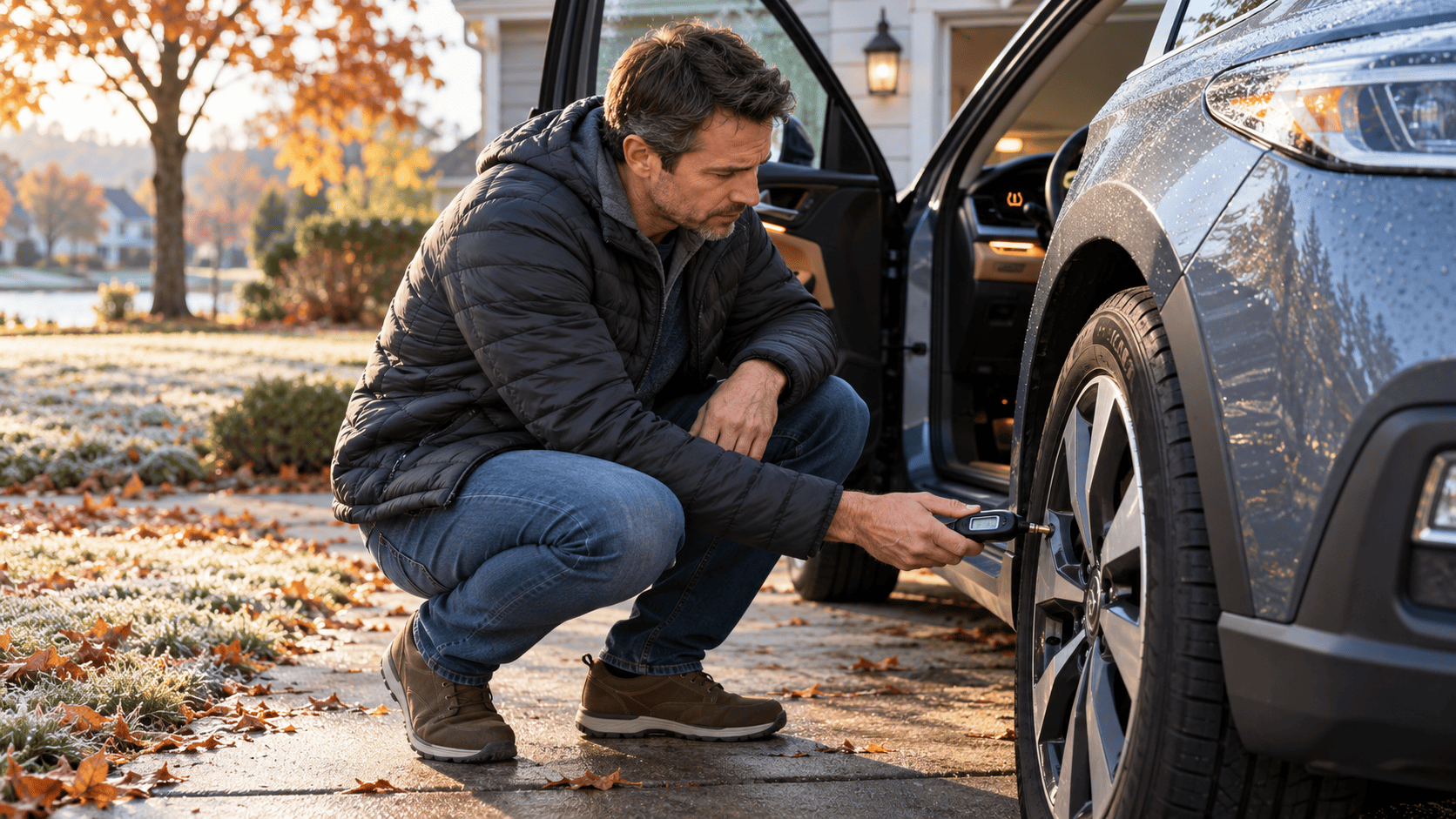
Your car was perfectly normal yesterday. Then the temperature drops overnight, you start the engine in the morning and the yellow tire-pressure symbol suddenly appears. A few miles later it may even switch itself off. That does not necessarily mean you have a flat tire—but it also does not mean you should ignore the warning.
Cold Weather Can Lower Tire Pressure Overnight
Air pressure changes with temperature.
AAA says tire pressure typically decreases by about 1 PSI for every 10°F drop in temperature. A 20- or 30-degree cold snap can therefore lower tire pressure enough to trigger a warning even though nothing punctured the tire overnight.
That makes fall especially confusing.
A tire that was correctly inflated during warmer weather may suddenly be several PSI lower after the season changes.
The tire did not necessarily lose all that air through a hole.
Some of the change is simply physics.
This Is Why the Warning Often Appears on the First Cold Morning
NHTSA specifically says the tire-pressure warning light may illuminate briefly on cold mornings and then turn off.
The likely reason is that a tire was already close to the warning threshold. Overnight cooling lowers its pressure enough to trigger TPMS. After the car is driven, the tires warm up, pressure rises and the warning may disappear.
That pattern can make the light look like a false alarm.
It is not.
NHTSA says that if the TPMS light goes on and off, the tires should still be inspected and their pressure checked. Properly inflated tires should not repeatedly trigger the warning.
The Light Going Away Does Not Mean You Fixed Anything
Driving warms the tires.
Warmer tires contain warmer air.
The pressure reading rises.
So the dashboard warning may disappear even though the tire is still below the manufacturer's recommended cold pressure.
This is one of the easiest mistakes to make.
A driver sees the warning in the morning.
The warning disappears during the commute.
Problem solved.
Except nothing was actually adjusted.
The next cold morning, the light may return.
Instead of using the warning light as the measurement, use a tire-pressure gauge.
Where Do You Find the Correct Tire Pressure?
Not on the tire sidewall.
This is important.
NHTSA says the correct inflation pressure for your vehicle is listed on the Tire and Loading Information label, usually on the driver's-side door jamb, and in the owner's manual.
The number molded into the tire itself is generally the tire's maximum pressure specification.
It is not necessarily the pressure your vehicle manufacturer wants you to use.
So if the sidewall says something like 44 PSI and the door sticker says 35 PSI, do not automatically fill the tire to 44.
Use the vehicle manufacturer's recommended pressure unless the manufacturer provides different instructions for your situation.
Check Tire Pressure When the Tires Are Cold
This is another detail that changes the answer.
NHTSA defines a cold tire, for pressure-checking purposes, as one that has not been driven on for at least three hours.
That is when the vehicle manufacturer's recommended PSI should be compared with your gauge reading.
The easiest time is often first thing in the morning.
Before driving.
Before the sun has heated one side of the car.
Before highway driving warms the tires.
That gives you a much more useful baseline.
Why Does Driving Raise the Pressure?
Tires flex continuously while rolling.
That movement creates heat.
The air inside warms as well.
As temperature rises, so does pressure.
This is normal.
It is also why measuring pressure immediately after a long highway trip can produce a higher number than the same tire showed that morning.
Do not release air simply because a warm tire is above the cold-pressure specification.
Allow it to cool and check again.
What Should You Do When the Light Comes On?
Start with the obvious.
Look at all four tires.
If one appears dramatically low, damaged or nearly flat, do not treat the situation as a routine seasonal-pressure adjustment.
A visibly damaged or severely deflated tire may not be safe to drive on.
If the tires appear normal, check their pressures with a reliable gauge as soon as practical.
Compare each reading with the driver's-door placard.
Then add air where necessary.
NHTSA recommends checking all tires, including the spare when applicable, at least once a month.
Do Not Depend on TPMS to Tell You When to Add Air
The dashboard system is a warning system.
It is not a replacement for routine pressure checks.
NHTSA says TPMS alerts drivers when a tire becomes significantly underinflated and specifically advises monthly manual pressure checks even on vehicles equipped with TPMS.
That means your tires can be below their ideal pressure without the dashboard light being on.
If the recommended pressure is 35 PSI, you should not wait for the car to decide the tire is low enough to warn you.
The gauge gives you the actual number.
What If All Four Tires Are Low by About the Same Amount?
That pattern can strongly suggest a seasonal temperature change.
Suppose all four tires were adjusted during warm weather.
A substantial cold front arrives.
Now every tire reads several PSI lower.
That is much less suspicious than one tire being dramatically lower than the other three.
Add air to the manufacturer's recommended cold pressure and continue monitoring.
If the pressures remain stable afterward, temperature was likely a major part of the change.
What If Only One Tire Is Low?
That deserves more attention.
One tire being substantially lower than the others can point toward an actual air leak rather than a simple weather-related pressure shift.
Possible causes include:
a nail or screw;
a leaking valve;
a damaged wheel;
bead leakage;
damage from a pothole;
or other tire problems.
NHTSA notes that a tire can suddenly lose pressure after events such as hitting a pothole or curb and recommends inspecting tires for punctures, cuts, bulges, cracks and other damage.
If one tire repeatedly needs air while the other three remain stable, stop treating it as a weather problem.
Have the tire inspected.
Adding Air Every Week Is Not a Repair
A slow leak can be deceptively manageable.
Monday morning:
add three PSI.
A week later:
add another three.
Then repeat.
That may keep the dashboard light off, but it does not identify why the pressure keeps falling.
Tires naturally lose some air over time, but repeated, noticeable loss in one tire deserves investigation.
There may be a repairable puncture.
There may be a valve problem.
There may be wheel damage.
Or the tire itself may be damaged.
Find the cause before it becomes a roadside problem.
What Does the TPMS Symbol Actually Look Like?
The common symbol resembles the cross-section of a tire—almost like a horseshoe—with an exclamation point inside.
Some vehicles may present tire information differently through the dashboard display, but the familiar yellow symbol is the standard warning most drivers recognize.
NHTSA says the light means at least one tire is significantly underinflated.
Do not confuse it with:
the check-engine light;
traction-control warning;
ABS light;
or other dashboard symbols.
If you are uncertain, consult the owner's manual.
What If the TPMS Light Flashes First?
That is different.
NHTSA says that on vehicles subject to the TPMS malfunction requirement, the warning may flash for approximately 60 to 90 seconds and then remain illuminated when the tire-pressure monitoring system itself has a malfunction.
Possible causes can include a sensor or communication problem.
This is not the same as a light that simply stays on because pressure is low.
If the warning repeatedly flashes at startup and then stays illuminated, have the TPMS system inspected according to your vehicle manufacturer's guidance.
You still need to check tire pressure manually because the monitoring system may not be functioning correctly.
Sometimes the Sensor Battery Is the Problem
Direct TPMS systems use pressure sensors mounted at or inside the wheels.
Those sensors contain electronics and, depending on the system, internal batteries that do not last forever.
If a sensor stops communicating, the vehicle may report a system malfunction rather than ordinary low pressure.
This becomes increasingly common as vehicles age.
A tire shop or qualified repair facility can usually identify which sensor is not communicating.
But do not assume a flashing light is automatically “just the sensor.”
Verify the actual tire pressures too.
Cold Weather Does Not Mean You Should Overinflate the Tires
Another common reaction is to add extra air so the warning will not return.
That is not the goal.
Inflate the cold tires to the vehicle manufacturer's recommended value.
Not five extra PSI “for winter.”
Not the number on the tire sidewall.
Not whatever your neighbor uses.
The manufacturer chose the recommended pressure based on the vehicle's tire size, load, handling and other engineering factors.
Use that number as your baseline.
Why Proper Tire Pressure Matters Beyond the Warning Light
Low pressure changes how the tire behaves.
NHTSA says proper inflation affects tire safety, durability and fuel consumption. It also identifies underinflation as an important contributor to tire failure.
An underinflated tire flexes more.
That can create additional heat.
It can also alter handling and accelerate wear.
AAA notes that underinflated tires can reduce fuel efficiency and contribute to uneven wear and poorer handling.
So adding air is not just about making a dashboard symbol disappear.
It is part of maintaining the tire itself.
Do Not Judge Tire Pressure by Looking at the Tire
Modern radial tires can look surprisingly normal even when underinflated.
NHTSA specifically warns that underinflation can be visually difficult to detect and recommends using an accurate pressure gauge.
That is why:
“It doesn't look flat”
is not a pressure measurement.
A $10 gauge can tell you more than staring at the sidewall.
Why Fall Creates So Many TPMS Complaints
Imagine a tire set to the correct pressure during a warm September afternoon.
Then October brings colder nights.
The average temperature continues dropping.
Pressure falls along with it.
If the tires were already slightly below specification, the first real cold morning may finally push them below the warning threshold.
That makes the dashboard light appear to have come from nowhere.
In reality, the tire may have been gradually approaching the threshold for weeks.
The cold morning simply revealed it.
This Is Also Why the Light May Appear Every Morning and Disappear Every Afternoon
Morning:
cold air;
lower pressure;
warning light.
Afternoon:
warmer ambient temperature;
warmer tires;
higher pressure;
warning disappears.
Then the cycle repeats.
NHTSA specifically describes this type of cold-morning on-and-off behavior as a sign that tire pressure should be checked.
The dashboard is showing you a temperature-dependent symptom.
The solution is still to check and adjust the tires to the correct cold pressure.
Do You Need Nitrogen to Stop This From Happening?
Some tire shops offer nitrogen inflation and promote more stable tire pressure.
But nitrogen does not repeal physics.
Temperature still affects pressure.
For everyday passenger vehicles, maintaining the correct inflation pressure matters far more than becoming obsessed with which gas is inside the tire.
Ordinary compressed air is already mostly nitrogen.
The practical priority is simple:
check the pressure regularly;
use the manufacturer's specification;
and correct genuine leaks.
Should You Check the Spare Tire Too?
Yes, if your vehicle has one.
NHTSA explicitly recommends checking the spare along with the road tires.
The spare may sit untouched for years.
That is exactly why it can be forgotten.
Discovering that the spare is severely underinflated after a highway puncture is a terrible time to remember it exists.
Some compact temporary spares also require much higher pressures than normal road tires.
Use the pressure specified for that spare.
What About Cars That Show the PSI for Every Tire?
Many newer vehicles display individual tire pressures on the dashboard.
That makes diagnosis much easier.
If all four numbers fall together after a cold night, temperature becomes an obvious suspect.
If three show 34 PSI and one shows 24, the pattern looks very different.
But dashboard readings do not eliminate the usefulness of a manual gauge.
If something looks suspicious, verify it.
And remember that the recommended specification is still the vehicle manufacturer's cold inflation pressure.
A Portable Tire Inflator Can Be Surprisingly Useful
Small 12-volt or battery-powered inflators have become inexpensive and convenient.
Keeping one in the trunk can turn a seasonal pressure adjustment into a five-minute job at home instead of a trip to a service station.
A basic tire-pressure gauge is still useful even if the inflator has a digital display.
The important part is not buying the fanciest equipment.
It is actually checking the tires.
Do Not Ignore Physical Tire Damage Just Because the Pressure Is Correct
Pressure is only one part of tire safety.
While checking the tires, look for:
bulges;
cracks;
cuts;
objects embedded in the tread;
unusual wear;
or obvious sidewall damage.
NHTSA recommends regular visual inspections along with pressure checks.
A tire can show the correct PSI and still be unsafe because of structural damage.
Pressure answers one question.
Condition answers another.
When Should You Stop Driving and Get Help?
A routine cold-weather TPMS light is very different from a tire that is rapidly losing pressure.
Use extra caution if:
one tire looks visibly flat;
pressure is extremely low;
the car suddenly pulls strongly;
you hear flapping or repeated thumping;
the tire has a large bulge or obvious damage;
or pressure continues dropping quickly after inflation.
Those symptoms can indicate a more serious tire problem.
Do not keep driving merely because the car is technically still moving.
The safest response may be to stop somewhere safe and arrange roadside or professional assistance.
What If You Add Air but the Light Stays On?
First, verify that every tire is actually at the recommended cold pressure.
Some vehicles also monitor a spare.
Others may require driving for a short period before the system updates.
Some systems have a reset or recalibration procedure.
Follow the vehicle manufacturer's instructions rather than randomly pressing dashboard buttons.
If pressures are correct and the warning remains—or the light flashes before staying on—the TPMS itself may need inspection.
Do Not Reset TPMS to Hide a Real Pressure Problem
Some vehicles allow the system to be recalibrated or reset.
That procedure should generally be performed only after the tires have been correctly adjusted according to the manufacturer's instructions.
Resetting a warning without correcting low tire pressure defeats the purpose of the system.
The dashboard should reflect reality.
Not simply stop annoying you.
Why the Door Sticker Matters More Than an Internet Search
Search your vehicle model online and you may find dozens of PSI recommendations.
Some may refer to:
different tire sizes;
different model years;
different trims;
different loads;
or completely different vehicles.
Your own vehicle's Tire and Loading Information label is a much better starting point.
NHTSA directs drivers to that label or the owner's manual for the manufacturer-recommended pressure.
That little sticker is more useful than a generic answer from a forum.
The Five-Minute Morning Check
If the TPMS light appears after a cold night, you do not need to turn the morning into an engineering project.
Wait until the tires are cold.
Find the recommended PSI on the driver's-door label.
Check all four tires with a gauge.
Add air where needed.
Look for obvious damage.
Check the spare if applicable.
Then monitor the pressures over the following days.
If they remain stable, seasonal temperature change may have been the main issue.
If one tire drops again, investigate a leak.
That simple process answers most of the mystery.
So Why Did Your Tire Pressure Light Come On Overnight?
Cold weather may be the explanation.
AAA says tire pressure typically changes by about 1 PSI for every 10°F change in temperature, which means a sudden cold snap can push a marginal tire below the TPMS warning threshold.
But “cold weather” should not become an excuse to ignore the dashboard.
NHTSA says a TPMS warning means at least one tire is significantly underinflated, and even a warning that appears on a cold morning and disappears later should prompt a pressure check.
The smartest response is simple.
Do not panic.
Do not ignore it.
Do not inflate to the number written on the tire.
Check the manufacturer's recommended cold pressure.
Adjust the tires.
Then watch what happens.
If all four remain stable, you probably dealt with seasonal temperature change.
If one keeps losing air, the car is telling you something else.
_________________________________________
tire pressure light on, tire pressure light cold weather, TPMS light, low tire pressure light, TPMS light comes on when cold, tire pressure drops overnight, tire pressure PSI, correct tire pressure, tire pressure in winter, tire pressure warning light, TPMS light goes off after driving, cold tire pressure, tire pressure door sticker, car tire pressure
Your Car Insurance Renewal Went Up Even Without an Accident
Your AC Is Running but the House Is Still Hot
Why Is That Credit Card Charge Still Pending? And Why Is the Amount Wrong?
Your Package Says “Delivered”—But It Isn’t There. What Should You Do Next?
Automotive
Lifestyle
Why Did the Tire Pressure Light Come On?
Tire Pressure Light Came On Overnight? Cold Weather May Be Why
A sudden cold morning can trigger your tire-pressure warning even without a puncture. Here’s why it happens, what PSI to use and when to suspect a leak.
Your Tire Pressure Light Was Fine Yesterday. Why Is It On This Morning?
Yesterday, no warning light.
This morning, the temperature dropped—and suddenly your dashboard says a tire is low.
Then you drive for 20 minutes and the light disappears.
Ignore it?
No.
Cold weather can lower tire pressure enough to trigger TPMS, and warming tires can make the warning disappear again without actually fixing the pressure.
The important number is not on the tire sidewall.
It is on a small sticker beside the driver's seat.
Reader Question
Does your tire-pressure light appear every year when the first cold mornings arrive?
Research Notes
NHTSA says drivers should check tire pressure at least once a month when tires are cold, meaning the vehicle has not been driven for at least three hours. The recommended pressure is found on the vehicle's Tire and Loading Information label, usually on the driver's-side door jamb, or in the owner's manual.
NHTSA says TPMS is not a substitute for manual tire-pressure checks. The warning illuminates when at least one tire is significantly underinflated. It also specifically notes that the warning may appear temporarily on cold mornings and disappear as the tires warm; this still calls for checking tire pressure.
AAA says tire pressure typically falls about 1 PSI for each 10°F drop in ambient temperature, making seasonal transitions a common time for low-pressure warnings.
NHTSA advises drivers not to inflate tires based on the pressure molded into the tire sidewall; that value represents a tire specification rather than the vehicle manufacturer's recommended operating pressure.
Safety Note
A low tire-pressure warning can result from normal seasonal temperature changes, but it can also indicate a puncture, valve leak, wheel damage or another tire problem. If a tire is visibly flat, rapidly losing pressure, physically damaged or causing abnormal vehicle handling, stop in a safe location and seek professional or roadside assistance rather than continuing to drive.
tire pressure light cold weather, TPMS light, low tire pressure light, tire pressure drops overnight, tire pressure in cold weather, TPMS light goes off after driving, correct tire pressure, tire pressure PSI, cold tire pressure, tire pressure warning light
Tire Pressure, TPMS, Tires, Cold Weather, Car Maintenance, Automotive, Driving Safety, Fall Car Care, Winter Driving, Everyday Problems