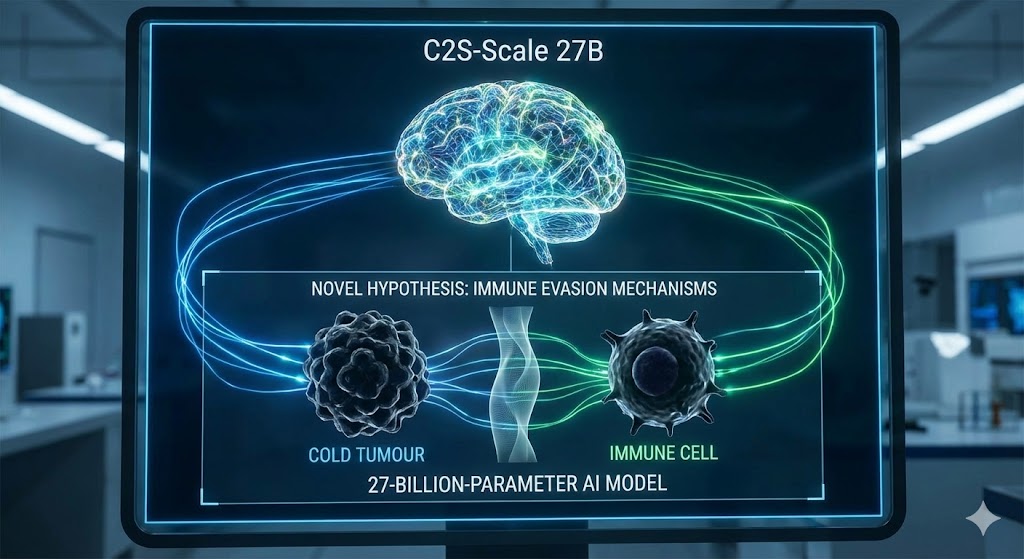
In a potential paradigm shift for oncology, a formidable 27-billion-parameter artificial intelligence model, C2S-Scale 27B, has unveiled a groundbreaking hypothesis concerning the intricate mechanisms by which 'cold' tumours elude the body’s vigilant immune system. This revelation, emerging from the depths of vast biological datasets, could redefine our understanding of immune evasion and pave the way for novel therapeutic strategies against some of the most challenging cancers.
Revolutionizing Cancer Research: C2S-Scale 27B Unveils Novel Cold Tumor Evasion Theory
The field of cancer research is constantly striving for breakthroughs, particularly in the realm of immunotherapy. While immune checkpoint inhibitors have revolutionized the treatment of many cancers, a significant subset—often termed 'cold' tumours—remains largely unresponsive. These tumours are characterized by a lack of immune cell infiltration, essentially creating an 'immune desert' that shields them from effective anti-tumour responses. For years, scientists have grappled with the precise reasons behind this profound immune suppression. Now, a machine learning marvel, C2S-Scale 27B, trained on an unprecedented scale of genomic, proteomic, transcriptomic, and clinical data, offers a fresh perspective.
The Enigma of 'Cold' Tumours
Traditionally, 'cold' tumours have been defined by their low tumour mutational burden (TMB) and minimal expression of neoantigens, which are critical for eliciting a robust immune response. However, even some tumours with higher TMB exhibit a 'cold' phenotype, suggesting more complex mechanisms at play. The prevailing theories have pointed towards an immunosuppressive tumour microenvironment (TME), characterized by the presence of regulatory T cells (Tregs), myeloid-derived suppressor cells (MDSCs), and certain cytokines like TGF-β. Yet, a unifying, comprehensive model explaining the initiation and maintenance of this immune-evasive state has remained elusive, hindering the development of effective treatments.
The challenge lies in the sheer complexity of cellular interactions within the TME, where tumour cells, stromal cells, and immune cells engage in a dynamic crosstalk. Disentangling these intricate networks, especially identifying subtle molecular switches or feedback loops that maintain immune suppression, is a task that often overwhelms human analytical capabilities. This is precisely where C2S-Scale 27B has demonstrated its extraordinary prowess.
C2S-Scale 27B: A New Paradigm in Scientific Discovery
C2S-Scale 27B is not just another algorithm; it represents a new frontier in AI-driven scientific discovery. With 27 billion parameters, it possesses an unparalleled capacity to identify subtle patterns, correlations, and causal relationships within massive, multi-modal biological datasets that would be invisible to human researchers or even simpler computational models. Its architecture allows it to process and synthesize information from tens of thousands of scientific papers, millions of patient records, and petabytes of molecular data, building an intricate, dynamic model of biological systems.
Unlike previous AI applications primarily focused on data analysis or drug screening, C2S-Scale 27B's unique strength lies in its ability to generate novel, testable hypotheses. By identifying gaps in current biological understanding and constructing plausible explanatory frameworks, it acts as a digital co-investigator, accelerating the pace of scientific inquiry. Its proposed hypothesis regarding cold tumours is a testament to this transformative capability, moving beyond prediction to genuine theory generation.
The AI's Novel Hypothesis: A Deeper Look
C2S-Scale 27B postulates that 'cold' tumours actively orchestrate a multi-layered immunosuppressive environment by recruiting and epigenetically reprogramming a specific subset of stromal cells, which it has termed 'Immunosuppressive Matrix-Sculpting Fibroblasts' (IMS-Fibroblasts).
The Proposed Mechanism: Multi-Factorial Immunosuppression
- Recruitment and Education of IMS-Fibroblasts: The AI suggests that tumour cells within 'cold' tumours secrete a unique chemokine cocktail, notably including a newly identified chemokine variant (tentatively named 'CXCL-Cold1'), which specifically attracts naive fibroblasts. Upon arrival, these fibroblasts are 'educated' by the tumour cells via direct contact and paracrine signaling involving a specific non-coding RNA (ncRNA-TME1). This education reprograms them into highly potent IMS-Fibroblasts.
- Secretion of Novel Inhibitory Cytokines and ECM Remodeling: These IMS-Fibroblasts, once reprogrammed, become prolific secretors of a unique blend of immunosuppressive molecules. Critically, C2S-Scale 27B identified a novel isoform of Transforming Growth Factor-beta (TGF-β3-IMS), distinct from previously studied TGF-β isoforms, which works synergistically with high levels of 'Tumor-Inhibitory Cytokine-X' (TIC-X). This combination, according to the AI, not only directly inhibits T-cell activation and proliferation but also induces widespread apoptosis in effector T-cells. Concurrently, IMS-Fibroblasts significantly remodel the extracellular matrix (ECM), creating a dense, collagenous barrier that physically impedes immune cell infiltration, making it difficult for T-cells to even reach the tumour core.
- Epigenetic Silencing of Immune Effector Genes: Perhaps the most striking aspect of the hypothesis is the AI's identification of a novel feedback loop. The unique cytokine environment created by IMS-Fibroblasts (TGF-β3-IMS and TIC-X) induces specific epigenetic modifications (e.g., histone methylation patterns) within early infiltrating T-cells and dendritic cells. These modifications lead to the silencing of critical genes required for robust anti-tumour immunity (e.g., genes for perforin, granzyme B, and specific co-stimulatory receptors), effectively rendering nascent immune responses anergic or exhausted even before full activation. This ensures that any immune cells attempting to infiltrate become dysfunctional rather than effector cells.
The novelty of C2S-Scale 27B's hypothesis lies in connecting these disparate observations into a cohesive, predictive framework, highlighting the specific molecular players (CXCL-Cold1, ncRNA-TME1, TGF-β3-IMS, TIC-X) and cellular subtypes (IMS-Fibroblasts) that orchestrate the 'cold' phenotype. It suggests that the 'coldness' is not merely a passive state but an actively maintained and tightly regulated suppressive program.
Implications for Diagnosis and Therapeutic Development
This AI-generated hypothesis carries profound implications for oncology. If validated, it could lead to:
- New Diagnostic Biomarkers: Identifying the presence of CXCL-Cold1, ncRNA-TME1, TGF-β3-IMS, or TIC-X in tumour biopsies or circulating fluids could serve as early indicators of a 'cold' tumour, allowing for more precise patient stratification. Detection of IMS-Fibroblasts could also be a critical prognostic marker.
- Novel Therapeutic Targets: The specific molecules and cellular pathways identified by C2S-Scale 27B offer entirely new avenues for drug development. Therapies could focus on:
- Inhibiting the secretion or activity of CXCL-Cold1 to prevent IMS-Fibroblast recruitment.
- Blocking ncRNA-TME1 signaling to prevent fibroblast reprogramming.
- Neutralizing TGF-β3-IMS or TIC-X to reverse immunosuppression.
- Developing drugs that specifically target and deplete IMS-Fibroblasts or reverse their epigenetic modifications.
- Strategies to counteract the epigenetic silencing within immune cells to restore their effector function.
- Combination Therapies: Understanding these mechanisms could inform the design of more effective combination therapies, pairing existing immunotherapies with agents that specifically disrupt the 'cold' tumour's immune-evasive shield. For instance, combining immune checkpoint inhibitors with a TGF-β3-IMS antagonist or an IMS-Fibroblast depleting agent.
Validating the AI's Insight: The Road Ahead
While C2S-Scale 27B's hypothesis is highly compelling, the next crucial step involves rigorous experimental validation. Research laboratories worldwide will now be tasked with designing and executing studies to confirm the existence of IMS-Fibroblasts, identify and characterize the proposed chemokine CXCL-Cold1, ncRNA-TME1, TGF-β3-IMS, and TIC-X, and verify their roles in immune evasion. This will involve sophisticated cell culture models, animal models, and ultimately, human clinical trials. The scientific community's ability to rapidly test and either confirm or refute this hypothesis will demonstrate the true value of AI in accelerating discovery.
The Broader Impact of AI in Biomedical Science
The C2S-Scale 27B's achievement extends beyond a single cancer hypothesis. It heralds a new era where powerful AI models can act as intellectual collaborators, sifting through unimaginable volumes of data to uncover patterns and propose theories that push the boundaries of human knowledge. This collaborative model between human intuition and AI's computational power promises to accelerate discovery across all biomedical fields, from neurodegenerative diseases to infectious diseases and metabolic disorders. It suggests a future where complex biological puzzles are solved not just by human ingenuity, but by the synergy of human and artificial intelligence.
A New Horizon in Oncology
The hypothesis put forth by C2S-Scale 27B represents more than just a scientific finding; it is a testament to the transformative potential of artificial intelligence in reshaping our approach to intractable diseases. By shedding new light on the shadowy mechanisms of 'cold' tumour immune evasion, this AI model has opened up a fresh horizon for cancer research. If validated, its insights could lead to a new generation of targeted immunotherapies, offering hope to millions of patients for whom current treatments fall short. The journey from AI-generated hypothesis to clinical reality will be long and challenging, but the path has been illuminated by an unprecedented leap in machine intelligence.






Discussion
Comments
Approved comments are published after moderation to keep discussion useful and spam-free.
No comments yet. Start the discussion below.