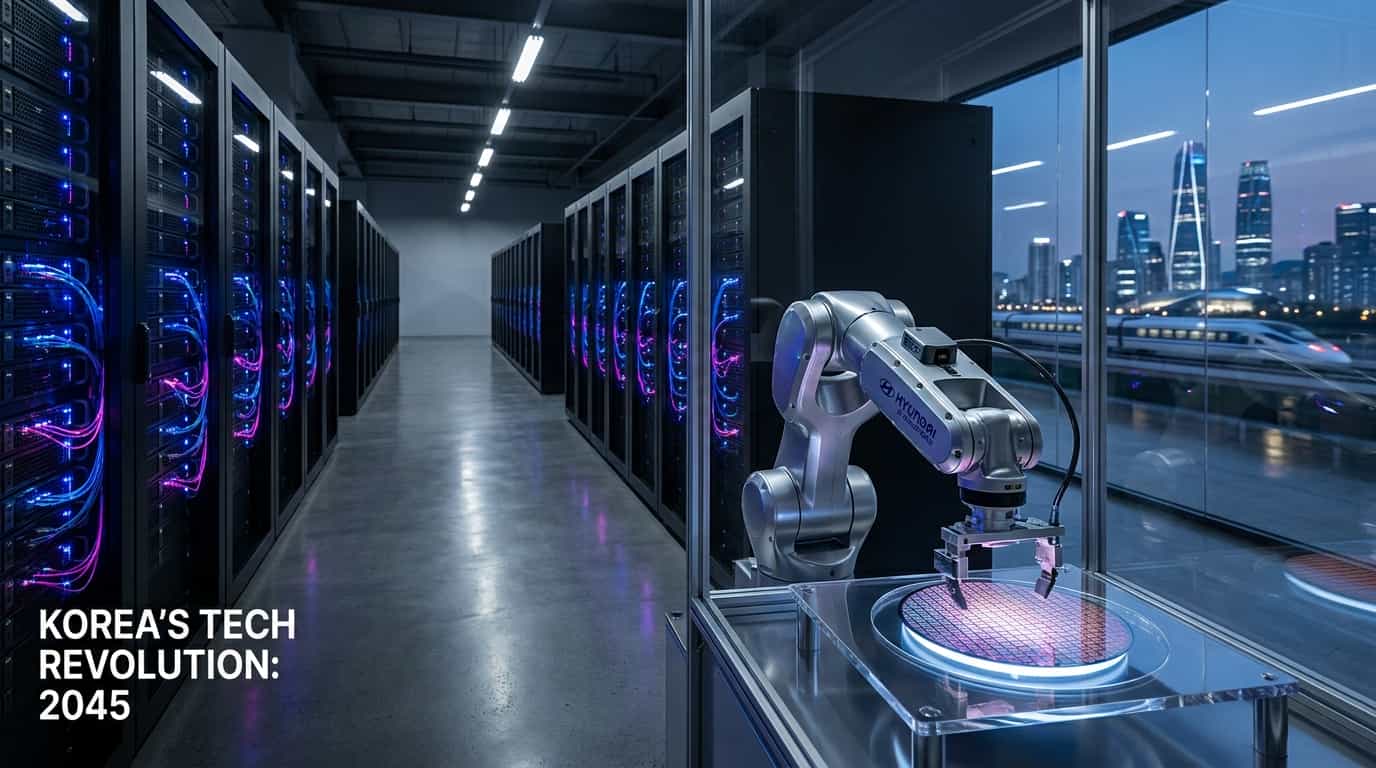
Announced today, the H2 2026 Economic Strategy directs massive investments into Semiconductors, AI Data Centers (AIDCs), and Physical AI, aiming to cement the nation as a global tech sovereign.
By Javaid Ahmed Solangi | July 23, 2026
The global technology arms race has just seen its largest and most aggressive financial escalation to date.
Today, July 23, 2026, South Korea's Ministry of Finance and Economy officially published its highly anticipated "Economic Growth Strategy for H2 2026". For developers, sysadmins, and tech investors watching from the sidelines, this is not just a standard bureaucratic policy update; it is a declaration of technological sovereignty. The strategic roadmap outlines a staggering, multi-hundred-trillion-won initiative focused intensely on "Three Mega Projects": Semiconductors, AI Data Centers (AIDCs), and Physical AI.
As artificial intelligence continues to disrupt everything from full-stack web architectures to automated code generation, South Korea has recognized that relying entirely on foreign API providers and external cloud infrastructure is a massive economic vulnerability. To counteract this, the nation is channeling its unmatched manufacturing prowess into a completely vertically integrated AI ecosystem.
Here is a comprehensive, deep-dive breakdown of the new policy, the massive hardware investments being mobilized, and exactly how this $1 trillion equivalent mega-project will reshape the global digital economy.
1. Advancing Unmatched Semiconductor Leadership
The bedrock of any artificial intelligence revolution is silicon. You cannot run advanced large language models or autonomous AI agents without a constant, high-yield supply of specialized memory and processing hardware. South Korea, already a titan in the global chip market, is now pushing all its chips to the center of the table.
To advance its unmatched semiconductor leadership, the South Korean government has laid out a colossal financial roadmap.
The strategy commits to a total investment of KRW 800 trillion to fund these sweeping hardware expansions.
The primary objective is to completely double the nation's memory production capacity within the next five years.
To achieve this unprecedented manufacturing scale, the plan mandates the construction of four new semiconductor fabs in the country's southwestern region.
For the global supply chain, this is a monumental shift. The demand for High-Bandwidth Memory (HBM) and low-power DDR RAM is currently at an all-time high, driven entirely by enterprise data centers scaling up their AI operations. By doubling their domestic production footprint, South Korea is ensuring that the bottleneck of the AI industry—access to ultra-fast memory—remains firmly under their geopolitical control.
2. The AI Data Center (AIDC) Explosion
Building the chips is only the first step; housing them in localized, high-efficiency server farms is the ultimate goal. Section two of the H2 2026 Economic Strategy focuses aggressively on revitalizing the data economy through massive infrastructure builds.
While tech companies worldwide are fighting for server rack space, South Korea is building entirely new computational cities.
The government plans to build an astonishing 8.4 GW of AI Data Center (AIDC) capacity.
This specific expansion is backed by KRW 550 trillion in targeted investments, which includes heavily mobilized private capital.
A major focal point of this initiative is breaking ground on a dedicated "National AI Computing Center".
Through this national center, the government aims to secure approximately 50,000 GPUs.
To put an 8.4 GW power capacity into perspective, that is the equivalent of the energy output of multiple large-scale nuclear power plants dedicated entirely to running servers. For network architects and backend engineers, this signals a massive shift toward highly localized, low-latency AI compute environments. Furthermore, a centralized cluster of 50,000 GPUs will place South Korea's sovereign compute power on par with the largest supercomputers currently operated by American tech giants.
3. The Push for "Physical AI" and Robotics
Software-based AI has dominated the headlines, but the next frontier is translating that digital reasoning into the physical world. South Korea is uniquely positioned to lead this transition, combining its deep automotive and heavy industry roots with next-generation machine learning algorithms.
The third mega-project explicitly targets the rapid development of Physical AI and robotics.
The state will expand its financial and structural support for the commercialization of Physical AI across seven predefined priority sectors.
A major initiative involves developing AI robots specialized for ten key industries.
To force immediate adoption, the government plans to deploy 1,000 of these specialized AI units directly to industrial sites annually.
This means we will rapidly see autonomous, AI-driven machinery taking over complex, hazardous, and high-precision tasks in manufacturing, logistics, and heavy construction. This hardware will not just be programmed with rigid scripts; it will run lightweight, multimodal AI models capable of real-time environmental reasoning and dynamic problem-solving.
4. Sovereign AI Models and Accelerated Transformation
Running 50,000 GPUs and 8.4 GW of server power is pointless if you are just licensing a foreign API. The H2 2026 strategy makes it explicitly clear that South Korea intends to own its intellectual property from the silicon layer all the way up to the neural network architecture.
To accelerate "AX" (AI Transformation) and strengthen domestic capabilities, the roadmap focuses on building proprietary intelligence.
The government is committed to developing a sovereign AI model that ranks squarely on par with the global top ten.
The overarching goal is to deploy a globally leading AI model tailored specifically for domestic enterprise and government use.
By building a sovereign AI model, South Korea ensures that highly sensitive corporate data, legal frameworks, and proprietary manufacturing secrets never have to bounce through a data center located overseas. It allows local developers to build applications using a model that natively understands localized cultural nuances, complex syntax, and regional compliance laws.
5. Hyper-Innovation, Edge Computing, and Defense Synergies
Beyond the core pillars of chips and data centers, the Ministry of Finance and Economy outlined several "Hyper-Innovation Economy Flagship Projects". These secondary initiatives act as force multipliers, ensuring that the AI revolution bleeds into every sector of the South Korean economy.
Edge Computing and Batteries
The government has designated on-sensor AI, advanced actuators, and secondary batteries as new, hyper-innovation projects. By focusing on on-sensor AI, South Korea is looking to push machine learning directly onto the edge devices, reducing latency and allowing hardware like mobile phones and security cameras to process data instantly without pinging a central server.
Biotechnology and Pharmaceuticals
To join the ranks of the "Global Top Five in Pharmaceuticals and Biotechnology," the state is establishing a mid- to long-term roadmap tailored for AI-based drug development, targeted for Q4 2026. Utilizing AI to fold proteins and simulate molecular interactions drastically cuts the research and development time for life-saving therapeutics.
Defense and Security Infrastructure
In an effort to become a "Global Top-Four Defense Industry Power," South Korea is establishing a domestic version of In-Q-Tel (IQT), the famed American venture capital firm historically backed by the CIA.
This initiative will include a dedicated support track specifically for running demonstration projects at active military facilities.
Revitalizing Blockchain Technologies
Finally, the strategy includes measures designed to revitalize the blockchain economy.
This will involve pursuing large-scale demonstration projects and securing leading technologies to strengthen overall industrial competitiveness.
The Bottom Line: The Era of Sovereign AI Has Arrived
The "Economic Growth Strategy for H2 2026" is a watershed moment for the global technology sector. By committing KRW 800 trillion to semiconductor manufacturing and KRW 550 trillion to AI Data Centers, South Korea is sending a clear, undeniable message to the rest of the world.
The era of relying on a handful of Silicon Valley corporations to power the globe's digital infrastructure is coming to an end. South Korea is actively building a closed-loop, vertically integrated tech ecosystem where they design the chips, manufacture the silicon, build the data centers, train the sovereign models, and deploy the physical AI robots.
For international developers, hardware vendors, and tech analysts, this mega-project will fundamentally alter global supply chains, create massive new opportunities for cross-border software integration, and establish a fierce new standard for national technological independence.





Discussion
Comments
Approved comments are published after moderation to keep discussion useful and spam-free.
No comments yet. Start the discussion below.