
Agentic AI in 2026: What It Is and Why It Matters
Agentic AI: The Technology Defining 2026
In 2025, AI was primarily a tool you talked to. In 2026, AI is increasingly a force that acts on your behalf. This shift — from reactive language models to autonomous, goal-driven agents — is what technologists mean when they say "agentic AI," and it represents the most consequential development in enterprise technology this decade.
The numbers confirm the momentum:
Market Scale: The agentic AI market expanded from $7.6 billion in 2025 to a projected $10.8 billion in 2026, completely outpacing early cloud adoption rates.
Enterprise Adoption: Gartner placed agentic AI at the Peak of Inflated Expectations in its 2026 Hype Cycle, predicting that 40 percent of enterprise applications will include task-specific AI agents by the end of 2026 — up from less than 5 percent a year earlier.
Operating Models: The UiPath 2026 AI and Agentic Automation Trends Report found that 78 percent of executives say they will need to reinvent their operating models to capture agentic AI's full value.
What Exactly Is an Agentic AI System?
An AI agent is a system that can perceive its environment, set sub-goals, plan sequences of actions, use tools (web search, code execution, APIs, file systems), and execute multi-step tasks with minimal human supervision — unlike traditional AI that simply responds to individual prompts.
Chatbots vs. Agentic AI Systems
This layout groups the information by the specific feature being compared. It allows the reader to instantly see the difference side-by-side.
Interaction Type
Traditional Chatbots (2025 Standard): Single-turn prompt and response.
Agentic AI Systems (2026 Standard): Long-horizon execution, iteration, and verification.
Memory
Traditional Chatbots (2025 Standard): Session-bound; no persistent long-term context.
Agentic AI Systems (2026 Standard): Deep short-term context paired with persistent vector memory.
Tool Capabilities
Traditional Chatbots (2025 Standard): Static informational output.
Agentic AI Systems (2026 Standard): Dynamic execution (calls APIs, writes code, modifies files).
Autonomy
Traditional Chatbots (2025 Standard): Requires constant human prompts at every step.
Agentic AI Systems (2026 Standard): Autonomously plans, spawns sub-agents, and self-corrects.
An agent does not just answer "how do I book a flight" — it books the flight, checks your calendar, sends a confirmation, and updates your expense report automatically.
The Five Trends Shaping Agentic AI in 2026
1. Multi-Agent Orchestration
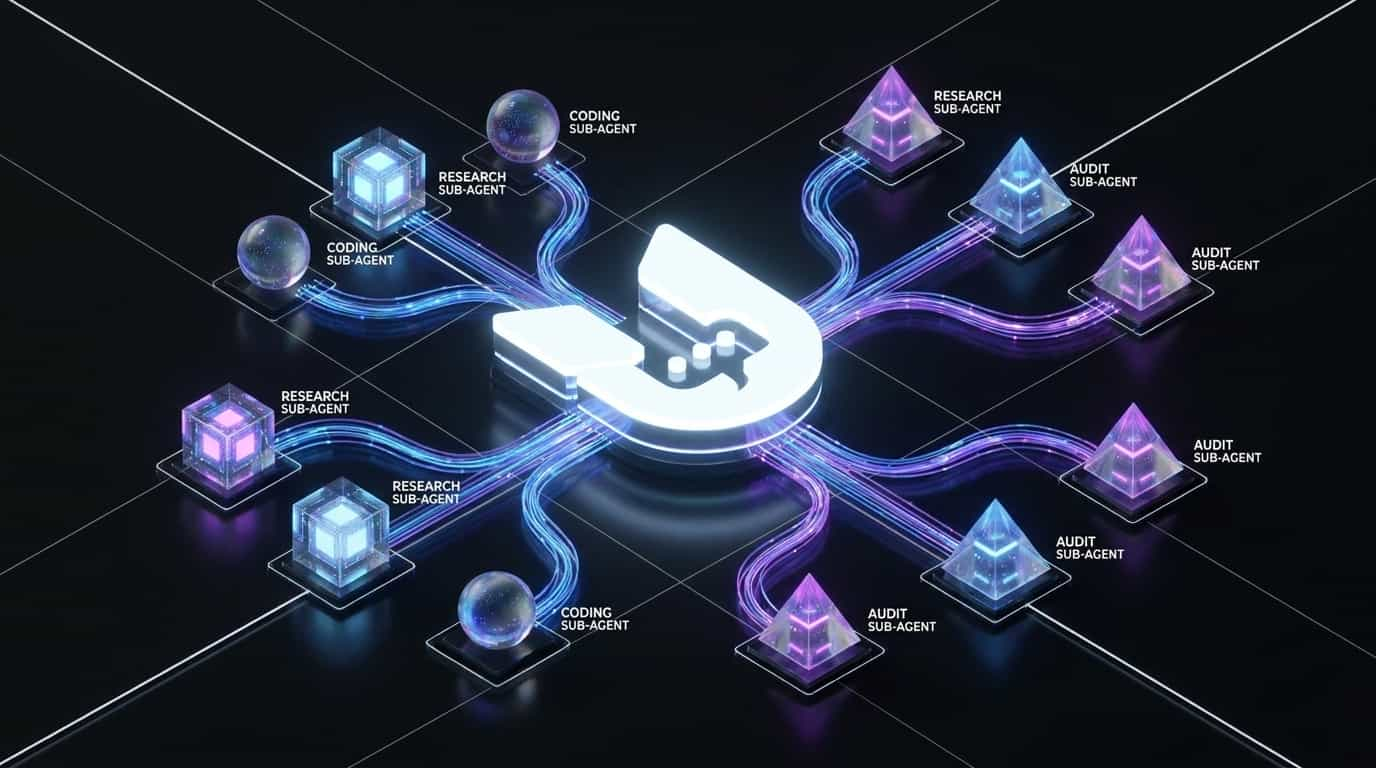
Solo agents are increasingly being replaced by multi-agent systems — networks of specialised agents coordinated by an orchestrator.
Fountain: Achieved 50 percent faster screening and 40 percent quicker candidate onboarding using hierarchical multi-agent orchestration.
Zapier: Deployed 800+ AI agents internally, reaching an incredible 89 percent AI adoption rate across the entire organisation.
2. Agentic Coding
2026 is the year when agentic AI fundamentally reconfigures the software development lifecycle. Coding agents do not just autocomplete — they read codebases, understand bug reports, write fixes, run test suites, handle security reviews, and open pull requests.
Tasks requiring weeks of cross-team coordination are collapsing into focused working sessions measured in hours. The emerging concept of "surge staffing" — deploying hundreds of specialized coding agents with deep codebase knowledge on-demand — is actively reshaping engineering team structures.
3. Guardian Agents and AI Governance
As AI agents become more autonomous and interconnected, governance has become the critical bottleneck. Guardian agents — AI systems specifically designed to monitor, audit, and constrain other agents — are one of the fastest-emerging profiles in the 2026 Gartner Hype Cycle alongside agentic AI security and FinOps for agentic AI.

Enterprises that deployed agents without governance frameworks in 2025 are learning expensive lessons in prompt injection, data leakage, and runaway API token costs.
4. Agentic Commerce
Agents are beginning to transact on behalf of users. From autonomous procurement bots that negotiate vendor contracts, to shopping agents that find and purchase items based on user preferences, to financial agents that execute trades within defined parameters — agentic commerce is moving from concept to cautious production deployment. The legal and regulatory frameworks are racing to keep up with machine-to-machine financial liability.

5. Low-Code Agent Building
Developer adoption of agent frameworks has surged 920 percent year-over-year, according to data from StartUs Insights. But perhaps more significant is the democratisation of agent building through low-code platforms.
Tools like Zapier AI Agents, Make, Relevance AI, and Microsoft Copilot Studio now allow non-technical users to build and deploy agents through visual interfaces — expanding the potential user base from millions of technical developers to hundreds of millions of knowledge workers.
The Gap Between Hype and Production
Despite the extraordinary momentum, most organisations are still struggling to deploy agentic AI reliably in production. The gap between experimentation and enterprise-grade deployment remains significant.
Common Failure Modes in Production
Tool Input Hallucinations: Agents passing syntactically incorrect or fabricated arguments to live APIs.
Unpredictable FinOps: Runaway internal agent loops that consume thousands of dollars in tokens on a single complex task.
Security Vulnerabilities: Indirect prompt injections where an agent reads an external file or webpage containing malicious instructions and overrides its system prompt.
The organisations successfully scaling agentic AI share common traits: they start with narrow, well-defined tasks where success is easily measurable; they build robust human-in-the-loop checkpoints for high-stakes actions; they invest heavily in agent observability and logging infrastructure; and they treat agent governance as a first-class engineering concern rather than an afterthought.
What This Means for Workers and Businesses
Agentic AI does not simply automate tasks — it automates entire workflows. This is a qualitatively different paradigm than previous waves of software automation.
Most Exposed Roles: Positions built primarily around information retrieval, scheduling, routine data entry, first-level customer triage, and basic documentation research.
Least Exposed Roles: Industries requiring physical presence, original creative judgment, ultimate ethical accountability, and complex interpersonal dynamics.
For businesses, the strategic imperative is to identify which workflows are most suitable for agentic automation — high volume, rule-bound, verifiable outcomes — and build robust governance structures before deploying at scale, not after.
Frequently Asked Questions
How is agentic AI different from regular AI or chatbots?
A chatbot responds to individual prompts within a single conversation. An AI agent autonomously plans and executes multi-step tasks using tools, memory, and self-correction — it acts rather than merely advises. The key difference is the capacity for sustained, goal-directed action without human guidance at each individual step.
Is agentic AI safe?
It can be, with proper governance. Key safeguards include clearly scoped tool permissions, human approval checkpoints for high-stakes actions (such as financial transactions or code deployment), comprehensive logging infrastructure, and secondary guardian agents that monitor the primary system.
What are the best agentic AI platforms in 2026?
Enterprise Suites: Microsoft Copilot Studio, Salesforce Agentforce, ServiceNow AI Agents.
Developer-Focused Frameworks: LangGraph, AutoGen, CrewAI, and direct API tool calling via Claude and OpenAI models.
Low-Code/No-Code Tools: Zapier AI Agents, Relevance AI, Make.
The right platform depends entirely on your team's technical capacity, existing enterprise software stack, and specific workflow requirements.
agentic AI 2026, what is agentic AI, multi-agent orchestration, autonomous AI systems, enterprise AI trends 2026, Gartner hype cycle 2026, agentic coding, guardian agents, AI governance frameworks, agentic commerce, low-code agent building, LangGraph 2026, Microsoft Copilot Studio, business workflow automation, AI safety and security

Discussion
Comments
Approved comments are published after moderation to keep discussion useful and spam-free.
No comments yet. Start the discussion below.